Act I
“Trash. Pay for the whole pallet.”
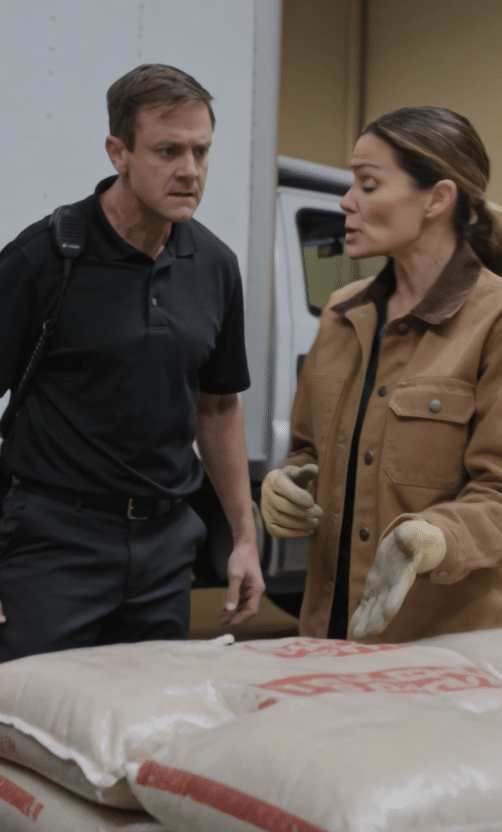
The warehouse manager pointed at the towering stack of rice bags as if the entire shipment had been personally damaged by the woman standing in front of him. Under the harsh yellow dock lights, his black polo shirt looked spotless, his sneakers were clean, and his manager’s name tag gleamed against his chest.
The woman holding the damaged bag looked as though she had spent the entire day carrying the weight of someone else’s problems.
She was forty-eight, thin, and exhausted. Her brown jacket was worn at the cuffs, her old gloves had begun to split at the fingertips, and loose strands of hair had escaped her low ponytail. A delivery truck idled behind her while warehouse workers and drivers watched from the edges of the loading dock.
She held the rice bag carefully, trying not to let any more grains spill through the torn seam.
“The bag was already torn at the seam,” she said.
Her voice was tired rather than defiant. She wasn’t trying to escape responsibility for a mistake. She was pointing out what she could see with her own eyes: the stitching had separated before she touched the bag, and the loose threads were faded and frayed.
The manager, whose name tag read Brandon Hale, barely glanced at it.
“Trash. Pay for the whole pallet.”
He jabbed a finger toward the stack behind her.
“You heard me. You’re going to move it again, and you’re paying for every bag that gets damaged.”
The woman stared at him.
Her name was Denise Walker, and she had spent most of her adult life learning how to remain calm when people with more money and less compassion tried to make her feel small. She had cleaned offices after midnight, stocked shelves before sunrise, and taken warehouse shifts whenever the bills outnumbered the hours available to work.
She knew what it meant to be blamed for something she hadn’t done.
But the demand was so outrageous that, for a moment, she could only look from the torn seam to the enormous pallet.
The rice belonged to the supermarket chain. The delivery had arrived with its own paperwork, and the bags had been stacked before Denise began unloading them. She had no authority over the shipment, no control over the packaging, and no reason to believe she could be held personally responsible for the condition of an entire pallet.
Brandon didn’t care.
He had spent years discovering that people who desperately needed their wages were easier to intimidate than people who could afford to walk away. He had turned that discovery into a management style, using deductions, threats, and public humiliation to make sure nobody challenged him twice.
Denise lifted the bag slightly and pointed toward the seam.
She was still holding the evidence in her hands when Brandon stepped forward.
Without warning, he drove a forceful kick into her chest, knocking her backward beside the pallet. She fell against the dock floor, and her elbow scraped the concrete. A thin trace of blood appeared where the skin had broken.
Before she could steady herself, Brandon delivered exactly two more hard kicks, one to her back and one to her side, as she tried to pull her hand away from a leaning rice bag.
The warehouse seemed to lose its breath.
A driver covered his mouth. Two workers stepped backward. A young employee standing near the steel warehouse door stared at Denise with wide eyes but did not move toward her.
No one helped.
Brandon stood over the woman, his expression hard and impatient, as though she had delayed an important meeting instead of been assaulted in front of an entire loading dock.
“Workers pay when stock gets touched.”
Denise drew a shaky breath and tried to sit up. The torn rice bag lay beside her, a small stream of white grains scattered across the concrete.
Brandon glanced down at it with contempt.
He believed the matter was settled. He believed the witnesses would stay silent, Denise would be too frightened to complain, and the next shift would begin with everyone remembering who controlled their paychecks.
Then the steel warehouse door slammed open against the wall.
A woman in a black coat and white suit stepped beneath the dock lights. Her short silver hair caught the glare as she crossed the threshold, and the workers nearest the door moved aside without being asked.
She walked directly toward the damaged rice bag.
Brandon’s expression began to change.
Because the woman in white wasn’t another employee, another delivery driver, or another person he could frighten into silence.
She was the owner of the entire supermarket chain.
And she had just seen enough to ask the question Brandon had spent years making sure nobody asked.
Act II
Denise Walker had never imagined that a warehouse job would become the center of a battle over dignity.
She had taken the position because it paid more reliably than the cleaning work she used to do. The hours were punishing, the loading dock was cold in winter and suffocating in summer, and every shift seemed to involve moving something heavier than it should have been.
But the wages came on schedule, at least in theory.
That mattered because Denise was supporting herself and helping her adult daughter, Rachel, who had recently separated from an unreliable partner and was trying to raise a young child on a limited income. Denise never discussed her family’s difficulties at work. She knew how quickly private information could become a weapon in the hands of someone who enjoyed reminding poorer people how little power they had.
She simply showed up.
At first, Brandon Hale had seemed like the sort of manager every warehouse eventually acquired: loud, impatient, and obsessed with numbers. He measured success by how quickly a pallet moved, how few complaints reached the regional office, and how much work he could squeeze out of a shift without authorizing overtime.
Then Denise began noticing that the numbers rarely told the same story twice.
A shipment would arrive with a damaged carton, and the cost would appear on a worker’s pay record. A pallet would be marked for repacking, and the people assigned to move it would suddenly owe money for the labor. A delivery discrepancy would be attributed to the loading crew before anyone examined the receiving documents.
Brandon always had an explanation.
Sometimes he called it a loss-prevention policy. Sometimes he described it as a standard accountability procedure. When a worker questioned a deduction, he would remind them that plenty of people were waiting for hours.
The message was unmistakable: accept his figures, or risk losing your shifts.
Denise had watched a younger loader named Marcus lose several days of work after questioning a deduction for damaged canned goods. She had seen another employee apologize for a box that had arrived crushed beneath heavier merchandise. She had heard Brandon tell a driver that the warehouse staff needed to learn what mistakes cost.
But the employees had little access to the records that supposedly justified the deductions. They were expected to trust the manager’s calculations, even when the paperwork they could see suggested otherwise.
Denise kept copies of her own pay statements.
She began doing so after discovering that a deduction on one paycheck had no clear explanation. At first, she thought it was a clerical error. Then another appeared, followed by a third. Each amount was small enough that challenging it felt exhausting, but together they represented groceries, electricity, and part of the rent.
She started keeping a notebook in her kitchen drawer.
She wrote down the dates of disputed deductions, the shipments involved, and the explanations Brandon gave. She saved delivery slips whenever she was allowed to see them. She didn’t accuse anyone of stealing. She simply wanted to understand why her wages kept shrinking when she had worked the hours she was promised.
One evening, Rachel found her sitting at the kitchen table, comparing two pay statements beneath the light above the stove.
“You know you don’t have to keep letting them do this,” Rachel said.
Denise gave a tired laugh.
“Letting them?”
Rachel went quiet.
Her mother softened her voice.
“I know what you mean. But I can’t just walk away. Not until I know how we’re going to pay for everything.”
That was the cruel arithmetic of low-wage work. The people most likely to be mistreated were often the people least able to risk confronting the person responsible.
Brandon understood that arithmetic. He had learned to use it.
What he didn’t know was that the same pattern had begun attracting attention beyond his warehouse.
The supermarket chain’s owner, Evelyn Whitmore, had built her business over three decades, starting with a handful of regional stores and expanding into a national operation. She was known for insisting that store-level decisions be supported by records, not merely by confident managers with polished explanations.
She had no illusion that a large company could run without mistakes. Damaged goods, shipping errors, inventory losses, and employee disputes were part of a complicated operation.
What she would not tolerate was a manager using those problems to enrich himself or intimidate workers.
Several months earlier, the chain’s internal review team had flagged irregularities at Brandon’s warehouse. Inventory adjustments appeared unusually high. Repacking costs had risen without a corresponding increase in damaged deliveries. A series of employee deductions had been recorded under broad categories that made the original reasons difficult to trace.
Brandon explained the figures as the result of careless workers and unreliable suppliers.
The explanation sounded plausible enough to delay a decision, but not convincing enough to close the review.
Evelyn authorized a deeper examination of the receiving records, vendor invoices, inventory adjustments, and payroll deductions. She wanted the investigators to establish whether the discrepancies were ordinary errors, poor management, or something more deliberate.
As the review progressed, one pattern became increasingly difficult to ignore: charges were repeatedly assigned to employees even when the original shipping paperwork indicated that the damage might have occurred before the goods reached the warehouse.
The company had not yet reached a final conclusion. Evelyn wanted the evidence checked carefully before anyone was accused.
Then a report arrived describing a manager who had threatened to make a worker pay for an entire pallet because one bag of rice had a torn seam.
It was not merely the size of the demand that caught her attention.
It was the possibility that the manager was turning damaged inventory into a source of money collected from the people least able to dispute him.
Evelyn decided to visit the warehouse herself.
She did not announce the exact time of her arrival. She wanted to see how the operation functioned when its managers believed no senior executive was watching.
And on the afternoon she walked through the steel warehouse door, she discovered that the records had only revealed the beginning of the problem.
Act III
Evelyn Whitmore stopped beside the torn rice bag.
The loading dock lights illuminated the frayed stitching along its edge. She crouched slightly, lifted the bag, and examined the seam without saying a word. Several grains of rice clung to the fabric where the stitching had separated.
Brandon watched her from a few feet away.
He recognized Evelyn immediately. Every manager in the chain had seen her photograph in company communications, and everyone knew she could demand records from any department without waiting for an appointment.
But Brandon’s first instinct was still to control the story.
“That’s a damaged product,” he said quickly. “The employee mishandled it, and I was enforcing our loss policy.”
Evelyn continued examining the seam.
“Did you inspect the bag before you assigned responsibility?”
Brandon hesitated.
“I saw what happened.”
“You saw the bag on the floor?”
“I saw her holding it.”
“That wasn’t my question.”
The dock fell silent again.
Evelyn turned the bag slightly so the damaged stitching faced him. The loose threads were worn and uneven. They did not look like a fresh tear caused by a sudden drop. They looked like a seam that had already begun to fail.
She had not yet determined the full cause of the damage, and she wasn’t going to pretend otherwise. But Brandon had demanded payment for an entire pallet without establishing what had happened to a single bag.
Worse, he had attacked the employee who questioned him.
Evelyn looked toward Denise.
“Did you report the damaged seam before he approached you?”
Denise struggled to sit upright. A nearby officer had not been called because this was a private warehouse confrontation, but several employees had finally begun moving closer after Brandon stepped away from her. One woman placed a folded jacket beside Denise so she could rest her arm without pressing the scraped elbow against the concrete.
Denise nodded.
“I showed him the seam. I told him it was already torn.”
“Did you damage the rest of the pallet?”
“No.”
“Did you agree to pay for it?”
Denise looked at Brandon before answering.
“He told me I had to.”
Evelyn’s expression changed almost imperceptibly.
She turned back to Brandon.
“You demanded that a worker pay for an entire pallet because one bag was damaged?”
“It’s about accountability,” he replied. “If we let people touch stock without consequences, we lose money. I’m responsible for this warehouse.”
“You are responsible for following company policy,” Evelyn said. “That doesn’t give you permission to invent charges.”
Brandon straightened, attempting to recover the authority that had worked so well moments earlier.
“You weren’t here when the damage happened. You don’t know what these employees are like. They make mistakes every day, and someone has to keep them in line.”
Evelyn’s eyes moved briefly to his name tag.
“I know exactly who is responsible for this warehouse.”
She paused, then lifted the torn bag a little higher.
“That rice just showed me who steals from workers.”
The words struck harder than a shout.
Brandon’s mouth opened.
“Steals?”
He looked around as though someone might interrupt and explain that this was all a misunderstanding. He expected a subordinate to defend him, a driver to complain about the disruption, or a worker to admit that Denise had been careless.
Instead, the staff remained silent.
Evelyn did not immediately accuse him of taking cash from the company. She knew that the evidence needed to establish what had happened, and she would not substitute outrage for an investigation. But she had seen enough to recognize the central issue: Brandon had treated a questionable inventory loss as an unquestionable debt owed by a vulnerable employee.
The earlier review had already raised concerns about deductions and inventory adjustments. Now she had witnessed the way Brandon enforced his own version of the rules.
She asked the warehouse supervisor to preserve the relevant receiving documents, shipment photographs, inventory records, and employee deduction reports. The instructions were clear: no one was to alter the records, and the investigation would determine what the evidence supported.
Brandon tried to interrupt.
“This is an internal matter.”
“Then you should have no objection to an internal review,” Evelyn replied.
She asked for the original delivery paperwork associated with the rice shipment. A staff member hurried toward the office while another retrieved the receiving log.
The paperwork mattered because the condition of the bag at the moment it arrived could help establish whether the damage predated Denise’s handling. If the delivery records showed that the shipment had been accepted with damaged packaging, Brandon’s demand that a worker pay for an entire pallet would become even harder to defend.
When the documents arrived, Evelyn compared the receiving notes with the inventory entry.
The records contained a discrepancy.
A delivery inspection had noted concerns about packaging on an earlier portion of the shipment, but the warehouse’s later adjustment treated the affected goods as though the damage had been caused internally. The paperwork did not settle every question, yet it raised a serious one: why had responsibility been shifted to the warehouse staff without a clear record of how the damage occurred?
Brandon stared at the documents.
For the first time, he seemed to understand that the torn bag was not an isolated inconvenience. It was a physical object that could be compared with dates, signatures, shipping records, and the deductions he had imposed.
The rice had a history.
And that history was about to collide with his.
Act IV
Evelyn ordered Brandon to step away from the pallet.
He did not move immediately.
For years, he had been the loudest person on the loading dock. His radio connected him to the supervisors. His name appeared on the shift schedules. He could assign the least desirable jobs, send workers home early, or threaten to remove someone from the roster.
He had mistaken those responsibilities for personal power.
Now, with the chain owner standing in front of him, he discovered how quickly a manager’s authority could narrow when someone finally demanded evidence.
Evelyn instructed the staff to secure the relevant records and ensure Denise received appropriate medical attention. She also directed that Brandon have no further contact with Denise while the incident was reviewed.
He tried to protest.
“You can’t make decisions based on one employee’s story.”
“I’m not,” Evelyn said. “I’m making decisions based on what I witnessed, the records already under review, and the evidence we still need to examine.”
The distinction mattered. She was not declaring every allegation proven in the middle of the warehouse. She was preventing a manager who had just assaulted an employee from controlling the scene or influencing the immediate review.
A member of the corporate review team arrived shortly afterward and began documenting the shipment details. The receiving records were compared with the inventory adjustment history. The employee deduction reports were checked against payroll records and the explanations entered by warehouse management.
As the review expanded, the investigators found that the rice shipment was not the only one requiring attention.
Several prior inventory losses had been recorded in ways that made the original source of damage difficult to trace. In some cases, employee deductions appeared to have been imposed without adequate supporting documentation. In others, the amount charged to workers seemed disproportionate to the reported loss.
The entries did not automatically establish fraud. Some might have reflected errors, incomplete documentation, or inconsistent procedures. But the recurring pattern justified a deeper investigation, and Brandon’s behavior on the dock made it impossible to treat the concerns as merely theoretical.
Evelyn asked the team to identify every deduction tied to a disputed shipment and determine whether the workers had been charged in accordance with lawful and company-approved procedures.
Brandon watched as the team opened files he had once regarded as private territory.
He tried to explain the discrepancies as the cost of maintaining discipline.
“If employees know they won’t pay for mistakes, they’ll stop caring,” he insisted.
Evelyn looked at him.
“Accountability means establishing what happened. It doesn’t mean choosing someone who can’t fight back and sending them the bill.”
The words brought Denise’s notebook to mind, though Evelyn had not yet seen it. Denise had kept her own records for months, recording deductions that had seemed too strange to challenge individually. Once she learned that the company was examining the issue, she told the review team that she had saved her pay statements and written down the dates of disputed charges.
She was not the only one.
Other employees began producing records of their own. Some had kept screenshots of scheduling messages. Others had saved copies of delivery slips or written down the reasons Brandon gave when he withheld money. The documents varied in quality, and each had to be checked, but together they offered a clearer picture than the manager’s summaries alone.
The investigation also examined whether workers had been pressured to accept deductions without a meaningful opportunity to dispute them.
Brandon had built his system on isolation. He made each employee feel that their problem was unique, that challenging a deduction would mark them as difficult, and that nobody else would risk their job to support them.
Now the records were being compared side by side.
A charge that once looked like a small administrative adjustment began to resemble part of a broader pattern. A complaint that had been dismissed as a personal grievance could now be checked against the shipment paperwork. An employee who had believed no one would listen discovered that several coworkers had faced similar demands.
The loading dock was no longer a place where Brandon could quietly decide what a mistake cost.
Evelyn made clear that the company would correct any improper deductions established by the review and take action consistent with the findings. Where the evidence suggested potential violations of law, the matter would be referred to the appropriate authorities. Brandon would not be allowed to supervise the affected employees while the investigation proceeded.
The consequences for him were immediate and serious. He was removed from his managerial duties pending the review, his access to relevant systems was restricted in accordance with company procedures, and his explanations would be assessed against the records rather than accepted on his authority alone.
He looked around for someone who might defend him.
The employees he had threatened were not celebrating. They were still shaken by the assault, and several were visibly distressed. But none stepped forward to claim that Denise deserved what had happened.
Brandon’s eyes settled on the torn rice bag.
He had treated it as a weapon against a worker who could barely afford to lose a shift. He had believed the bag gave him permission to demand money, to impose punishment, and finally to use violence when the woman questioned him.
Instead, the damaged seam had connected the incident to a chain of records he could no longer control.
And when Evelyn turned toward Denise, the next question she asked would determine how the company began repairing the damage he had caused.
Act V
Denise sat in a quiet room near the warehouse offices while a medical professional checked her injuries.
Her elbow had been scraped, leaving a thin trace of blood, and her chest and side hurt where Brandon had kicked her. The pain made every movement uncomfortable, but she was more unsettled by how quickly the entire event had happened.
One moment, she had been trying to show a manager a torn seam.
The next, she had been lying on the dock floor while people watched.
She kept thinking about the faces around her. The workers who had covered their mouths. The drivers who had stepped backward. The young employee who had looked as though he wanted to help but had remained frozen in place.
She understood fear. She had felt it herself.
But understanding it did not erase the loneliness of being the person on the ground.
Evelyn came to see her after the immediate review steps were underway. She had removed her black coat, but the white suit beneath it remained immaculate. She sat across from Denise rather than standing over her, and for the first time that day, the loading dock’s hierarchy seemed to disappear.
“I saw what happened,” Evelyn said. “You should never have been treated that way.”
Denise stared at her hands.
“I just wanted him to look at the bag.”
“I know.”
“I wasn’t trying to cause trouble.”
Evelyn paused before answering.
“You don’t have to prove that you deserve to be safe at work.”
Denise’s eyes filled with tears.
She had spent so long explaining herself to people who were already determined not to believe her that she had forgotten what it felt like to be heard without first being forced to defend every detail of her life.
She told Evelyn about the deductions. She explained how small charges had accumulated and how Brandon had reacted whenever someone asked for documentation. She described the fear of losing shifts, the pressure to accept his calculations, and the way workers learned to keep their questions to themselves.
Evelyn listened without interrupting.
She did not promise to solve every problem before the investigation was complete. Instead, she told Denise that the company would examine the records, correct improper deductions established by the review, and ensure that she would not be punished for cooperating.
That last assurance mattered almost as much as the first.
Denise had worried that reporting Brandon would leave her without work. She had worried that the company might protect a manager with a better title and a more polished explanation. She had worried that, even if people believed her, she would still be the one paying the price.
For once, those fears were being addressed directly.
In the weeks that followed, the company completed a broader review of the warehouse’s practices. Records supported the correction of certain disputed charges, and affected employees were informed of the process for reviewing their own pay records. Procedures for documenting damaged deliveries were tightened, and inventory losses could no longer be assigned to workers merely because a manager said they were responsible.
The company also strengthened the rules governing deductions and created a clearer channel for employees to challenge disputed charges without going through the manager whose decisions they were questioning.
The assault was handled separately through the appropriate legal process. Brandon’s removal from his position became permanent after the company completed its disciplinary review, and the findings concerning his conduct were referred for further action where warranted.
Not every question was resolved overnight. Some records required additional examination, and the company had to distinguish documented wrongdoing from incomplete paperwork or ordinary mistakes. But the old arrangement, in which Brandon could make a charge and force a worker to accept it without meaningful scrutiny, was no longer allowed to continue.
For Denise, the first tangible change came with a corrected payroll statement.
She sat at her kitchen table with Rachel beside her, comparing the document against the notes she had kept in her drawer. Some of the disputed charges had been reversed after the review established that they were improper. The adjustment was not a fortune, but it was money she had earned and should never have had to fight to recover.
Rachel let out a long breath.
“You were right to keep everything.”
Denise looked at the notebook.
“I kept it because I thought nobody would believe me without it.”
Her daughter reached across the table and took her hand.
“Maybe now you won’t have to prove every little thing by yourself.”
Denise smiled faintly, but her eyes were wet.
The money helped. The new procedures mattered. Knowing that Brandon could no longer threaten her shifts mattered even more.
Still, the most meaningful change was something less visible.
She no longer felt that asking a question made her guilty.
When she returned to work, the loading dock looked almost exactly as it had before. Trucks arrived under the yellow lights. Pallets of groceries waited to be moved. Steel doors opened and closed, and workers continued the exhausting routine of getting food from delivery vehicles to supermarket shelves.
But the damaged rice bag had become a reminder that a worker’s word could matter, that a manager’s authority had limits, and that records could expose the difference between a legitimate business loss and a convenient excuse.
Denise did not return to the warehouse because she had suddenly become fearless. She returned because she needed her job, because she deserved to earn a living, and because she refused to let Brandon’s cruelty decide the rest of her life.
Evelyn later visited the loading dock again, this time to review the new receiving procedures and speak with staff. She made no grand speech about kindness. She asked practical questions about how damaged shipments were recorded, how employees could dispute deductions, and whether supervisors were following the revised process.
That was how she intended to measure the change: not by how sorry the company sounded, but by whether its workers were treated differently when no executive was watching.
Denise never forgot the moment the steel door slammed open.
She remembered Brandon’s face when Evelyn lifted the torn bag. She remembered the sudden silence after the words, “That rice just showed me who steals from workers.” And she remembered his confused response.
“Steals?”
For years, he had assumed that stealing only meant taking something from a company. He had never considered what it meant to take wages from workers through unsupported deductions, to make them pay for losses they had not caused, or to use their fear of poverty as leverage.
The investigation would determine the formal consequences of the documented conduct. But the moral truth had already become clear on that loading dock.
Denise had not destroyed the pallet.
She had not created the torn seam.
She had simply refused to pretend that something she could see with her own eyes was her fault.
And the woman who owned the entire chain had finally looked closely enough to see what had been happening beneath her company’s roof.
The rice bag was worth only a few dollars.
The truth it revealed was worth far more.
Tighten the middle actsClarify Evelyn’s arrival timeline