Act I
“My back can’t lift that today.”
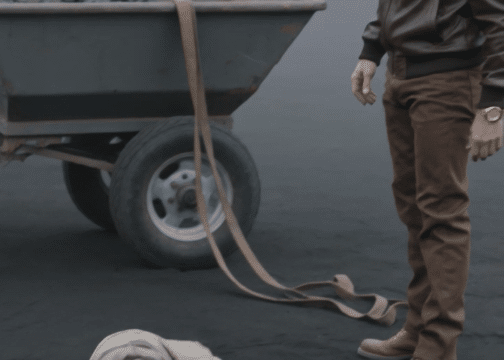
The old man stood beside a stack of cement bags, one trembling hand pressed against his lower back, while the construction supervisor pointed at the load as if he had just been caught stealing. Dust hung in the morning air, the concrete mixer rattled behind them, and workers in faded reflective vests moved around the site without daring to look directly at the confrontation.
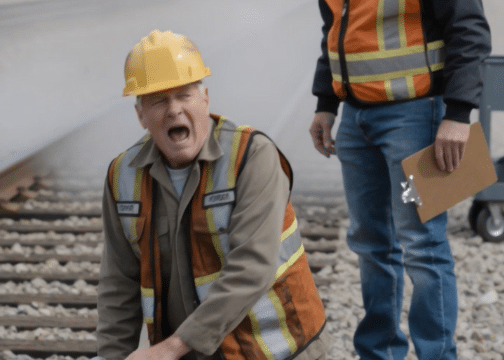
Frank Miller was sixty years old. His hard hat was scratched, his gloves were torn at the fingertips, and the reflective vest hanging over his work clothes had been washed so many times that its bright stripes had begun to fade. He had spent most of his adult life building things for people who would never know his name.
Today, even bending down hurt.
He had felt the pain before sunrise, when he climbed out of bed and tried to put on his boots. A sharp ache had settled into his lower back after years of carrying heavy materials, climbing uneven stairs, and working through injuries because missing a day meant missing money he could not afford to lose.
But Frank had shown up anyway.
He had a rent payment due in four days, a truck that needed repairs, and a refrigerator at home that was nearly empty. The construction site was the only steady source of income he had left. He knew that if he complained too often, the supervisor could replace him with someone younger before the week was over.
Still, when he looked at the cement bag, he knew he could not lift it safely.
“I’m asking for lighter duty,” Frank said. “Just for today.”
The supervisor, Bradley Knox, gave a short laugh.
Bradley was forty-three, clean-shaven, and dressed as if he had come to supervise a photo shoot rather than a construction site. His new reflective vest was spotless. His white hard hat showed no scratches, and his polished boots seemed untouched by the loose gravel beneath them.
A clipboard rested in his left hand.
It contained the daily assignments, attendance records, and the names of workers whose hours could be cut with a single mark. Bradley liked to remind people that he controlled all three.
“Trash. Carry it or leave hungry.”
Frank stared at him.
For a moment, he wondered whether he had heard correctly. He had worked under harsh supervisors before. He had been shouted at, cursed at, and blamed for mistakes that belonged to other people. But Bradley had a special talent for turning ordinary requests into public humiliations.
“I’m not refusing to work,” Frank said carefully. “I just can’t lift that weight today.”
Bradley shoved the cement bag toward him.
“Then find a way.”
Several workers nearby slowed their movements. A young laborer carrying a bucket of tools glanced toward Frank, then immediately looked away when Bradley noticed him watching. Everyone knew the supervisor’s favorite punishment: the worker who challenged him would lose overtime, receive the heaviest assignments, or discover that his name had mysteriously vanished from the next week’s schedule.
Frank had seen it happen to men who were younger and stronger than he was.
He reached toward the cement bag anyway, hoping to slide it into position without lifting the full weight. His fingers settled against the rough paper surface. He bent slightly, felt the pain flare through his back, and stopped.
Bradley stepped closer.
“What’s the matter? You think this place owes you a vacation?”
“No,” Frank whispered. “I just need a different task.”
Bradley’s face hardened.
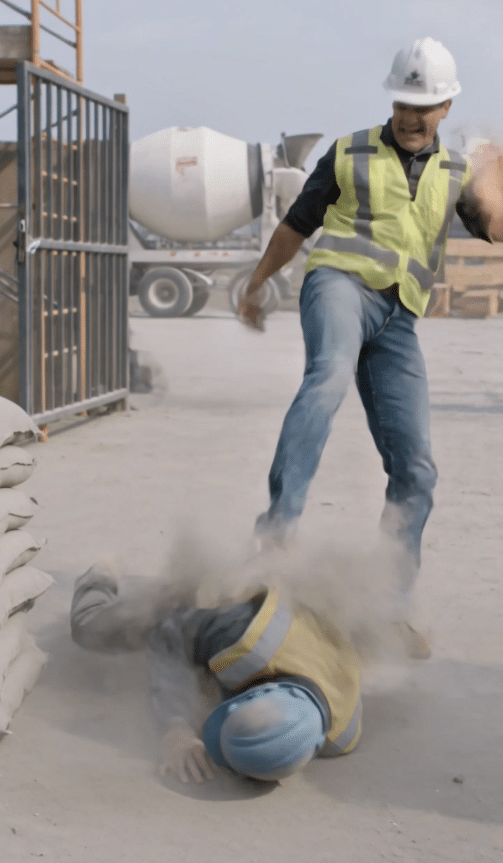
He stepped across the gravel and drove a forceful kick into Frank’s chest.
The old man stumbled backward and fell hard onto the dusty ground. His palm scraped across loose gravel, leaving a thin red trace against his skin. For a second, he lay stunned, struggling to draw a full breath while dust settled across his vest.
The cement bag sat beside his shoulder.
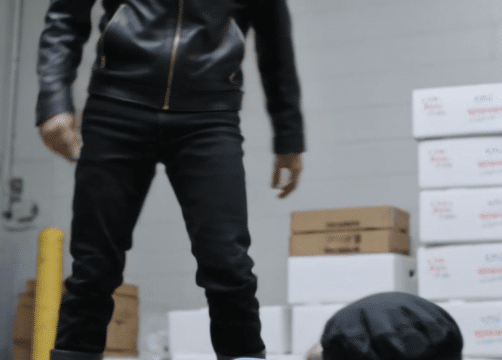
Frank tried to turn away from it, protecting himself as best he could. Bradley delivered exactly two more hard kicks, one to his back and one to his side, while Frank curled in pain on the ground.
Nobody intervened.
A worker covered his mouth. Another stepped back so quickly that he nearly struck the concrete mixer. Several men stared at the ground, their faces tight with fear, each silently calculating what might happen if they tried to help.
Bradley stood over Frank and adjusted the clipboard beneath his arm.
“Old backs still build my site.”
Frank looked up at him, his eyes watering from pain and dust. He did not answer. He could barely manage a breath.
Then a loud metallic crash rang out from the construction gate.
A black car braked at the entrance, sending a cloud of dust across the driveway. The gate swung open, and a man in a black suit beneath a high-grade reflective vest stepped out, his polished shoes touching the gravel.
The entire work crew fell silent.
Bradley turned toward the entrance, already preparing the professional smile he used whenever an important visitor appeared.
But the man did not look at the building plans or the unfinished structure.
He looked directly at Frank on the ground.
Then he walked toward Bradley, reached for the supervisor’s clipboard, and took it out of his hand.
“You just dropped your future on this site.”
Bradley stared at him.
“My future?”
For the first time that morning, the supervisor seemed unable to understand what was happening.
And the man standing before him was not merely another investor checking on his money. He was the one person Bradley had spent months trying to impress.
Act II
The man was Richard Lawson, a fifty-nine-year-old property investor whose company had financed the entire development.
The project was supposed to become a landmark for the surrounding community: a mixed-use complex with affordable apartments, retail space, and offices intended to attract new businesses to an aging industrial district. Richard had committed millions of dollars to the project, and he had personally negotiated the financing after two previous developers abandoned the site.
He had not grown up rich.
Richard’s father had worked as a carpenter, taking whatever jobs he could find to keep food on the table. When Richard was a teenager, he sometimes accompanied him to job sites, carrying tools and sweeping floors after the crews went home.
He remembered the men who worked through summer heat, winter rain, and injuries they were too frightened to report. He remembered his father coming home with cracked hands and a stiff shoulder, then waking before dawn to do it all again.
His father had once told him, “Buildings don’t stand because the people at the top have good ideas. They stand because somebody down there puts the weight on his back.”
Richard had never forgotten that sentence.
When he became an investor, he learned to study contracts, budgets, and construction schedules. But he also made a habit of visiting active sites without elaborate announcements. He wanted to know whether the people responsible for building his projects were being treated like human beings.
Bradley Knox had been hired by the general contractor as the site’s day-to-day supervisor. He had come highly recommended, with references praising his ability to keep workers on schedule and prevent costly delays.
Richard had initially been impressed.
The progress reports were detailed. Material waste was low. Deadlines had been met, and the monthly photographs showed an orderly construction site with neatly stacked supplies and workers following instructions.
But several weeks earlier, Richard had received a call from a former laborer who had left the project abruptly.
The man had not asked for money or threatened legal action. He had simply said that the site looked good on paper because Bradley made sure nobody reported what was happening beneath the surface.
He described workers being threatened with lost hours for refusing unsafe assignments. He claimed that injured employees were encouraged to finish their shifts before seeking medical attention. He also alleged that Bradley used attendance and assignment records to punish anyone who questioned him.
Richard asked the general contractor to investigate.
The response came back within days: no substantiated violations, no significant safety concerns, no evidence of abusive conduct.
The report was so tidy that Richard found himself wondering whether it had been written before anyone spoke to the workers.
He arranged an unannounced visit.
His intention had been to review the project’s progress, speak to the crew, and inspect a few concerns that had surfaced in the monthly safety summaries. He expected to find ordinary problems: a delayed delivery, an equipment issue, perhaps a disagreement about scheduling.
Instead, he arrived in time to see Bradley kick a sixty-year-old worker to the ground.
Richard had recognized Frank’s face from the personnel photographs attached to the project’s labor records. The older man had worked at the site for nearly eight months, mostly handling materials and supporting the crews responsible for the lower levels.
He was not a stranger wandering through the construction gate. He was one of the people whose labor had helped make the development possible.
Richard handed the clipboard to his assistant, who had followed him from the car, and ordered the site safety lead to call for medical assistance.
Then he turned toward the workers.
“Everyone who witnessed this incident will have an opportunity to speak privately,” he said. “You will not be required to make a statement in front of your supervisor.”
Nobody answered at first.
Bradley stepped forward, forcing a laugh that sounded more nervous than amused.
“Mr. Lawson, I can explain. The worker refused a direct instruction, and I was correcting a serious discipline problem.”
Richard looked down at Frank.
The old man was still on the ground, one arm wrapped around his side. A thin line of blood marked his scraped palm. He was trying to push himself upright, embarrassed by the attention as much as he was hurt by the assault.
“Did you see him refuse to work?” Richard asked.
Bradley hesitated.
“He refused the assignment.”
“Did he tell you he was injured?”
“He said his back hurt.”
“And you kicked him?”
Bradley’s expression tightened.
“This is a construction site. Things get heated. You can’t run a project by treating every disagreement like a catastrophe.”
Richard looked at the clipboard in his assistant’s hands.
“You recorded his assignments?”
“Of course.”
“His hours?”
“Yes.”
“His safety training?”
“Everything is documented.”
“Good,” Richard said. “Then we won’t have to rely on your memory.”
Bradley’s jaw shifted.
He had expected anger, perhaps a warning, and then an opportunity to explain the incident away. What he had not expected was a man who appeared more interested in the records than in the excuses.
Richard had spent decades learning that the first version of a story was rarely the whole story. Especially when the person telling it controlled the paperwork.
He instructed the site team to preserve the records and restrict Bradley’s access to personnel decisions while the incident was investigated. The general contractor’s regional manager was contacted, and an independent safety representative was asked to attend.
Bradley protested that the project would fall behind schedule.
Richard barely glanced at him.
“If the project cannot function without someone kicking an injured worker, we have a much bigger problem than the schedule.”
Then he followed the medical team toward Frank.
The old man looked up at him, still breathing carefully.
“I’m sorry,” Frank said.
Richard stopped.
“For what?”
Frank glanced at the cement bag.
“I couldn’t get the job done.”
Richard felt something cold settle behind his ribs.
The worker had been assaulted in front of an entire crew, and he was still apologizing for failing to lift a bag he had already explained he could not safely carry.
Richard pulled a chair close while the medical team assessed Frank.
“You don’t owe anyone an apology for telling them you’re hurt.”
Frank looked away, unable to believe that someone with Richard’s authority would say such a thing.
But the investor’s expression changed when he learned that Frank had requested lighter duty before the assault.
It was not the first time the older man had asked for help.
And Bradley had not merely ignored the request. He had made sure Frank would regret ever asking.
Act III
The first review of Frank’s employment record revealed a pattern that Richard could not dismiss as coincidence.
Two weeks earlier, Frank had been assigned to move heavy materials across the site for an entire shift after reporting back pain. A week before that, he had lost a day of work after asking for assistance with a load that exceeded the lifting limit in the site’s safety guidance.
The official notes described him as slow, unreliable, and unwilling to follow instructions.
There was no mention of the pain he had reported.
The records also showed that Frank’s hours had been reduced after he asked the safety lead whether he could be moved to a lighter task. The decision had been approved by Bradley.
Richard requested the original schedules rather than the summaries.
The differences were revealing. Several entries had been amended after the fact, making it appear that Frank had refused assignments without explanation. In the original notes, he had asked for help or reported that a task aggravated his back.
Someone had turned reasonable requests into evidence of misconduct.
Frank was not the only worker affected.
As the investigation expanded, employees began describing a familiar pattern. Workers who questioned unsafe assignments were labeled difficult. Men who reported pain were accused of pretending to be injured. Anyone who asked why protective equipment was missing or damaged risked losing the overtime that made the job financially worthwhile.
Bradley had created a system in which every worker knew the cost of speaking up.
One laborer described being told that there were twenty men waiting outside the gate who would gladly take his place. Another said Bradley had threatened to remove him from the schedule after he asked for help moving a heavy beam.
The stories were strikingly similar.
At first, the workers had assumed their experiences were isolated. They had not realized how many others were being pressured in the same way.
The most damaging evidence came from a series of messages between Bradley and a junior site coordinator.
In one exchange, the coordinator warned that Frank’s back pain might require a temporary change in duties. Bradley responded that the older worker needed to learn that assignments were not optional.
In another message, he instructed the coordinator to document Frank’s next refusal carefully.
If he won’t carry what he’s given, make sure he understands what happens to men who stop being useful.
Richard read the line twice.
The words explained the expression on Frank’s face when he had apologized on the ground. They explained why the workers had stepped backward instead of forward. And they explained why the official reports had portrayed the people raising concerns as the problem.
Bradley had not simply been trying to keep the project moving. He had been using control over assignments and hours to frighten workers into silence.
The investigation then uncovered an additional concern.
Several safety checklists had been marked complete even though workers reported that required lifting equipment was unavailable or had not been inspected. One report indicated that the site had sufficient personnel for handling heavy materials, but the shift roster showed that two experienced workers had been sent home early.
The gap had reduced labor costs on paper while leaving the remaining crew with more work than they could safely perform.
Richard requested the underlying invoices, staffing records, and safety assessments. He also asked the general contractor to explain why earlier complaints had been closed without independent interviews.
The answer was not immediately clear. Some records had been approved by people who relied on Bradley’s summaries; others had been reviewed by managers who had never visited the site during the night or early morning shifts.
But the evidence showed that the reporting system had failed to protect the workers it was supposed to serve.
Bradley, meanwhile, continued to insist that Richard was overreacting.
He argued that every construction project had difficult personalities and that a few complaints should not outweigh months of completed work. He pointed to the concrete already poured, the deliveries that had arrived on time, and the money saved by maintaining a lean crew.
Richard listened without interrupting.
Then he placed the original schedules beside the revised reports.
“Why do these dates differ?”
Bradley glanced at the documents.
“Administrative corrections.”
“Who made them?”
“Someone in the office, probably.”
“Who approved them?”
Bradley looked at the signatures.
For the first time, he seemed to realize that the paperwork could not be brushed aside with a confident voice. The approvals carried his name.
Richard turned to the safety findings.
“And why were these requests marked complete when the workers say the problems were still there?”
Bradley shifted his weight.
“We were under pressure to keep the schedule.”
“From whom?”
Bradley did not answer.
The silence was more revealing than any excuse he could have offered.
Richard had financed the development, but he had never instructed Bradley to ignore injuries, falsify records, or threaten employees. The project was supposed to be completed safely and responsibly. Any schedule that depended on hiding hazards was not a successful schedule.
Richard closed the folder.
“You have confused meeting a deadline with having permission to do anything necessary to meet it.”
Bradley’s face reddened.
“You don’t know what it takes to manage these men.”
Richard stood.
“I know exactly what it takes to manage a project. That’s why I’m looking at the evidence instead of listening to your opinion of the people you supervise.”
By the end of the day, Bradley’s authority over the site had been suspended pending the formal findings. The general contractor was required to preserve the relevant records, arrange an independent review, and ensure that no witness suffered retaliation.
Frank’s assault was being documented separately from the broader employment concerns, and the company was cooperating with the appropriate authorities.
Yet one question remained.
Why had Bradley been so confident that nobody would ever challenge him?
The answer was hidden in the very system that had allowed him to turn worker complaints into disciplinary records.
Act IV
The deeper review revealed that Bradley’s influence had extended well beyond the construction gate.
For months, he had been the main point of contact between the crew and the general contractor’s regional office. He prepared weekly labor summaries, reported safety concerns, and recommended which workers should receive overtime or be removed from the schedule.
His supervisors had relied on those reports because the project appeared to be progressing smoothly.
When a worker complained, Bradley classified the issue as a personnel dispute. When someone reported a safety problem, he described it as a misunderstanding that had already been corrected. If a laborer objected to an assignment, the resulting disciplinary note made the employee appear unreliable.
The system rewarded the person who controlled the story.
It also made the people most affected by his decisions appear to be the least credible.
Once investigators compared the reports with the original records and witness accounts, that advantage began to disappear. The unexplained changes to schedules, the repeated complaints about unsafe workloads, and the messages about punishing workers who spoke up formed a pattern that could no longer be dismissed as ordinary friction.
The general contractor placed additional managers on the project and brought in independent safety personnel. Workers were interviewed separately, and the company established a direct reporting channel for concerns that did not pass through Bradley or anyone who had approved his decisions.
The investigation also reviewed whether earlier management warnings had been ignored. Some had been recorded as resolved without sufficient evidence that corrective action had taken place.
That failure had consequences beyond Bradley himself.
The regional managers who approved the reports were required to explain their decisions. The general contractor reviewed its supervisory procedures and began revising how it verified safety issues, staffing levels, and complaints involving retaliation.
Richard refused to let the review end with a single dismissal.
“If we remove one supervisor but leave the same system in place,” he told the project leadership team, “we haven’t fixed the problem. We’ve only changed the name on the door.”
The construction schedule was adjusted to allow safer staffing and proper handling procedures. Loads that required assistance could no longer be assigned to a single worker merely because a supervisor wanted to save time. Employees who reported pain or a possible injury were directed through the established safety process rather than being treated as disciplinary problems.
Frank’s employment record was corrected while the review of his treatment continued. His lost hours were examined, and the contractor arranged for him to receive the medical evaluation and work-related support appropriate to his circumstances.
Most importantly, he was told that he would not be required to return to heavy lifting before he was ready.
When Richard visited him a few days later, Frank was sitting in a small recovery room near the site office. His hand was bandaged lightly, and his work vest lay folded on the chair beside him.
“I heard they’re changing the assignments,” Frank said.
“They are.”
“Because of me?”
“Because the assignments should never have been handled that way.”
Frank considered the answer.
“I didn’t want to cause trouble. I just wanted to finish the day.”
Richard pulled a chair closer.
“That’s what Bradley counted on. He knew you needed the work, so he assumed you would accept anything he demanded.”
Frank stared at his hands.
For years, he had believed that enduring discomfort was simply part of being a reliable worker. He had watched men come to work sick, carry loads with injured shoulders, and hide pain because they feared being replaced. He had done the same thing himself.
He had never imagined that asking for a safer task could become the reason someone attacked him.
“I thought if I complained, nobody would hire me again,” he admitted.
Richard did not offer a promise that every employer would be fair or that every problem could be solved overnight.
Instead, he told Frank that the investigation would continue, that his complaint would be documented, and that no one had the right to punish him for reporting an injury or refusing an unsafe task.
For the first time since the assault, Frank seemed to believe that he might be allowed to return to work without surrendering his dignity.
Bradley, meanwhile, was discovering what it meant to lose the authority he had treated as permanent.
He was formally removed from the project while the investigation concluded. His access to site records was restricted, and he was instructed not to contact workers about their statements. The general contractor reviewed his employment in light of the documented assault, the disputed records, and the evidence of retaliatory conduct.
He attempted to contact several former colleagues, insisting that the workers were exaggerating and that Richard had already decided to blame him.
But the records did not change to match his explanation.
Neither did the witness statements.
After the review substantiated the assault and the serious misconduct surrounding his supervision, the general contractor terminated his employment and reported the relevant safety and employment concerns through the appropriate channels.
His clipboard, once a symbol of power, became part of the evidence explaining how that power had been misused.
And Richard made one final decision about the project: the construction would continue, but not at the expense of the people building it.
Bradley had believed that the investor cared only about money.
He was about to learn that the man who had financed the site cared very much about what his money was being used to justify.
Act V
The project did not transform overnight.
The concrete still needed to be poured. Deliveries still arrived late, equipment still required maintenance, and workers still faced long days under difficult conditions. Changing a culture built on fear took more than a new supervisor and a few revised forms.
But the first changes were visible.
The cement bags were stored and moved according to updated handling procedures. Workers had access to the equipment and assistance required for heavier loads. Damaged protective gear was replaced, and safety concerns were tracked until corrective action could be verified rather than merely marked complete.
The crew also received a clear explanation of how to report injuries, unsafe assignments, and retaliation without having to place the complaint in the hands of the person being accused.
At first, the workers used the new process cautiously.
They had heard promises before. They wanted to know whether the changes would survive the next deadline, the next budget meeting, and the next supervisor who decided that speed mattered more than safety.
Richard understood their skepticism.
He made regular site visits, not to demand praise or inspect a polished presentation, but to speak with workers and verify that the revised procedures were actually being followed. The general contractor was required to report on corrective actions, and unresolved issues were escalated beyond the local management team.
The development lost some time.
It also gained something its progress reports had never measured: workers who no longer had to hide every problem until it became impossible to ignore.
Frank spent several weeks away from heavy duties while his condition was assessed. He worried about his finances and wondered whether the construction industry still had a place for a man his age.
One morning, Richard invited him to meet with the site’s new management team.
Frank arrived wearing his old reflective vest, its faded stripes brightened by the morning sun. He had cleaned his hard hat, but the scratches remained. He still moved carefully when he bent down.
The new supervisor explained that Frank’s experience could be put to better use in materials coordination, where he could help track deliveries, check inventory, and guide newer workers through safe handling procedures. The role would require training, but it would not depend on repeatedly lifting loads that aggravated his back.
Frank listened quietly.
“You’re saying I can still work?”
“If you want to,” the supervisor replied. “We’ll review the duties with you and make sure they’re appropriate.”
Frank looked toward Richard.
The investor nodded.
“You’ve spent decades helping build projects like this. You shouldn’t have to destroy your health to prove you still belong here.”
Frank’s mouth tightened. He tried to answer, but the words did not come immediately.
He had spent so long preparing himself for rejection that an ordinary offer of respect felt almost impossible to accept.
Finally, he nodded.
“I’d like to try.”
His new role did not make him wealthy. It did not erase the years he had spent working through pain or the humiliation he had endured in front of his colleagues. But it gave him a way to remain employed without pretending that his body could carry the same weight it had carried at thirty.
More importantly, it allowed him to work without being afraid that a request for help would become a threat to his livelihood.
The other workers noticed.
A younger laborer who had witnessed the assault later approached Frank during a break. He admitted that he had wanted to step forward but had been terrified Bradley would fire him.
Frank did not condemn him.
“I was scared too,” he said. “That’s why people like him get away with it for so long.”
The younger man looked down.
“I should’ve helped.”
“Next time,” Frank replied, “don’t wait for somebody important to show up.”
The words stayed with him.
Months later, the development reached a major construction milestone. The steel structure stood against the skyline, and crews moved across the site beneath the steady rhythm of machinery. The project was still behind its original schedule, but the workers were no longer being told that deadlines justified ignoring safety.
Richard attended the milestone meeting without a parade of executives or a speech about his own generosity. He thanked the crews, acknowledged the delays, and made it clear that the revised procedures were permanent requirements, not temporary concessions made after an embarrassing incident.
He also announced that the company would review labor and safety practices on its other active projects.
The decision cost money. It required new training, additional oversight, and changes to contracts that had previously rewarded speed without adequately measuring the risks taken by workers.
Richard approved the expenses.
He knew what it meant when a worker stood beside a load and had to decide whether to risk an injury or risk going hungry. His father’s old lesson had never been about sentiment. It had been about understanding what held a building together.
A structure could have expensive materials, ambitious designs, and a powerful investor. But if the people doing the work were treated as disposable, its apparent strength rested on something dangerously weak.
On the day Frank returned to the construction floor in his new role, he passed the place where Bradley had kicked him.
The ground had been leveled, and the cement bags were stacked neatly behind the marked loading area. A young worker was checking the labels before moving a pallet, and a supervisor stood nearby answering a question without raising his voice.
Frank paused for a moment.
He could still remember the dust in his mouth, the pain in his chest, and the faces of the workers who had stepped backward. He could still hear Bradley’s voice telling him that old backs built the site.
But the memory no longer belonged to Bradley alone.
It belonged to the moment when a man who believed himself untouchable discovered that his authority could not protect him from the truth.
Frank adjusted his gloves and continued toward the materials office.
Behind him, the construction site carried on—not perfectly, not without pressure, but under rules that recognized the difference between work and punishment.
Bradley had thought the cement bag was a test of obedience. He believed a worker’s hunger could be used as a weapon and that a supervisor’s clipboard gave him the right to decide whose pain mattered.
He was wrong.
The investor had not taken the clipboard because it was valuable. He had taken it because the man holding it had forgotten what it was meant to represent.
A record of work. A responsibility to the people doing it. An obligation to tell the truth.
And when Bradley kicked a sixty-year-old man into the dust, he did more than assault a worker.
He exposed the system he had built around himself—and dropped his own future on the very ground he believed he controlled.
Tighten the middle investigation chapters