Act I
“My hands are numb. I can straighten it.”
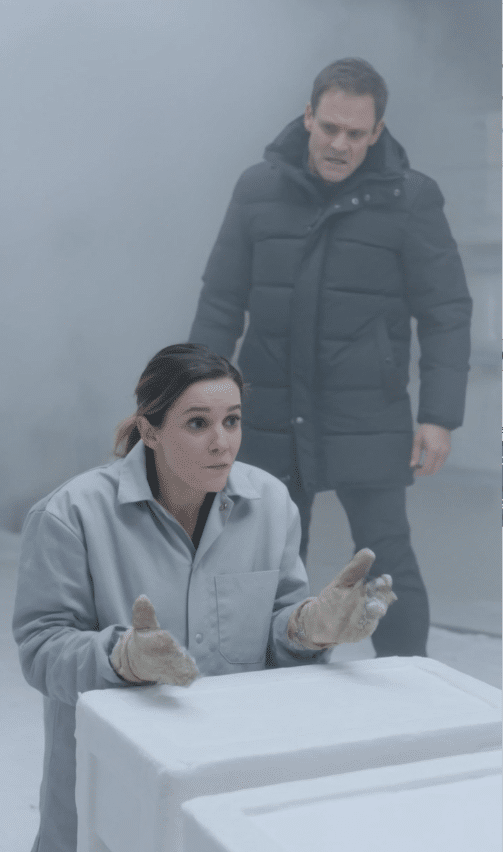
The words barely escaped the woman’s trembling lips before the warehouse manager pointed at the pallet as if she had committed a crime. White vapor drifted around their boots, frozen boxes towered along the aisle, and the harsh fluorescent lights made everything look even colder than it was.
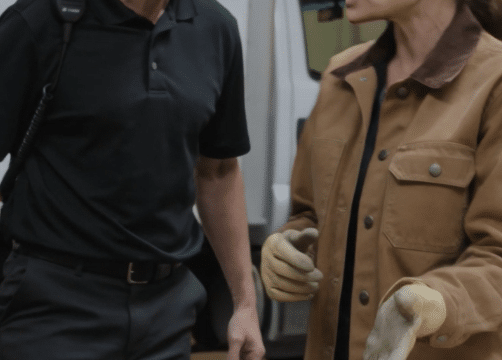
The woman, a thirty-nine-year-old mother named Emily Carter, wore a thin gray jacket that had lost most of its warmth years ago. Her brown hair was tied back, a few strands clinging to her damp forehead, and her old gloves were stiff with frost. Beside her, one frozen box sat several inches beyond the yellow line painted on the floor.
It was a tiny mistake. Her fingers had gone nearly numb, and the cardboard had become slippery beneath her gloves. She had already started correcting the box when the man blocking her path decided that the opportunity to humiliate her was too good to waste.
“Trash. Lift the whole stack.”
Derek Harlan, the forty-seven-year-old night-shift warehouse manager, stood in a thick black insulated coat and a brand-new knit cap. A radio crackled against his shoulder, and his heavy boots were planted squarely in the aisle. He looked warm, comfortable, and entirely certain that no one in the building would challenge him.
Emily glanced at the stack. It was tall enough that lifting it alone would have been dangerous, especially on the slick floor. She looked toward the other workers, hoping someone might remind Derek that the mistake could be corrected in seconds.
Nobody spoke.
Three men stood near the next pallet, their faces pale beneath the cold-room lights. A woman in a faded blue uniform lowered her eyes. Another worker slowly covered his mouth, not because he was surprised by the misplaced box, but because he already knew how ugly Derek could become when he had an audience.
“Please,” Emily said. “I’m trying to fix it.”
Derek stepped closer.
“You heard me.”
Emily bent toward the box again, determined to finish the job and return to her station before the argument cost her another shift. She had learned that fighting with Derek rarely ended when the words stopped. He could make someone’s schedule disappear, assign the worst jobs to anyone who displeased him, or quietly recommend that a temporary worker never be hired again.
She needed the paycheck too badly to risk any of those things.
Her daughter had a school trip coming up. The electricity bill was overdue, and there was a small envelope on her kitchen counter containing the last of the money she had saved for an emergency. Every dollar from the warehouse had already been promised to something essential.
Derek knew workers like Emily depended on their jobs. He treated that dependence as permission.
As she gripped the frozen box and tried to slide it back over the line, he moved across the slick floor.
The kick came without warning.
His boot struck Emily hard in the chest, knocking her away from the pallet. She fell onto the cold concrete beside the stacked boxes, the breath driven from her lungs. One elbow scraped the floor, leaving a thin red trace against her skin.
For a moment, she could do nothing but gasp.
The air in front of her face turned white with every shallow breath. Her hand searched for the edge of the pallet, but her fingers would not close properly around it. She tried to pull herself upright, bewildered by the speed with which an ordinary shift had become something she could barely understand.
Derek did not offer his hand.
He delivered exactly two more hard kicks, one to her back and one to her side, while she curled in pain on the freezing floor.
The workers flinched. One took a step forward, then stopped when Derek turned his head.
No one helped her.
Derek straightened his coat and looked down at Emily as if she were an inconvenience left in his path.
“Cold workers move faster.”
The sentence landed almost as cruelly as the blows.
Emily pressed one gloved hand against the floor, fighting to sit up. She could feel her heartbeat hammering against her ribs, and her eyes burned with tears she desperately did not want the others to see.
Then the heavy steel door at the far end of the cold room swung open.
The metallic crash echoed through the aisle. A cloud of white vapor rolled over the threshold, and a woman in a long navy coat entered with quick, purposeful steps.
She took in the pallet, the frightened workers, and Emily on the floor.
Then she began removing her coat.
And Derek Harlan, who had spent years making people afraid of him, was about to discover why the woman walking toward his victim had come to the warehouse after midnight.
Act II
The woman was Margaret Whitmore, fifty-three years old, founder and majority owner of Whitmore Logistics.
Her company distributed frozen food to grocery chains, hospitals, school cafeterias, and regional food banks across several states. It had begun with a single refrigerated truck and a handful of customers. Twenty-seven years later, it operated dozens of warehouses and employed thousands of people.
Margaret had built it through long nights, difficult contracts, and a stubborn refusal to accept that the people doing the hardest work deserved the least respect.
She remembered what the cold felt like.
Before she wore tailored coats and carried an executive badge, she had worked in a small distribution depot with a broken loading-bay heater. She had watched employees hide numb fingers beneath their armpits between shipments. She had seen managers punish people for damaged packaging while ignoring the equipment failures that made the damage inevitable.
One of those workers had been her father.
He had spent nearly thirty years loading trucks for a regional supplier. When a supervisor injured his back and blamed him for refusing to work quickly enough, the company quietly dismissed him. He never recovered financially, and he never again trusted a manager who described cruelty as discipline.
Margaret had never forgotten the look on his face when he came home carrying his last paycheck.
Years later, when she launched Whitmore Logistics, she promised herself that no employee would have to choose between personal safety and keeping a job simply because someone above them wanted to feel powerful.
The promise had become part of the company’s culture. At least, that was what Margaret believed.
Lately, however, she had begun receiving complaints from one particular warehouse. Workers described punitive schedules, unexplained deductions, unsafe lifting demands, and a manager who treated the cold room like his private kingdom.
The complaints were anonymous.
Every time Margaret asked for an investigation, the reports that came back looked clean. Safety inspections had been completed. Training records were signed. Temperature logs were in order. Employees were supposedly satisfied with their supervisor.
The manager responsible for those reports was Derek Harlan.
He had been with the company for six years and had developed a reputation for keeping shipments moving even during difficult periods. On paper, he was efficient. He rarely missed a dispatch deadline, and his warehouse had recently received praise for reducing overtime costs.
Margaret had initially believed that the complaints reflected a difficult adjustment to new operating targets.
Then an envelope arrived at her private office.
Inside were photocopies of shift schedules, photographs of damaged protective gloves, and a handwritten note from someone who had worked nights at the warehouse. The note described employees being ordered to move loads without enough assistance and being threatened with dismissal if they reported injuries.
One sentence had been underlined twice.
He says the company only cares about the numbers, and nobody important ever comes here at night.
Margaret read it several times.
She ordered an unannounced visit, asking only her compliance director to accompany her as far as the facility entrance. She wanted to see the operation without a carefully staged welcome, without a manager escorting her past the trouble spots, and without employees being warned to smile.
She arrived shortly after midnight.
Her plan was to walk the floor, inspect the working conditions, and speak privately with the night crew. She had expected evasiveness. Perhaps a few minor violations. Maybe a supervisor who needed retraining.
She had not expected to hear a woman pleading for the chance to correct a box before watching a manager kick her to the ground.
Margaret crossed the aisle and knelt beside Emily.
The younger woman recoiled slightly when she saw someone approaching. She had spent the last few seconds waiting for another command, another accusation, another reason she might lose her job.
Instead, Margaret removed her long navy coat and gently placed it around Emily’s trembling shoulders.
“You’re safe for the moment,” she said quietly. “Don’t try to stand yet.”
Emily stared at her, confused.
The coat was warm, heavy, and smelled faintly of clean wool and winter air. Emily clutched it around herself, struggling to catch her breath. She looked from Margaret to Derek, as though expecting the manager to explain why this stranger was interfering.
Margaret rose slowly.
She was not a tall woman, and she did not shout. She simply turned toward Derek with an expression so controlled that the people nearby seemed to stop breathing.
“That box just opened the wrong door.”
Derek frowned.
“What door?”
He sounded irritated rather than frightened. He had seen executives visit warehouses before. They asked questions, took photographs, shook hands, and left. The manager remained in charge after the visitors drove away.
He assumed this woman would be no different.
Margaret reached inside her coat pocket and removed her phone. She did not wave it in his face or threaten him with it. She simply made one call to the compliance director waiting near the front entrance.
“Secure the incident records,” she said. “Nobody changes a schedule, deletes a message, or moves a pallet until the safety team arrives.”
Derek’s expression shifted.
Margaret ended the call and looked toward the workers.
“My name is Margaret Whitmore. I own this company.”
The words traveled through the aisle more quickly than any radio announcement.
A worker near the wall whispered something under his breath. Another lowered his hands from his mouth. Derek’s face lost some of its color, but he recovered quickly enough to force a thin smile.
“Ms. Whitmore, this is a misunderstanding. The employee failed to follow the floor markings, and I was correcting a safety issue.”
Margaret looked at the frozen box.
Then she looked at Emily, still curled beneath the coat.
“By kicking her?”
Derek opened his mouth.
For the first time that night, he had no answer ready.
But the owner had not come all this way to settle for a denial, because the documents in her office had already suggested that Emily was not the first person Derek had hurt.
Act III
Margaret instructed the nearest worker to call the site’s emergency response team and asked another to bring the warehouse first-aid kit. She stayed beside Emily until trained personnel arrived, making sure the woman was not pressured to move before she could be assessed.
Derek watched the scene with mounting frustration.
He tried to regain control by issuing orders to the crew, telling them to return to their stations and warning them that the shipment schedule would not wait for a personal dispute. No one moved.
For the first time, the silence he had cultivated around himself was no longer obedience. It was evidence of how frightened everyone had been to speak.
Margaret turned to him.
“Step away from her.”
Derek took one step back, his jaw tightening.
“I have a warehouse to run.”
“You had a worker on the floor, and you chose to kick her.”
“She was insubordinate.”
“She told you her hands were numb.”
Derek glanced at the surrounding employees. He was calculating now, searching their faces for someone who would confirm his version of events. Usually, one nervous worker was enough. People who depended on the next paycheck often repeated whatever a supervisor told them to repeat.
But the workers had seen everything.
They had watched Emily attempt to correct the box. They had heard Derek order her to lift the entire stack alone. They had seen him kick her, then deliver two more kicks while she curled in pain.
There was no reasonable version of the incident that made him look like a manager enforcing safety.
Margaret asked the compliance director to arrange separate statements from every witness. No one would be questioned in Derek’s presence, and no employee would be required to confront him directly.
Then she requested the warehouse’s shift records, disciplinary reports, safety logs, and communications relating to Emily.
Derek gave a short, disbelieving laugh.
“You can’t just shut down my operation because someone made a complaint.”
“I haven’t shut anything down,” Margaret replied. “I’m preserving evidence.”
That distinction unsettled him more than an angry threat would have.
A few minutes later, the compliance director arrived with two members of the safety team. Emily was being examined by the response personnel, and Margaret moved to a nearby office to review the first documents brought over.
The initial records appeared ordinary.
Emily had received two written warnings in the previous month. One concerned a shipment that had been incorrectly labeled. The other claimed she had abandoned her station without permission.
Both reports carried Derek’s approval.
But the accompanying notes raised questions. The first shipment had been relabeled before dispatch, and the error appeared to have originated during an earlier shift. The second incident occurred during a scheduled equipment break, yet Emily’s record described it as an unauthorized absence.
Margaret requested the original logs.
The timestamps did not match the summaries.
Then the compliance director found something else: several workers had been assigned unusually high rates of disciplinary action after questioning the warehouse’s safety practices. Some had lost preferred shifts. Others had been removed from overtime lists. One employee had resigned after receiving three warnings in less than two weeks.
Derek insisted the records were being misinterpreted.
“People complain when they’re held accountable,” he said. “You can’t run a warehouse by making everybody comfortable.”
Margaret looked up from the paperwork.
“Accountability is not the same thing as intimidation.”
She had heard versions of his argument before. Managers who abused their authority often wrapped their behavior in the language of efficiency. They called humiliation discipline, fear motivation, and silence proof that everything was working.
Derek had built a system in which every person below him understood the cost of challenging him.
Now that system was beginning to unravel.
A safety specialist returned with a report about the cold room. The aisle where Emily had been working had a slick section near the pallet line, and the floor markings were worn enough to require maintenance. Several gloves issued to night-shift workers were also overdue for replacement.
None of those conditions excused Emily’s misplaced box, but they exposed the hypocrisy of Derek’s punishment. He had demanded perfect performance from people working in conditions he had failed to address.
Margaret asked for the maintenance requests.
Two had been submitted and marked as completed, although the underlying work had never been verified. One request specifically mentioned the slippery aisle where Emily had fallen.
Derek had signed off on both.
The room seemed to grow colder.
Margaret placed the documents beside the disciplinary reports. A single mistake by a tired worker had led her to an entire pattern of questionable management decisions.
Still, she needed to know why the records had been altered and whether Derek had acted alone.
That answer came from a message thread recovered from the warehouse’s internal system.
Several weeks earlier, Derek had written to a shift supervisor that workers who complained about the cold should be given the most difficult assignments until they learned to stop making excuses. In another message, he had described the night crew as replaceable and instructed a subordinate to document every small mistake made by employees who had questioned him.
Then came a final exchange about the safety logs.
Derek had asked whether the maintenance requests would be checked during the upcoming review. The supervisor replied that the records showed the issues had been resolved.
Derek’s response was brief.
Good. Keep it that way.
Margaret read the sentence without moving.
This was no longer a dispute over one box or one violent outburst. It was a question of whether a manager had deliberately concealed workplace hazards while punishing the people who reported them.
And now there was a woman on the cold-room floor whose injuries could no longer be dismissed as a scheduling problem.
Margaret looked toward the glass office door, where Derek stood watching the investigation unfold.
He had spent years believing that the company existed to protect his authority.
He was about to learn that the records he had used to control his workers might be the very thing that destroyed it.
Act IV
By two in the morning, the warehouse had changed.
The conveyor belts had been stopped in the affected area. Safety personnel were checking the aisle, and the compliance team had secured the relevant records. Workers who had once hurried away whenever Derek approached now stood in small groups, speaking in low voices.
Some were still afraid.
Others seemed unable to believe that they were finally allowed to tell the truth.
Emily had been taken to a warmer room for medical evaluation. The coat remained around her shoulders, its sleeves hanging past her hands. When Margaret came to check on her, Emily apologized for the delay she had caused.
Margaret stopped in the doorway.
“You don’t need to apologize for being hurt.”
Emily looked down at her gloves.
“I can’t afford to lose this job.”
“You won’t be punished for reporting what happened tonight.”
The answer brought tears to Emily’s eyes, but she wiped them away quickly. She had learned to hide distress at work. Crying could be described as instability, anger as insubordination, and fear as proof that someone could not handle the job.
Margaret pulled a chair beside her.
“No one should have to endure violence to keep a paycheck,” she said. “We’ll deal with the evidence properly. For now, your only responsibility is to let the medical team take care of you.”
Emily finally allowed herself to breathe.
Across the warehouse, Derek was discovering that his authority had limits.
He demanded to speak privately with Margaret. When she declined to interrupt the investigation, he accused her of humiliating him in front of the staff. He insisted that the workers had always known he was strict and that the company had benefited from his willingness to make difficult decisions.
“You hired me to get results,” he said. “Look at our shipping numbers.”
Margaret glanced at the performance report.
“Your numbers don’t erase what happened to Emily.”
“She made a mistake.”
“And you made a choice.”
Derek’s voice sharpened.
“You can’t let one employee ruin six years of my work.”
Margaret regarded him steadily.
“You are not losing your position because someone misplaced a box. Your conduct, the incident records, the safety reports, and the messages are being reviewed because of what you did.”
He looked toward the workers gathered beyond the office.
“You’re going to let them turn against me?”
“No,” Margaret replied. “I’m going to let them speak for themselves.”
That was the moment Derek began to understand what frightened him most. It was not the owner’s anger. It was the possibility that the people he had silenced would finally be heard.
The compliance director presented a preliminary account of the evidence. Witness statements supported the sequence of the assault. The internal messages raised concerns about retaliatory scheduling and deliberate pressure on employees who reported problems. The maintenance records suggested that required repairs had been marked complete without adequate verification.
The company would need a formal investigation before making final findings about every allegation. But there was no ambiguity about the violence that had occurred in front of the pallet.
Margaret placed Derek on immediate administrative suspension pending the investigation and directed security to collect his access badge and company radio. He was instructed not to contact witnesses or alter any work records.
He stared at the badge as if it were a personal possession being stolen from him.
“This is because of her,” he said, glancing toward the room where Emily was recovering.
“No,” Margaret answered. “This is because of you.”
He tried to argue that his record of meeting deadlines should count for something. He mentioned the overtime he had saved, the shipments he had pushed through during difficult weeks, and the managers who had praised his results.
Margaret listened until he ran out of words.
Then she opened a folder containing the original maintenance requests and the messages recovered from the system.
“Your performance reports told me you were efficient,” she said. “These records tell me what that efficiency cost.”
Derek’s eyes moved across the pages. He recognized the messages immediately. For months, he had assumed that internal communications would remain buried beneath the daily flood of dispatch updates, scheduling notes, and inventory reports.
He had mistaken a busy company for an inattentive one.
He had also mistaken his own access to the system for control over the truth.
The compliance team continued gathering evidence after he left the office. The company arranged independent review of the safety failures, preserved the records for any required external investigation, and began contacting employees who had previously raised concerns.
The next morning, the warehouse’s regional leadership received notice that Derek’s suspension would remain in place while the findings were assessed. His access to scheduling and personnel systems was revoked, and the company began reviewing his prior disciplinary decisions for possible retaliation.
It was not an instant, theatrical punishment. There were interviews to conduct, records to verify, and workers whose trust could not be restored with one announcement.
But the direction had changed.
For the first time, Derek could not decide who worked the worst shift, whose complaint disappeared, or whose mistake became a reason to threaten their livelihood.
And when the formal findings arrived, the truth would be even harder for him to escape.
Act V
The investigation took several weeks.
By then, Emily had returned home and begun recovering from the assault. The bruising and soreness reminded her of that night, but the injury she found hardest to explain was the fear that had followed her back through the front door.
For days, she woke before dawn convinced she had missed an alarm. She would sit on the edge of her bed, listening for the sound of her daughter’s footsteps, then remember that she no longer had to hurry into a freezing warehouse where every small mistake might become an excuse for punishment.
Her daughter noticed the change before Emily could put it into words.
One evening, the girl found the navy coat folded carefully on the kitchen chair. Emily had washed it according to the care label, although she had worried that she might damage something expensive. She planned to return it personally when she was ready.
“Is it yours now?” her daughter asked.
Emily smiled faintly.
“No, sweetheart. Someone lent it to me when I needed it.”
“Was she nice?”
Emily thought of Margaret kneeling beside her on the cold floor, speaking softly while everyone else had stood frozen in fear.
“Yes,” she said. “She was.”
The company did not simply move Emily to another warehouse and call the problem solved. An independent review confirmed that Derek had used disciplinary measures inappropriately, failed to address documented safety concerns, and falsified or improperly approved maintenance records. Witness accounts and the preserved video evidence established the assault.
Whitmore Logistics terminated his employment after completing its formal process. The company also referred the relevant safety and assault concerns to the appropriate authorities and cooperated with any further proceedings.
His professional reputation collapsed faster than his job title had disappeared.
Managers who had praised his shipping figures were asked to explain why earlier complaints had been dismissed. The regional leadership team had to account for the gaps between the official reports and the conditions employees described. Several of Derek’s disciplinary actions were overturned, and workers who had lost shifts after raising safety concerns received reviews of their records.
The warehouse underwent a full safety assessment. Damaged gloves were replaced, the slippery aisle was repaired, and lifting procedures were revised so that employees were not ordered to move unsafe loads alone. A new reporting process allowed workers to raise concerns directly with the compliance team instead of routing every complaint through their own manager.
Margaret also required the company to examine how its performance targets had been set.
She had once believed that a clean report meant a healthy workplace. Now she understood how easily a system could look successful when the people inside it were too frightened to tell the truth.
At the next company-wide leadership meeting, she displayed no photographs of Emily’s injuries. She did not use the woman’s pain as a dramatic prop or invite executives to congratulate themselves for removing one bad manager.
Instead, Margaret placed a copy of the original maintenance request on the table.
“This was submitted before the incident,” she said. “It was marked complete without the underlying problem being properly addressed. The employee who later suffered the consequences had no authority to correct that failure.”
She looked around the room.
“Our responsibility is not simply to demand that workers follow the rules. We are responsible for making sure those rules can be followed safely, and for ensuring that no manager mistakes authority for ownership of another person’s dignity.”
Nobody interrupted.
Margaret ordered a broader review of complaint handling across the company. Senior managers would be held accountable for how safety concerns were investigated, not merely for whether shipments left on time. Anonymous reports would be tracked to resolution, and retaliation would trigger a separate review rather than being buried beneath ordinary performance metrics.
It was an expensive correction. It would take months to implement, and it would require the company to admit that its existing systems had failed.
Margaret approved it anyway.
A few weeks later, Emily returned to the warehouse for a meeting with the compliance team. She wore a warmer jacket and a new pair of insulated gloves, but she still hesitated at the entrance to the cold room.
The steel door stood open.
Beyond it, white vapor drifted over the floor, and the familiar rows of frozen boxes waited beneath the fluorescent lights. For a moment, she was back on the concrete, unable to catch her breath while the other workers looked away.
Then she heard a voice from behind her.
“Take your time.”
It was Margaret.
Emily turned, surprised to see the owner had come down from her office to meet her. Margaret carried the navy coat over one arm, freshly cleaned and carefully folded.
“I wanted to return this,” Emily said. “And thank you.”
Margaret accepted the coat but did not immediately put it on.
“You don’t owe me gratitude for helping you after someone hurt you.”
Emily lowered her eyes, struggling to find an answer.
“I just thought nobody would do anything,” she admitted. “I thought if I made trouble, I’d lose everything.”
Margaret looked through the open door at the workers preparing for the night shift. A supervisor was checking the equipment, and two employees were reviewing the lifting procedure together. The atmosphere was not suddenly perfect, and no one pretended that a few weeks could erase years of fear.
But people were speaking.
That mattered.
“Then we have more work to do,” Margaret said.
Emily returned to the warehouse several days later, not because she was forced to prove her loyalty, but because she wanted to decide for herself what came next. She was offered a position in inventory coordination after a review of her experience and preferences, with proper training and no requirement that she work in conditions she could not safely tolerate.
She accepted.
The work was still demanding. The cold still crept through the doors whenever a shipment arrived, and some nights stretched longer than she wanted. But she no longer felt that one misplaced box could destroy her life.
The yellow floor marking beside the pallet was repainted. The worn section of concrete was repaired. And the workers who had watched Derek’s cruelty in silence were given a way to report what they saw without having to place their jobs in his hands.
One evening, Emily stood beside the same pallet where everything had happened. A box sat a few inches outside the line.
She noticed it, reached down, and corrected it.
Then she paused.
For the first time in years, she did not look over her shoulder to see whether a manager was waiting to punish her.
She simply finished the task and returned to work.
Derek Harlan had believed that a warm coat, a radio, and a managerial title made him untouchable. He had mistaken the fear of poor workers for proof that they were powerless, and the company’s silence for permission to do whatever he pleased.
But the woman who owned the company had walked through the steel door, placed her coat around the person he had hurt, and refused to look away.
The box had never been the real problem.
It had only exposed what Derek had spent years trying to hide.
And in the end, the most powerful thing Margaret Whitmore did that night was not remove a manager’s badge or threaten his career.
It was give a frightened woman the chance to stand upright again—and make sure the next worker who needed help would not have to wait for the owner to walk through the door.
Strengthen the opening with immediate stakes