Act I
“My voucher says one blanket for my child.”
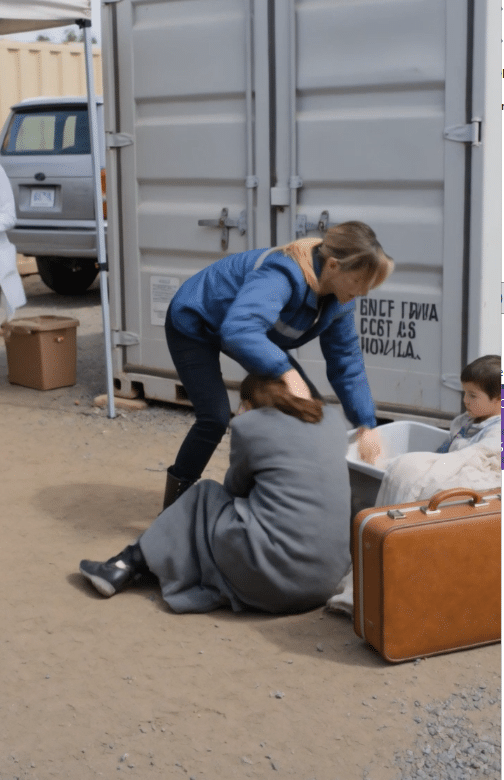
The woman held the paper in both hands, careful not to tear it as the aid coordinator snatched the blanket away from the distribution counter. Behind her, a little girl sat beside two battered suitcases, rubbing her hands together beneath a thin sweater. The wind slipped between the temporary tents, carrying the cold straight through the camp.
The mother’s name was Rachel Miller. At forty-two, she had learned to make herself small whenever someone behind a counter looked impatient. Her gray coat was worn at the cuffs, her brown hair was tied into a messy ponytail, and the skin across her hands had cracked from weeks of washing clothes in cold water.
But she could not make herself walk away this time.
The voucher was valid. It carried the camp’s official stamp, the correct household number, and a clear authorization for one blanket for her daughter, Lily. Rachel had waited in line for nearly two hours, watching volunteers distribute supplies to families whose children were already shivering beneath the open sides of their tents.
Now, when her turn finally came, the woman in the blue relief jacket had refused her.
“Trash. Stand at the back.”
The coordinator, Vanessa Cole, pointed toward the end of the line. Her plastic name badge swung against her jacket, and her high blonde ponytail remained perfectly neat despite the dust and cold. She wore clean boots and the expression of someone who believed that a small amount of authority made her more important than the people asking her for help.
Rachel glanced at the voucher again.
“I think there’s been a mistake. It says right here—”
“I can read.”
“Then could you please tell me why it’s being refused?”
Vanessa leaned across the counter.
“Because I said so.”
The line fell quiet.
Rachel felt the eyes of the people behind her. Some looked uncomfortable. Others lowered their heads, afraid that asking questions might put their own supplies at risk. A little boy clutched his mother’s sleeve, and an elderly man shifted a blanket tighter around his shoulders.
Rachel looked toward Lily.
Her daughter was seven years old, small for her age, with a pink scarf wrapped around her neck and a suitcase that had once belonged to Rachel’s mother. They had arrived at the resettlement camp after an apartment fire displaced several families in their building. Their insurance claim was still being processed, their savings were nearly gone, and the temporary housing they had been promised had been delayed twice.
Rachel had told Lily that the camp was only a stop along the way.
She had promised that things would get better.
Last night, Lily had curled up inside her coat because their thin sleeping cover did little to block the cold. She had not complained. She had simply asked whether they could get a real blanket the next day.
Rachel had promised they would try.
Now Vanessa was standing between her daughter and the one thing the voucher had guaranteed.
“Please,” Rachel said. “She’s cold. I’m not asking for anything extra. Just what the voucher says.”
Vanessa’s expression hardened.
“You people always have a reason why the rules shouldn’t apply to you.”
Rachel stared at her.
“I’m asking you to follow the rules.”
That answer changed the coordinator’s face.
For a moment, the woman seemed less offended by the request than by the fact that Rachel had dared to question her. Vanessa reached for the voucher, but Rachel held on to it.
“I need that back,” Rachel said. “It belongs to my daughter.”
Vanessa stepped around the counter.
“Then maybe you should learn when to stop talking.”
Rachel did not move.
She was frightened, but she could see Lily watching from beside the suitcases. If she walked away, her daughter would spend another cold night without the blanket they had been promised. If she stayed, Vanessa might find another way to punish her.
Rachel chose to stay.
The coordinator drove a brutal kick into her chest.
Rachel fell sideways beside the blanket storage bin, landing on the hard ground. Her elbow scraped against the rough surface, leaving a thin trace of blood. The voucher remained clenched in her fist.
Before she could recover, Vanessa delivered exactly two more hard kicks, one to Rachel’s back and another to her side.
A woman in line covered her mouth.
Someone gasped.
The people closest to the counter stepped backward, creating a circle of empty space around Rachel as though the violence itself might spread to anyone who came too near.
Rachel curled around the paper in her hand.
She did not reach for Vanessa. She did not scream for revenge. Her first instinct was to look toward Lily, who had risen beside the suitcases and stood frozen, her small face drained of color.
Vanessa straightened her jacket.
“Your child waits like everyone else.”
Rachel struggled to breathe through the shock. She looked at the coordinator, then at the blanket inside the bin, and finally at her daughter.
Nobody helped her.
Then the metal door of the white aid container swung open with a violent bang. Its chain struck the side of the container, sending a sharp echo through the line.
A woman in a navy suit beneath a white coat stepped into the camp, a red authority badge fixed to her chest. Three inspectors followed close behind her.
She stopped when she saw Rachel on the ground.
Her gaze moved to the voucher in Rachel’s hand, then to the blanket Vanessa had pulled away.
Without saying a word, she crossed to the bin, picked up the blanket, and carried it to Lily.
She placed it firmly in the child’s arms.
Then she turned toward Vanessa.
“That blanket just uncovered everything.”
Vanessa’s face lost its color.
“Uncovered what?”
For the first time that morning, the aid coordinator had no idea what the rules were about to do to her.
Act II
The woman in the white coat was Helen Brooks, a fifty-four-year-old senior representative responsible for overseeing humanitarian programs across several regional resettlement sites.
Her job was to make sure that aid reached the people it was intended for, that public and donated funds were properly accounted for, and that local coordinators followed the procedures established to protect vulnerable families. She had spent more than twenty years working in emergency housing, disaster recovery, and refugee assistance.
Helen had learned that humanitarian programs rarely failed because supplies were completely unavailable. More often, they failed because someone decided that the people receiving help were too powerless to demand what they had been promised.
A box of blankets could arrive on time and still never reach the right families. A food shipment could be fully funded and still disappear from the inventory. A voucher could carry every necessary signature and still be refused by a person who had discovered that control over a distribution table was a convenient form of power.
That was why Helen conducted unannounced inspections.
Three weeks earlier, she had received a complaint from a former volunteer at the resettlement camp. The message described unexplained discrepancies in the blanket inventory and a pattern of residents being turned away despite having valid vouchers.
The volunteer had not provided a full name.
They had included photographs of handwritten distribution sheets, several voucher numbers, and one sentence that stayed with Helen long after she finished reading.
The families who complain are the families who never seem to receive anything afterward.
Helen had requested the original records, but the camp’s local management sent back incomplete files. The coordinator’s reports showed that supplies were being distributed according to plan, and the inventory totals appeared consistent with the official numbers.
Yet the complaints continued.
One resident claimed that her voucher had been marked as redeemed even though she had received nothing. Another said that a volunteer had quietly told her to return the next morning because the remaining blankets were being held for a separate group. A third reported seeing bags of new blankets moved into a locked storage area after the public distribution line closed.
Each account was concerning.
Together, they suggested that someone was controlling access to the supplies in ways the official reports did not explain.
Helen arranged an inspection without announcing the exact time of her arrival. She brought two compliance inspectors and a logistics specialist, intending to compare the inventory, the voucher register, and the actual distribution process.
She expected to find administrative errors.
Instead, she found Rachel Miller on the ground.
Rachel had not always needed humanitarian assistance. Before the fire, she had worked as a receptionist at a small dental office. She had paid her bills, packed Lily’s school lunches, and kept a careful household budget. She was not wealthy, but she had built a stable life through years of ordinary work and careful decisions.
The fire had taken that stability in a single night.
Rachel and Lily escaped with the clothes they were wearing and a small suitcase that Rachel had managed to retrieve from the hallway. Their apartment was declared temporarily uninhabitable, and the family was moved between emergency accommodation sites while the housing agency searched for a permanent solution.
Rachel filed the paperwork, answered every question, and attended every appointment. She kept copies of her documents in a plastic folder because losing one form could mean waiting weeks for another.
The blanket voucher had arrived after an assessment of her household’s needs.
It was not a favor from Vanessa. It was an authorized allocation under the camp’s relief program, intended to ensure that Lily had suitable bedding while the family remained in temporary accommodation.
Rachel had followed every instruction.
She had presented the voucher at the correct window, during the designated distribution period, with the required identification. The refusal had no explanation printed on the form and no documented reason attached to the household record.
Vanessa had simply taken the blanket away.
That mattered to Helen.
The coordinator was not a volunteer making an innocent mistake. She was a paid employee entrusted with the distribution of essential supplies. Her authority came with obligations: to follow eligibility rules, document exceptions, treat residents fairly, and report shortages honestly.
Instead, she had used that authority to humiliate a mother who was asking for an item her child had already been approved to receive.
Helen knelt briefly beside Rachel while an inspector called for medical assistance. She asked Rachel not to move too quickly and made sure another staff member stayed with Lily.
Rachel looked embarrassed.
“I didn’t mean to cause a problem,” she whispered.
Helen’s expression softened.
“You didn’t cause this problem.”
Rachel glanced at the voucher.
“I just wanted her to give my daughter the blanket.”
“And she should have.”
Those words nearly broke Rachel’s composure.
For days, she had been trying to avoid becoming the difficult person in the room. She had thanked volunteers for small favors, apologized whenever Lily needed something, and accepted delays because she knew the camp was crowded and resources were limited.
She had begun to feel that asking for anything at all was a kind of failure.
Helen understood how easily that feeling could be exploited.
When people depended on an institution for shelter, food, or warmth, they often believed they had to earn kindness through perfect behavior. A coordinator who understood that fear could make residents obey without ever issuing a formal threat.
Vanessa had turned a blanket into a test of submission.
But Helen had not come to the camp merely to resolve a dispute at the distribution counter. She had come to find out why the inventory and the complaints did not match.
As the medical responder helped Rachel sit up, Helen looked toward the white aid container.
“Bring me the voucher register,” she told the inspectors. “And every inventory sheet from the last thirty days.”
Vanessa stiffened.
“There’s no need to turn this into an investigation.”
Helen looked at her.
“Then the records should make it very easy to resolve.”
The coordinator said nothing.
She had spent months controlling what residents could receive. Now someone had arrived who could examine what she had been doing when nobody was watching.
And the paperwork inside that container was about to become far more dangerous than Rachel’s questions.
Act III
The first thing Helen noticed was the number on Rachel’s voucher.
It was printed clearly beneath the household authorization, followed by a date, a distribution code, and the initials of the staff member responsible for fulfilling the request. The document was valid, and nothing on it indicated a shortage, suspension, or eligibility dispute.
Helen handed it to the logistics inspector.
“Check this against the register.”
The inspector entered the container and returned with a thick binder and a tablet. He searched the voucher number, then looked up at Helen.
“According to the system, this household already received its blanket.”
Rachel stared at him.
“That can’t be right. We never got one.”
Helen held out her hand for the tablet.
The record showed that the voucher had been redeemed two days earlier. A blanket had supposedly been issued to Rachel Miller, and the transaction had been closed under Vanessa’s staff identification.
Rachel shook her head.
“We weren’t even here that morning. Lily had an appointment at the housing office.”
The inspector checked the timestamp.
The transaction had been recorded while Rachel and Lily were signed in at a different service location.
Helen’s face became still.
A simple clerical error could explain one mistaken entry. It could not explain why a valid voucher had been marked as redeemed before the mother presented it, why the blanket had then been refused, and why the coordinator had reacted with violence when Rachel asked for an explanation.
“Pull every transaction under this staff ID,” Helen said.
Vanessa stepped forward.
“Our system sometimes duplicates entries. It happens when the network drops.”
“Then we’ll be able to identify the duplicates.”
“The records aren’t always perfect.”
“That’s why we’re reviewing them.”
Vanessa glanced toward the line, where residents were still watching. She tried to recover her usual authority, straightening her jacket and raising her voice.
“This is a public distribution site. We can’t stop everything because someone is confused about a voucher.”
Helen did not look away from the tablet.
“No. We stop distribution when there’s evidence that the process may be compromised.”
The inspectors began comparing the electronic register with the paper sheets. The first discrepancies appeared quickly. Several vouchers had been marked as fulfilled, even though the corresponding inventory entries showed no blanket leaving storage. In other cases, blankets had been recorded as issued to households whose members said they had received nothing.
The numbers were small enough to escape attention when viewed one at a time.
Across several weeks, they became a pattern.
Some residents had been told that their allocations were delayed. Others had been directed to return on another day. Their vouchers were then closed in the system, allowing the camp to report that the supplies had been distributed as planned.
But where had the blankets gone?
Helen asked for a physical inventory.
The logistics inspector counted the remaining stock and compared it with the recorded deliveries and redemptions. The total did not match. More blankets had been logged as distributed than could be accounted for through the official records, yet residents continued to report being turned away.
Then a volunteer who had been standing near the storage shelves quietly approached the inspection team.
“I think you should check the locked section,” she said.
Vanessa turned sharply.
“That’s restricted storage.”
The volunteer hesitated.
“I know.”
Helen noticed the fear in her face.
“Why is it restricted?”
“Coordinator approval only.”
“Who authorized that rule?”
Vanessa answered before the volunteer could speak.
“Me. We need to protect supplies from misuse.”
Helen nodded toward the container.
“Open it.”
Vanessa did not move.
For several seconds, the only sound was the wind tugging at the tent fabric outside. Then the coordinator reached into her pocket, produced a key, and unlocked the partition at the back of the container.
Inside were several unopened packages of blankets.
They were stacked separately from the public inventory, each marked with a small paper tag. Some tags carried household numbers. Others had handwritten names and short notes.
Helen picked up one of the packages.
The tag read: Hold for preferred household.
Another read: Release after coordinator approval.
The labels did not correspond to any recognized category in the distribution policy.
“What does preferred household mean?” Helen asked.
Vanessa folded her arms.
“Special circumstances. People who cooperate with the program.”
“Cooperate how?”
“Some residents help us out. They donate supplies, bring food for the volunteers, or show appreciation. We have to make judgment calls.”
Helen slowly turned toward her.
“Are you saying that people who bring you gifts receive blankets ahead of people with valid vouchers?”
“That’s not what I said.”
“Then explain the tags.”
Vanessa’s cheeks reddened.
“We have limited resources. Sometimes you have to decide who deserves priority.”
“The eligibility rules already determine priority.”
“Those rules don’t account for everything.”
“No,” Helen said. “They don’t account for staff members rewarding people who give them gifts.”
The words landed hard.
Several residents exchanged glances. One older woman stepped forward, clutching a folded paper in her hand. She explained that she had brought a small bag of groceries for the volunteers after receiving help with her housing forms. Vanessa had thanked her and promised to keep an eye on her household’s needs.
The woman had later received a blanket.
Another resident had given Vanessa a gift card as a thank-you after being moved to a better tent location. He, too, had received supplies without waiting for his scheduled distribution day.
Neither resident had understood that their gestures might be interpreted as a transaction.
But the pattern was becoming difficult to deny.
The locked storage area contained blankets set aside for households selected through an undocumented process. The electronic register showed vouchers marked as redeemed when the recipients had received nothing. And the woman responsible for the system had physically assaulted a mother whose valid request threatened to expose the discrepancy.
Helen looked again at Rachel’s voucher.
The paper was creased from being held tightly in the mother’s hand. It had seemed like a simple document, a small promise that Lily would have something warm to sleep under.
Now it was evidence.
The inspection team photographed the storage area, preserved the inventory records, and restricted access to the relevant files. Helen ordered that no additional supplies be released from the disputed stock until it could be reconciled with the official records. She also made it clear that emergency needs would still be met through a documented alternative process, so that the review itself would not punish the families already waiting for help.
Vanessa watched the inspectors work.
Her face had changed from anger to calculation. She seemed to be searching for a way to separate the missing blankets from the assault, the gift tags from the false redemptions, and the entire system from her own decisions.
But the evidence was no longer a collection of unrelated mistakes.
It was a story written in voucher numbers, inventory totals, and the names of people who had been told to wait.
And Rachel Miller’s refusal to walk away had forced someone to read it.
Act IV
By late afternoon, the blanket line had been reorganized.
A separate team began checking vouchers against the verified allocation list. Families with valid claims were given clear instructions, and those whose records had been incorrectly marked as redeemed were placed into a priority review. The inspectors preserved the disputed documents and interviewed volunteers outside Vanessa’s chain of command.
The process was slower than the coordinator’s old system.
It was also honest.
For the first time in weeks, residents could ask questions without being sent to the back of the line simply because someone behind the counter disliked their tone.
Vanessa was removed from distribution duties while the investigation proceeded. Her access to the inventory system was suspended, and she was instructed not to contact residents or volunteers about their statements. The organization also arranged for an independent review of the camp’s aid records and any staff decisions involving special allocations.
Vanessa protested.
She said the inspection team was embarrassing her in front of the residents. She insisted that she had kept the camp functioning during a difficult period and that nobody understood the pressure of distributing limited supplies to hundreds of people.
Helen listened until the coordinator finished.
Then she asked one question.
“Why did you kick Rachel Miller?”
Vanessa looked away.
“She wouldn’t leave.”
“She was holding a valid voucher.”
“She was challenging me in front of everyone.”
“Was that a reason to hurt her?”
Vanessa’s mouth tightened.
“I lost my temper.”
Helen’s expression remained controlled.
“Then the investigation will distinguish between what you did in anger and what you did deliberately. But neither can be erased by claiming the job was stressful.”
Vanessa had expected to be judged by her intentions. Helen was examining her actions, the records, and the consequences for the people who depended on the program.
That distinction terrified her.
The interviews revealed that several volunteers had been aware of the locked storage section. Most had assumed that the blankets were reserved for special cases approved by senior management. A few had questioned the labels, but Vanessa had told them not to interfere with administrative decisions.
One volunteer admitted that she had seen a resident’s voucher marked as redeemed before the family received its supplies. When she asked about it, Vanessa told her the system was being updated and instructed her to return to her assigned duties.
Another volunteer described a conversation in which Vanessa had joked that people who knew how to show gratitude rarely had to wait as long as those who complained.
The witnesses had not initially connected those comments to the inventory discrepancies. Each had seen only a small part of the operation. Now their statements were being compared with the records, and the pieces were beginning to fit together.
The review did not assume that every gift had been given in exchange for aid. Many residents brought food or small tokens simply because they were grateful. The investigation focused on whether staff had improperly favored certain households, manipulated distribution records, or used access to essential supplies for personal benefit.
That distinction mattered.
The camp’s residents were already living with uncertainty. They should not have to wonder whether a thank-you note, a bag of groceries, or a simple act of kindness had unknowingly become part of a corrupt arrangement.
As the evidence accumulated, the organization discovered that the inventory problem had been developing for at least several weeks. The missing blankets represented only part of the issue. Other records showed unexplained adjustments to hygiene kits and household supply packages, though those discrepancies required additional review before conclusions could be reached.
Helen ordered a broader audit.
She also insisted that the camp publish a clear explanation of the distribution process, including how residents could challenge a refusal without risking their place in line. A complaint would receive a reference number, and another staff member would review it if the original coordinator was involved in the dispute.
The goal was not simply to remove Vanessa.
It was to prevent the next person from gaining the same unchecked control.
That evening, Helen returned to Rachel’s tent.
Lily was sitting on a folded blanket beside the suitcase, carefully arranging her few belongings. When she saw Helen, she looked up with the wary expression of a child who had learned not to trust promises too quickly.
Helen crouched near the entrance.
“I brought you something.”
She held out a clean blanket, one from the verified stock that had been set aside for urgent family needs.
Lily looked at her mother before taking it.
Rachel nodded.
The girl wrapped the blanket around her shoulders. It was soft, thick, and large enough to cover her when she slept. She pressed her cheek against the fabric, and for a moment her face looked like that of an ordinary child receiving an ordinary gift.
Rachel’s eyes filled.
“Thank you,” she whispered.
Helen shook her head gently.
“You were entitled to this. You shouldn’t have had to fight for it.”
Rachel looked down at the voucher still resting in her lap.
“I thought if I kept asking, they’d decide I wasn’t worth helping.”
Helen did not rush to reassure her. She knew that a single conversation could not undo the shame of being publicly humiliated, especially in front of a child.
Instead, she sat with Rachel and explained what would happen next. The assault would be documented, the relevant authorities would be notified as appropriate, and the organization would make sure that Rachel and Lily’s access to assistance was not affected by the investigation.
Rachel listened carefully.
Then she asked the question that had been bothering her since the moment Helen entered the camp.
“Will the other families get their blankets?”
“Yes,” Helen said. “Every valid claim will be reviewed. Nobody should lose assistance because they were too afraid to complain.”
Outside, the line had begun moving again.
People were still tired. Some were angry. Others remained suspicious of the officials who had promised that things would improve. Trust would take more than an afternoon to rebuild.
But the blankets were being counted, the records were being checked, and the person who had controlled the line through fear no longer had the authority to decide who deserved warmth.
Vanessa had once believed that a name badge and a locked storage cabinet made her untouchable.
Now every decision she had hidden behind those things was being examined.
And the truth was becoming impossible to contain.
Act V
The formal investigation took several weeks.
The organization reviewed the voucher register, inventory records, staff messages, and witness statements. Investigators confirmed that multiple households had been recorded as receiving supplies they said they never received, and that blankets had been held in a restricted area under criteria that were not part of the authorized distribution policy.
The evidence also showed that Vanessa had used her position to favor selected residents, including people who had brought gifts to staff. Not every gift had been connected to a specific allocation, and the review did not treat every act of gratitude as wrongdoing. But the undocumented preferences, false redemption records, and unexplained inventory discrepancies established a pattern serious enough to warrant disciplinary action and further scrutiny.
The assault on Rachel was documented separately.
Witness statements and the medical report supported her account of what had happened at the distribution line. The organization terminated Vanessa’s employment after concluding that she had violated its conduct and safeguarding rules, and the relevant evidence was referred to the appropriate authorities for any further action.
Her name badge was collected.
Her access credentials were disabled.
The blanket line continued without her.
For Rachel, however, the most important change was not the coordinator’s dismissal. It was the return of ordinary choices that she had begun to fear she no longer possessed.
She could ask when supplies would arrive without being insulted. She could question a record without being treated as dishonest. She could explain that Lily needed something without feeling that she had to apologize for being poor.
The camp also assigned Rachel a new caseworker who helped her follow up on the housing application delayed after the apartment fire. The family received updated information about their eligibility, a clear timeline for the next review, and a contact who could answer questions without sending them from office to office.
It was not an instant rescue.
The apartment still needed repairs. The insurance claim remained unresolved, and Rachel still had to stretch every dollar. There were mornings when she woke before dawn, worried about how long the temporary arrangement would last.
But she no longer had to fight an invisible battle simply to learn what was happening.
Lily, meanwhile, began sleeping more comfortably.
For the first few nights, she kept the new blanket folded neatly at the foot of her sleeping space, as if she were afraid that using it might somehow make it disappear. Eventually, she began wrapping herself in it while reading a picture book that one of the volunteers had found for her.
One night, she asked Rachel whether the woman in the blue jacket would come back.
Rachel paused before answering.
“No,” she said. “She won’t be deciding things here anymore.”
Lily considered that.
“Because I was cold?”
Rachel sat beside her.
“Because you deserved to be warm. And because nobody should have to be hurt for asking for what they’re supposed to receive.”
Her daughter leaned against her shoulder.
Rachel held her close, remembering the moment she had fallen beside the blanket bin. The ground had been hard, the air cold, and the faces around her had seemed impossibly far away. She had looked at Lily and wondered whether refusing to leave had made things worse.
Now she understood that the responsibility for the violence had never belonged to her.
She had asked a reasonable question.
She had held a valid voucher.
She had refused to abandon her child to another cold night.
None of those things justified what Vanessa had done.
A month after the inspection, Helen returned to the camp for a follow-up review. The distribution process had changed, and the new system required two staff members to verify disputed vouchers. Inventory counts were reconciled daily, and residents could report a refusal directly to an independent support officer.
The locked storage section had been converted into a clearly labeled reserve area with documented rules for emergency allocations. No coordinator could quietly create a private category of preferred households.
Helen also met with volunteers who had remained silent during the original incident.
She did not accuse them of sharing Vanessa’s intentions. Some had been afraid of losing their positions. Others had believed they lacked the authority to intervene. Several had been uncertain whether the coordinator’s decisions were improper at all.
But Helen asked them to consider what their silence had meant to Rachel.
When a person is being threatened, she explained, the absence of help can make the person feel as though everyone has agreed that the abuse is deserved. The organization could not demand that every volunteer physically intervene in a dangerous situation, but it could ensure that they knew how to summon assistance, report misconduct, and protect residents without escalating a confrontation.
The training was practical rather than ceremonial.
Volunteers learned how to challenge a questionable refusal, document a concern, and contact a supervisor outside their immediate chain of command. They were reminded that the people receiving assistance were not interruptions to the program.
They were the reason the program existed.
At the end of the inspection, Helen asked Rachel whether she would be willing to share her experience during a staff training session. Rachel hesitated. She had no desire to become the face of a scandal or relive the humiliation in front of strangers.
Helen made it clear that the decision was hers.
Rachel thought about it for several days.
Then she agreed—not because she wanted sympathy, and not because she wanted revenge, but because she remembered the faces in the line. She remembered the people who had covered their mouths and stepped backward, the parents who had watched quietly because they were afraid their own children might lose their place.
She wanted them to understand that the system had to be safe enough for people to speak.
At the training session, Rachel stood in front of a small group of staff members. She wore her gray coat, though the weather had warmed, and held a copy of the original voucher.
“This paper was supposed to mean my daughter would have a blanket,” she said. “I thought if I showed it and explained the mistake, someone would correct it.”
She paused.
“Instead, I was made to feel like I was asking for something I hadn’t earned.”
The room was quiet.
Rachel did not describe herself as brave. She admitted that she had been frightened, that she had worried about losing access to assistance, and that part of her had wanted to walk away simply to make the confrontation stop.
“But my daughter was cold,” she continued. “I couldn’t explain to her why a piece of paper said she was allowed to have something, and the person holding it could still decide she didn’t deserve it.”
Nobody interrupted.
“I don’t want another mother to have to choose between staying quiet and keeping her child warm.”
When Rachel finished, Helen thanked her. There was no applause at first, only a few seconds of silence while the staff members absorbed what she had said.
Then one volunteer began clapping softly.
Others joined.
Rachel lowered her eyes, uncomfortable with the attention, but she did not retreat from the room. For the first time, she was not standing in a line hoping someone would allow her to speak. She was speaking because the organization had finally recognized that her experience mattered.
Later that afternoon, Helen visited Rachel and Lily one last time before the family moved to a temporary apartment arranged through the housing program.
The apartment was modest, with old kitchen cabinets and a living room barely large enough for a small table. But it had a working heater, a door that locked, and a bedroom where Lily could sleep without hearing the wind move through tent fabric.
Rachel carried the blanket inside and placed it on the bed.
Lily climbed up beside it, then looked at her mother.
“Can we keep it?”
Rachel smiled.
“Yes, sweetheart. It’s yours.”
Lily wrapped herself in the blanket and lay down, closing her eyes for a moment as if she were testing what it felt like to be warm without worrying about the next night.
Rachel stood in the doorway, watching her daughter breathe peacefully.
She thought about the voucher, the insults, and the terrible seconds beside the storage bin. She thought about the people who had remained silent and the woman who had finally stepped through the container door. The memory would not vanish, and the investigation could not return the dignity she had lost in front of her child.
But it had given her something she had nearly stopped believing was possible.
A fair chance to be heard.
Across the camp, the aid program continued distributing supplies under rules that could be checked and challenged. There were still shortages, delays, and difficult decisions. Humanitarian work was never simple, and no procedure could guarantee that every problem would disappear.
But a blanket could no longer be withheld because a coordinator disliked the person asking for it. A valid voucher could not be quietly erased without leaving a record. And the people who needed help were no longer expected to treat humiliation as the price of receiving it.
Vanessa had believed that controlling a small resource made her powerful.
She had mistaken dependence for permission.
The blanket had exposed the missing inventory, the manipulated records, and the favoritism hidden behind a plastic name badge. More importantly, it had exposed the danger of giving one person unchecked control over the basic needs of families who were already struggling to survive.
Helen had not needed to strike Vanessa or shout her down. She had simply placed the blanket into a child’s arms, preserved the evidence, and allowed the truth to do what fear had prevented for weeks.
And Rachel had not needed to be wealthy, influential, or connected to someone important to deserve justice.
She had needed only a valid promise—and the courage to insist that it be honored.
In the end, that was what the blanket uncovered.
Not just a dishonest coordinator.
Not just missing supplies.
It uncovered a system that had forgotten the difference between serving people and controlling them.
And it reminded everyone in that camp that compassion was not a reward for being quiet, grateful, or convenient.
It was the responsibility of anyone entrusted with the power to help.
Tighten the middle investigation sections