Act I
“I can pick it up right now.”
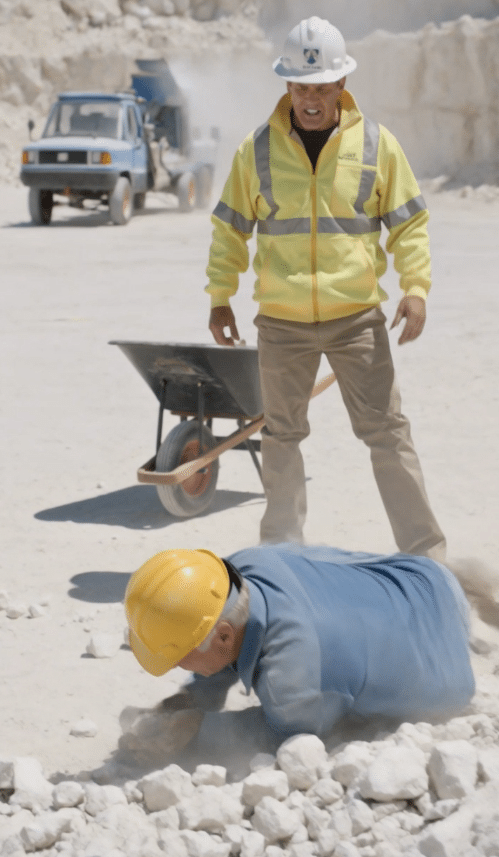
The old man bent toward the small stone lying in the white quarry dust, one hand still gripping the handle of his overloaded wheelbarrow. His faded blue work shirt clung to his back beneath the scorching sun, and his scratched yellow hard hat had a crack near the rim that he had covered with tape weeks earlier.
He had dropped one stone.
Just one.
But the man standing in front of him reacted as though he had sabotaged an entire shipment.
“Trash. Start the whole load again.”
The quarry manager, Grant Mercer, pointed at the scattered stone with a gloved finger. His clean white hard hat gleamed beneath the sun, and his new yellow safety jacket looked almost untouched by the dust that covered everyone else. Behind his dark sunglasses, his eyes held the cold impatience of someone who had never doubted that other people existed to obey him.
The old worker, Samuel Hayes, was sixty-two years old. His back had been giving him trouble for months, and his knees stiffened whenever he stood too long. But he needed the work, so he pushed the heavy wheelbarrow across the quarry floor, one exhausting load at a time, determined not to give the manager another excuse to cut his hours.
“Please,” Samuel said quietly. “It fell out when the wheel hit that ridge. I’ll pick it up.”
Grant stepped into his path.
“Did I tell you to pick it up?”
Samuel paused.
Around them, the quarry continued to rumble. The crusher machine chewed through another load of stone, sending a low vibration through the ground. Dust drifted between the workers and the towering white rock walls, settling on their clothes, their tools, and the faces of men who had learned that keeping their heads down was often the only way to finish a shift in peace.
Samuel slowly straightened.
“No, sir.”
“Then why are you talking?”
The old man lowered his eyes. He had worked in quarries and construction yards for more than thirty years. He knew how to handle stone, how to read a dangerous slope, and how to recognize the moment a load became too heavy for one man to move safely. He also knew that experience meant very little when a supervisor had decided to confuse obedience with respect.
He reached for the wheelbarrow handle again.
Grant watched him struggle to steady the load. The manager could have told him to take a second worker, or simply allowed him to retrieve the fallen stone and continue. Instead, he stepped closer, his polished boots crunching over the loose gravel.
Then he kicked Samuel hard in the chest.
The impact knocked the old man backward into the white dust. His wheelbarrow lurched sideways, and loose stones scattered across the ground. Samuel landed beside the tire, instinctively reaching to keep the heavy load from rolling farther.
His palm scraped against the sharp stone fragments.
A thin trace of blood appeared across the dusty skin.
For a moment, he could do nothing but stare at his hand, as if his mind were struggling to understand how a small mistake had turned into this.
Then Grant delivered exactly two more hard kicks, one to Samuel’s back and another to his side, while the old man tried to pull his hand clear of the wheelbarrow tire.
A worker near the crusher covered his mouth.
Another stepped backward.
Nobody moved toward Samuel.
Grant stood over the fallen man, his breathing steady, as though he had merely corrected a problem with a machine.
“Old backs still owe me work.”
Samuel tried to push himself up, but his body would not cooperate immediately. He turned his face toward the men standing nearby. Some looked horrified. Others stared at the ground, their expressions tight with shame and fear.
He was not asking them to fight Grant.
He only wanted someone to help him stand.
But nobody came.
Then the steel door of the elevated glass office slammed open.
The sound echoed across the quarry, cutting through the roar of the crusher. A man in a black construction coat stepped onto the metal staircase, wearing a white hard hat marked with the company’s logo. He descended quickly through the drifting stone dust, his dark work trousers brushing against the railing as he took the steps two at a time.
Grant turned toward the noise.
The newcomer did not look at him first.
He looked at Samuel lying in the dust.
Then he looked at the blood on the old man’s palm, the overturned wheelbarrow, and the manager standing over him.
His face hardened.
He crossed the final few feet and stepped between Samuel and Grant. Without raising his voice, he lifted one hand toward the crusher operator.
“Shut it down.”
The machine began to wind down, its grinding roar fading until the entire quarry seemed to fall into an unnatural silence.
The man in the black coat fixed his eyes on Grant.
“That stone just cost you this whole quarry.”
Grant’s mouth opened slightly.
“This whole quarry?”
He had no idea that the little stone he had treated as worthless was about to expose a secret that could destroy everything he had built.
Act II
The man standing between Samuel and Grant was Robert Whitmore, the sixty-one-year-old owner of Whitmore Stone and Aggregate.
He had founded the company nearly three decades earlier with two aging excavators, a handful of workers, and a loan secured against the modest house where his family lived. He had spent years building the operation into one of the region’s largest independent stone suppliers, supplying road projects, construction firms, and public infrastructure contracts across several states.
Robert was not a man who spent every day on the quarry floor. Most of his work involved contracts, equipment financing, environmental compliance, and negotiations with clients who measured everything in deadlines and dollars. The glass office above the work area allowed him to observe operations without constantly interrupting the people responsible for running them.
But lately, the reports coming across his desk had begun to trouble him.
Production figures had climbed sharply, even as the workforce shrank. Overtime costs had dropped, despite increasingly aggressive delivery schedules. Maintenance expenses appeared suspiciously low, while several experienced workers had disappeared from the payroll without clear explanations.
Whenever Robert asked questions, Grant Mercer supplied answers.
He blamed the missing workers on retirement and poor performance. He attributed production increases to improved efficiency. He explained the reduced maintenance costs as evidence that the quarry’s equipment was being managed more carefully than ever.
The reports were polished. The explanations were confident.
And every time Robert asked for details, Grant found a reason to promise them later.
Robert had initially suspected poor recordkeeping. Then an anonymous letter arrived at the corporate office.
It contained only three sentences.
Your numbers look better because your people are being punished for slowing down. Ask what happened to the workers who complained. Then look at the quarry floor yourself.
There was no signature.
Robert read the letter twice before placing it in a folder. He could have dismissed it as the grievance of a disgruntled employee, but something about the wording bothered him. It did not ask for money, threaten a lawsuit, or accuse the company of a specific crime. It simply asked him to look.
So he had arranged an unannounced visit.
He expected to discover a staffing dispute, a maintenance issue, or perhaps a supervisor who had become too aggressive about productivity.
He had not expected to find Samuel Hayes on the ground.
Samuel had started working at the quarry four years earlier, after the small machine shop where he had been employed closed its doors. At sixty-two, he had few opportunities to begin a new career. His wife had died several years before, and the house they had shared was still burdened by medical debt from her final illness.
He lived alone in a small rented home beyond the highway, where the kitchen window rattled whenever trucks passed. His pension was modest, and the cost of heating, medication, and groceries seemed to increase every year.
The quarry had given him something he desperately needed: regular wages.
Samuel arrived early, stayed late when asked, and rarely complained. He knew the names of the older machines and could often recognize a mechanical problem by sound alone. When younger workers struggled with an unstable wheelbarrow or an awkward load, he showed them how to distribute the weight and avoid injuring their backs.
Grant considered those habits a weakness.
He preferred workers who moved quickly, accepted orders without questions, and never reminded him that the quarry had safety procedures for a reason. Samuel’s careful pace irritated him because it demonstrated something Grant did not want to acknowledge: experienced workers understood the difference between working hard and working recklessly.
The trouble began when Samuel refused to push a damaged wheelbarrow down a steep section of the yard.
The tire was loose, and the load had shifted. Samuel told Grant that the wheel could come off under pressure, sending the stones across the path of another crew.
Grant accused him of making excuses.
Samuel refused to move the load until the wheelbarrow was repaired.
The next morning, his schedule was cut.
Then he was assigned the heaviest loads, often without assistance. When he asked for another worker, Grant reminded him that younger men were waiting for full-time positions and that nobody was obligated to accommodate an old man’s limitations.
Samuel endured it because he needed the money.
He also knew that leaving would not solve everything. The quarry had become one of the few employers within driving distance willing to hire someone his age for physical work. If he lost the job, he could lose the ability to pay rent without asking his adult daughter for help—a prospect that wounded his pride more deeply than he liked to admit.
He had spent his life providing for his family.
He did not want to become another problem they had to solve.
What he did not know was that Grant had been quietly removing more than complaints from the operation.
Several workers had been dismissed after reporting unsafe assignments. Their departures were recorded as voluntary resignations or performance-related terminations, even when the employees had asked for medical leave or safer duties. Some had been replaced by temporary laborers who received fewer benefits and were less likely to challenge a supervisor.
The system made the quarry look leaner and more productive.
It also made Grant look indispensable.
Robert had come to investigate those discrepancies, but he had not yet seen enough to understand their full extent. The anonymous letter had given him a reason to look beyond the reports, and Samuel’s fall had shown him the human cost of failing to do so.
As Robert stood over Grant, the crusher finally went silent.
For the first time in years, the manager had no machine noise to hide behind.
And no report to protect him.
Act III
Grant was the first to break the silence.
“You can’t shut down an entire operation because one worker lost his footing.”
Robert looked at him steadily.
“One worker?”
Grant gestured toward Samuel, who was still on the ground beside the wheelbarrow.
“He dropped a stone. I was correcting the mistake. You don’t run a quarry by letting people do whatever they want.”
Robert’s expression did not change.
“Is that what you call kicking a man who is already on the ground?”
“He was being insubordinate.”
Samuel slowly lifted his head.
He had spent years listening to people argue about his work as though he were not standing in the room. Now he found himself listening to Grant describe the assault as a management decision, and something inside him grew colder than fear.
“I was picking it up,” Samuel said quietly.
Grant snapped toward him.
“Stay out of this.”
Robert raised one hand.
“Don’t speak to him like that.”
The order was simple, but it landed differently from the threats Grant was accustomed to making. He looked at Robert’s white hard hat, then at the company logo printed across it. His expression changed as recognition began to catch up with his anger.
“You’re Mr. Whitmore?”
Robert did not answer the question.
Instead, he crouched beside Samuel and asked whether he could sit up without making the pain worse. Samuel nodded cautiously. Robert called for the site medic, then directed the nearest safety officer to secure the area and document what had happened.
Grant watched, growing increasingly agitated.
“You’re taking his side without hearing mine.”
“I heard you tell him to start the entire load again,” Robert replied. “I heard you call him trash. I watched you kick him.”
Grant’s jaw tightened.
“You don’t understand the pressure we’re under. The shipment schedule is impossible. The clients want everything yesterday. If people can’t keep up, the company loses money.”
“Then we examine the schedule.”
“And when the numbers fall?”
“Then we examine the numbers.”
Grant gave a short, disbelieving laugh.
“That’s easy to say from your office.”
Robert glanced up toward the glass office above the quarry floor. From there, the workers had always looked like small figures moving between piles of stone, and the noise had made it easy to mistake constant movement for healthy operations.
“I came down from that office because the numbers stopped making sense,” he said. “And now I understand why.”
He asked the safety officer to retrieve the day’s assignment sheets and dispatch records. Then he requested the maintenance logs for the wheelbarrows and the equipment used to move the heavier loads.
Grant’s face tightened further.
“Those records are confidential.”
“They belong to the company.”
“I manage this site.”
“You manage it on my authority.”
The distinction hung between them.
For years, Grant had treated his position as though it made the quarry his personal property. He had forgotten that a manager’s authority existed to carry out a responsibility, not to give him ownership over the people who worked beneath him.
Robert turned toward the workers.
“I want to speak with anyone who has seen unsafe assignments, retaliation, or abuse on this site. You can report directly to the company review team. Your shifts will not be cut for cooperating.”
The workers did not immediately respond.
They had heard promises before. Grant had made a habit of telling people that complaints would be handled fairly, then quietly changing their schedules until they understood the cost of speaking up.
Robert could see their hesitation.
So he added, “The review will not be controlled by anyone who reports to Mr. Mercer.”
A man near the crusher slowly lowered his hands from his mouth.
Another worker looked at Samuel, then at the manager.
No one spoke yet, but the silence had changed. It no longer belonged entirely to Grant.
The site medic arrived and helped Samuel into a safer position before arranging a medical evaluation. Robert stayed nearby until he was certain the old worker was being attended to. When Samuel tried to apologize for stopping production, Robert interrupted him.
“You have nothing to apologize for.”
Samuel looked at the silent crusher.
“It’s a big order,” he murmured. “People are waiting on that stone.”
“The order can wait.”
The answer seemed to surprise him.
Robert turned back toward Grant, who had begun pacing in short, angry steps.
“You can’t make this into a personal crusade,” Grant said. “I’ve kept this place running while everyone else sits in meetings. I’ve worked weekends. I’ve dealt with clients who threaten to take their contracts elsewhere. You think I enjoy pushing people?”
Robert’s eyes narrowed.
“Did you push them because the work required it, or because you knew they couldn’t afford to refuse?”
Grant stopped pacing.
For a fraction of a second, he had no answer.
That was the moment Robert knew the problem was larger than one violent incident.
He ordered an independent review of staffing records, safety complaints, equipment maintenance, and production reports. Grant was removed from operational control while the review proceeded, and his access to the scheduling system was suspended to preserve the records.
Grant protested that the decision was premature.
Robert told him he would have every opportunity to respond through the proper process.
Then he turned away.
The manager had spent years believing that a person with enough authority could make the truth disappear. He was about to discover that a paper trail could survive long after the man who controlled it had lost his keys.
And buried inside those records was something even more damaging than the assault.
Act IV
The first discrepancies appeared before the end of the week.
Maintenance logs showed that several wheelbarrows and small transport carts had been flagged for repair but returned to service without documented clearance. Workers had repeatedly been assigned loads that required additional hands, even when the scheduling system showed enough personnel available to assist them.
The records also revealed a disturbing pattern in the way complaints were handled.
When an employee reported a safety concern, the complaint was frequently followed by a reduction in hours, a reassignment to heavier work, or a disciplinary note describing the worker as uncooperative. Some of those notes had later been used to justify termination.
Grant had insisted that the workers who left were simply unable to meet expectations.
The documents suggested otherwise.
Several employees had raised the same concerns Samuel had raised: unstable equipment, unreasonable production targets, and pressure to move heavy material without sufficient support. Their accounts had been dismissed individually, allowing Grant to present each case as a personal dispute.
Together, they told a different story.
He had not merely lost his temper with an old worker. He had built a management system around the belief that people who depended on their wages could be forced to accept almost anything.
The independent review also uncovered a financial irregularity.
A portion of the quarry’s production bonuses had been tied to exceptionally high output figures. Grant’s department had repeatedly exceeded its targets, earning him substantial performance payments and strengthening his position with the executive team.
But those figures had been achieved partly by shifting work onto fewer employees, postponing maintenance, and recording safety-related delays as worker failures rather than operational problems.
The bonus structure had rewarded the very behavior Robert was now investigating.
He stared at the report for a long time.
It would have been easy to blame Grant alone. The manager had chosen his words, made his assignments, and delivered the blows. Nothing in a contract or bonus plan could excuse those choices.
But Robert also had to confront the uncomfortable fact that the company had rewarded the results without asking enough questions about how they were achieved.
He had built the quarry to provide steady work for ordinary families. Somewhere along the way, he had allowed a clean spreadsheet to become more persuasive than the people who worked beneath it.
The realization changed the scope of the investigation.
The review team examined not only Grant’s decisions but also the incentives and oversight procedures that had allowed those decisions to go unchallenged. The company contacted former employees whose departures had been questioned and offered them an opportunity to provide information without going through their old supervisor.
One former worker described being sent home after refusing to move an unstable load. Another had been warned that his hours would disappear if he continued documenting equipment problems. A third produced messages in which Grant had described older laborers as liabilities who should be pushed out before they became expensive.
The wording was cruel.
The records made it difficult to dismiss as a misunderstanding.
Meanwhile, Samuel recovered at home.
His injuries required follow-up care, and the pain in his back and side made ordinary movements difficult for several days. He hated sitting still. He had always measured his worth by what he could do for himself, and being unable to carry a grocery bag without discomfort made him feel older than he had the week before.
His daughter, Laura, came to stay with him.
She found him sitting at the kitchen table, staring at an unopened envelope from the quarry. He had received messages from coworkers asking how he was feeling, but he had not answered most of them. He was embarrassed by the attention and worried that his name would become attached to a public dispute he had never wanted.
Laura placed a cup of coffee in front of him.
“You don’t have to protect them,” she said.
Samuel frowned.
“Protect who?”
“The people who let that happen.”
He looked away.
“I don’t want anyone losing their job because of me.”
“Dad, you didn’t make him do it.”
Samuel rubbed the edge of the cup with his thumb. He had spent so much of his life avoiding conflict that he had come to believe every confrontation carried equal blame. If someone shouted, he searched for the mistake he might have made. If someone mistreated him, he wondered whether he had failed to be patient enough.
Laura had watched that habit follow him through years of difficult jobs.
This time, she refused to let him carry the responsibility alone.
“You dropped a stone,” she said. “You didn’t hurt anybody. You didn’t threaten anybody. You didn’t kick anybody. Why are you the one lying awake wondering whether you did something wrong?”
Samuel had no answer.
The next morning, he agreed to speak with the company’s review team.
He told them about the damaged wheelbarrow, the reduced shifts, and the increasingly heavy assignments. He described how Grant had spoken to older workers and how everyone had learned to avoid his attention. Samuel did not exaggerate. He did not ask for revenge. He simply explained what had happened, one detail at a time.
His statement matched the records.
It also gave other workers the courage to speak.
By the time the review concluded, Grant’s position was no longer defensible. The evidence showed a sustained pattern of intimidation, retaliation, and unsafe management, alongside the assault witnessed by multiple employees.
The company terminated his employment and referred the relevant evidence to the appropriate authorities. Any further legal consequences would be determined through the proper process.
Robert also announced changes to production targets, equipment inspection procedures, and the reporting system for workplace complaints. Performance bonuses would be reviewed to ensure that supervisors were not rewarded for cutting corners or suppressing legitimate safety concerns.
He did not present the changes as a victory.
He presented them as overdue corrections.
When the final meeting was scheduled, Grant requested the chance to address the management team. He arrived expecting an argument over numbers, a chance to explain that the quarry had been under pressure, and perhaps an opportunity to blame the incident on a momentary loss of temper.
Instead, Robert placed the review findings on the table.
Grant glanced at the first page.
Then the second.
His confidence began to collapse.
“These workers have been waiting for a chance to turn against me,” he said.
Robert folded his hands.
“Perhaps some of them disliked you. That doesn’t explain the records.”
“I delivered results.”
“You delivered numbers. We are now examining the cost.”
Grant looked around the room, searching for someone willing to defend him.
Nobody did.
For years, he had assumed the men who remained silent were loyal to him. Now he understood that many had simply been afraid. The moment the fear lost its power, his authority disappeared with it.
Robert closed the folder.
“You were trusted to manage this quarry,” he said. “You used that trust to make people afraid of reporting danger, and then you treated their fear as proof that your methods worked.”
Grant’s lips parted, but no defense came.
Robert stood.
“The stone wasn’t the problem. It never was.”
For the first time, Grant understood that the incident had not destroyed his career because one old man dropped a rock.
It had destroyed his career because the rock revealed what he had been hiding in plain sight.
Act V
The quarry reopened under revised procedures, but the changes were visible long before the machines began running at full capacity again.
Damaged equipment was removed from service until it had been inspected. Heavy loads were assigned according to the handling requirements, not the impatience of whichever supervisor happened to be on duty. Workers received a direct way to report unsafe practices, and complaints were reviewed by people outside their immediate management chain.
The company also began contacting former employees whose records suggested that they might have been penalized for raising legitimate concerns.
Some had moved on. Others were still looking for steady work. A few returned to discuss what had happened, not because they expected the past to be repaired, but because they wanted the company to understand how much a missing paycheck could cost a family.
Robert listened.
He learned that one worker had delayed a medical appointment because his hours were cut after a complaint. Another had borrowed money from his brother to cover rent after refusing to operate faulty equipment. Several had simply stopped reporting problems, convinced that the safest course was to let the next person take the risk.
Those stories stayed with him.
The quarry had been built on the labor of people whose names rarely appeared in contracts. Robert had spent decades negotiating the price of stone, but he had not always considered what the people producing it were being asked to sacrifice.
Now he understood that the true cost of a load could not be measured only in fuel, labor hours, and delivery fees.
Sometimes it was measured in the silence of a man who was afraid to say no.
Samuel returned to the quarry several weeks later, after his doctor cleared him for modified duties. He did not return to pushing the heaviest wheelbarrows. Instead, Robert offered him a role helping review equipment conditions and advising on safer handling practices, drawing on the experience Samuel had accumulated over three decades in construction and industrial work.
The offer was not charity.
Samuel knew machines. He understood weight distribution, worn parts, unstable loads, and the small warning signs that inexperienced managers often ignored. His knowledge had been undervalued because he was older and worked slowly, but the review made it clear that his caution had prevented problems more than once.
At first, he was uncertain about accepting.
“I don’t want people thinking I got special treatment,” he told Robert.
Robert shook his head.
“You were doing the work before anyone paid attention. We’re correcting a mistake, not giving you a favor.”
Samuel considered the offer for several days before agreeing.
His new duties were less physically demanding, but they were not easy. He had to learn how to document inspections, communicate with supervisors, and speak in meetings where he had once been afraid to raise his hand. Yet he discovered that the same people who had watched him fall were now asking for his advice.
One afternoon, a younger worker approached him beside a repaired transport cart.
“I saw what happened that day,” the man admitted. “I wanted to help you.”
Samuel looked at him.
“Why didn’t you?”
The worker lowered his eyes.
“I was afraid I’d be next.”
Samuel understood the answer. He had been afraid too, in different ways, for much of his life. Fear did not always make people cruel. Sometimes it made them stand still when they knew they should move.
“I hope next time you won’t wait,” Samuel said.
The young worker nodded.
It was not a grand reconciliation. Samuel did not tell him that everything was forgiven, and the man did not ask him to pretend the silence had meant nothing. But the conversation marked the beginning of something different: an acknowledgment that doing the right thing sometimes required a person to risk the comfort of remaining uninvolved.
Daniel, one of the workers who had witnessed the assault, later joined Samuel in reviewing the quarry’s handling procedures. He helped identify places where the layout made it difficult to move loads safely and where a small adjustment could prevent an injury. Other workers began offering suggestions as well.
For the first time in years, their knowledge was treated as an asset rather than an inconvenience.
Robert visited the work floor more often, though he made a point of listening instead of simply appearing to supervise. He held regular meetings with workers, reviewed incident reports personally, and insisted that production targets be reconsidered whenever they conflicted with safety requirements.
He also changed how managers were evaluated.
Output still mattered. Deadlines still mattered. The quarry remained a business, and its contracts still depended on reliable deliveries. But supervisors could no longer build their reputations solely on how much stone they moved. Their performance reviews now included equipment compliance, staff retention, safety reporting, and evidence that concerns were being handled fairly.
The message was simple: a manager who achieved impressive numbers by frightening people was not an exceptional manager.
He was a liability.
As for Grant, his name disappeared from the shift schedule. The company continued cooperating with the relevant authorities, and his conduct remained subject to whatever further consequences the evidence warranted. He had once walked through the quarry as though every worker belonged to him. Now he had no authority there at all.
But the most meaningful change happened far from the executive office.
One clear morning, Samuel pushed a small cart of loose stone along a marked path near the crusher. A single rock bounced over the edge and landed in the dust.
He stopped.
For a moment, he felt the old tension rise through his shoulders. He remembered Grant’s polished boots, the contemptuous voice, and the humiliation of lying on the ground while men who had seen everything stood frozen.
Then Samuel bent down, picked up the stone, and placed it back in the cart.
A younger worker nearby offered to help him steady the load.
Samuel smiled faintly.
“Thank you. I’ve got it.”
The man stayed beside him anyway, walking with the cart until they reached the designated unloading point.
Nothing dramatic happened. No machine stopped. No executive descended from a glass office. Nobody needed to be reminded that an old worker deserved respect.
That was how it should have been all along.
Later that afternoon, Robert stood near the office window and watched the crews move through the yard. The white stone dust still hung in the sunlight. The crusher still rumbled. Trucks still arrived with orders that needed to be filled.
From a distance, the quarry looked exactly as it had on the day Samuel was assaulted.
But Robert knew the difference now.
The company had not become better because its owner had arrived at the right moment and said the right words. It had become better because the incident forced people to examine the habits, incentives, and silences that had allowed abuse to survive.
One small stone had exposed a much larger failure.
Grant had looked at it and seen an excuse to humiliate a man he considered weak. Samuel had looked at it and seen a simple mistake that could be corrected. Robert had looked at the aftermath and finally understood what his reports had failed to show him.
The quarry’s greatest danger had never been the weight of the stone.
It was the belief that the people carrying it could be treated as though they weighed nothing at all.
And that was the lesson Grant Mercer had learned too late.
He had believed the quarry belonged to him because he controlled the workers, the schedules, and the daily flow of stone. He had mistaken the authority to give orders for the right to decide whose dignity mattered.
But a title could be taken away. A contract could be canceled. A position could disappear as quickly as it had been granted.
The people he had called old, weak, and useless were the ones who had kept the operation alive.
Samuel Hayes had never needed to own the quarry to deserve respect.
He had needed only what every worker should be able to expect when he arrived for an honest day’s labor: fair treatment, safe conditions, and the right to make a small mistake without being treated like a disposable human being.
In the end, the stone did not cost Grant the quarry.
His own choices did.
The stone simply made sure everyone could finally see them.
Tighten the middle-act investigation