Act I
“Trash. You’ll redo the whole lot for free.”
The words cracked across the garment workshop, louder than the sewing machines, louder than the tired workers who had spent twelve hours bent over fabric beneath the cold white lights.
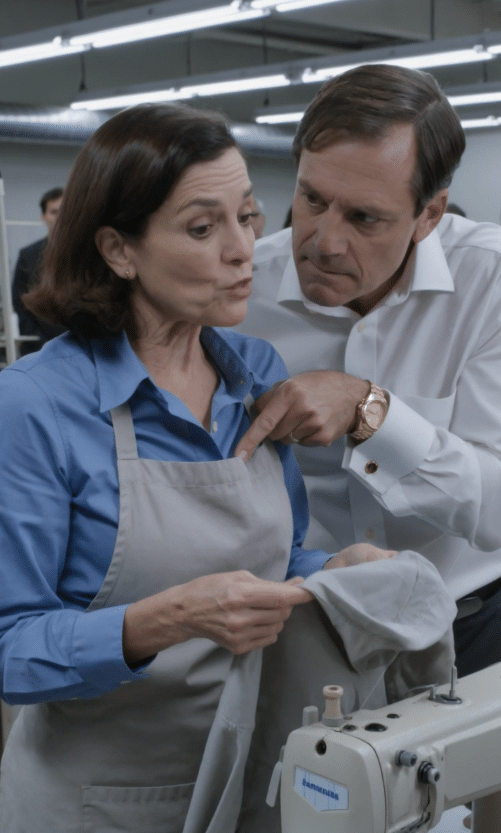
At the center of it all stood Margaret Ellis, a forty-six-year-old seamstress with gray strands escaping her brown ponytail, an old blue shirt beneath a faded gray apron, and exhaustion etched into every line of her face. She held a sample shirt in both hands, trying to explain the smallest mistake imaginable: one stitch, slightly uneven, on a seam that could be corrected in seconds.
“I can fix that stitch right now.”
Margaret spoke carefully. She had learned that a raised voice could cost her a shift, a sharp answer could cost her a week’s wages, and a moment of pride could cost her the only job keeping a roof over her head.
But Richard Voss, the workshop owner, had never been interested in solutions when humiliation offered him something more satisfying.
He was fifty, wealthy enough to wear an immaculate white dress shirt and a gold watch that caught the fluorescent light whenever he moved his hand. His polished black shoes clicked between the sewing tables as though the entire building belonged to him personally—not just the machines, the fabric, and the merchandise, but the people whose hands made his money.
He snatched the sample shirt from Margaret and held it up for the surrounding workers to see.
“One mistake,” he announced, turning it from side to side. “One little mistake, and suddenly everyone thinks the rules don’t apply to them.”
Margaret swallowed.
“It isn’t a defective shirt, Mr. Voss. It’s just that one stitch. I’ll correct it before the next batch goes through.”
Richard’s expression tightened. She had made the mistake of speaking as though she were a professional whose judgment deserved consideration instead of a pair of hands he rented by the hour.
“Trash. You’ll redo the whole lot for free.”
A few machines continued humming. Others slowed as workers began to understand that something worse than an ordinary argument was unfolding.
Margaret looked at the stack of finished shirts waiting beside her station. There were nearly two hundred of them, each carefully assembled through hours of repetitive work. Redoing the entire lot would take days, and Richard knew perfectly well that she would never be paid for those hours.
“Please,” she said. “I can repair the sample and inspect the others. There is no reason to throw away all that work.”
Richard stepped closer.
For one brief moment, Margaret thought he might listen. She saw his eyes flick toward the sample, then toward the workers watching from their stations.
Instead, he turned her attempt to reason with him into another excuse to punish her.
She was still holding the shirt when he moved beside the sewing table and drove a forceful kick into her chest.
Margaret fell hard beside the machine’s metal leg. The sample shirt slipped from her fingers, landing in a heap on the concrete floor. As she reached for the table to steady herself, the edge scraped her hand, leaving a thin trace of blood.
A woman at the next station covered her mouth.
Someone whispered Margaret’s name, but nobody stepped forward.
Richard delivered exactly two more hard kicks to Margaret’s back and side as she tried to pull her hand away from the sewing pedal. The machines around them seemed to fade beneath the sound of her startled breath and the scrape of shoes retreating across the floor.
Then he stepped back, straightened his expensive shirt, and looked down at her as though she had inconvenienced him by falling.
“Workers pay when they waste my time.”
Margaret pressed one hand against the floor. Her breathing was shallow, and her fingers trembled, but even then she looked first toward the sample shirt.
That small, almost instinctive movement told the watching workers something Richard could not understand.
She was afraid of losing her job even after he had assaulted her.
For years, he had trained them to believe that their livelihoods depended entirely on his temper. He could reduce a paycheck, invent a penalty, withhold overtime, or quietly remove someone’s name from the next week’s schedule. Those who complained disappeared from the production line, and those who remained learned to keep their heads down.
Margaret had a daughter in community college, a mortgage payment that was already late, and a husband who had died three winters earlier. She could not afford to become a hero in a room full of frightened people.
Richard had counted on that.
He had counted on every person in that workshop believing that silence was the price of survival.
Then the metal entrance door slammed open.
The sound cut through the sewing machines so sharply that every head turned.
A tall man in a black suit and long dark coat stepped inside, carrying a closed leather folder. An inspection assistant followed close behind him. The newcomer did not shout, did not demand an explanation, and did not need to raise his voice.
He lifted one hand.
Across the workshop, the production line stopped.
Richard turned, already preparing the polished smile he reserved for important clients.
The man in the black suit walked straight toward him.
And when he finally spoke, the entire workshop would learn that Richard Voss had misunderstood the meaning of power.
Act II
The man was Daniel Whitmore, fifty-five, senior purchasing director for Bellamy & Rowe, a luxury clothing brand whose tailored jackets and shirts sold for more than many of the workshop’s employees earned in a month.
For six years, Richard had built his business around that relationship.
Bellamy & Rowe supplied the orders that kept his factory running, financed new machinery through predictable purchase commitments, and gave him a reputation that allowed him to charge other clients premium prices. Richard displayed the brand’s name in his office as though its prestige had somehow become his own.
He told everyone that he had personally earned the partnership through superior standards.
The truth was more complicated.
Daniel had approved the original contract after meeting Richard’s father, a modest tailor who had run the workshop before his death. The older man had believed that a factory could be profitable without treating its workers as disposable. He had paid for training, corrected mistakes without humiliation, and once delayed a shipment rather than force exhausted employees to work through a dangerous equipment failure.
Richard inherited the business, but not his father’s principles.
Over time, he replaced experienced supervisors with people who would enforce his demands without question. He introduced arbitrary penalties for damaged materials, required workers to absorb the cost of certain production errors, and began docking wages for delays that had little to do with the employees themselves.
A broken machine became a worker’s debt. A late delivery became a seamstress’s unpaid weekend. A rejected sample became an excuse to threaten the entire production line.
Richard called it discipline.
The workers called it surviving until Friday.
Margaret had worked at the factory for eleven years. She had been there when the old owner still walked the floor carrying a thermos of coffee, asking people about their families and checking whether the heating worked during winter. She remembered him sitting beside a new employee to demonstrate a difficult seam rather than berating her for getting it wrong.
After he died, Richard removed his father’s photograph from the office wall.
He said the factory needed to move forward.
Margaret suspected he simply disliked being reminded of the man who had built everything he now controlled.
She had stayed because she was good at her work. Her hands could identify uneven tension by touch, and she could spot a fabric defect before most people noticed the color had changed. Supervisors had once requested her opinion on difficult samples, and newer seamstresses quietly came to her when a machine began producing crooked seams.
But competence did not protect her from Richard.
In fact, it sometimes made her a target.
Margaret knew the difference between a genuine quality problem and an excuse to extract free labor. She knew which fabrics would shrink after washing, which seams needed reinforcement, and how long a proper inspection required. Richard preferred workers who never questioned his decisions, even when his decisions threatened the very quality he claimed to defend.
The uneven stitch that had triggered the confrontation was real. It was also minor, easily repairable, and well within the kind of routine correction expected in garment production.
Margaret had acknowledged it immediately.
That should have ended the matter.
Instead, Richard had turned a small manufacturing issue into a public demonstration of control.
What he did not know was that Daniel Whitmore had come to the workshop because of a growing number of complaints about its production records.
Bellamy & Rowe had received shipments that appeared perfect on arrival but developed loose seams after ordinary washing. Several invoices included unexplained quality-control charges. Most troubling, an internal audit had discovered that the factory’s inspection reports contained identical approval times for batches that could not possibly have been examined simultaneously.
Daniel had asked Richard for an explanation.
Richard supplied one within minutes.
A software problem, he said. A temporary staffing shortage. A few careless workers trying to blame management for their own mistakes.
He promised that everything would be corrected.
But Daniel had spent three decades in luxury manufacturing. He knew that poor quality could come from bad training, faulty equipment, or unrealistic deadlines. He also knew that a company confident in its own integrity did not become hostile whenever someone requested the underlying records.
So he arranged an unannounced inspection.
He did not tell Richard the date. He did not send a list of questions in advance. And he brought an assistant carrying the production documents that Richard had repeatedly insisted were beyond reproach.
Daniel had expected to find bad paperwork, perhaps even deliberate misrepresentation.
He had not expected to walk into a room where a man was kicking an employee on the floor.
Now he stood beside the sewing tables, looking at Richard with an expression so cold that the owner’s welcoming smile began to falter.
Richard glanced at the workers, then at Margaret, who was struggling to sit upright.
He seemed to realize, perhaps for the first time, that the scene could not be explained away as a disagreement over quality.
Still, arrogance had carried him through years of consequences that should have humbled him.
He reached for the familiar language of business.
“Daniel, this is an internal personnel matter. We have standards here, and sometimes employees need to understand that mistakes have consequences.”
Daniel looked down at the sample shirt lying near Margaret’s foot.
Then he opened the leather folder.
What he removed from it was not merely a contract.
It was the beginning of the end for Richard Voss.
Act III
Daniel held up a printed inspection report.
“This batch was approved yesterday at 4:18 p.m.,” he said. “Your records say every shirt passed final inspection before shipment.”
Richard nodded too quickly.
“Yes. Exactly. Our quality team has been working around the clock.”
Daniel placed a second document beside the first.
“This report says the same thing about another batch. Same inspection time. Same initials. Same number of rejected pieces.”
He laid down a third.
“And this one.”
The workshop had gone so quiet that the soft ticking of a cooling machine sounded unnaturally loud.
Richard glanced at the pages, then toward his office. His confidence was not gone, but it had begun to fracture around the edges.
“Our system generates standard entries,” he said. “It doesn’t mean the inspections weren’t completed.”
“Then show me who completed them.”
Richard opened his mouth.
No answer came.
Daniel’s assistant stepped forward and placed a fourth document on the table. It contained a comparison between the factory’s production records and the shipment data maintained by Bellamy & Rowe. Several batches had been recorded as fully inspected at times when the factory’s own machine logs showed that production was still underway.
Some reports listed workers who had already clocked out. Others showed approval signatures that appeared on multiple inspection sheets within the same minute.
The discrepancies were not proof of every allegation Daniel had received, but they were serious enough to demand a full investigation.
Richard’s eyes hardened.
“You’re here to discuss quality, not interrogate my staff.”
“No,” Daniel replied. “I’m here to determine whether the quality records you certified are reliable.”
For the first time, Richard looked past Daniel and seemed to notice the assistant recording the documents and the workers standing motionless along the production line.
He had spent years teaching them that paperwork belonged to management, that questions were insubordination, and that no one outside the factory would care what happened inside it.
Now the records were on a table in front of his largest client.
And the people who knew the truth were watching.
Margaret slowly pulled herself to her feet using the edge of the sewing table. Her hand stung where the skin had scraped against the metal, but she ignored it. She wanted to retrieve the sample shirt, not because it mattered more than what had happened to her, but because she had spent eleven years learning that every small detail mattered when someone was determined to blame the wrong person.
Daniel noticed her reaching for it.
He moved the shirt away from the machine pedal and placed it on the table.
“Is this the sample?” he asked.
Margaret nodded.
“I told him I could fix the stitch. It wouldn’t take a minute.”
Daniel examined the seam.
It was not perfect. One short section had drifted slightly from the intended line, but the defect was small, visible, and straightforward to correct. It did not justify rejecting an entire batch, much less demanding days of unpaid labor.
“Did you refuse to repair it?” Daniel asked.
“No.” Margaret’s voice shook, but she met his eyes. “I offered to repair it immediately.”
“Did you damage the rest of the lot?”
“No.”
“Were you told you would have to redo it without pay?”
She hesitated.
Richard cut in before she could answer.
“This is getting ridiculous. I run this workshop. I decide how problems are handled.”
Daniel turned toward him.
“And that is precisely what we are going to examine.”
Richard’s face flushed.
He had expected Daniel to protect the contract, the delivery schedule, and the reputation of a luxury brand that could not afford a public dispute with one of its suppliers. He believed that business relationships were built on mutual dependence—and that because Bellamy & Rowe needed his production capacity, Daniel would tolerate almost anything short of a failed shipment.
He had forgotten something fundamental.
A major buyer did not merely purchase shirts. He also accepted responsibility for choosing the people entrusted to manufacture them.
If Richard’s factory was concealing quality failures, manipulating inspection records, and using unpaid labor to compensate for management mistakes, then the contract itself had become a liability.
And if the person running the factory was willing to assault an employee in front of witnesses, Daniel had reason to question what happened when no client was present.
Daniel closed the folder.
Richard took a step toward him.
“Let’s go into my office,” he said quietly. “We can sort this out without turning it into a spectacle.”
Daniel did not move.
“Your employees have spent years being told to stay quiet,” he said. “I’m not going to ask them to be quiet for your convenience.”
A few workers lowered their eyes. Others looked directly at Margaret for the first time since she had fallen.
Richard’s gaze swept across them, searching for the familiar signs of submission. He expected the fear to return them to their stations, expected the threat of unemployment to make every witness suddenly forget what they had seen.
Then he looked at Daniel.
And Daniel delivered the sentence that shattered the illusion Richard had built around himself.
“That stitch just ended your contract.”
Richard stared at him.
“My contract?”
The question escaped his mouth before he could stop it.
For years, he had treated the partnership as proof that he was untouchable. Now he was beginning to understand that it had always been conditional—and that the man standing in front of him had the authority to make that condition real.
But Richard still believed there was a way to regain control.
He had no idea how much evidence was already waiting inside the folder.
Act IV
Richard’s face twisted with disbelief.
“You can’t terminate a six-year partnership over a minor defect,” he said. “We’ve invested millions in this operation. You have delivery commitments. You can’t simply walk away because you don’t like the way I manage my employees.”
Daniel’s expression did not change.
“This isn’t about one stitch.”
“Then what is it about?”
“The inspection records. The discrepancies in your invoices. The repeated quality complaints. The penalties charged to workers for production problems they may not have caused. And now, what I just witnessed.”
Richard laughed once, sharply.
“You’re taking the word of a woman who made a mistake.”
“No,” Daniel said. “I’m looking at the evidence.”
Richard turned toward Margaret as if he could still make her the center of the problem.
“Tell him what happened. Tell him you made the mistake.”
Margaret’s shoulders tightened.
For eleven years, she had learned to respond when Richard called her name. The reflex was almost physical. She could feel the old fear pulling at her, warning her that one wrong word might cost her everything.
But she also remembered his shoe striking her chest. She remembered the floor beneath her and the workers staring at their machines because they were too frightened to help.
She looked at the sample shirt on the table.
“Yes,” she said. “The stitch was uneven. I said I would fix it.”
Richard’s mouth tightened.
“Exactly.”
“No,” Margaret continued, her voice growing steadier. “That isn’t the same as ruining a batch. And it isn’t a reason to make me work for free. It certainly isn’t a reason to kick me.”
The words were quiet.
Their effect was enormous.
One worker lifted her head. Another moved away from the machine she had been pretending to adjust. A man near the cutting table removed his glasses and wiped them with the hem of his shirt, though they were not dirty.
Richard looked around as if the room had betrayed him.
“You all need to remember who pays you.”
Nobody answered.
For years, that sentence had ended arguments. It had sent people back to their stations and made complaints disappear. It had convinced workers that their wages were a gift Richard could withdraw whenever he wished.
Now it sounded different.
It sounded like a threat made by a man who had run out of explanations.
Daniel’s assistant placed another sheet on the table. It was the preliminary list of disputed shipments and production records that had prompted the inspection. Daniel explained that the documents would be preserved, the discrepancies reviewed independently, and the relevant contract provisions assessed before any further production could be authorized.
Richard reached for the papers.
Daniel’s assistant pulled them back.
“Those are company records,” Richard snapped.
“They are records relevant to an active contractual review,” Daniel replied. “You will receive formal notice through the proper channels.”
Richard’s jaw worked as he tried to calculate the consequences. A suspension of orders would leave him with unfinished inventory, unpaid supplier bills, and workers whose wages still had to be met. A termination could cost him not only Bellamy & Rowe but also the confidence of other clients who relied on its reputation.
The workshop he had presented as a thriving operation might suddenly look like a business built on unstable foundations.
He turned to Daniel again, lowering his voice.
“We can fix this. I’ll pay for the reinspection. I’ll retrain the staff. I’ll replace whoever needs replacing. You know how difficult it is to move production at this scale.”
Daniel looked at Margaret.
She stood beside the sewing table, one arm held close to her body, trying not to show how much it hurt to breathe. Her gray apron was twisted at the waist. A thin line of blood marked her scraped hand.
Daniel turned back to Richard.
“You had an opportunity to fix a stitch,” he said. “You chose to hurt the person who offered to fix it.”
Richard’s expression darkened.
He took a step forward, his hands tightening at his sides. Perhaps he intended to intimidate Daniel. Perhaps he expected the buyer to retreat once the conversation became personal.
Daniel moved toward him.
The punch came suddenly and with full force, a single blow that caught Richard across the face and sent him staggering backward against the edge of the worktable. He caught himself before he fell, his polished shoes sliding against the concrete.
A thin trace of blood appeared at the corner of his mouth.
For a moment, neither man spoke.
Daniel stood over him, the closed leather folder still in his hand, his expression cold and controlled. The workers gasped softly and stepped back. No one joined the confrontation. No one cheered. They simply watched as the man who had terrorized them for years struggled to understand why the room no longer belonged to him.
Daniel’s fist had delivered no legal judgment, and it could not substitute for one. But the blow made the collapse of Richard’s authority impossible to ignore.
Richard touched his mouth.
His fingers trembled.
He looked at Daniel, then at the workers, and finally at the sample shirt still lying on the table. His eyes widened as the pieces of the moment came together: the inspection, the records, the witnesses, the contract.
For once, no amount of money or shouting could force the truth back into the folder.
Daniel stepped away and instructed his assistant to contact the appropriate representatives and arrange the next steps. The contract would be suspended pending formal review, the records preserved, and the allegations investigated through the proper channels.
Richard said nothing.
He was no longer giving orders.
He was waiting for someone to tell him what happened next.
And the question that came out of his mouth was smaller than anything he had said that morning.
“My contract?”
Act V
By the following morning, the workshop had become the center of an investigation that Richard could no longer control.
Bellamy & Rowe issued formal notice that production under the disputed agreement was suspended while the quality records and allegations of workplace misconduct were reviewed. The company also arranged for an independent assessment of affected shipments and requested that relevant documents be preserved.
Richard’s lawyers challenged the decision. He argued that Daniel had acted emotionally, that the incident with Margaret was an isolated dispute, and that the business had been unfairly judged before the review was complete.
But the evidence did not disappear because Richard objected to it.
The production records still contained conflicting timestamps. The inspection signatures still required verification. The invoices still included charges that demanded explanation. And several workers, after learning that their statements could be collected privately, began describing the penalties and unpaid rework they had endured.
Their accounts did not all match in every detail. They did not need to.
Together, they revealed a pattern of fear, arbitrary punishment, and management practices that had gone largely unchallenged because every employee believed speaking up would cost them their livelihood.
Margaret gave her statement from a quiet office away from the production floor.
She described the uneven stitch, her offer to repair it, Richard’s demand that she redo the entire lot for free, and the assault that followed. She did not exaggerate what had happened. She did not ask the investigators to punish him because she hated him.
She simply told the truth.
When she finished, the investigator asked whether she was afraid of retaliation.
Margaret looked at her scraped hand.
“Yes,” she said. “I still am.”
It was the most honest answer she could give.
Justice did not erase the fear overnight. It did not pay the mortgage that had been due the previous week or guarantee that every employer in the industry would treat her fairly. But for the first time in years, her fear was no longer the only thing being taken seriously.
The workshop’s employees were interviewed individually. They were told how to submit relevant records and how to report any threats connected to their statements. The contract review continued, and the factory’s business relationships came under increasing scrutiny.
Within weeks, the preliminary findings confirmed significant inconsistencies in the inspection records and raised serious questions about the way production penalties had been imposed. The final contractual decision followed the review process, but the commercial relationship that had once made Richard feel untouchable was over.
Bellamy & Rowe terminated the agreement after concluding that the factory could no longer meet the standards required by the partnership.
The company did not pretend that a single executive’s decision could repair every problem in the garment industry. Instead, it arranged alternative production capacity, commissioned further checks on affected inventory, and began reviewing how supplier complaints were escalated before they became crises.
Richard’s factory faced the consequences of losing its most important client. Other customers requested documentation he had once dismissed as unnecessary. Suppliers tightened their terms. Employees who had remained silent for years began seeking advice about wages and working conditions.
The investigation into the workplace assault proceeded separately, as it should have. The contract decision was not a criminal verdict, and the end of a business relationship did not automatically settle every legal question. Richard would have to answer for his conduct through the appropriate process.
But one thing had already changed beyond repair.
The workers no longer believed that his authority was absolute.
Margaret returned to the factory only long enough to collect her personal belongings and speak with the people who had stood frozen beside their machines. She did not blame them for failing to intervene. She understood the arithmetic of desperation too well: one lost paycheck could mean an overdue bill, an empty refrigerator, or a child forced to leave school.
Still, she hoped they would remember that the silence which protected them for one day could become the same silence that trapped them for years.
A week later, she received an offer from a smaller tailoring company that specialized in custom garments. The owner had heard about her work through a former supervisor and wanted someone capable of training younger seamstresses in precision finishing.
During the interview, he placed a sample shirt on the table.
One seam was slightly uneven.
Margaret examined it, turned the fabric beneath the light, and pointed out exactly where the line had drifted.
“I can fix that stitch right now,” she said.
The owner smiled.
“I thought you might be able to.”
He did not shout. He did not threaten to dock her wages. He did not treat a correctable mistake as a personal insult.
He asked her to show him how she would repair it.
For a moment, Margaret could not answer. The ordinary kindness of the question caught her more deeply than she expected. She had spent so long preparing herself for punishment that she had forgotten what it felt like to have her skill treated as something valuable.
She sat down, threaded the needle, and made the correction.
The seam was clean when she finished.
Months later, Margaret was training two new employees when one of them struggled with a difficult corner seam. The young woman apologized before Margaret had even inspected the work, bracing herself for the sharp criticism she had come to expect from other jobs.
Margaret placed a hand beside the fabric.
“Don’t apologize before we know what’s wrong,” she said. “Let’s look at it first.”
The young woman leaned closer.
Together, they found the problem and corrected it.
That evening, Margaret drove home with the windows cracked open, letting the cool air move through the car. Her hand had healed, and the memory of the workshop no longer followed her into every quiet room. It remained part of her story, but it no longer defined the limits of what she believed she deserved.
She kept a photograph of the old factory in a drawer, not because she missed it, but because she wanted to remember the day she had finally spoken the truth without surrendering to the fear that followed.
Richard Voss had believed that ownership gave him the right to decide whose dignity mattered. He had mistaken money for moral authority, silence for agreement, and a business contract for a guarantee that no one would ever challenge him.
The tiny stitch exposed the flaw in that belief.
Not because the stitch itself was important enough to destroy a company, but because Richard’s response revealed everything he had tried to hide behind the machinery, the invoices, and the polished gold watch on his wrist.
A small mistake could be corrected.
A frightened worker could be heard.
A powerful man could lose the trust that made his power possible.
And sometimes, the moment that changes everything begins with one ordinary person offering to fix what is wrong.
Richard had been given that chance.
He chose cruelty instead.
By the time he understood what it had cost him, the entire room had already stopped listening to his orders.
Make Richard’s downfall more legally credible