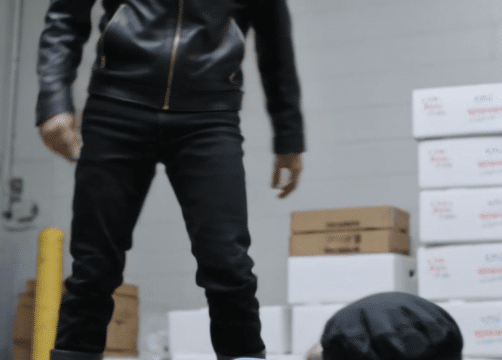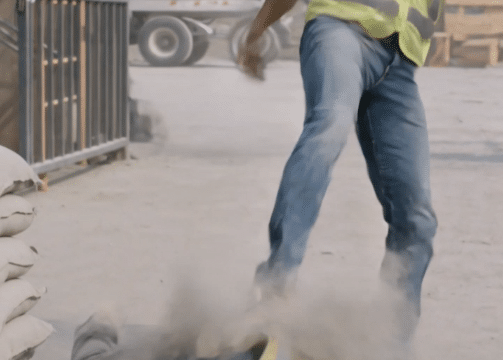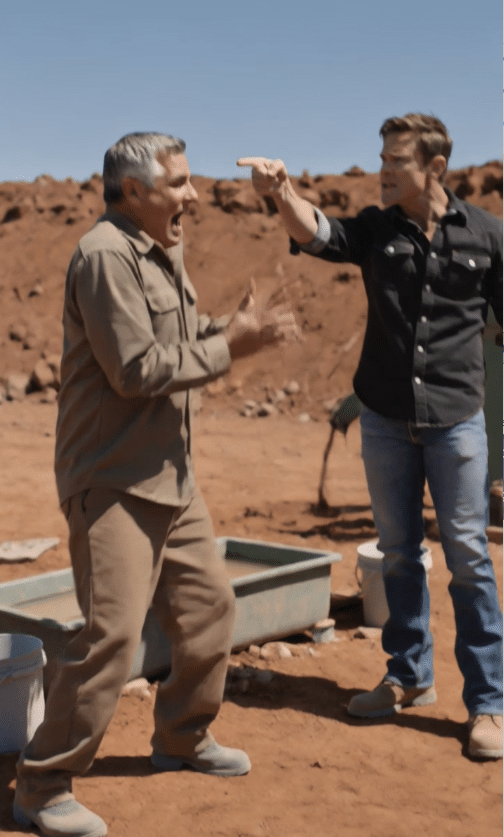
Act I
“Trash. Water comes after the dirt.”
The words came just as Walter Hayes lifted a nearly empty plastic bottle to his lips. His hands were trembling in the brutal afternoon heat, and sweat had soaked the collar of his faded brown work shirt. Beside him, a cart stood loaded with red earth, waiting to be emptied into the sluice tray.
Walter was sixty-five years old. His boots were worn thin, his neck cloth was dark with sweat, and his shoulders ached from hours of shoveling dirt beneath a sun that seemed determined to burn the color out of everything it touched.
“I just needed one drink.”
He spoke quietly, almost apologetically, as though asking for water were a privilege he had failed to earn.
Across from him stood Clayton Briggs, the forty-four-year-old owner of the small gold-digging operation. Clayton wore a black denim shirt, a wide-brimmed hat, and a thin gold chain that rested against his chest. His boots were clean enough to suggest he rarely did the work he demanded from others.
He snatched the bottle from Walter’s hand and pointed toward the cart.
“You have one more load to finish.”
Walter swallowed. His mouth was so dry that even speaking had become uncomfortable.
“I’ve been working since before sunrise. I’ll finish it. I only need a moment.”
Clayton laughed without humor.
“A moment? That’s what every lazy man wants. A moment to sit down. A moment to drink. A moment to pretend the world owes him something.”
Walter lowered his eyes.
He had spent most of his life working with his hands. He had repaired fences, unloaded trucks, poured concrete, and taken whatever jobs he could find when steady employment disappeared. He had never expected an easy life. He had simply believed that honest work should leave a man with enough dignity to get through the day.
But Clayton had a different understanding of dignity.
To him, workers were numbers on a ledger. Their exhaustion mattered only when it slowed production, and their pain mattered only when it threatened to become expensive. If a man was too old to keep pace, Clayton considered him replaceable. If a worker complained, Clayton called him ungrateful.
Walter had learned to endure it because he needed the money.
His wife, June, had been struggling with a heart condition, and the prescriptions she needed were not fully covered by their insurance. Their savings had dwindled through hospital visits and unexpected bills. Walter had taken the gold-site job because it paid by the day, and because the owner had promised that anyone willing to work hard could earn enough to get by.
The promise had sounded believable when Walter first arrived.
Now, after weeks of punishing shifts, he understood how carefully Clayton had chosen his words.
Workers could earn enough to get by—as long as they never became sick, never slowed down, never asked for anything, and never questioned how their pay was calculated.
Walter glanced at the bottle.
“Please. There’s barely anything left.”
Clayton twisted the cap onto it and tossed it onto the dirt beside the sluice tray.
“Then you should have thought about that before stopping.”
Walter took one step toward the bottle.
Clayton moved in from the side and drove a hard kick into Walter’s chest.
The older man fell backward into the red dirt, landing beside the sluice tray. His forearm scraped across the rough ground, leaving a thin trace of blood beneath the dust. The plastic bottle bounced once, then rolled toward the cart’s front wheel.
Walter struggled to draw a full breath.
Before he could get his feet beneath him, Clayton delivered exactly two more hard kicks to his back and side. Walter curled in pain, reaching weakly toward the bottle as it rolled farther away.
The workers nearby froze.
A man holding a shovel covered his mouth. Another took a step backward from the sluice trays. Several laborers exchanged frightened glances, but none dared approach Walter.
They had seen Clayton punish people before. They had seen men dismissed for refusing dangerous assignments and watched their final pay become tangled in accusations of damaged equipment or missing gold.
Nobody wanted to be next.
Clayton stood over Walter, his shadow falling across the older man’s face.
“Old men dig until I’m done.”
Walter looked up at him. His expression held pain, but there was something else in it, too—a bewilderment that seemed to trouble Clayton more than anger would have.
Walter had never understood how a person could look at another human being struggling to breathe and see nothing but an inconvenience.
Then an off-road vehicle came racing down the dirt track.
Its brakes bit into the loose ground, sending red dust swirling around the tires. The driver’s door opened sharply, and a man in a khaki government field jacket stepped out, safety glasses catching the afternoon light. An official clipboard was tucked beneath his arm.
He looked first at the fallen water bottle.
Then at Walter.
Finally, he turned toward Clayton.
The newcomer raised one hand.
The pump machine fell silent.
The entire worksite seemed to stop with it.
Clayton’s face changed as the inspector approached, but he tried to recover his usual confidence.
The inspector did not shout. He did not threaten to strike him. He simply stepped between Clayton and Walter, then looked at the manager with an expression colder than anything the workers had ever seen.
“You just buried your license.”
Clayton stared at him.
“My license?”
For the first time that afternoon, the man who controlled every shovel, every cart, and every worker at the site looked like someone who had just discovered that he had never truly been in control.
And the inspector had not even opened his clipboard yet.
Act II
The inspector’s name was Martin Shaw. At fifty-eight, he had spent more than two decades examining small mining operations, industrial sites, and extraction projects where the promise of quick money often concealed dangerous working conditions.
He had seen operations with faulty machinery, missing protective equipment, unsafe excavation practices, and managers who treated basic safety requirements as optional expenses.
But the gold site owned by Clayton Briggs had appeared deceptively ordinary in its paperwork.
The operation was small, spread across a patch of red earth far from the nearest major town. Workers fed dirt into sluice trays while water carried lighter sediment away, leaving heavier particles behind. An old pump supplied much of the water used in the process, and a collection of aging tools and makeshift workstations filled the site.
Clayton liked to describe the operation as a family business.
There was nothing familial about the way he ran it.
He paid workers by the day, demanded long hours during productive periods, and discouraged written complaints. When someone asked about protective equipment, he complained about costs. When a worker needed a break, he reminded them how many people were waiting for jobs.
The arrangement benefited him in ways that did not appear on the official production summaries.
Exhausted workers made mistakes. Mistakes created deductions. Deductions reduced payroll costs. And because the laborers were often desperate for immediate income, many accepted the shortfalls rather than risk being dismissed.
Clayton’s business records showed a modest operation with fluctuating yields. His safety filings, however, described a workplace with established procedures, adequate supplies, and documented employee training.
Martin had come to verify those claims after receiving a series of complaints from former workers.
The complaints were not identical, and none alone established every allegation. One former laborer described being ordered to continue working after feeling faint. Another claimed that protective equipment had been withheld during particularly demanding shifts. A third said the owner regularly threatened to withhold pay from anyone who stopped work before the daily target was met.
One complaint mentioned something that Martin found especially troubling: workers were allegedly discouraged from drinking water during production runs because breaks interfered with the schedule.
In a hot, exposed worksite, that was not a minor administrative issue.
It was a warning sign.
Martin had requested records from Clayton’s operation and scheduled a field inspection. He had expected to examine the pump, check the work areas, verify the safety supplies, and interview employees away from management.
He had not expected to arrive in time to witness an assault.
Clayton, meanwhile, had spent years constructing a different version of himself.
He told new workers that he had built the operation from nothing. He claimed that every dollar earned came from his personal sacrifice and that the men and women working under him should be grateful for the opportunity.
Some of that story was true.
Clayton had invested money in the equipment and taken risks when the site first opened. But he had also received financial backing from a local investor and benefited from a small extraction lease that had taken considerable effort to secure.
He rarely mentioned the people who had helped him.
He never mentioned the laborers who worked in the heat to turn dirt into revenue.
To Clayton, ownership meant permission. He believed that because he paid the wages, he could determine how much discomfort a worker should tolerate. Because he controlled the schedule, he could decide when someone deserved water. Because the workers needed their jobs, he assumed they would accept whatever he demanded.
Walter had become one of his preferred targets.
The older man was experienced, dependable, and reluctant to argue. He arrived early, worked carefully, and never pretended that his age made him more valuable than anyone else. He simply wanted to finish his shift, collect his pay, and return home to June.
Clayton interpreted that restraint as weakness.
He assigned Walter some of the heaviest manual tasks, then criticized him when the work took longer than it did for younger men. When Walter asked for a lighter assignment, Clayton reminded him that no one had forced him to take the job.
Walter had considered leaving more than once.
Each time, he calculated the cost of doing so.
A missed shift meant less money for medication. A dispute over unpaid wages could leave him waiting weeks for income he needed immediately. Starting over at another site would require proving himself to a new employer, and there was no guarantee the next manager would be kinder.
So Walter stayed.
He did not stay because he admired Clayton. He stayed because the bills at home did not care whether his pride had been wounded.
That afternoon, Walter had already completed several loads when the pump began to sputter. The crew paused while Clayton inspected the machine and ordered them to catch up as soon as it restarted.
The workers had been standing under the sun for hours. Their water supply was running low, and the next delivery had not arrived.
Walter took the last drink from his bottle.
It was a small, ordinary act of survival.
Clayton turned it into a public test of obedience.
Now Martin Shaw stood in the middle of the site, watching the owner struggle to explain himself.
“Mr. Briggs,” Martin said, “step away from the worker.”
Clayton’s jaw tightened.
“This is my property. I decide how the work gets done.”
Martin held his gaze.
“You may own the equipment and operate the business. That does not place you above workplace safety requirements.”
Clayton glanced at the clipboard.
Then at the silent pump.
He began to understand that this was not a visitor he could impress with a tour of the operation or silence with a confident explanation.
The man in the khaki jacket had arrived with official authority.
And he had witnessed something Clayton could not erase from the record.
Act III
Martin crouched beside Walter long enough to check whether he could respond, then directed the nearest worker to contact emergency medical services. Walter was conscious, but breathing hurt, and his forearm was scraped and dusty.
The worker hesitated.
Clayton turned sharply.
“Don’t make a scene. He’s an old man. He’ll be fine.”
Martin rose.
“Call now.”
The worker moved immediately.
It was the first order anyone had followed that afternoon without looking to Clayton for permission.
Martin then instructed the crew to remain clear of the affected work area while he documented what had happened. He recorded the position of the water bottle, the location where Walter had fallen, and the names of the workers who had witnessed the assault.
No one was required to gather around him. In fact, Martin made it clear that interviews would be conducted privately so workers could speak without management standing over them.
Clayton objected to every step.
“You’re treating a disagreement like a federal case.”
“I’m documenting an incident I witnessed,” Martin replied. “The scope of the review will depend on the evidence.”
Clayton folded his arms.
“Then write down that he stopped working.”
Martin looked at him.
“I will write down what I observed.”
That answer unsettled Clayton more than a threat would have.
He was accustomed to shaping the story before anyone else could tell it. He could describe a broken tool as worker negligence, a missed target as laziness, or an injury as an accident caused by carelessness. If he spoke first and confidently enough, people often accepted his account.
Martin was not accepting it.
The inspector opened his clipboard and requested the site’s operating documents, safety records, water-supply arrangements, equipment inspection logs, and the relevant authorization for extraction activities.
Clayton began listing excuses before Martin had finished.
Some records were in the office. Others were being updated. A few had been misplaced during the previous month’s equipment changes. The water supply had been delayed by a delivery problem, but everyone knew where the spare containers were supposed to be.
Martin wrote each response down.
Then he asked to see the containers.
The workers led him to a storage area beside the old pump. Several empty jugs sat near the wall, and a few remaining bottles were scattered among tools and fuel cans. The drinking water had not been organized in a way that made it readily available to every worker throughout the shift.
Martin examined the setup without making assumptions about what had happened on other days. He documented what he could verify and asked the workers when the last delivery had arrived.
Their answers differed in small details, but a consistent concern emerged: workers had sometimes been told to finish a production target before collecting more water.
Clayton insisted that the crew could always ask him.
One worker looked at the ground.
Another glanced toward Walter, who was being helped into a vehicle for medical assessment.
Finally, an older laborer named Frank spoke.
“We did ask,” he said. “He told us to finish first.”
Clayton spun toward him.
“Watch your mouth.”
Martin immediately instructed Clayton not to interfere with the interviews.
The order landed harder than Clayton expected.
For years, he had used the threat of dismissal to keep his employees silent. Now a government inspector was standing between him and the people he had taught to fear him.
Martin requested the site’s records for the previous months. He compared the listed safety provisions with the equipment and supplies available at the worksite. He also asked for the documentation governing the operation’s authorization and any conditions attached to its continued use.
The paperwork contained gaps.
Some inspection entries lacked supporting details. Several safety checks had been recorded in broad terms without identifying the equipment examined. The records did not, by themselves, prove that Clayton had deliberately falsified anything, but they were insufficient to settle the questions raised by the complaints.
Martin marked the discrepancies for further review.
Then he asked Clayton about the water-supply plan.
Clayton’s face reddened.
“This is a small operation. We don’t have the resources of a major mine.”
“Then your procedures need to reflect the risks of your operation,” Martin said. “Limited resources don’t make basic safety optional.”
Clayton gave a bitter laugh.
“You people come out here with your clipboards and tell us how to run a business. You have no idea what it takes to make a profit.”
Martin remained still.
“I know what it takes to keep a business operating within the law.”
Clayton looked around for support.
The workers stood quietly beside the sluice trays. Their mouths were covered by their hands or pressed into tense lines. Nobody intervened, but nobody stepped forward to defend him, either.
For the first time, Clayton saw the difference between obedience and loyalty.
His workers had never trusted him enough to stand beside him. They had simply been afraid to stand against him.
Martin closed the folder containing his preliminary notes.
The assault would be documented and referred through the appropriate process. The site conditions and records would be reviewed against the requirements governing the operation. Any formal restriction or licensing action would depend on the findings and the authority responsible for the relevant permits.
But the immediate safety decision could not wait for the entire review to conclude.
Martin looked toward the pump.
Then he raised one hand.
“Shut it down.”
A worker moved to the controls.
The old machine sputtered once, rattled, and fell silent.
The sound of the site changed instantly. Without the pump, the steady rush of water disappeared, leaving only the wind moving across the red dirt and the distant noise of traffic beyond the hills.
Clayton stared at the machine.
“You can’t stop production over a bottle of water.”
Martin turned toward him.
“No. I’m stopping work while I assess the conditions and determine what must be corrected.”
He lifted the clipboard.
“And you should understand something, Mr. Briggs. That license you keep talking about is not a permanent possession. It depends on meeting the conditions that allow you to operate.”
Clayton’s confidence began to collapse.
He had spent so long treating the site as his private kingdom that he had forgotten the distinction between owning a business and having permission to run it.
And Martin had only just begun examining the records.
Act IV
By the end of the afternoon, the worksite had been placed under a formal safety review, with operations remaining suspended until the immediate concerns could be assessed and addressed. Martin documented the conditions he had observed, preserved the relevant records, and initiated the procedures required to determine whether further restrictions were necessary.
Clayton followed him toward the office, speaking faster with every step.
“You’re going to cost me the entire week. The gold doesn’t wait. If we stop now, we lose production, and I still have people to pay.”
Martin did not turn around.
“Then you should have planned for safe working conditions before you began the shift.”
“I have safe conditions.”
“You had a worker lying in the dirt after you kicked him.”
Clayton fell silent for half a second.
Then he tried again.
“Walter is old. He should know his limits.”
Martin stopped walking.
“His age does not excuse what you did.”
Clayton’s hands tightened.
He had expected the inspector to focus on paperwork, perhaps issue a warning, and leave after collecting a few signatures. He had not expected the assault to become the event around which every other question was organized.
Now every excuse seemed to open another door.
If the water supply had been adequate, why had workers been discouraged from taking breaks? If the site had been operating safely, why did the records contain gaps? If the crew had been treated fairly, why were so many employees afraid to speak in front of their manager?
Martin did not assume that every complaint was true. He did not need to.
The documented incident alone was serious. The other concerns required evidence, and the review would proceed accordingly.
Clayton finally lowered his voice.
“Listen. We can work something out. I’ll make sure Walter gets paid for the day. I’ll buy more water. I’ll have the crew sign a statement that this was an isolated disagreement.”
Martin looked at him as though he had misunderstood the conversation.
“You will not pressure anyone to sign anything.”
“I’m trying to solve the problem.”
“No,” Martin said. “You’re trying to control the account of what happened.”
He instructed Clayton to preserve all relevant records and to avoid contacting workers about their statements. The inspector also explained that any formal licensing or permit action would follow the applicable procedures, with findings reviewed by the appropriate authority.
Clayton’s face darkened.
“You can’t take my license because you don’t like me.”
Martin’s answer was immediate.
“This isn’t about whether I like you. It’s about whether you can demonstrate that this operation meets the requirements under which it is allowed to run.”
The words seemed to drain the strength from Clayton’s posture.
His operation depended on its authorization to extract and process material. Without that authorization, he could not simply hire another crew and continue as usual. Equipment sat idle, production stopped, and buyers would begin asking why deliveries had been delayed.
The financial consequences could be severe.
But Martin was not there to destroy a business for the sake of making an example of its owner. He was there to determine whether the operation could be run safely and lawfully.
If the deficiencies could be corrected, the process would establish what was required. If the investigation found violations warranting suspension or revocation, those decisions would be made through the relevant legal and administrative channels.
Clayton had mistaken that process for weakness.
He had assumed that officials would be too busy, too distant, or too cautious to challenge a small operation hidden beyond the main road.
Now he was discovering that the size of a business did not make its responsibilities smaller.
Meanwhile, Walter was being examined by medical personnel. His injuries required attention, and he was advised to rest while his condition was assessed. Martin made sure the incident was documented and that Walter had an opportunity to provide his account without Clayton present.
When Walter eventually spoke, he did not demand revenge.
He described the heat, the nearly empty bottle, the order to finish another cart, and the moment Clayton kicked him to the ground. He explained that he had tried to reach the bottle because he was thirsty, not because he intended to abandon his work.
He also described the financial pressure that had kept him at the site.
“I can’t afford to lose a day,” Walter said. “My wife needs her medicine.”
Martin listened carefully.
“That doesn’t mean you should have to risk your health to earn your wages.”
Walter gave a tired, disbelieving smile.
“That’s not how it works out here.”
Martin had heard versions of that sentence throughout his career. Sometimes it came from workers in warehouses, sometimes from construction crews, sometimes from people handling dangerous materials for employers who assumed desperation would make them compliant.
The details changed.
The underlying problem did not.
A worker who believed that asking for water might cost him his job was not freely choosing between work and rest. He was being pushed toward a decision in which every option carried a penalty.
Martin recorded Walter’s statement and explained the next steps. The workplace investigation would continue, and any questions about unpaid wages or other employment issues would be referred to the appropriate channels.
Back at the site, the workers began collecting their belongings for the day.
They did not celebrate the shutdown. Many of them depended on the daily pay, and a prolonged suspension could create new hardships. Martin recognized that reality and documented the concerns without promising outcomes he could not guarantee.
But he also knew that restarting the pump without addressing the immediate risks would make the workers bear the cost of management’s failures all over again.
Clayton stood beside the silent machine, watching the crew disperse.
For years, he had measured his success by how much dirt moved through the sluice trays and how little time his workers spent away from them. He had believed that every pause was a loss and every complaint a threat.
Now the entire operation had stopped because he could not tolerate one old man drinking water.
The irony was not lost on anyone.
The man who had demanded that workers sacrifice everything for the harvest was about to discover that the law did not measure success by the amount of dirt he processed.
It measured whether he had met the obligations that made the work permissible in the first place.
Act V
The review continued over the following weeks.
Investigators examined the site’s safety procedures, water-supply arrangements, equipment records, and operating documents. Workers were interviewed privately, and the accounts were compared with the available records. The assault was handled through the appropriate process, separate from the administrative questions surrounding the site’s operation.
The findings identified serious deficiencies in the site’s safety practices and recordkeeping. The review also found that the water-supply arrangements had not been managed in a way that adequately protected workers during demanding shifts.
Not every allegation could be substantiated, and not every missing record proved deliberate misconduct. But the verified deficiencies were enough to require corrective action before the operation could resume.
The licensing authority reviewed the evidence and imposed formal restrictions on Clayton’s operation. The eventual administrative decision left him unable to continue under the terms he had previously relied upon, and his authorization was revoked after the required process was completed.
Clayton challenged the outcome, arguing that the consequences were disproportionate and that the site could have been corrected without ending his operation.
But the decision was not based on a single argument about water.
It reflected the documented conditions, the failures to maintain adequate safeguards, and the evidence gathered during the review. The assault had brought the inspector to the center of the problem, but the records showed that the problem extended beyond one afternoon.
Clayton had believed he could keep the operation running by demanding more from the people who had the least power to refuse him.
Instead, his refusal to respect their basic safety had brought the entire business to a halt.
The workers faced their own uncertainty. Some found jobs at other operations, while others took temporary work repairing fences, hauling supplies, or helping nearby farms. The shutdown was not a painless victory. Losing access to a familiar worksite meant losing a source of income, even for people who had suffered under its management.
Martin understood that accountability did not automatically solve the financial problems of the people who had been harmed.
He helped ensure that the workers received information about the relevant reporting channels and any available procedures for addressing unpaid wages. He also made sure their statements were preserved as part of the record, so that the investigation would not depend solely on the memory of one person.
Walter returned home to June.
For several days, he moved carefully and rested as instructed. His forearm healed, though the memory of the red dirt beneath his face stayed with him longer than the scrape itself.
June was furious when she heard what had happened.
Not because Walter had failed to fight back, but because he had been placed in a position where he felt compelled to apologize for needing water.
“You went out there to work,” she told him. “You didn’t go out there to beg.”
Walter sat at the kitchen table, turning a glass of water slowly between his hands.
“I know.”
“Do you?”
He looked at her.
For years, he had accepted indignities that seemed too small to challenge individually and too costly to confront together. A withheld break. A threat about pay. A manager’s insult. Each one had seemed survivable, and he had convinced himself that endurance was a kind of strength.
Now he wondered how much of that endurance had simply taught other people that they could keep taking.
“I thought if I kept my head down, we’d get through it,” he admitted.
June reached across the table and placed her hand over his.
“You still have to get through it,” she said. “But you don’t have to pretend it was right.”
A few weeks later, Walter received confirmation that his account of the incident had been added to the official record. The process was not a dramatic courtroom victory, and there was no instant payment large enough to erase the family’s worries. There were forms, interviews, waiting periods, and questions that required patience.
But his statement mattered.
So did the statements from the other workers.
One of the men who had stood beside the sluice trays eventually admitted that he had wanted to help Walter but had been afraid of losing his job. He did not ask Walter to excuse him. He simply said that watching the assault had forced him to confront how thoroughly Clayton had trained the crew to confuse fear with obedience.
Walter understood the fear.
He had felt it himself.
But he told the man something he had only recently begun to believe.
“You can be scared and still tell the truth.”
The words stayed with the worker. Later, when he was interviewed about the site’s practices, he gave a full account of what he had witnessed and what he had experienced himself.
The gold site did not reopen under Clayton’s control.
Its pump remained silent, its trays gathered dust, and the red earth slowly reclaimed the paths where carts had once moved from morning until dusk. To an outsider passing along the road, it looked like an ordinary abandoned worksite.
To the people who had worked there, it marked the end of a period in which their need for money had been used against them.
Walter found another job through a local contractor who needed experienced hands for lighter maintenance work. The hours were shorter, and the pay was not generous, but the supervisor was willing to discuss assignments honestly. When Walter needed a drink of water, he did not have to calculate whether asking would provoke a threat.
The first time he stopped to rest during a hot afternoon, he almost apologized out of habit.
Then he caught himself.
He drank, tightened the cap, and returned to his task when he was ready.
It was such a small moment that no one else noticed.
For Walter, it felt like reclaiming something he had slowly surrendered without realizing it.
Martin continued his work elsewhere, carrying the lessons of the inspection into the next site on his schedule. He knew there would be other managers who mistook authority for ownership of the people beneath them. There would be other workers who stayed quiet because their bills could not wait for justice.
An inspector could not remove every hardship from their lives.
But he could document what happened, enforce the rules within his authority, and refuse to treat cruelty as an ordinary cost of doing business.
Clayton had thought the water bottle was the issue.
He had believed that if he could force Walter back to the cart, he could restore his control and keep the day’s production moving. He had not understood that his behavior was exposing the weakness beneath his authority.
The water was only the beginning.
The assault brought the inspector’s attention to the site. The records revealed the gaps in its safeguards. The workers’ statements showed how fear had become part of the daily routine. Each piece of evidence made it harder to dismiss the next.
And when the licensing decision finally came, Clayton could no longer command the pump to start, order the crew back into the dirt, or threaten a worker into silence.
His business had depended on permission he had treated as a permanent possession.
It was not.
Months later, Walter stood outside his home as the evening light settled across the yard. June was inside preparing dinner, and a bottle of cool water rested on the porch rail beside him.
He picked it up and took a long drink.
There was no manager watching. No cart waiting. No one counting the seconds until he returned to work.
He looked toward the road and thought of the red dirt, the silent pump, and the inspector stepping out of his vehicle with a clipboard in hand.
For a long time, Walter had believed that surviving meant enduring whatever powerful people chose to do to him.
Now he understood that survival and dignity were not opposites. He could need the money and still deserve safety. He could be old and still deserve respect. He could make a mistake, take a break, or ask for water without becoming someone’s target.
Clayton had tried to make Walter feel worthless because the older man needed the job.
Instead, he had exposed the truth about his own operation.
The license had never been a trophy proving that Clayton could do whatever he wanted.
It was a responsibility he had to keep earning.
And the day he kicked a tired old worker into the red dirt was the day he began losing the right to hold it.
Tighten Act II’s BackstoryClarify the Inspector’s Authority