Act I
“Trash. Carry it full this time.”
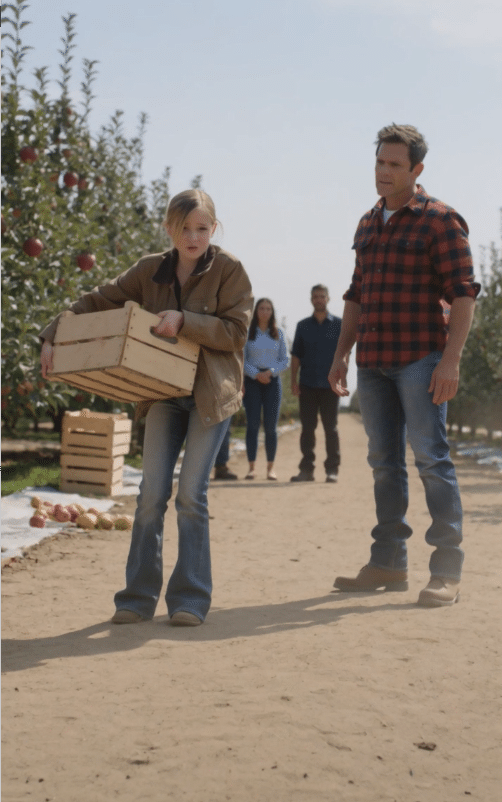
The wooden crate tipped in Lily Carter’s trembling hands, and three red apples rolled across the dusty path beneath the orchard trees.
She was fourteen years old, wearing a brown jacket that had been patched at one elbow and faded jeans that no longer fit properly at the waist. Her blonde hair was tied low behind her neck, and her small fingers strained against the rough edges of the crate as she tried to keep the remaining apples from spilling.
“I’m sorry. It was too heavy.”
The apology came quickly. Too quickly for a child who had done nothing more than struggle beneath a load that should never have been hers to carry.
Across from her stood Travis Boone, the farm manager, a forty-one-year-old man in a new red flannel shirt, black baseball cap, and spotless work boots. He looked at the scattered apples as though Lily had deliberately destroyed something priceless.
“Pick them up,” he ordered.
Lily bent toward the dirt.
“Carefully,” he added, his voice dripping with contempt. “And don’t waste any more of my time.”
Her mother, Ellen, stood several rows away beside a harvest bin. She had been sorting apples since sunrise, her back aching and her hands stained from hours of handling fruit. The moment she heard Travis’s voice, she turned.
She knew that tone.
It was the sound that preceded a reduced paycheck, an invented penalty, or a threat that anyone who complained could find work somewhere else.
Ellen started toward them, but Travis lifted one hand without even looking at her.
“Stay where you are.”
She stopped.
It was not because she agreed with him. It was because she had spent three months learning how easily a manager could turn one worker’s mistake into an entire family’s financial disaster.
The Carter family had arrived in the county after Ellen lost her husband, Daniel, to a sudden illness. His death had left behind unpaid medical bills, a small rented house, and a daughter who had learned to hide her worries behind a brave smile.
The seasonal farm job was supposed to be temporary. It had become the only reliable income Ellen could find before winter.
Lily had insisted on helping after school and on weekends. She wanted to contribute, and she hated watching her mother count every dollar at the kitchen table. Ellen had tried to explain that a child should not have to carry the family’s troubles, but Lily had already learned what adults sometimes forgot: when money is scarce, even small kindnesses can feel like luxuries.
Now she stood in front of Travis, trying to lift the crate again.
The apples inside shifted under their own weight. Her arms shook, and she struggled to get the wooden bottom clear of the dirt.
“Come on,” Travis snapped. “You dropped it once. You’re not dropping it again.”
Lily tightened her grip.
She tried to stand.
Travis stepped in from the side and drove a hard kick into her hip, knocking her down onto the dirt path.
The crate fell beside her. Apples scattered between the rows, some rolling beneath the harvest truck and others disappearing into the dry grass. Lily landed on one knee, scraping it against the rough ground. A thin trace of blood appeared through the dust.
Ellen covered her mouth.
Several workers froze beside their crates. One man took half a step forward, then stopped when Travis turned his head. No one wanted to become the next person whose name disappeared from the work schedule.
Lily curled in pain, instinctively trying to protect herself while avoiding the apples scattered beneath her.
Travis delivered exactly two more hard kicks to her back and side.
Then he stepped away, breathing sharply, as if the incident had exhausted him rather than the child lying at his feet.
“Hungry kids work harder.”
For a moment, the only sound was the wind moving through the apple trees.
Lily looked toward her mother. She did not cry out or demand that anyone help her. Her eyes simply searched for Ellen’s face, as if she needed reassurance that the world had not changed beyond recognition in the space of a few seconds.
Ellen began moving again, but fear held her back. Travis had threatened to remove workers from the next harvest shift for far less, and she knew that losing both their jobs would leave them with almost nothing.
Then a pickup truck came racing down the dirt path.
Its brakes locked with a sharp crunch of gravel, and a cloud of dust rose around the tires. The driver’s door swung open.
A sixty-year-old man stepped out wearing a white cowboy hat, a dark denim jacket, and worn boots that looked expensive despite the scratches along their leather. He took one look at Lily on the ground, at the scattered apples, and at Travis standing over her.
The man’s face changed.
He walked between Travis and the girl, pointing the manager away from the crate.
“You just crushed your own harvest.”
Travis stared at him.
For the first time that afternoon, he seemed unable to find the right words.
Because the man in the white hat was not simply another farmer passing through.
He owned the land, the trees, the harvest, and the business Travis had spent years treating as his personal kingdom.
And he had just witnessed the one thing Travis could never explain away.
Act II
The farm belonged to Samuel Whitaker, a third-generation apple grower whose family had cultivated the same stretch of American countryside for nearly eighty years.
Whitaker Orchards was not the largest operation in the state, but it had built a reputation for fruit that reached grocery stores and regional markets in excellent condition. Samuel had spent most of his life learning the land: which trees needed pruning, which slopes held moisture, and how a few days of bad weather could turn a promising harvest into a financial disaster.
He understood hard work.
He understood mistakes.
And he understood the difference between holding someone accountable and making them afraid.
When Samuel was young, his father had taught him to inspect every crate before blaming the person who packed it. An apple might fall because a branch had broken, a ladder had shifted, or a container had been loaded incorrectly. The solution depended on the cause, not on how loudly someone could shout.
That lesson had shaped Samuel’s approach to farming long before the business became profitable.
It was also the reason he had hired Travis Boone.
Travis had arrived at the orchard five years earlier with an impressive résumé and a reputation for increasing productivity. He could organize crews quickly, negotiate transportation schedules, and calculate how many workers were needed to finish a field before the weather turned.
At first, Samuel believed he had found someone who could help modernize the operation.
The harvest numbers improved. Deliveries left on schedule. The books showed fewer delays, and the farm’s buyers received their orders with remarkable consistency.
Samuel gradually stepped back from daily management to care for his wife, Margaret, whose health had begun to decline. He trusted Travis to handle the seasonal crews and report any serious problems.
What Samuel did not see was how Travis achieved his results.
He cut rest periods whenever he believed the schedule was falling behind. He threatened workers with lost shifts if they failed to meet quotas, even when the assigned loads were too heavy or the equipment was inadequate. He quietly deducted money for damaged crates and spoiled fruit without explaining how the losses had been calculated.
When workers complained, he reminded them that seasonal employment was easy to replace.
Some left.
Others stayed because they had rent to pay, children to feed, or no transportation to reach another farm.
Travis called the resulting silence respect.
He also began treating the orchard’s success as proof that he was indispensable. He told employees that Samuel was too old-fashioned to understand modern agriculture, that the farm would collapse without strict discipline, and that every decision had to pass through him.
The workers learned to ask Travis for permission before making even minor adjustments.
They learned not to question a quota.
And they learned that the safest way to survive a shift was to become invisible.
Ellen Carter had discovered all of this within her first two weeks.
She was a careful worker, never careless with the fruit and rarely late. Lily had come to help only after Ellen received permission for her to assist with light sorting during limited hours, away from dangerous machinery. The arrangement was supposed to involve simple tasks, under adult supervision, with no expectation that Lily carry heavy crates.
Samuel had approved the general youth-work policy through the farm’s seasonal employment program. He believed it offered families a way to earn modest additional income without placing children in dangerous situations. He had also made it clear that school, safety, and reasonable workloads came first.
Travis treated those safeguards as obstacles.
He told Ellen that the farm needed every available hand during the busiest weeks. If Lily wanted to help, he argued, she could do the same work as everyone else.
Ellen resisted at first.
Then Travis showed her the schedule and pointed out how few shifts remained before the harvest ended.
“You need this job,” he told her. “Don’t make it difficult.”
Ellen agreed to let Lily help with light sorting and carrying empty containers. She never agreed to the heavy loads Travis began assigning when supervisors were not watching.
She had intended to report him.
But each time she considered it, she remembered the overdue electric bill and the envelope of medical debt statements tucked inside her kitchen drawer. She remembered how many applications she had submitted without receiving an answer.
And she remembered Lily quietly placing a few dollars from her own savings beside the grocery money, pretending it was no big deal.
Ellen had promised herself that the farm would be a temporary sacrifice.
She had not realized how easily temporary desperation could become a trap.
Samuel, meanwhile, had begun noticing irregularities in the orchard’s financial reports. Equipment expenses had risen, several crates of premium fruit had been classified as losses, and the labor costs did not seem to match the hours recorded in the harvest logs.
When he asked Travis about the discrepancies, the manager blamed weather damage, worker carelessness, and rising transportation costs.
The explanations were plausible enough to delay further questions.
But they did not fully satisfy Samuel.
Two days before the confrontation, he had received a short message from a longtime employee who had worked for his family for decades.
The message contained only one sentence.
You should come see what is happening in your orchard.
Samuel had decided to make an unannounced visit.
He had expected to find inefficiency, perhaps even mismanagement.
He had not expected to find a fourteen-year-old girl on the ground while his manager stood over her.
And as Samuel looked from Lily to the scattered apples, he began to suspect that the missing money and the frightened workers were connected to something much worse than poor leadership.
Act III
“Step away from her,” Samuel said.
Travis straightened, trying to recover the authority that had always worked in his favor.
“Samuel, this is a work matter. The girl dropped a crate, and I was correcting the problem.”
Samuel looked at Lily’s scraped knee.
“By kicking her?”
“She was being careless.”
“She is fourteen.”
“She agreed to work.”
“For light tasks,” Samuel replied. “Not to be beaten because a crate was too heavy.”
Travis glanced toward the other workers. They stood scattered among the apple rows, their hands suspended above their crates, their expressions caught between fear and disbelief.
He had spent years convincing them that Samuel cared only about the final numbers. He had told them that the owner would always side with the person responsible for meeting the harvest target, regardless of how that target was achieved.
Now Samuel was standing between him and the girl.
Travis lowered his voice.
“You don’t understand the pressure we’re under. We’re behind schedule, and these people make mistakes every hour. If I don’t enforce standards, we lose the shipment.”
Samuel did not answer immediately.
Instead, he crouched beside Lily, keeping a respectful distance so he would not frighten her further.
“Can you tell me your name?”
“Lily,” she whispered.
“I’m Samuel. This is my farm.”
She looked at his white hat, then toward her mother.
“I didn’t mean to drop them.”
“I believe you,” Samuel said. “You don’t have to explain anything else right now.”
Ellen finally reached her daughter. She knelt in the dirt and wrapped an arm around Lily’s shoulders, holding her as carefully as if the slightest movement might hurt her more.
Samuel rose and turned to Travis.
“Go to the office. Do not give anyone instructions, alter any records, or contact the workers about what happened until I speak with you.”
Travis stared at him.
“You can’t suspend me in the middle of the harvest.”
“I just did.”
For a few seconds, Travis seemed to consider arguing. Then he looked at Samuel’s expression and walked toward the main building, his boots grinding into the dirt.
Samuel watched him leave before calling for the farm’s safety coordinator. He asked the coordinator to arrange appropriate medical attention for Lily, preserve the incident records, and ensure that no worker would be punished for speaking about what they had witnessed.
Only then did he turn to the harvest crews.
“Set the crates down,” he said. “No one is carrying another load until we review the assignments.”
A few workers exchanged startled glances.
They had never heard the owner stop production because of a worker’s safety concern.
Samuel knew the interruption would cost time. Fruit left uncollected could become overripe, and a delayed shipment might affect the farm’s revenue. But the cost of continuing as if nothing had happened was greater.
He asked the coordinator to bring him the labor logs, crate-damage reports, and records of deductions taken from workers’ pay.
Within an hour, the first discrepancies began to surface.
The harvest reports showed unusually high numbers of damaged crates, but the records did not consistently identify when or how the damage occurred. Several workers had been charged for losses on days when they had been assigned to different sections of the orchard. In other cases, the deductions appeared to have been entered in batches at the end of the week, without supporting notes.
The farm had also paid for temporary labor during periods when the recorded staffing levels suggested there were already enough workers to complete the assigned tasks.
Samuel studied the papers in silence.
Travis had described the higher expenses as the unavoidable price of a difficult season. But the documents raised a different possibility: that the manager had been manipulating reports to conceal poor planning, inflate the apparent cost of labor, and make his own performance look better than it was.
The records did not yet prove where every dollar had gone.
They did show that the explanations Samuel had accepted were incomplete.
Then a veteran picker named Rosa Alvarez approached the coordinator and asked to speak privately.
She had worked at Whitaker Orchards for eleven seasons. She knew the difference between an ordinary harvest loss and a manager trying to hide one.
Rosa explained that Travis had begun requiring workers to replace damaged crates out of their own wages. Some crates had been broken before reaching the field, but employees were charged anyway. When a load was too heavy or a container split, the loss was attributed to whoever happened to be nearest.
Rosa had tried to question the practice.
Travis had removed her from the better-paying morning shifts.
After that, she had stopped asking.
One by one, other workers began confirming parts of her account.
No one claimed to know everything. Some had witnessed deductions; others had heard threats. Several had seen Travis assign loads that were too heavy for smaller workers, then blame them when fruit fell.
Their statements formed a pattern that could no longer be dismissed as a single misunderstanding.
Samuel returned to the office and opened the financial records from the previous harvest.
There, tucked between routine supply expenses, he found repeated payments authorized under a category labeled equipment and field-loss adjustments. The entries were vague, and several lacked the receipts required by the farm’s own accounting rules.
The total was large enough to demand an independent review.
Samuel had come to the orchard to find out why the numbers no longer made sense.
Now he understood that the problem was not simply what Travis had taken from the farm.
It was what he had taught everyone working there to accept.
And the person who had finally exposed it was a child carrying a crate that was too heavy for her.
Act IV
By the next morning, Travis Boone was no longer managing the harvest.
Samuel placed him on immediate administrative suspension while the farm reviewed the assault, the labor records, and the disputed financial entries. Travis was instructed to remain away from the workers and surrender access to the scheduling system and accounting files while the investigation proceeded.
He reacted as though Samuel had committed a personal betrayal.
“You’re going to ruin five years of work because of one incident?” Travis demanded.
Samuel stood behind his desk, his white cowboy hat resting beside the open ledger.
“No. I’m reviewing five years of work because one incident made me question what I was looking at.”
Travis shook his head.
“You know what this place needs. You know what happens if we miss the market window. I kept the operation running while you were away dealing with family problems.”
The words struck where he intended.
Samuel had spent months beside Margaret’s hospital bed, listening to doctors explain what they could and could not promise. During that time, he had entrusted the farm to Travis more completely than ever before.
For a moment, Samuel felt the weight of that decision.
Then he looked at the payroll reports.
Trust was not a license to operate without oversight.
“You were hired to manage a harvest,” he said. “Not to decide that frightened people have no rights.”
Travis tried a different approach.
He claimed the workers were exaggerating. He suggested that Ellen had encouraged Lily to work beyond the agreed limits. He argued that the farm could not be expected to prosper if every dropped apple became a formal complaint.
But the evidence was no longer confined to his version of events.
The safety coordinator had documented Lily’s injury and collected statements from those present. The labor records showed questionable deductions. The financial entries required explanations that Travis had not provided. Samuel ordered an independent accountant to review the relevant transactions and a separate investigator to examine the workplace allegations.
The farm’s lawyer also reviewed the youth-work arrangements and the safety procedures governing seasonal labor. Any violations would be addressed through the proper channels, rather than settled by an internal promise that everything would be fine.
Meanwhile, Samuel made a decision that surprised the workers even more than Travis’s suspension.
He ordered the disputed wage deductions frozen pending review and directed the payroll team to reconcile every affected employee’s account. Workers would be paid for verified hours without being forced to wait for the financial investigation to finish.
No one would lose a shift simply for participating in an interview.
The harvest resumed under temporary supervision, but the atmosphere had changed. Workers were still tired. The apples still had to be picked before they spoiled, and the weather had not suddenly become more forgiving.
Yet people began speaking to one another again.
They reported broken crate handles before someone was hurt. They asked for assistance with heavy loads. They told the supervisors when a task could not be completed safely within the assigned time.
The changes were small, but each one challenged the system Travis had built.
Ellen spent the next few days at home with Lily while her daughter recovered. She worried about the bills, the missed shifts, and the possibility that the farm might eventually decide the family was more trouble than it was worth.
Samuel called her personally.
He apologized for what had happened on his property and assured her that neither she nor Lily would be punished for reporting it. He arranged for the farm to cover Lily’s reasonable medical expenses while the incident was reviewed, without asking Ellen to sign away any rights or remain silent.
Ellen thanked him, but she did not pretend that the apology made everything disappear.
“I’m glad you came,” she said. “But you should have known what was happening before it reached my daughter.”
Samuel listened without interrupting.
She was right.
He had trusted the reports because they were neat, timely, and easy to understand. He had mistaken an absence of complaints for evidence that everything was working. He had allowed distance to become an excuse for not looking closely enough.
That evening, Samuel walked the orchard rows alone.
He stopped beside the place where Lily had fallen. Most of the spilled apples had been collected, but a few bruised ones remained near the path, their skins marked where they had struck the ground.
They were ordinary apples. They would never have been worth more than a few dollars.
But the scene had forced Samuel to confront the cost of a management system that treated every loss as a reason to blame the person with the least power.
Travis had believed that the harvest belonged to him because he controlled the workers.
He had forgotten that he was only a manager, entrusted with something that belonged to someone else.
And he had mistaken the silence of desperate people for permission.
The final accounting review would determine the extent of the financial discrepancies. The workplace investigation would establish the facts surrounding Lily’s assault. Samuel would not declare every allegation proven before the evidence was examined.
But he no longer had any doubt about one thing.
Travis could not return to his position.
The farm had to become a place where workers could report a problem without fearing that the person receiving the report would become the next source of danger.
And that change would begin with the family Travis had tried to frighten into silence.
Act V
The independent review took several weeks.
It found that a number of wage deductions had been imposed without adequate documentation and that the farm’s reporting procedures had failed to distinguish between losses caused by worker error and those caused by damaged equipment, poor load assignments, or other operational problems. Some entries could not be reconciled with the supporting records.
The review did not establish that every disputed payment had been deliberately stolen. It did establish that the controls were inadequate and that Travis had exercised authority without the oversight the farm’s own policies required.
The findings were serious enough to end his employment.
Samuel dismissed Travis after the formal review of his conduct and management practices. The assault allegations were handled separately, with the relevant evidence made available to the appropriate authorities. Samuel understood that dismissal was an employment decision, not a substitute for any legal process that might follow.
Travis left the property carrying a box of personal belongings.
He did not receive a farewell gathering. No one lined the dirt path to thank him for his leadership. The workers watched from a distance, quiet and cautious, unwilling to celebrate too soon after years of learning how quickly circumstances could change.
But when his truck disappeared beyond the entrance, something shifted.
A few shoulders relaxed.
Someone let out a breath that sounded almost like a laugh.
Then the harvest bell rang, and the crew returned to work.
Samuel introduced new procedures for handling damaged fruit, reviewing pay deductions, and reporting safety concerns. Crate weights were standardized, equipment checks were documented, and workers were given a clear way to raise concerns without going through the supervisor whose conduct they were reporting.
The farm also reviewed its seasonal youth-work rules. Tasks assigned to younger helpers were limited to appropriate, supervised duties, with safety and school obligations treated as requirements rather than inconveniences.
Samuel did not announce that the orchard had become perfect.
He knew better.
Rules written on paper could be ignored. A new manager could repeat old mistakes. Trust, once damaged, did not return simply because someone promised to behave differently.
So he began visiting the harvest crews regularly, not to demand better numbers, but to ask what was preventing people from doing their work safely.
At first, the workers answered cautiously.
They were used to questions that concealed blame.
Over time, their answers became more direct.
One crew needed lighter containers. Another needed a repaired section of the loading path. Several workers wanted clearer explanations of how damaged fruit was recorded. Samuel listened, assigned responsibility, and returned to see whether the problems had actually been addressed.
For the first time in years, the workers began to believe that reporting a problem might lead to a solution instead of a punishment.
Ellen returned to work after Lily had recovered enough to resume her normal routine. She was offered her original position, and her wages were reconciled through the farm’s review process. She accepted, though she made it clear that her family would not continue under conditions that placed Lily at risk again.
Samuel agreed without hesitation.
Lily did not return to carrying crates.
She had been shaken by what happened, and there were days when the memory of the dirt path returned unexpectedly. A loud voice could make her tense. The smell of bruised apples sometimes reminded her of the moment she had fallen and seen her mother’s face above her.
But the experience did not erase her kindness or her determination.
When she was ready, Samuel invited her and Ellen to visit the orchard on a quiet afternoon. He met them near the old apple trees, wearing the same dark denim jacket and white cowboy hat he had worn on the day of the confrontation.
Lily looked at the crates stacked beside the path.
“Are those heavy?” she asked.
“Some are,” Samuel admitted. “That’s why we make sure people have the right equipment and help.”
She considered that answer.
Then she looked at him.
“Mr. Boone said hungry kids work harder.”
Samuel’s expression grew solemn.
“He was wrong.”
Lily glanced down at her hands.
“Sometimes I thought if I worked hard enough, Mom wouldn’t have to worry so much.”
Ellen reached for her daughter, but Lily continued.
“I wanted to help. I didn’t want to be a problem.”
Samuel crouched so that he was speaking to her at eye level.
“You were never the problem, Lily. Asking a child to carry more than she safely can—and hurting her when she struggles—that was the problem.”
Lily did not answer immediately.
Then she nodded, not because the memory had stopped hurting, but because someone had finally given her words that made sense of it.
Samuel showed her a small section of the orchard where the trees had been planted years earlier by his father. One tree had grown crooked after a storm bent its trunk, but it had continued producing fruit.
His father used to say that a crooked tree was not a failed tree, Samuel explained. Sometimes it simply needed support while it found a way to keep growing.
Lily touched the rough bark.
“Did you fix it?”
“We supported it,” Samuel said. “The tree did the growing.”
For the first time since the incident, she smiled.
The next harvest was not free of difficulty. A late storm damaged part of the crop, transportation costs rose, and several weeks of rain forced the workers to change their schedule. But when problems appeared, the farm addressed them through inspection, planning, and cooperation rather than fear.
The workers remained employees, not members of a perfect family. They still disagreed, made mistakes, and sometimes grew frustrated with one another. Yet the basic expectation had changed: no one had to surrender their dignity to earn a day’s pay.
Ellen continued working at Whitaker Orchards for another season before accepting a more stable position closer to home. She left with a letter of reference, a corrected wage record, and something she had not expected to recover so soon—a measure of confidence in her ability to speak up when something was wrong.
Lily returned her attention to school.
She kept one small apple from that afternoon in a photograph she had taken before it was bruised beyond saving. The picture was not a reminder of the day Travis had hurt her. It was a reminder of the moment the entire orchard had stopped pretending that cruelty was simply part of hard work.
Samuel kept the original incident report in a file with the records that had prompted his investigation. He did not display it or turn Lily’s suffering into a public symbol. He kept it because he wanted the lesson to remain uncomfortable enough that no manager could dismiss it as an old story.
He had spent decades believing that good intentions and a trusted supervisor were enough to protect the farm.
Lily’s fall taught him that responsibility meant more than trusting the right people. It meant checking the records, listening to workers, and making sure that those with the least power were not the ones forced to pay for everyone else’s mistakes.
Travis had looked at a few fallen apples and seen an opportunity to demonstrate control.
Samuel had looked at the same scene and seen a warning about everything his business had allowed to go wrong.
The apples could be replaced. The crates could be repaired. Even a damaged harvest could be survived.
But a child’s trust, once crushed beneath the authority of an adult who should have known better, was not so easily restored.
That was what Travis had truly destroyed.
And when he finally understood that the orchard had never belonged to him—not the land, not the harvest, and certainly not the people who worked beneath its trees—his old certainty gave way to a single bewildered question.
“My harvest?”
For the first time, he had to face the answer.
It had never been his to crush.
Tighten the story’s middle actsMake Lily’s recovery more central