Act I
“It’s too heavy. I’m trying.”
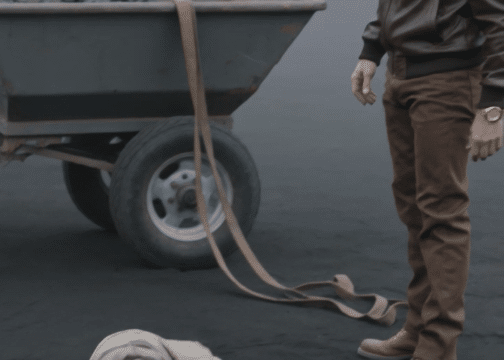
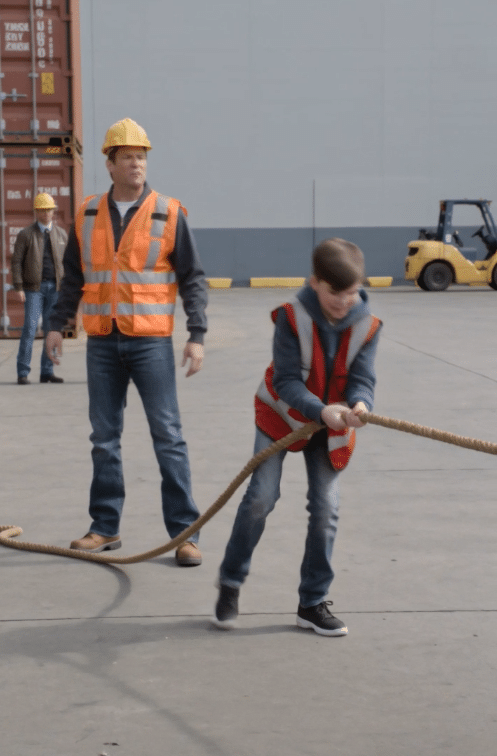
The boy’s voice barely carried across the loading yard. His small hands were wrapped around a thick cargo rope, his faded jeans streaked with dust, and an old gray hoodie hung beneath a reflective vest several sizes too large. Every time he leaned backward, the enormous bundle of freight scraped across the concrete by an inch, then stopped.
Standing over him, the dock crew boss looked at the boy as if he were something that had been dragged in with the garbage.
“Trash. Pull it alone.”
The man wore a spotless orange reflective vest, a yellow hard hat, and black gloves that made his clenched fists look even larger. At thirty-nine, he had spent years learning how to make people afraid of disappointing him. He knew which workers needed their wages badly enough to tolerate insults, which fathers would swallow their pride to keep a job, and which young faces could be frightened into obedience.
The boy was fifteen.
His name was Noah Bennett, and he was trying to help his father finish a shift neither of them could afford to lose.
The cargo bundle was enormous, secured with industrial straps and a drag rope that had been intended for a team of workers. The boss had ordered Noah to move it alone because the other men were busy unloading a shipment that had arrived late. The load barely budged, but the boss seemed less interested in getting the work done than in proving that he could force someone smaller to suffer.
Noah dug his shoes into the concrete and pulled again.
The rope tightened across his palms. His shoulders trembled. Behind him, his father, Daniel, stood beside a stack of containers, watching with a terror he could not hide. He had spent the morning asking the supervisor to assign Noah lighter tasks. Each request had been met with the same warning: one more complaint, and both of them could forget about their shifts tomorrow.
Now Daniel watched his son struggle beneath a load that should never have been his responsibility.
“Come on,” the boss snapped. “You heard me.”
Noah leaned back harder. One foot slipped on the dusty concrete, and his grip shifted.
That was all it took.
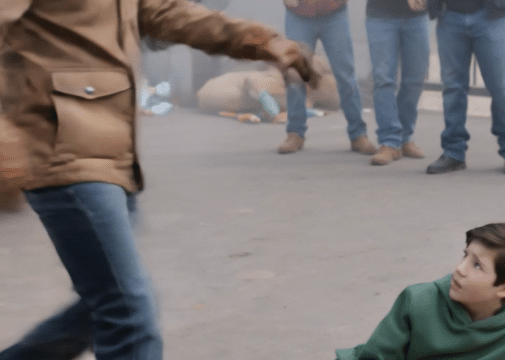
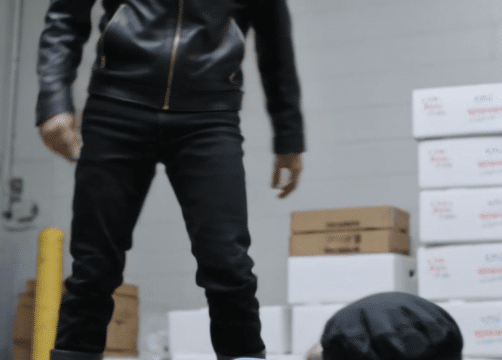
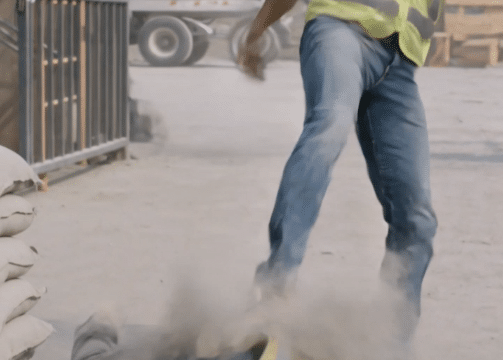
The boss stepped beside the cargo line and drove a brutal kick into Noah’s chest. The boy was knocked backward, landing hard near the rope. His elbow scraped across the concrete, leaving a thin streak of blood against the dust.
A sharp gasp passed through the workers.
Noah tried to sit up, but the cargo bundle had begun to slide. The rope pulled taut again, dragging against his hands. His father was standing dangerously close to its path, and the boy instinctively grabbed the line to keep the load from shifting toward him.
The boss saw him holding on.
Instead of stepping away, he delivered exactly two more hard kicks, one to Noah’s back and another to his side.
Daniel moved forward.
Then he stopped.
The boss turned his head toward him, and the warning in his expression was enough to freeze the older man in place. Daniel’s hands curled into fists at his sides. He looked as though every instinct in his body was screaming at him to protect his son, while every desperate calculation about rent, food, and employment held him where he stood.
Noah remained on the ground, still gripping the rope.
The boss towered over him.
“Poor kids work before they complain.”
Nobody answered.
Several dockworkers covered their mouths. One took a step backward. Another looked down at the concrete, unable to meet Noah’s eyes. They had watched the boss humiliate people before, but this was different. This was a child, and the man standing over him seemed proud of what he had done.
Noah looked toward his father.
Daniel looked back, helplessness and shame battling across his face.
Then a black executive car came racing between the containers and braked so sharply that the sound cut through the entire yard.
A nearby forklift shut off its engine.
The driver’s door swung open.
A tall man in a long black coat stepped out, wearing a white hard hat that looked strangely out of place among the battered equipment and dusty work clothes. His black leather shoes struck the concrete in steady, deliberate steps. He looked at the boy on the ground, then at the boss standing above him.
The expression on his face changed.
He crossed the remaining distance without asking a single question.
Then he turned toward the man in the orange vest.
“You just put your hands on the wrong worker.”
The boss stared at him, confusion briefly overpowering his anger.
“The wrong worker?”
He had no idea that those three words had just brought the most dangerous moment of his career to the loading yard.
Act II
To understand why the man in the black coat had arrived at precisely the wrong moment for the boss, it was necessary to understand the place he controlled—and the people who had been suffering inside it.
The port belonged to Richard Whitmore, a fifty-eight-year-old businessman whose name appeared on shipping contracts, property records, and the glass doors of the administrative building overlooking the harbor. His company moved millions of dollars in cargo every month. Its clients included major retailers, manufacturers, and shipping firms that expected their goods to travel through the yard quickly and efficiently.
Richard had built his reputation on one principle: a business could be demanding without becoming cruel.
At least, that was what he believed.
For years, he had relied on reports from department heads, quarterly reviews, and carefully prepared presentations to tell him how the port was operating. Productivity was high. Shipments were moving on schedule. Labor costs remained under control. Every official report suggested that the loading yard was running better than ever.
But reports had a way of hiding the people who paid for their numbers.
The boss, Grant Holloway, understood that better than anyone.
Grant had been hired to manage a section of the dock where freight was transferred between storage areas and outbound trucks. He was not the port’s owner, nor was he a senior executive. His authority came from a narrow slice of responsibility, a radio clipped to his vest, and the knowledge that temporary workers could be replaced faster than they could file complaints.
He had learned to turn that limited authority into something resembling absolute power.
If a worker missed a target, Grant threatened to remove him from the schedule. If someone questioned an unsafe assignment, he called the person lazy. If a man needed extra hours to pay his bills, Grant reminded him that hundreds of people would gladly take his place.
And when someone was too poor to fight back, Grant treated poverty as proof that the person deserved less respect.
Daniel Bennett had been working at the port for nearly six months. Before that, he had repaired commercial refrigeration units, a trade he had practiced for most of his adult life. Then an accident at a warehouse damaged his shoulder, and a series of medical bills consumed the savings he and his late wife had left for their son.
The injury had healed enough for Daniel to return to physical work, but not enough to compete with younger men on every assignment. He took whatever shifts he could find, often leaving home before sunrise and returning after Noah had already fallen asleep.
Noah had started helping because the bills did not care how old he was.
His school attendance had become irregular during the worst months. He had missed classes to accompany his father to job interviews, help repair a leaking roof, and watch the family car when its engine began making a sound Daniel could not afford to investigate. Eventually, Daniel allowed him to accompany him to the port on a few weekends, believing the boy would be safe doing simple errands near the office.
He never intended for Noah to become part of the dock crew.
But Grant had other ideas.
The first time he saw Noah carrying a coil of rope, he laughed and asked whether Daniel had brought his son to replace a missing worker. Daniel explained that the boy was only helping with light tasks and would leave before the heavy unloading began.
Grant smiled.
It was the kind of smile that made Daniel wish he had never spoken.
“Then he won’t mind proving he’s useful,” Grant had said.
After that, Noah was occasionally ordered to move equipment, carry supplies, or assist workers who were already overloaded. Whenever Daniel objected, Grant reminded him that the port had no obligation to keep an injured laborer on its payroll.
Daniel knew the arrangement was wrong. Noah was a minor, and the yard contained moving machinery, heavy freight, and hazards that even experienced workers treated with caution. But every time he considered taking his son away for good, he imagined the overdue rent notice on the kitchen counter and the empty space in their refrigerator.
He told himself he could protect Noah by staying close.
That morning, he had been wrong.
What Daniel did not know was that Richard Whitmore had already begun questioning the numbers Grant submitted. The reports showed that labor costs had fallen while productivity had climbed to extraordinary levels. Temporary staffing expenses were unusually low, yet shipments were being moved faster than in previous years.
On paper, Grant looked like a remarkable manager.
In reality, he had been pushing his workers harder, suppressing complaints, and quietly shifting tasks onto people who had no formal power to refuse.
Richard had asked the human resources department for an unannounced operational review. Rather than send another executive to announce the visit, he decided to inspect the yard himself.
He had expected to find paperwork problems.
Instead, he found a fifteen-year-old boy on the concrete, a frightened father standing several feet away, and a manager who appeared to believe that his position gave him the right to hurt them both.
Richard looked down at Noah.
Then he looked at Daniel.
“Get medical help,” he ordered the nearest worker. “Now.”
For the first time that morning, someone moved toward the boy without looking to Grant for permission.
But Grant still believed he could talk his way out of what had happened.
He had no idea how much Richard already suspected.
Act III
Grant’s confidence lasted only a few seconds.
Richard stepped directly in front of him, and the boss reacted with the expression of a man who had suddenly discovered that the rules he enforced on everyone else might apply to him.
“You can’t just walk into my operation and start giving orders,” Grant snapped.
Richard said nothing.
Grant’s eyes moved toward the black car, then the white hard hat, then the men who had stopped working to watch. Something about the scene unsettled him, but pride would not allow him to retreat.
“I handle this section,” he continued. “I know what these workers need. If someone can’t do the job, that’s my problem to deal with.”
Richard’s jaw tightened.
“You call kicking a child in the chest dealing with a problem?”
“He was refusing an order.”
“He told you the load was too heavy.”
“He wasn’t pulling hard enough.”
Richard glanced at the cargo bundle. Its size was obvious, even to someone who had never worked a dock. The drag rope was designed for a coordinated team, and the markings on the freight tag indicated a load that required controlled movement and adequate personnel.
Grant had not merely assigned Noah a difficult task. He had ordered a child to move industrial cargo alone, then attacked him when the task proved impossible.
Richard stepped closer.
Grant raised his hands slightly, not in surrender but in the familiar gesture of someone preparing to explain why the obvious truth was not the whole story.
“You don’t understand how this place works,” he said. “Deadlines cost money. Clients don’t care about excuses. I have a schedule to maintain.”
“And you think that gives you the right to hurt people?”
“I think somebody has to make them work.”
Richard’s fist struck before Grant could finish his next sentence.
The punch landed hard across Grant’s face, sending him stumbling backward. He caught himself awkwardly, one hand flying to his mouth. When he looked at his glove, a thin trace of blood marked his lip.
For a moment, the entire loading yard seemed to stop breathing.
Richard stood over him, his expression cold.
“You just put your hands on the wrong worker.”
The words were no longer a warning. They were a statement of fact.
Grant stared at him, stunned and furious, but the anger was already being overtaken by something less familiar.
Fear.
He had spent years making other people feel small. He knew exactly how power looked when it was used to intimidate someone who had nowhere else to go. Now he was on the receiving end of a force he could not threaten, schedule, or dismiss.
“The wrong worker?” he repeated, his voice thinner than before.
Richard did not answer immediately.
He turned toward the medical responder who had arrived and watched as the man knelt beside Noah. The boy was conscious, frightened, and struggling to catch his breath. His scraped elbow was minor compared with the force of the assault, but nobody could yet be certain that he had escaped more serious injury.
Daniel finally reached his son.
He dropped to his knees beside him, careful not to pull at the boy’s arms, and asked him to look at his face. Noah did, though his eyes kept drifting toward Grant.
“I’m here,” Daniel whispered. “I’m right here.”
The words came out broken.
Noah had been trying to protect his father even while he was being hurt. Daniel understood that now, and the realization cut deeper than the sight of the boy on the ground. He had brought Noah into a place where a man could mistake desperation for permission, and he had stood still when his son needed him most.
Richard saw the father’s expression.
He had witnessed arguments over money, contracts, and ownership. He had watched executives defend decisions that cost thousands of workers their jobs. But the sight of Daniel kneeling beside his son made the consequences of Grant’s management impossible to reduce to a spreadsheet.
Richard turned to the workers.
“I want every person who saw what happened to give a statement,” he said. “Nobody is going to lose a shift, a contract, or a paycheck for telling the truth.”
The men exchanged uncertain glances.
For years, Grant had taught them that silence was the price of survival. Some had seen him humiliate workers for asking for gloves. Others had watched him threaten a man who refused to operate damaged equipment. One employee had quietly reported unsafe assignments months earlier, only to find his hours cut the following week.
Nobody had proof that Grant had ordered the cuts.
Nobody had been willing to challenge him.
Until now.
Richard removed a small notebook from his coat and began writing down names, times, and the details of what he had seen. Then he asked the workers to preserve any dispatch records, messages, or assignment sheets connected to the morning’s shipment.
Grant pushed himself upright.
“You can’t do this,” he said. “You don’t have the full story.”
Richard finally looked at him.
“Then you’ll have the opportunity to explain every part of it.”
Grant swallowed.
He had assumed the port owner’s arrival was the end of the confrontation. He did not yet understand that the punch was the least of his problems.
Because Richard had not come to the yard simply to observe a difficult shift.
He had come looking for the truth behind a set of numbers that no longer made sense.
And Noah Bennett had just exposed the human cost of those numbers.
Act IV
By noon, the loading yard had changed.
The cargo bundle remained where it had stopped, surrounded by workers who had finally been allowed to step away. A safety officer documented the assignment, while another employee photographed the rope and the freight markings. Noah was taken for a medical evaluation, with Daniel beside him and Richard arranging transportation.
Grant was ordered to surrender his radio and remain away from the work area while the incident was investigated.
He protested loudly.
He insisted that Richard had overreacted. He claimed that the boy had interfered with legitimate operations, that Daniel had allowed his son to enter the yard, and that the entire incident had been exaggerated by frightened workers who did not understand the pressures of the job.
But the more he spoke, the more questions his explanations created.
Who had authorized Noah to perform the assignment?
Why had a load intended for coordinated handling been assigned to one person?
Why had Grant continued the punishment after the boy fell?
And why were several workers suddenly willing to describe earlier incidents that had never appeared in official reports?
The answers began to emerge from the records.
An internal review found that Grant had repeatedly marked delayed shipments as worker noncompliance, even when the delays had resulted from understaffing or equipment problems. Those entries had justified disciplinary warnings and the removal of shifts from employees who challenged his decisions.
Several workers had also been assigned tasks outside their training. In one case, a laborer had refused to move an unstable load and was threatened with termination. In another, a temporary employee had reported a damaged lifting strap, only to be told that stopping the operation would cost everyone their overtime.
The reports were not isolated misunderstandings.
They formed a pattern.
Grant had created a system in which workers were punished for identifying problems, then blamed for the consequences when those problems became impossible to ignore. The numbers looked efficient because the cost of that efficiency had been pushed onto the people least able to protest.
Richard read the records in silence.
He had believed that the port’s procedures were strong enough to protect workers without requiring him to watch every supervisor personally. That belief had been convenient. It had also allowed a man like Grant to build a private kingdom inside a business whose public reputation depended on safety and accountability.
Richard could not undo what had happened to Noah.
But he could stop pretending that the problem began and ended with one violent man.
The investigation was expanded to include staffing decisions, safety violations, complaints, and disciplinary actions under Grant’s supervision. Human resources was instructed to review every employment record he had influenced. The company also preserved the relevant dispatch logs and camera footage for examination by the appropriate authorities.
When the workers learned that their statements would be protected, the silence began to break.
One man described being called useless in front of an entire crew. Another admitted that he had concealed a shoulder injury because he feared losing his place on the schedule. A woman who handled dispatch records explained that Grant had repeatedly demanded unrealistic turnaround times, then blamed the people who could not meet them.
Their stories were different.
The pattern was the same.
Grant had treated fear as a management tool and obedience as proof that he was right.
Now the people he had frightened were finally being heard.
Late that afternoon, Richard visited Noah and Daniel after the medical evaluation. Noah was tired and shaken, with his elbow bandaged and his father sitting close enough to reach him without stretching. Daniel stood when Richard entered, instinctively straightening his worn jacket as though he were about to be questioned by another supervisor.
Richard stopped him.
“You don’t have to stand for me,” he said.
Daniel hesitated, then slowly sat down.
“I should have stopped him,” Daniel said. “I should’ve taken Noah away.”
“You were trying to protect your family’s livelihood.”
“I was protecting a paycheck.”
“You were trying to survive,” Richard replied. “The responsibility for what happened belongs to the person who chose to hurt your son.”
Daniel looked toward Noah, who was watching them quietly.
For the first time since the incident, his shoulders lowered a little.
Richard explained that Grant would not return to his position while the investigation continued. The company would cooperate with any external inquiry, and the records would be made available to the proper authorities. No employee would be punished for speaking honestly about the working conditions.
Then Richard addressed the question Daniel had been afraid to ask.
“What happens to our jobs?” he said.
“You won’t be asked to return to that environment as though nothing happened,” Richard answered. “We’ll review your employment situation separately, and we’ll make sure your son isn’t put in that position again.”
Daniel’s eyes filled, though he tried to hide it.
He had spent months believing that every request for fair treatment could cost him the only work he had. Now the owner of the port was sitting across from him, promising to investigate the very system Daniel had been too frightened to challenge.
But Noah spoke before his father could respond.
“Are the other workers going to be okay?”
Richard turned toward him.
The boy was still pale, still shaken, and still too young to have learned how expensive compassion could become in a place ruled by fear. Yet his first question was not about Grant or the pain in his chest.
It was about the people who had watched him fall.
Richard gave him an answer he could stand behind.
“They’re going to have a chance to tell the truth without being punished for it.”
For the first time that day, Noah looked away from the door as though he no longer expected Grant to walk back through it.
The investigation would take time. The company would have to examine its own failures, and the appropriate authorities would determine what consequences followed the assault. Richard could suspend a manager and order records preserved, but he could not declare himself judge and jury over every question that remained.
What he could do was ensure that the truth would no longer depend on Grant’s permission.
And that was exactly what frightened the man most.
Act V
Three weeks later, the port looked almost the same from the road.
Containers rose in towering rows. Forklifts moved through marked lanes. Trucks arrived, cargo was transferred, and ships waited offshore for their scheduled departures. To someone passing by, it was an ordinary working port, busy with the familiar machinery of commerce.
But inside the company, the old rules were coming apart.
Grant Holloway had been dismissed after the investigation confirmed the assault and documented serious violations of workplace policy. The evidence had been referred to the appropriate authorities, who would determine any further consequences. The company also began reviewing the disciplinary actions and lost shifts connected to his management, with particular attention to workers who had raised safety concerns.
Richard ordered changes that reached beyond the man who had kicked Noah.
Heavy cargo could no longer be reassigned informally to a single worker when the handling procedure required a team. Supervisors had to document safety objections rather than classify them as refusal to work. Employees gained a direct reporting channel outside their department, and retaliation for making a good-faith complaint became grounds for disciplinary action.
The company also reviewed its procedures for visitors and minors, making clear that children were not to be used as substitutes for trained labor.
Those changes could not erase the sight of Noah lying on the concrete. They could, however, make it harder for another manager to create the same conditions and call them efficiency.
For Daniel, the weeks that followed were a mixture of relief and uncertainty.
He had worried that speaking honestly would cost him his livelihood. Instead, the company offered him a different position after evaluating his experience with equipment repair. It was work he knew how to do, work that placed his skills ahead of the limits of his injured shoulder.
He accepted cautiously.
Daniel had learned that promises could sound convincing in an office and disappear as soon as the door closed. He waited for the conditions to change before allowing himself to believe that his life might be changing with them.
Noah returned to school.
At first, he struggled to concentrate. A slammed locker could make him tense. The sight of a man in an orange vest made his hands tighten before he realized why. He hated that a few seconds in the loading yard had followed him into places where nobody knew his name.
His father did not tell him to be brave.
Instead, Daniel listened when Noah talked, sat beside him when he could not sleep, and reminded him that being frightened did not mean he was weak. They began rebuilding the ordinary routines that had once seemed too expensive to maintain: dinner at the kitchen table, homework before bed, and Saturday mornings without a shift hanging over their heads.
One evening, Noah asked his father why he had frozen when Grant attacked him.
Daniel stared at the table for a long time.
“Because I was scared he’d take everything we had,” he admitted. “And I thought if I stayed quiet, I could keep you safe.”
Noah looked down at his hands.
“I thought if I kept holding the rope, it wouldn’t hit you.”
The silence that followed was heavier than either of them expected.
Daniel reached across the table and took his son’s hand.
“You should never have had to make that choice,” he said. “That was never supposed to be your responsibility.”
Noah nodded, but tears slipped down his face anyway.
For weeks, he had carried the belief that he had somehow failed because he could not move the cargo, because he had fallen, because he had not been strong enough to stop the man who hurt him. Now his father was telling him the truth he had needed to hear from the beginning.
The load had been too heavy.
The assignment had been wrong.
And the person who chose violence was responsible for it.
A month after the incident, Richard invited Daniel and Noah to the port’s administrative building. Daniel arrived in his cleanest jacket, still uncertain about why the owner wanted to see them again. Noah wore an ordinary sweatshirt and jeans, looking younger than he had on the day of the assault.
Richard met them without a conference room full of executives or a prepared speech.
He handed Noah a sealed envelope.
Inside was a letter confirming that the company had established a worker safety initiative named in honor of the principle Noah had forced it to confront: no shipment, deadline, or financial target was more important than the people moving it. The initiative would fund additional safety training and provide support for employees who needed to report dangerous assignments.
Noah read the letter twice.
“Is it because of me?” he asked.
“It’s because what happened to you should never have happened,” Richard replied. “But the problems were here before you arrived. Your experience made it impossible for us to keep pretending we hadn’t seen them.”
Noah considered that.
He did not want to be remembered as the boy who had been kicked in a loading yard. He did not want the worst afternoon of his life to become the only thing people knew about him. But he understood what Richard was saying: the truth mattered because it reached beyond one person.
Daniel thanked Richard, though the words felt inadequate.
Richard shook his hand.
Then he turned to Noah.
“I owe you an apology, too.”
The boy looked surprised.
“You didn’t hurt me,” Noah said.
“No,” Richard answered. “But I own the place where it happened. I trusted reports that made everything look fine. I should have asked harder questions before a child ended up on that concrete.”
It was not a dramatic speech, and Richard did not ask Noah to forgive him. He simply accepted that responsibility did not end with the person who delivered the blow.
That mattered more to Daniel than any promise of compensation could have.
As they left the building, Noah glanced back toward the loading yard. The containers were still stacked against the sky, and the ropes still lay coiled beside the freight. The port had not become a gentle place overnight. It was still a workplace full of deadlines, pressure, and difficult decisions.
But the men moving the cargo were no longer expected to confuse cruelty with authority.
Noah stopped beside his father.
“Do you think people will remember what happened?” he asked.
Daniel considered the question.
“Some will remember the man who hurt you,” he said. “Some will remember the owner who stopped him. But I hope they remember something else.”
“What?”
“That you told the truth even when you were scared.”
Noah looked toward the distant cranes, where a new shipment was being prepared for movement. For a moment, he remembered the rope cutting into his palms, the weight refusing to budge, and the voice that had called him trash because he could not do the impossible.
Then he remembered the sound of the black car braking between the containers.
The sudden silence.
The words that changed everything.
You just put your hands on the wrong worker.
Grant had believed that a poor boy had no power because he wore old clothes, needed a paycheck, and could be ordered around by anyone with a radio and a title. He had mistaken desperation for weakness and authority for ownership of another human being.
He had been wrong about both.
The boy had not needed to be rich, important, or secretly powerful to deserve protection. He had needed adults to recognize that his dignity was never theirs to take away.
And the port owner had not made Noah valuable by arriving in a black car.
Noah had been valuable before the car appeared, before the punch landed, before a single worker dared to speak.
That was the truth Grant had never understood.
And it was the truth the entire loading yard would remember long after his orange vest was gone.
Make Richard’s confrontation legally believable