Act I
The paper had barely touched the floor when seventeen-year-old Brandon Whitmore looked down at it, then slowly raised his eyes toward the boy standing in front of him.
“Pick it up,” Brandon ordered, pointing at his expensive black leather shoe. “And while you’re down there, you might as well make yourself useful.”
Ethan Carter froze in the middle of the hallway, his arms full of textbooks and worn notebooks. Around them, students in perfectly pressed uniforms moved aside, forming a loose circle as they sensed that something ugly was about to happen.
Ethan glanced at the fallen paper.
It was a page of handwritten notes he’d spent most of the previous night preparing for his advanced mathematics class. One corner had folded beneath Brandon’s shoe, but the paper itself was still clean.
“I’m sorry,” Ethan said quietly. “I’ll pick it up.”
He bent down.
Brandon’s expression changed.
The rich boy had expected Ethan to hesitate, to argue, perhaps even to make some pathetic attempt at defending himself. Instead, the scholarship student had simply obeyed, as though the humiliation were an ordinary part of his day.
That irritated Brandon more than defiance would have.
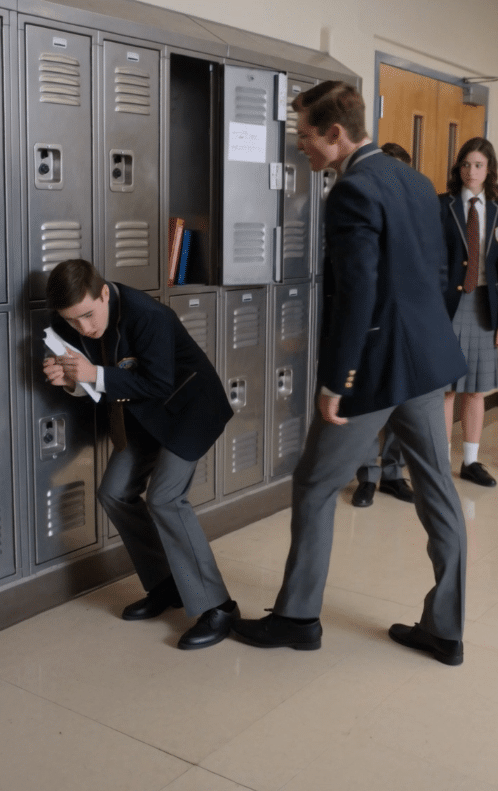
He stepped forward and drove a forceful kick into Ethan’s chest.
The impact sent Ethan backward into the polished lockers. His books flew from his arms, striking the stone floor and scattering across the hallway. He crumpled beside them, one hand pressed against his chest, struggling to draw a comfortable breath.
A thin trace of blood appeared on his forearm where it had scraped against the rough edge of a locker.
For one terrible second, nobody moved.
A girl near the honor board covered her mouth. Two boys exchanged frightened glances. Someone at the far end of the corridor whispered Ethan’s name, but no one stepped forward.
Brandon looked down at the boy he’d just kicked.
“Trash,” he said with a contemptuous smile. “Scholarship kids wipe shoes.”
Ethan’s fingers trembled as he reached for his scattered books. His face had gone pale, but he refused to cry.
He knew what happened to students who made trouble at Westbridge Academy.
And he knew what happened to students who made trouble for the Whitmore family.
Brandon crouched slightly, bringing his face closer to Ethan’s.
“What’s wrong?” he mocked. “You were so polite a second ago.”
Ethan tried to push himself upright.
Brandon delivered two more forceful kicks, one to Ethan’s back and another to his side. Ethan recoiled, curling instinctively around himself as pain shot through him.
The hallway filled with frightened gasps.
Still, nobody intervened.
Brandon straightened his immaculate blazer and looked around at the watching students, pleased to find that his audience remained exactly where he wanted it.
“Look at him,” he announced. “This is what happens when people forget their place.”
Ethan gathered one book against his chest, his eyes lowered.
Brandon stepped over another notebook.
“You belong under this hallway,” he said. “Not in my school.”
The words struck harder than the kicks.
Ethan had heard variations of them before. From classmates who assumed his worn shoes meant he was poor. From parents who whispered about scholarship students at school events. From people who treated admission to Westbridge as something their money had purchased for their children.
But this time, something about Brandon’s confidence felt different.
He wasn’t merely insulting Ethan.
He was convinced he had the right to decide whether Ethan deserved to exist in that hallway at all.
Then the door beside the principal’s office flew open.
The handle struck the wall with a sharp crack.
And the man who stepped out behind the principal saw Ethan on the floor.
He stopped walking.
For a moment, the entire hallway seemed to lose its air.
Because the gray-haired man in the dark suit wasn’t just another school administrator.
He was the chairman of Westbridge Academy’s board of trustees.
And Brandon had no idea what that man had come to the school to decide.
Act II
Westbridge Academy was the kind of school where family names mattered almost as much as grades.
Its stone buildings stood behind iron gates, its classrooms were equipped with the latest technology, and its graduates went on to attend the country’s most prestigious universities. Parents paid extraordinary sums to secure their children’s places, believing that a Westbridge education offered something money alone could not buy: access to the right people.
For the Whitmores, that access had become a family tradition.
Brandon’s father, Richard Whitmore, owned a powerful investment firm. His mother served on several charitable foundations, and the family name appeared on plaques in hospitals, museums, and university buildings.
Brandon had grown up surrounded by people who rarely told him no.
When he broke something, someone else paid for it. When he insulted someone, his father called it a misunderstanding. When teachers complained about his behavior, his parents reminded the school how generously their family supported its programs.
Over time, Brandon had come to believe that consequences were something that happened to other people.
His classmates knew it, too.
Some admired him because he could afford anything he wanted. Others stayed close because being invited into his social circle meant access to parties, expensive vacations, and the sort of connections their parents valued.
Most simply feared becoming his next target.
Ethan Carter had become an especially convenient one.
He arrived at Westbridge two years earlier after earning a full academic scholarship through a fiercely competitive admissions process. His application scores had been extraordinary, and his teachers had described him as one of the most disciplined students they had ever encountered.
But his family couldn’t afford the school.
His father, Daniel Carter, had died when Ethan was twelve, leaving his mother, Laura, to raise him alone. She worked long shifts as a nurse at a local hospital, sometimes picking up extra hours whenever the household bills threatened to outgrow her paycheck.
There had been no private tutors for Ethan. No expensive summer programs. No family connections to open doors.
There had only been a library card, borrowed textbooks, and a mother who insisted that circumstances could limit a person’s opportunities without defining their worth.
When Ethan received his scholarship letter, Laura had cried over the kitchen table.
She had held the letter with both hands, reading it again and again as though the words might disappear.
“You earned this,” she’d told him. “Never let anyone convince you that you don’t belong somewhere you’ve worked hard to reach.”
Ethan had carried those words into Westbridge.
He had also learned how quickly other students could turn his scholarship into a weapon.
Brandon first mocked his shoes. Then his lunch. Then the fact that he stayed in the library while other students went shopping after class.
Whenever Ethan performed well on an exam, Brandon called him a teacher’s pet. When he won a place on the school’s academic team, Brandon suggested the judges had taken pity on him.
Ethan tried ignoring him.
He reported one incident to a teacher, only to hear that Brandon was under considerable pressure and that Ethan should avoid provoking him.
The advice had stayed with him.
Avoid provoking him.
As though the responsibility for Brandon’s cruelty belonged to the person receiving it.
So Ethan became careful. He walked the longer route between classes to avoid Brandon’s favorite corridor. He kept his books close to his chest. He learned to recognize the sound of Brandon’s laughter before he even turned a corner.
And he stopped telling his mother about most of what happened.
Laura already worried about money. She worried about the hours she worked, the car that needed repairs, and the possibility that Ethan might lose the opportunity she’d sacrificed so much to help him keep.
He couldn’t bear the thought of adding fear to her exhaustion.
But there was something Ethan didn’t know about Westbridge.
His scholarship had recently attracted the attention of the board chairman, a man named Arthur Bennett.
Bennett had spent more than three decades building a reputation as a demanding but principled education advocate. He had donated to public schools, funded university programs for disadvantaged students, and challenged institutions that used charitable language while quietly protecting privilege.
Several months earlier, he’d requested a review of Westbridge’s scholarship program.
The numbers had raised questions.
Some deserving applicants had been rejected despite exceptional academic records. Others had received generous awards despite weaker qualifications. A handful of the school’s largest donors seemed to enjoy unusual influence over admissions decisions.
Arthur had insisted on examining the process personally.
Ethan Carter’s application was among the files he had requested.
What he found surprised him.
Ethan had achieved one of the highest entrance examination scores in the school’s recent history. His teachers described him as diligent, thoughtful, and unusually willing to help struggling classmates.
His scholarship had not been a favor.
It had been earned.
Arthur had also noticed something else: Ethan’s father had once worked on a project connected to Westbridge’s original educational foundation.
It was an old detail, easy to overlook, but it had led Arthur to request additional records.
That morning, he had arrived at the school to discuss his findings with the principal.
He expected to review financial documents, question the admissions committee, and determine whether the scholarship program was being administered fairly.
He had not expected to walk out of a meeting and find one of its beneficiaries lying injured on the floor.
And he certainly hadn’t expected the boy standing over him to be a Whitmore.
Because the instant Arthur recognized Ethan, he understood that the investigation had just become something far more urgent.
Act III
Arthur Bennett moved before the principal could say a word.
He crossed the hallway and positioned himself between Brandon and Ethan.
“Step away from him,” he said.
His voice wasn’t loud, but it carried the kind of authority that made people stop talking.
Brandon blinked in surprise.
For a second, he looked almost offended that an adult had interrupted him. Then he noticed the principal standing behind Arthur, his expression rigid and his face drained of color.
Brandon’s confidence faltered.
“Sir, this is a misunderstanding,” he began.
Arthur didn’t look at him.
Instead, he turned toward Ethan and crouched beside the scattered books.
“Can you breathe?” he asked.
Ethan nodded faintly, though the movement seemed to hurt.
“Don’t try to stand yet. The nurse is coming.”
Arthur glanced at the thin blood mark on Ethan’s arm. His jaw tightened, but his voice remained controlled as he asked the principal to summon the school nurse and contact emergency medical services for an assessment.
Only after ensuring that help was on its way did he rise to face Brandon.
“What happened here?”
Brandon’s eyes darted toward his friends.
They suddenly found the floor fascinating.
“He dropped something,” Brandon said. “I told him to pick it up.”
“And then?”
“He got in my way.”
Arthur studied him.
“That doesn’t answer my question.”
Brandon swallowed.
“He was being disrespectful.”
The principal closed his eyes briefly.
Arthur had spent years listening to powerful people explain away ugly decisions. He knew the vocabulary of evasion: misunderstanding, provocation, unfortunate incident, regrettable lapse in judgment.
Brandon had already reached for nearly every excuse.
Arthur glanced at the fallen paper near the expensive shoe.
Then he looked at Ethan, who was trying to sit up despite the pain.
“Did you touch his shoe?” Arthur asked gently.
Ethan shook his head.
“I was just picking up my paper.”
Brandon scoffed.
“Oh, come on. You’re acting like I nearly killed you.”
Several students flinched.
Arthur turned slowly.
It was the first time Brandon seemed to realize that the chairman wasn’t merely annoyed.
He was disgusted.
But Brandon still didn’t understand the danger he was in.
His father had taught him that every problem could be solved through a phone call. He assumed the principal would eventually calm everyone down, that the witnesses would be reminded to remain quiet, and that his family’s donations would make the entire incident disappear.
He had no idea that Arthur Bennett had spent the previous hour discussing precisely that kind of institutional protection.
Only minutes before leaving the meeting room, Arthur had placed a folder on the principal’s desk.
Inside were records suggesting that Westbridge’s scholarship program had been influenced by wealthy donors for years. Several applications had received unusual treatment, and internal correspondence indicated that at least one administrator had been pressured to reconsider decisions after complaints from influential parents.
Arthur had not yet reached a final conclusion.
He had wanted more evidence before making accusations.
Then he’d opened the door and found a scholarship student being kicked in the hallway while everyone watched.
The sight had made the school’s written policies seem painfully inadequate.
Brandon adjusted his blazer.
“Do you know who my father is?” he demanded.
Arthur stared at him for a long moment.
“Yes,” he said. “I do.”
The answer seemed to reassure Brandon.
“My family has supported this school for years. You can’t just walk in here and—”
“Your family supports this school?”
Arthur interrupted him quietly.
“Then you should understand why what you did matters.”
Brandon’s mouth tightened.
Arthur turned to the principal.
“I want the hallway cameras preserved. I want written statements from every witness, and I want the student’s family contacted immediately. No one is to pressure him or any other student about what happened here.”
The principal nodded.
“Of course.”
“And I want the school’s disciplinary and scholarship records secured until the board has completed its review.”
Brandon’s face changed.
“Wait. What review?”
Arthur finally looked directly at him.
“The one your behavior has made impossible to postpone.”
For the first time, Brandon looked frightened.
But Arthur wasn’t finished.
He stepped closer, his voice low enough that the entire hallway had to fall silent to hear him.
“That scholarship just showed me who doesn’t belong here.”
Brandon stared at him.
The words didn’t make sense.
He had heard people talk about Ethan’s scholarship for two years. He had watched teachers praise Ethan’s grades and administrators celebrate the program during school events.
He had always assumed the scholarship existed because Westbridge wanted to look generous.
Now the chairman was speaking as though the scholarship had revealed something about Brandon himself.
Brandon took a half step backward.
“Doesn’t belong?”
Arthur’s expression hardened.
And in that instant, Brandon understood that the man standing before him was not someone his father could easily dismiss.
Act IV
What happened next would be discussed at Westbridge for months.
Arthur’s anger was unmistakable, but the moment did not become a lesson in violence. He resisted the impulse to turn the hallway into another place where the powerful settled disputes through force.
Instead, he kept himself between Brandon and Ethan while the principal called for immediate medical attention.
Brandon tried to speak again.
He complained that nobody had heard his side. He insisted that Ethan was exaggerating. He demanded that the principal call his parents.
Each sentence made the situation worse.
Arthur listened until Brandon finally stopped.
“Your side will be heard,” he said. “So will every witness’s. But you will not intimidate this student, and you will not leave here believing your family’s money makes you immune from the rules.”
The hallway remained silent.
For years, Brandon had mistaken fear for respect. He had believed that because people moved out of his way, they must consider him important.
Now the same students who had laughed at his jokes were looking at him with something he had never learned how to handle.
Disappointment.
The principal knelt beside Ethan as the nurse arrived. Ethan was helped into a more comfortable position and examined while another staff member gathered the scattered books.
Arthur remained nearby.
He noticed that even while injured, Ethan kept trying to retrieve the fallen pages of his notebook.
“Leave those for now,” Arthur told him gently. “Your health comes first.”
Ethan looked up.
“I don’t want to lose them.”
Something in the answer made Arthur pause.
“What is it you’re working on?”
Ethan hesitated.
“An application for a summer research program. The deadline is next week.”
Arthur glanced at the pages.
They were filled with equations, diagrams, and careful annotations. The handwriting was small but precise, with corrections in the margins and references to books Ethan had apparently consulted on his own.
It wasn’t merely schoolwork.
It was evidence of a mind that had kept moving forward despite everything around it.
Arthur looked back at the principal.
“Make sure his academic opportunities are protected. Nothing about today’s incident should be allowed to jeopardize his education.”
Brandon gave a bitter laugh.
“You’re really doing all this over him?”
Arthur turned.
“No. I’m doing this because of what happened to him.”
That distinction landed harder than any insult.
Brandon had spent his life believing that the importance of a person could be measured by the resources surrounding them. Arthur was telling him that the question wasn’t how much Ethan’s family could donate.
It was whether Ethan deserved to be safe.
And that was a question Brandon had never considered.
A school administrator arrived carrying a tablet. The hallway footage had been preserved, and several students had already agreed to provide statements.
Brandon looked at the screen from a distance.
He could see himself approaching Ethan. He could see the paper fall, Ethan bend to retrieve it, and his own sudden movement.
There was no ambiguity in the recording.
No shove disguised as an accident. No misunderstanding that could be corrected with a carefully worded apology.
The footage showed exactly what had happened.
Brandon turned to the principal.
“You can’t use that without talking to my father.”
“We will follow the school’s procedures,” the principal replied.
“My father will shut this place down before he lets you blame me for something like this.”
Arthur’s expression barely changed.
“Then your father will have the opportunity to explain his position to the board.”
Brandon stared.
For the first time, the possibility that his father might not be able to fix everything entered his mind.
Then Arthur asked the question that changed the entire investigation.
“Principal, did the Whitmore family have any involvement in Ethan Carter’s scholarship review?”
The principal went still.
It was a tiny reaction, but Arthur saw it.
So did Brandon.
“What does that mean?” Brandon demanded.
The principal cleared his throat.
“The scholarship decisions were made by the admissions committee.”
“That wasn’t my question.”
Silence.
Arthur continued.
“I want the original application records, the committee’s scoring sheets, and every communication concerning this student’s award. If anyone has altered a record, pressured a committee member, or retaliated against a scholarship recipient, the board needs to know.”
Brandon’s face drained of color.
He had known his father made donations to Westbridge. He had occasionally heard conversations about admissions, fundraising, and the importance of maintaining relationships with wealthy families.
But he had never imagined those conversations could become evidence in an investigation.
The principal looked toward the meeting room.
“I believe we should continue this discussion privately.”
“No,” Arthur said. “The review can continue privately. The student’s safety cannot wait.”
The nurse helped Ethan toward the infirmary, accompanied by a staff member who had been instructed to contact his mother. Arthur waited until Ethan was safely on his way before turning back to Brandon.
“You will remain here with the principal until your parents arrive.”
Brandon opened his mouth to protest.
Arthur raised one hand.
“Your privileges are not the issue right now. Your conduct is.”
Then he walked away.
The hallway slowly emptied, but the silence he left behind was different from the one Brandon had created.
This time, nobody was afraid to look at him.
They were waiting to see what happened next.
And somewhere inside the principal’s office, a file was being opened that could expose far more than one student’s cruelty.
It could reveal how long Westbridge had allowed money to speak louder than merit.
Act V
Ethan’s mother arrived at the school before the end of the afternoon.
Laura Carter came straight from the hospital, still wearing her work clothes, her hair hastily tied back and her face tight with worry. She had received a call saying Ethan had been hurt, but nobody had been able to explain exactly what had happened.
When she found him sitting in the infirmary, she stopped at the doorway.
For one moment, neither of them spoke.
Then Ethan stood carefully and moved toward her.
Laura wrapped her arms around him, holding him as though she could protect him from every cruel thing the world had ever done simply by refusing to let go.
“I’m okay, Mom,” he whispered.
She pulled back enough to look at his face.
“Don’t tell me you’re okay just because you think I have enough to worry about.”
Ethan’s expression crumpled.
He had endured the humiliation in the hallway without crying. He had kept his voice steady when Brandon called him trash. He had tried to gather his books while pain made it difficult to breathe.
But when his mother touched his cheek, he finally allowed himself to cry.
Laura held him until the trembling passed.
Arthur Bennett waited nearby, giving them privacy. When Laura was ready, he introduced himself and explained that the school would preserve the evidence, arrange for a full investigation, and take steps to protect Ethan from retaliation.
Laura listened carefully.
She was grateful, but she was also wary.
She had spent years watching people with authority promise that problems would be handled. She knew how easily a sincere statement could become a forgotten conversation once a wealthy family started making phone calls.
“Will my son still have his scholarship?” she asked.
Arthur answered without hesitation.
“His scholarship will not be threatened because he reported an assault. And the board will examine the program itself to make sure no student has been treated unfairly.”
Laura searched his face.
“I’m not asking for special treatment,” she said. “I just want him to have the same chance everyone else has.”
Arthur nodded.
“That is exactly what he should have.”
Over the following days, Westbridge changed in ways its students had never seen before.
The school secured the hallway footage and collected witness statements. Investigators reviewed the incident alongside the scholarship records Arthur had requested before the assault.
Brandon was removed from classes while the school conducted its disciplinary process. He was prohibited from contacting Ethan, directly or through friends, and the board began examining whether his previous conduct had been ignored or minimized.
His parents reacted exactly as Arthur had anticipated.
Richard Whitmore arrived with a lawyer and demanded that the school describe the incident as a mutual altercation. He argued that Brandon was a minor, that the footage lacked context, and that a suspension would be an excessive response to an emotional confrontation.
Then he threatened to withdraw the family’s donations.
Arthur listened patiently.
When Richard finished, the chairman opened a folder and placed several documents on the table.
“The board is not asking you to fund the school,” he said. “We’re asking you to understand that funding the school does not give your family authority over its students.”
Richard glanced at the papers.
The documents concerned the scholarship review.
Several communications suggested that donors had been allowed to influence admissions discussions. One internal email raised concerns about pressure to preserve relationships with families whose contributions were considered essential to certain programs.
The evidence did not establish that Richard had personally directed every questionable decision, but it raised serious enough questions to require a formal independent investigation.
His expression tightened.
“Are you accusing me of wrongdoing?”
“I’m telling you that the records will be reviewed independently, and the findings will be reported to the board.”
Richard leaned back.
For the first time, his usual confidence seemed less secure.
The school could no longer quietly dismiss the matter as a misunderstanding between students. Too many people had witnessed the assault. Too much of it had been recorded. And Arthur Bennett had made it clear that the investigation would not stop at Brandon’s behavior if the evidence pointed toward a larger institutional failure.
Brandon’s disciplinary hearing took place the following week.
He sat beside his parents in a conference room with glass walls, looking smaller than he ever had in the hallway. His lawyer spoke first, emphasizing his academic record and promising that Brandon regretted the incident.
But the witnesses told their stories.
They described the fallen paper, the demand that Ethan wipe the shoe, and the sudden kick that sent him into the lockers. They recounted the insults and the two additional kicks that followed.
The footage confirmed their accounts.
Brandon was given an opportunity to respond.
For a long time, he stared at the table.
Then he said, “I didn’t think it would become this big.”
Arthur looked at him.
“Why not?”
Brandon had no answer.
Because the truth was that he had never considered the consequences for Ethan. He had not wondered whether Ethan might be frightened to return to school, whether the assault would affect his studies, or whether his mother would spend the night worrying about him.
Brandon had only thought about what he wanted in that moment.
He had wanted obedience.
He had wanted an audience.
He had wanted to prove that a scholarship student could be forced to kneel simply because Brandon had decided he should.
The disciplinary panel concluded that his actions warranted serious consequences. Brandon was expelled under the school’s conduct policy, with the decision documented in a formal record. His parents were informed that their donations would play no role in the outcome.
The independent review continued after his departure.
It found weaknesses in the way Westbridge had handled donor influence and scholarship oversight. The board ordered reforms, established clearer admissions safeguards, and created a confidential process for students to report harassment without fear of losing their educational opportunities.
Not every question about the school’s past could be answered immediately.
But the culture of silence had been broken.
For Ethan, the most important moment came several weeks later.
He returned to the hallway where everything had happened.
The lockers had been cleaned, the floor polished, and the scattered books long since returned to their shelves. Students moved between classes as usual, carrying their bags and talking about exams, sports, and weekend plans.
At first, Ethan found himself slowing as he approached the spot where he had fallen.
Then he saw the honor board.
A new notice had been placed near the principal’s office announcing the creation of a student scholarship advisory committee. Its purpose was to ensure that students receiving financial aid had a voice in decisions affecting their education.
Beneath the notice was a letter from Arthur Bennett.
It thanked the students who had provided honest testimony and reaffirmed that no student’s financial circumstances should determine their dignity or safety.
Ethan read it twice.
He didn’t feel triumphant.
He didn’t feel as though Brandon’s expulsion had erased what happened. He still remembered the pain, the laughter that never came, and the terrible realization that an entire hallway could watch someone suffer without moving.
But he felt something else, too.
Relief.
For the first time since arriving at Westbridge, he no longer felt that he had to make himself invisible to deserve his place there.
A few days later, Arthur invited Ethan and Laura to meet with him.
He asked Ethan about his research application, his academic goals, and the subjects that interested him most. Ethan spoke cautiously at first, then with increasing enthusiasm as he explained the mathematical model he’d been developing.
Arthur listened without interrupting.
When Ethan finished, the chairman smiled.
“You know what impressed me most about your application?” he asked.
Ethan shook his head.
“Your grades were excellent. Your recommendations were excellent. But the thing that stood out was that you kept working even when nobody was watching.”
Ethan looked down at his hands.
“My mom always says that doing the right thing shouldn’t depend on whether someone sees you do it.”
Laura’s eyes filled with tears.
Arthur glanced at her.
“She raised you well.”
For the first time that afternoon, Ethan smiled without trying to hide it.
He eventually received an interview for the summer research program. His scholarship remained secure, and he continued earning excellent grades. The assault became part of his past, not the definition of his future.
Brandon, meanwhile, had to face a world that no longer rearranged itself to protect him.
His family’s wealth remained. Their homes, investments, and social connections did not disappear overnight.
But the unquestioning deference Brandon had taken for granted was gone.
His former classmates had seen what happened when he believed another person’s dignity was beneath him. His expulsion became a permanent reminder that privilege could open doors, but it could not make cruelty respectable.
Months later, Arthur Bennett passed through the same hallway on his way to another board meeting.
He noticed Ethan standing beside the honor board, explaining a difficult problem to a younger student. Ethan was patient, drawing diagrams on a scrap of paper and encouraging the student to work through each step.
Arthur paused for a moment.
Then he continued down the corridor.
He didn’t need to intervene.
Ethan was exactly where he belonged.
And that was the lesson Brandon Whitmore had never understood.
A school wasn’t made great by the families who could afford its tuition, the names engraved on its walls, or the donations displayed at its entrance.
It was made great by the students it gave a chance to succeed—and by the courage of the adults who refused to let that chance be taken away.
The day Brandon ordered Ethan to kneel, he believed he was demonstrating the power of his family.
Instead, he revealed the weakness of his own character.
And when the chairman walked out of that meeting room, the question was no longer whether a scholarship boy belonged at Westbridge Academy.
The question was whether Westbridge Academy deserved the privilege of educating him.
Make the chairman’s question more specificTrim repeated moral explanations