Act I
“Two hundred… there should be three fifty.”
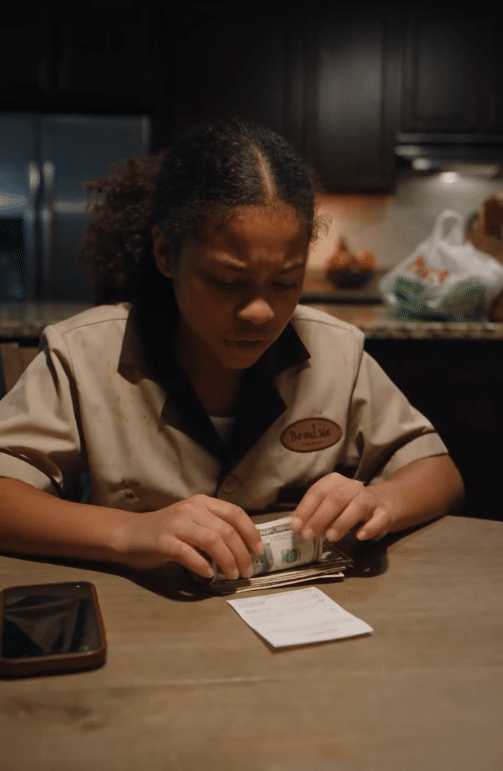
Nia counted the cash again, her fingers moving more slowly with every bill. She sat at the kitchen table in her restaurant uniform, exhausted after her shift, expecting to put her wages away and take one more small step toward the future she had been building for herself.
But the numbers refused to change.
Two hundred dollars.
She had earned three hundred and fifty.
A hundred and fifty dollars was missing.
Across the kitchen, her stepmother unpacked groceries, moving items from plastic bags to the counter as though nothing unusual had happened. Dressed in red, with her glossy black bob neatly framing her face, she barely glanced at the cash spread across the table.
Nia looked down at it again.
She had worked for every dollar. Every shift meant standing for hours, following orders, serving customers, and coming home tired while other teenagers her age spent their evenings doing homework or relaxing with friends.
She didn’t resent the work.
She wanted it.
At fourteen, Nia already understood that the things she dreamed about would not simply appear in front of her. If she wanted to go to college, she would have to save. If she wanted choices when she grew older, she would have to start building them now.
That was why she kept her wages separate.
That was why she counted them.
And that was why the missing money felt like something much bigger than a mistake.
Her stepmother continued unpacking the groceries, placing a carton on the counter before finally looking over.
“Money doesn’t grow on trees, sweetie.”
The casual remark made Nia look up.
She hadn’t asked her stepmother for money. She hadn’t complained about the cost of the groceries. She had simply counted her own wages and noticed that the amount was wrong.
Yet the response made it sound as though she were the one being unreasonable.
Nia gathered the cash into a small pile.
She counted it a third time, hoping she had overlooked a bill or miscalculated in her exhaustion. Perhaps she had made a mistake after a long shift. Perhaps the money had slipped into her bag.
But she knew how much she had earned.
She remembered counting it before putting it away.
Her father, Marcus, sat nearby in a white shirt, looking over the papers on the table. He had been quiet while Nia counted, but he was beginning to notice the tension in her voice.
Nia looked at her stepmother again.
“A hundred and fifty is missing!”
Her stepmother gave a small, dismissive look.
“Maybe you spent it. Kids have no discipline.”
The accusation landed harder than the missing money itself.
Nia felt her face grow warm. She had spent the evening working, not shopping. She hadn’t used the money for clothes, entertainment, or anything else. She had been saving it for a future she could barely afford to imagine.
She looked at the cash again.
Then she raised her eyes, her voice shaking with frustration.
“I haven’t spent a dime! This is my college fund!”
For the first time, Marcus stopped looking at the papers in front of him.
Because if Nia was telling the truth, the missing $150 wasn’t a budgeting mistake. Someone had taken money she had worked for—and then tried to make her feel guilty for noticing.
Act II
Marcus looked at the cash on the table.
He knew his daughter worked hard. He knew she had been setting money aside instead of spending every paycheck as soon as she received it. And he understood that, at fourteen, saving for college required a kind of discipline many adults struggled to maintain.
His wife’s explanation didn’t sit right with him.
Nia had counted the money carefully. She wasn’t asking anyone to replace it, and she wasn’t claiming that she deserved extra spending money. She was insisting that the amount she had earned did not match the amount she had brought home.
Marcus reached toward the paperwork.
“Let me see the pay stub.”
Nia handed it to him.
The paper was ordinary, the kind of record that could easily be overlooked after a long shift. But to Marcus, it offered something the argument did not: a number that could be checked.
He studied the stub.
His wife continued unpacking groceries, though her movements had become less casual. She shifted a bag on the counter and adjusted a carton, keeping herself occupied while Marcus read.
He didn’t rush.
He compared the amount on the paper with the cash lying in front of him. Then he looked up.
“Says three fifty. Paid in cash.”
The figure confirmed what Nia had been saying.
Her wages had been three hundred and fifty dollars.
Only two hundred remained.
For a moment, the kitchen was quiet.
The pay stub sat in Marcus’s hand, and the cash remained on the table. Nia watched her father, waiting for him to recognize what the numbers meant. She had been defending herself against the claim that she was careless, but she had no way to prove where the missing money had gone.
Now the discrepancy was no longer just her word against someone else’s.
Her stepmother turned toward them.
“Then she lost it. Case closed.”
She said it as though the document had settled the argument in her favor.
But it had done the opposite.
The pay stub showed that Nia had earned the full amount. It did not explain why the cash she possessed was short, and it certainly did not prove that she had misplaced the difference.
Marcus looked at the paper again.
His wife had offered one explanation after another, but each one depended on treating Nia as unreliable without examining the evidence. First, the girl was supposedly careless. Then she might have spent the money. Now she had supposedly lost it.
No explanation accounted for the actual numbers.
Nia could see her father thinking.
She felt a small measure of relief, but it was mixed with a familiar anxiety. Even when she had done everything right, she often found herself having to defend the fact that she had done it.
She didn’t want a fight.
She wanted her wages accounted for.
And she wanted her father to understand that the money represented more than what she could buy that week.
It represented the possibility of a different future.
Nia glanced at the pay stub in Marcus’s hand, then at her smartphone beside the table. She remembered that her restaurant manager, Mrs. Carter, paid overtime through bank transfer.
That meant there was another record.
A second source of information.
Nia reached for her phone.
Her stepmother’s expression shifted as the screen lit up.
The cash had raised the question. Now Nia was about to show her father the one record that couldn’t be dismissed as a child’s bad memory.
Act III
Nia opened her banking app.
Her movements were deliberate now. She was still upset, but she had stopped trying to defend herself with words alone. If her stepmother believed the missing money could be blamed on carelessness, Nia would show Marcus what had actually reached her account.
“Mrs. Carter pays by bank transfer too. For overtime.”
She brought up the statement and held the phone where her father could see it.
The bank record showed the transfers she had received for overtime. Those payments were still there, intact. She hadn’t withdrawn them or spent them, and she had kept them separate from the cash she brought home after her shifts.
“Every dollar is here. Untouched.”
Marcus examined the information.
The bank statement didn’t show where the missing cash had gone, but it established something important: Nia had not been casually spending all the money she earned. The overtime funds remained in her account, exactly as she said.
He looked from the phone to the pay stub.
Then he looked at the cash.
The figures told a consistent story. Nia had earned three hundred and fifty dollars in cash. She now had two hundred. Her separate bank transfers remained untouched.
The difference was clear.
A hundred and fifty dollars.
Nia watched her father compare the records. She had come into the kitchen expecting to put her wages away, and now she was presenting evidence to defend herself against an accusation she had never deserved.
The room felt different.
Her stepmother was no longer moving groceries around with the same easy rhythm. She stood near the counter, holding her handbag, her attention fixed on Marcus.
He set the pay stub down.
The evidence didn’t tell him every detail of what had happened, but it removed the easy explanation that Nia had simply spent her money and forgotten about it. Her records were consistent with what she had been saying from the beginning.
Marcus finally spoke.
“So the cash is short, but the bank money is intact.”
His wife hesitated.
The certainty she had displayed when she called Nia careless was disappearing. She had insisted the girl might have spent the money, then claimed she had lost it. But Nia had shown that her savings were still accounted for, and the pay stub confirmed the amount she should have received.
The question was no longer whether Nia could count.
It was what had happened to the missing cash.
The stepmother looked at Marcus, then down at the groceries she had been unpacking. Her fingers tightened around the handle of her handbag.
For a brief moment, she said nothing.
Nia remained seated at the table, her smartphone still in her hand. She didn’t interrupt or demand an apology. She had provided the information she possessed, and now she waited for the adults to deal with what it meant.
Marcus held his wife’s gaze.
The silence grew uncomfortable.
The missing money could no longer be waved away with a remark about discipline. The numbers had made the problem concrete, and the explanation that Nia had lost the cash no longer fit the evidence in front of them.
Her stepmother finally spoke.
“I… I borrowed it for groceries! I’ll pay it back!”
The admission changed the atmosphere instantly.
Nia stared at her.
A moment earlier, she had been told she was careless and lacked discipline. Now the woman who had blamed her was admitting that she had taken the money.
And the money had come from Nia’s college savings.
The accusation had finally turned around—but the word “borrowed” was about to become the next thing Marcus challenged.
Act IV
“Groceries? With my college fund?”
Nia’s voice was quieter now.
The question wasn’t complicated. Her stepmother had taken money that Nia had earned through her own work, then blamed the girl when she noticed the shortage. Only after Marcus checked the pay stub and the bank statement had the explanation changed.
Now it was supposedly a loan.
But Nia hadn’t agreed to lend the money.
She hadn’t even known it was missing until she came home from her shift and counted her wages.
The word borrowed couldn’t change that.
Nia looked at the groceries on the counter. They were ordinary household items, the kinds of things families bought every week. But their presence offered no comfort. The problem wasn’t whether groceries were necessary.
It was whether the money used to buy them belonged to the person who had taken it.
Nia had worked for that cash.
She had chosen to save it.
She had made plans for it, dollar by dollar, because she knew college would require more than hope. Even if she didn’t yet know the full cost of the future she wanted, she understood that saving early could make a difference.
Her stepmother’s admission had reduced all her effort to a source of convenient money.
Marcus placed the pay stub on the table beside the phone.
He had listened to his wife blame Nia, watched his daughter defend herself, and checked the records that supported her account. The numbers were no longer a mystery. His wife had now acknowledged taking the cash and offered groceries as the reason.
But she had not asked Nia for permission.
She had not told Marcus beforehand.
And when Nia noticed the shortage, she had tried to make the girl believe the fault was hers.
Marcus looked toward the handbag his wife was clutching.
“Open your purse.”
The instruction was direct.
His wife pulled the bag closer to herself.
The change in her posture was immediate. The woman who had confidently dismissed Nia’s concerns was now holding her handbag as though the request itself were an insult.
“You don’t trust your own wife?!”
Her voice carried disbelief and indignation, as if the real offense were Marcus’s demand rather than the admission that had led to it.
Nia watched them both.
She didn’t know whether the missing cash was still in the bag. The evidence already established that her stepmother had taken the money, but the exact location of the cash had not been confirmed.
Marcus didn’t reach for the handbag.
He didn’t try to pull it from his wife’s hands or force it open. He stood across from her and repeated the demand, leaving the choice of opening it to her.
His face remained stern.
This was no longer about a disagreement over household expenses. His wife had blamed a fourteen-year-old for a shortage in her wages, despite the pay stub and bank records that contradicted her story. Then, confronted with the evidence, she had admitted taking the money and described it as borrowed.
The admission had raised another question: what else might be inside the bag, and would she be willing to account for what she had done?
Nia sat quietly at the table.
Her wages lay before her. The pay stub was beside them, and the banking app remained open on her phone. The records had helped establish the facts, but they had not restored the money or erased the humiliation of being called irresponsible.
Marcus kept his attention on his wife.
She clutched the handbag more tightly.
This time, he wasn’t asking Nia to prove herself. He was asking the person who admitted taking her money to account for it.
Act V
“Open your purse.”
Marcus stood beside the kitchen table, his voice low.
His wife stepped back, holding the handbag close to her body. The red dress she wore looked vivid beneath the kitchen lights, but the confidence she had carried into the conversation was gone.
She had begun the evening unpacking groceries while Nia counted her wages.
She had dismissed the missing money as carelessness, suggested that Nia had spent it, and then insisted that the girl must have lost it. Each explanation placed the responsibility on the person whose money had disappeared.
But the pay stub confirmed the original amount.
The bank statement showed that Nia’s overtime transfers remained untouched.
And when Marcus pointed out the difference, his wife admitted taking the cash.
Now the handbag stood between them.
Nia looked down at the money on the table. Two hundred dollars remained from the three hundred and fifty she had earned. The missing hundred and fifty was no longer an unexplained discrepancy; her stepmother had acknowledged taking it.
Yet the word borrowed continued to hang over the kitchen.
Borrowing required permission.
Nia had given none.
She had not been asked whether the money could be used for groceries. She had not agreed to lend it until the next paycheck or accepted any arrangement to have it returned. She had simply discovered that part of her wages was missing and been told that the problem was her own lack of discipline.
The admission had come only after Marcus examined the records.
Her stepmother looked at him, clutching the bag.
“You don’t trust your own wife?!”
The question sounded like a challenge, but it did nothing to explain why she had taken the money in the first place or why she had blamed Nia for its disappearance.
Marcus did not grab the handbag.
He didn’t raise his hands or attempt to force the matter physically. He remained where he was, his expression fixed, while his wife held the bag tightly against herself.
Nia stayed silent.
She had already said what she needed to say. She had explained that the cash was part of her college fund, shown her father the pay stub, and demonstrated that the bank transfers remained untouched. The numbers had spoken clearly enough.
She didn’t need to argue with her stepmother about whether groceries mattered.
She needed the truth about her money to be acknowledged without turning her into the person at fault.
Marcus looked directly at his wife.
Then he repeated the instruction, separating each word with deliberate precision.
“Open. Your. Purse.”
His wife froze.
Her fingers tightened around the handbag until the material creased beneath her grip. The grocery bags remained on the counter, and Nia’s pay stub lay beside the cash. The banking app was still open, its screen facing upward on the kitchen table.
No one moved to close the conversation.
No one reached for the bag.
Marcus waited, his gaze fixed on his wife, while she clutched the handbag against herself.
Hard cut.