Act I
“You cut in front of me.”
Captain Ryan Mercer’s voice carried across the crowded dining hall, sharp enough to make several soldiers turn from their lunches. He stood in an immaculate combat uniform, his short brown hair perfectly groomed, with two junior lieutenants watching from behind him.
The woman holding the meal tray looked over her shoulder.
“I’m just going to my table.”
She was twenty-seven, with dark-blond hair secured in a low bun and a clean OCP uniform. Her tray held rice, meat, vegetables, and gravy. She had done nothing more than move through the serving area toward an open table.
But Mercer had already decided she had challenged him.
He stepped behind her.
Before she could take another step, he drove a brutal kick into her back.
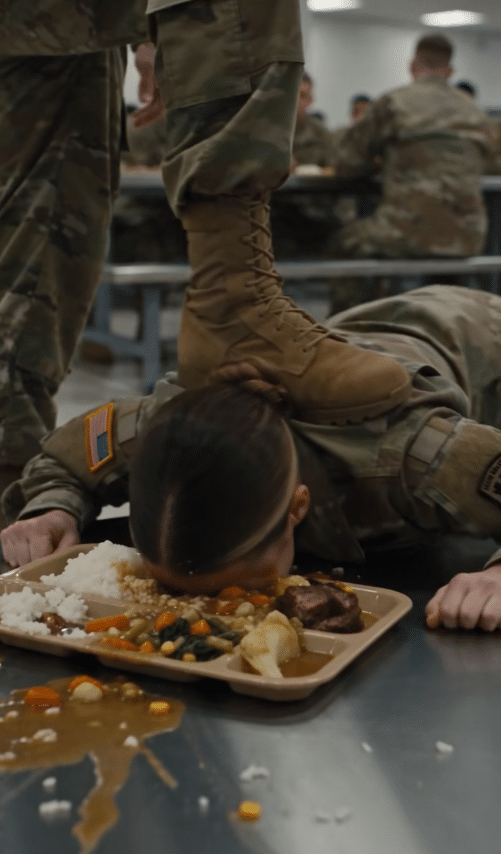
The lieutenant pitched forward. Her tray flew out of her hands, and she landed face-first in the food, her cheek and the front of her uniform crashing into rice, meat, vegetables, and gravy. The tray clattered across the floor, sending food beneath nearby tables.
A hundred conversations seemed to stop at once.
The young woman tried to push herself up. Mercer kicked her twice in the back, then planted his boot firmly between her shoulder blades, pinning her against the floor.
Her palms scraped against the hard surface as she struggled to draw a full breath. Food clung to her hair and uniform. Her fingers trembled, but she did not cry out or beg him to stop.
Mercer looked around, checking whether his audience had noticed.
They had.
That was exactly what he wanted.
“Stay on the floor until an officer tells you to stand.”
One of the lieutenants beside him looked away. The other stared at the woman, horrified, but neither dared move. Around them, soldiers stopped eating. A spoon slipped from someone’s hand and struck a metal tray with a sharp clatter.
Then a chair scraped backward at the command table.
A senior colonel rose to his feet.
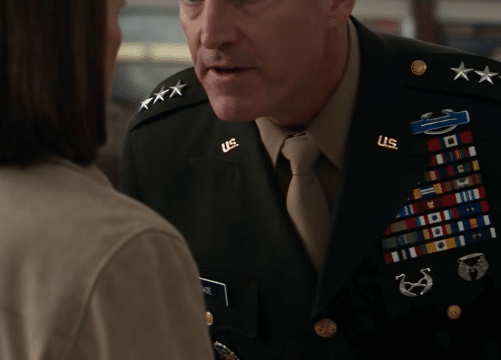
He was fifty-four, with graying hair and a service-duty uniform bearing the unmistakable insignia of his rank. Until that moment, he had been quietly eating lunch while reviewing a document.
Now his face had gone rigid.
“Captain… take your boot off her. Now.”
Mercer glanced toward him, annoyed at the interruption.
“She’s just another careless lieutenant.”
The colonel did not repeat himself. He simply began walking toward them.
Still pinned to the floor, the young woman turned her face slightly away from the spilled food. Her breathing was painful, but when she spoke, her voice remained steady.
“You should’ve checked who signed my orders.”
Mercer’s boot stopped moving.
For the first time, he looked at her name tape.
Then he looked at the approaching colonel.
Something in the older officer’s expression told him this was no ordinary reprimand. The colonel was not merely angry about the assault.
He was alarmed by whom Mercer had chosen to attack.
The captain’s confidence began to collapse.
“Your orders…?”
The dining hall fell silent.
And the answer he was about to receive would change the course of his career.
Act II
First Lieutenant Claire Bennett had learned early that the fastest way to attract the wrong kind of attention in the military was to let people know how much you knew.
She was not secretive by nature. She simply understood that competence could make insecure people uncomfortable, especially when it came from someone young enough to be mistaken for inexperienced.
At twenty-seven, Bennett had already earned a reputation among a small circle of senior officers for extraordinary analytical judgment. She could recognize inconsistencies in an operational plan, identify risks buried beneath reassuring language, and connect details that other people treated as unrelated.
She rarely spoke unless she had something useful to say.
That habit had made her invaluable to the people who knew her work.
It had also made her easy to underestimate.
Most soldiers at the base knew her only as a quiet first lieutenant who arrived early, completed her assignments, and never seemed interested in the informal competitions that dominated some officers’ lives. She did not boast about her evaluations. She did not name-drop senior commanders. She never used a connection to get a better table or avoid a difficult assignment.
Her uniform was always clean, her reports precise, and her behavior professional.
To Captain Ryan Mercer, however, those qualities were invisible.
Mercer was thirty, physically fit, and proud of his ability to project authority. He had spent years learning how to look like the kind of officer senior leaders wanted to promote. His boots were polished, his uniform immaculate, and his voice carried just enough confidence to make junior personnel hesitate before questioning him.
He had been rewarded for decisiveness.
Over time, he had begun confusing decisiveness with being right.
Mercer believed an officer’s status should be obvious to everyone in the room. He expected subordinates to step aside, junior personnel to agree, and other officers to recognize his presence without requiring an explanation.
When people complied, he interpreted it as respect.
When they did not, he treated it as a challenge.
His two companions, Second Lieutenant Daniel Price and Second Lieutenant Evan Brooks, had already seen glimpses of this behavior. Mercer liked to correct them in public, especially when other officers were present. He would turn a small mistake into a lecture and then describe the humiliation as a lesson in discipline.
Both younger men had learned to keep their faces neutral.
Neither wanted to become his next example.
That morning, Mercer had arrived at the dining hall after a difficult briefing. He believed his recommendations had been ignored, and he was irritated that a more senior officer had questioned his assessment in front of the room.
He needed to feel in control again.
The lunch line offered an easy opportunity.
When Bennett moved past him with her tray, he saw a chance to remind the younger officers beside him that rank meant something. He did not ask whether she had cut in line. He did not care whether she had been directed to a different serving station.
He saw a woman who did not immediately react to his presence.
So he confronted her.
When she answered calmly, he took it as defiance. When she refused to apologize for something she had not done, his irritation turned into a need to punish her.
The assault was not an accident.
It was a performance.
And the audience he had chosen was about to become the reason he could never pretend otherwise.
Bennett, meanwhile, had spent the previous six weeks working under special orders that were not widely discussed outside the command group. Her assignment involved reviewing operational readiness, testing the reliability of reporting procedures, and identifying places where information was being altered before it reached senior decision-makers.
She was not there to supervise the dining hall.
She was not there to inspect uniforms.
And she had not been sent to the base because someone wanted a young lieutenant to gain experience.
Her orders had been signed by a senior commander whose confidence in her judgment had been earned through difficult work, not personal connections.
Bennett had accepted the assignment with one condition: she would be treated according to her actual rank, not given special privileges because of the work she was doing.
She wanted to see how the base functioned when people believed nobody important was watching.
That was why she had walked into the dining hall alone.
She had no escort, no visible announcement, and no reason to expect anyone to recognize her.
The captain had seen an ordinary lieutenant carrying lunch.
He had not considered that the woman he was humiliating might be standing at the center of an investigation into the very culture he was displaying.
But the colonel approaching them knew enough to understand the danger.
He had seen Bennett’s name on documents that required his attention. He knew the authority behind her assignment, and he knew the commander who had personally approved it.
What he did not know was how much of the investigation Bennett had already uncovered.
And now, in front of hundreds of witnesses, Mercer had given her one more thing to report.
Act III
Colonel Michael Hayes reached the table and stopped a few feet from the captain.
“Remove your boot,” he said.
Mercer hesitated.
For one dangerous second, he seemed to consider whether he could turn the situation into another display of authority. He looked down at Bennett, then back at Hayes, as though expecting the senior colonel to explain why this particular lieutenant deserved special treatment.
Hayes’s expression made it clear there would be no discussion.
Mercer lifted his foot.
Bennett remained on the floor for a moment, breathing carefully. She pushed herself onto one knee, then used the edge of a nearby table to stand. Food covered the front of her uniform, and a smear of gravy marked one sleeve.
Her face was pale, but she did not collapse.
Hayes moved toward her.
“Lieutenant, are you hurt?”
“I need a moment, sir.”
“Take it.”
He turned toward a nearby soldier and ordered medical assistance. Then he looked at Mercer.
“Step back.”
The captain obeyed, though the movement looked more like retreat than compliance.
“What is this about?” Mercer demanded. “She cut in front of me, and when I corrected her—”
“You kicked her in the back.”
“She was being disrespectful.”
Hayes’s eyes hardened. “That is not what I asked.”
Mercer stopped talking.
The dining hall was still. Hundreds of soldiers had watched the assault, and now they were watching the aftermath. Some stood beside their tables. Others remained seated, their meals forgotten. The two junior lieutenants who had accompanied Mercer looked as though they wished they could disappear.
Hayes turned back to Bennett.
“Do you want to make a formal statement?”
“Yes, sir.”
Her answer came without hesitation.
Mercer scoffed. “You can’t be serious. This is being blown out of proportion.”
Bennett looked at him.
“You knocked me to the floor and stood on my back.”
“I was correcting your behavior.”
“No,” she said. “You were trying to make an example of me.”
There was no anger in her voice, which somehow made the words more difficult to dismiss.
Hayes studied her for a moment. He knew she was disciplined enough to avoid unnecessary confrontation. He also knew that the assignment she had been given required her to document what happened rather than allow a powerful person to rewrite it afterward.
He glanced toward the two junior officers.
“Did you witness the incident?”
Price swallowed.
“Yes, sir.”
“Tell me what you saw.”
Mercer turned on him. “Think carefully before you answer.”
Hayes stepped between them.
“Captain, you will not speak to that lieutenant again unless I authorize it.”
The command landed with unmistakable force.
Price looked at Brooks, then back at Hayes.
“He accused Lieutenant Bennett of cutting in line,” Price said. “She told him she was going to her table. Then he kicked her from behind.”
Brooks nodded, his face tight.
“He kicked her twice after she fell, sir. Then he put his boot on her back.”
Mercer stared at them in disbelief.
“You’re both making this sound worse than it was.”
“No,” Hayes replied. “They are describing what happened.”
The captain’s eyes shifted around the dining hall. He had expected the witnesses to stay silent, just as they had during his previous public reprimands. He had assumed that people would protect their careers, their reputations, and their peace of mind before challenging him.
He had mistaken their fear for loyalty.
Hayes motioned toward the dining facility manager.
“Secure any available camera footage. Preserve the incident reports and identify the witnesses.”
The manager hurried away.
Mercer’s expression changed.
“Sir, surely we can handle this through the chain of command.”
“We will handle it through the proper channels.”
“I made a mistake.”
“You made several choices.”
Hayes paused, allowing the words to settle.
“You chose to confront her. You chose to escalate the encounter. You chose to use physical force. And when I ordered you to stop, you tried to justify it by calling her careless.”
Mercer’s jaw tightened.
“She’s just another careless lieutenant.”
He repeated the words as if saying them again might restore the balance he had lost.
Bennett wiped a smear of gravy from her wrist.
Then she met his eyes.
“You should’ve checked who signed my orders.”
This time, Hayes did not interrupt her.
Mercer looked at her name tape again. He had seen it earlier, but now he was searching for something hidden inside it. A clue. A title. A connection that would explain why the senior colonel had reacted as though the captain had set fire to the command table.
“What orders?” he asked.
Bennett said nothing.
Hayes’s expression grew colder.
“Captain, you are not entitled to the details of every assignment in this command. You are, however, responsible for treating every soldier under your authority with basic professionalism.”
“I didn’t know who she was.”
“That is not a defense.”
The words left Mercer with nowhere to go.
If Bennett had been an ordinary lieutenant, his behavior would still have been indefensible. Her assignment did not create the wrongdoing. It merely exposed how little he understood about the responsibilities he claimed to represent.
But Mercer could sense there was more to the story.
Hayes had not simply been embarrassed by a public assault. He was worried about what the incident revealed, and what Bennett might now be required to document.
The captain had wanted to dominate a lunch line.
Instead, he had walked directly into the consequences of an investigation he did not know existed.
And the most damaging evidence had not yet been reviewed.
Act IV
The medical team arrived and escorted Bennett to a nearby treatment room.
Before leaving, she asked the dining facility manager to preserve the condition of the scene until the incident had been documented. The request was quiet and practical, not an attempt to stage a dramatic accusation.
Hayes approved it.
Then he turned to Mercer.
“You will accompany me to the command office.”
Mercer’s face tightened. “Sir, I have duties scheduled this afternoon.”
“You no longer have those duties until further notice.”
The captain glanced toward the junior lieutenants, hoping to find some sign that they still saw him as the man who had controlled the room. Price looked at the floor. Brooks watched Hayes with rigid attention.
Neither offered him support.
Mercer followed the colonel out of the dining hall.
Behind them, the room gradually resumed its noise, but it was no longer the same noise. Conversations began in low voices. Soldiers returned to their tables without looking at the spilled food. A few people shook their heads in disbelief.
Others seemed troubled by something less obvious than the assault itself.
They had watched a captain attack a lieutenant in public, and almost everyone had waited for someone more senior to intervene.
That realization would remain with them.
At the command office, Hayes ordered Mercer to sit. He then contacted the officers responsible for reviewing the incident and confirmed that the security footage was being preserved.
Mercer tried to regain control of the conversation.
“Sir, I understand how this looked. But she was disrespectful, and I reacted badly. I can apologize.”
“You can provide a statement.”
“I’m offering to make this right.”
“You do not get to decide that the matter is resolved because you are willing to apologize.”
Mercer fell silent.
Hayes had spent more than thirty years in uniform. He had seen good officers make bad decisions under pressure, and he had seen weak officers hide behind the word discipline whenever they wanted to punish someone who could not fight back.
The distinction was not complicated.
Real discipline required control over oneself before control over anyone else.
Mercer had failed that test in front of hundreds of witnesses.
Hayes opened a folder on his desk. Inside were documents related to Bennett’s special assignment, including the formal authorization that had brought her to the base.
The captain stared at the signature.
He recognized the name.
General Adrian Cole, the senior commander responsible for the readiness review, had personally approved Bennett’s orders. The general had insisted that her findings be delivered without interference and that her work be evaluated on its merits rather than her age or rank.
Mercer had heard the general speak about accountability during a command briefing. He remembered the warning that no officer should use authority to suppress inconvenient information.
At the time, he had assumed the message was intended for someone else.
Now he was looking at the signature beneath the orders of the woman he had kicked to the floor.
“You’re telling me she’s part of the readiness review?” he asked.
“I am telling you that her assignment is authorized, and you had no reason to interfere with it.”
Mercer swallowed.
“Does the general know what happened?”
“He will receive the report through the proper channels.”
The captain’s shoulders stiffened. “Sir, I made a mistake.”
Hayes closed the folder.
“You made a decision. Now you will be accountable for it.”
The investigation moved quickly because the facts were unusually clear. The dining hall footage showed the sequence of events. The witnesses agreed on the essential details. Bennett’s injuries were documented, and the captain’s own words were preserved in their original context.
There was no need to rely on rumor or speculation.
The assault was the central issue.
But as investigators reviewed Mercer’s record, they also examined earlier complaints involving his treatment of junior personnel. Several had been dismissed as personality conflicts or minor disagreements. Others had never progressed beyond informal counseling.
This time, the evidence could not be reduced to a difference in communication styles.
Mercer had used physical force against a subordinate in a public dining facility. He had continued to demean her after she was down, and he had attempted to justify his actions when ordered to stop.
The incident raised serious questions about his fitness to lead.
His command duties were suspended while the review proceeded, and the resulting disciplinary process placed his career in jeopardy. His behavior toward the witnesses was also examined after the junior lieutenants reported that he had attempted to intimidate them.
Bennett did not demand that he be destroyed.
She did not call for special punishment because of the orders she carried.
She submitted her statement, answered questions, and returned to her assignment when medical personnel cleared her to do so.
That restraint frustrated Mercer more than anger would have.
He had expected her to use the authority behind her orders as a weapon. He had imagined she would threaten him with connections, demand a public apology, or insist that the entire base learn her identity.
Instead, she continued working.
She reviewed reports, attended briefings, and asked the same precise questions she had asked before the assault. She did not bring up Mercer unless the investigation required it.
The captain had tried to humiliate her into silence.
He had failed to make her change a single professional standard.
And as the review progressed, Bennett’s assignment began revealing problems that had nothing to do with a lunch line—problems that made the command even more determined to protect the integrity of her work.
Act V
Three weeks later, Captain Mercer stood before the officers responsible for reviewing his conduct.
The findings were clear. Video evidence confirmed the assault, witness statements corroborated the sequence, and the medical documentation supported Bennett’s account. His claim that he had been correcting a subordinate’s behavior was rejected.
He was formally relieved of his leadership duties while further administrative and disciplinary action proceeded.
The decision was not based on Bennett’s special assignment. It was based on what he had done to her.
That distinction mattered to Colonel Hayes.
When asked whether the lieutenant’s orders had influenced his response, he answered plainly: the assault would have required intervention regardless of who she was. The signed orders explained why Bennett was at the base, but they did not make her more deserving of protection than any other soldier.
A junior officer should not have to carry the signature of a general to be safe from a captain’s temper.
Mercer’s two companions also faced a difficult reckoning of their own. They had not committed the assault, but they had stood beside him while he humiliated a fellow officer. Both were required to provide formal accounts of what they had witnessed.
Price later admitted that he had been afraid to challenge Mercer because he worried about the effect on his evaluations.
“I kept telling myself it wasn’t my place,” he explained during a private conversation with Hayes. “I thought someone else would step in.”
Hayes listened.
“Remember that feeling,” he said. “The next time you see someone being mistreated, decide whether you want it to define you.”
The words stayed with Price long after the investigation ended.
Bennett returned to the dining hall the following week.
She wore a clean uniform and carried her tray with both hands. For a brief moment, she paused at the entrance, taking in the familiar rows of tables, the stainless-steel counters, and the steady movement of soldiers through the serving line.
The place looked exactly as it had before.
But people noticed her now.
A sergeant near the entrance stepped aside to let her pass. A young private nodded respectfully. At a table by the windows, two soldiers who had witnessed the assault looked up and then quickly returned to their conversation, embarrassed by the memory of having done nothing.
Bennett did not demand their attention.
She joined the line, collected her lunch, and walked toward an open table.
No one blocked her path.
Colonel Hayes was already seated near the command table. When he saw her, he stood and gave her a brief nod. She returned it without ceremony.
He did not announce her assignment or reveal the details of the review. Her work remained her work, and her rank remained her rank.
That was how she wanted it.
After lunch, Bennett returned to the office where she had been reviewing readiness reports. The investigation into Mercer had become one more documented example of a larger principle: authority could not be measured by how effectively a person controlled others, but by what that person did when they believed nobody could challenge them.
Her report did not name the captain as the center of the readiness review. It did not need to.
The review identified weaknesses in reporting procedures, gaps in oversight, and a pattern of complaints that had been handled inconsistently. The command began addressing those issues through formal channels, ensuring that future complaints would be documented and evaluated rather than dismissed because the person accused held a higher rank.
Bennett’s work continued.
She had not been sent to the base to expose one cruel captain. She had been sent to understand how a system behaved under pressure, how information moved upward, and whether people could report problems without fear of retaliation.
The dining hall incident had become an unmistakable example of what happened when fear replaced accountability.
But it had also shown something else.
When the colonel stood and ordered Mercer to remove his boot, the room had changed. The captain had discovered that his authority had limits. The junior lieutenants had discovered that they could tell the truth. And hundreds of soldiers had witnessed a senior officer use his position not to protect a colleague’s reputation, but to stop an abuse of power.
Those moments mattered.
Not because they erased the humiliation Bennett had suffered, but because they prevented it from being quietly buried.
Months later, Bennett received a brief note from Price. He thanked her for remaining composed that day and admitted that he had learned more about leadership from watching her recover than he had from many formal lectures.
She read it twice before placing it in a drawer.
She did not write back immediately. She had no interest in becoming a symbol for someone else’s professional growth.
Still, she kept the note.
Not because she needed to remember Mercer.
Because she wanted to remember that even a room full of witnesses could choose differently the next time.
The captain had believed the dining hall belonged to officers like him. He had mistaken rank for permission, silence for agreement, and humiliation for strength.
He had looked at a quiet lieutenant and seen someone he could punish without consequence.
What he failed to understand was that Bennett’s authority had never depended on whether he recognized it.
It had been there before he entered the room.
It remained there when he kicked her to the floor.
And it was still there when she stood up, cleaned the food from her uniform, and returned to work.
The most revealing moment had not been when Colonel Hayes recognized her orders.
It had been when Bennett, lying face-down in the wreckage of her lunch, refused to beg the man standing over her.
She had known that the truth would eventually matter more than his performance of power.
And when the final report was signed, the lesson was no longer just about one captain’s disgrace.
It was about every person who had watched, every officer who had hesitated, and every soldier who would someday have to decide whether silence was safer than doing what was right.
Mercer had tried to make an example of a lieutenant.
Instead, he had become one.