Act I
“Keep your hands off my table.”
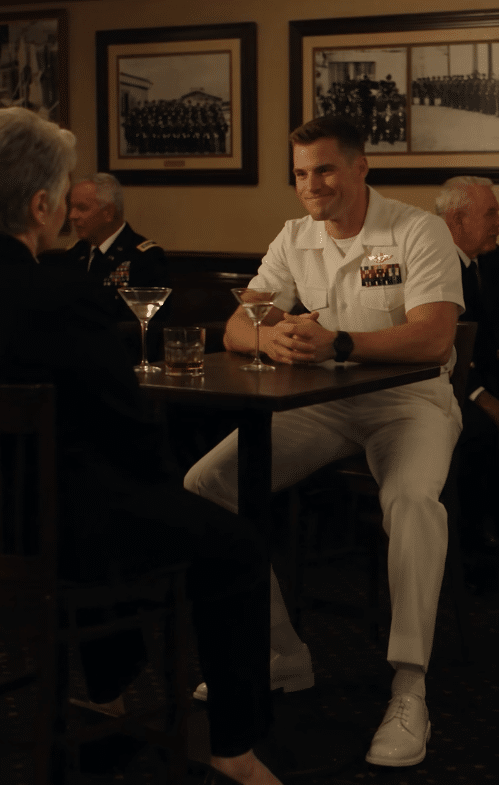
The major’s voice cut through the amber-lit hotel bar, loud enough for the two junior officers beside him to hear. He stood in a fitted white dress shirt, polished shoes planted confidently against the floor, looking down at a silver-haired woman in a black blazer as though she had wandered into a place where she didn’t belong.
The woman glanced at the napkin she had just moved away from the edge of the table.
“It was a napkin.”
Her voice was calm. Almost bored.
That calmness irritated him more than an argument would have. Major Nathan Cole was thirty-five, athletic, ambitious, and deeply attached to the idea that rank should be visible in every room he entered. He had spent the evening making sure the younger officers noticed his confidence, his stories, and the way people seemed to step aside when he approached.
Now an older woman was refusing to play her part.
Cole grabbed his cocktail and threw it directly into her face.
The drink splashed across her short silver hair and ivory blouse. Before anyone could react, he hurled the glass onto the floor. It shattered beside the bar stool, scattering fragments across the polished wood.
Then he struck her hard across the cheek.
Her head turned with the impact. A red mark spread across her cheek, swelling beneath the skin, and a faint trace of blood appeared at the corner of her mouth. She barely had time to steady herself before Cole drove a punch into her stomach.
The woman folded forward, her breath disappearing. She dropped beside the bar stool, one hand pressed against her abdomen as she fought to draw air back into her lungs.
A conversation stopped halfway through a sentence. Someone near the hotel lounge gasped. Two veterans rose halfway from their seats, then froze, stunned by the speed and brutality of what they had witnessed.
Cole straightened his shirt.
“Stay away from officers’ tables.”
The woman looked up at him.
She was hurt. That much was obvious. But there was no begging in her eyes, no frantic attempt to defend herself, and no fear that he could easily recognize.
Instead, she looked at him with a strange, almost sorrowful patience.
As if she had seen this exact kind of man before—and knew how the story ended.
Then a woman in a navy blazer entered the bar.
She was sixty-three, with silver hair tied low at the back of her neck. She had been smiling at someone behind her until she noticed the woman on the floor.
The smile vanished.
She stopped so abruptly that the veteran walking beside her nearly collided with her shoulder. Her eyes moved from the injured woman’s face to the black blazer, then back to the eyes she had not seen in years.
Her lips parted.
“Ash Queen?”
The major gave a short laugh.
“That’s supposed to impress me?”
The older woman did not look at him.
“Ask anyone who came back from Operation Ember Crown what that name meant.”
Something changed in the room.
A veteran at the bar slowly removed his cap. An elderly man near the windows straightened in his chair. Two retired officers exchanged a look that seemed to carry an entire conversation neither wanted to have aloud.
Cole’s smile began to weaken.
He looked down at the woman he had just assaulted, then toward the stranger who had recognized her. For the first time that evening, he seemed unsure which person in the room held the power.
“Ember Crown… and she is…?”
No one answered.
And the silence was far more frightening than any threat could have been.
Act II
The woman on the floor was named Evelyn Hart.
At fifty-nine, she had mastered the art of moving through the world without inviting questions. Her silver hair was cut short and practical. Her clothes were simple, her jewelry almost nonexistent, and her manner so restrained that strangers often mistook it for coldness.
She rarely volunteered information about her life.
At the hotel, she had registered under her own name, collected her room key, and gone downstairs for a quiet drink before the reunion dinner. She had no interest in standing beside a podium, shaking hands with people who remembered her differently, or listening to another speech about the glory of military service.
She had come because of a promise.
Years earlier, she had told an old friend that if they were both still alive for the next reunion, she would attend. At the time, neither woman had known whether that future would ever arrive.
Evelyn had kept the promise.
She had not expected to spend the evening on the floor with a swollen cheek and a stranger’s drink running down her blouse.
Nor had she expected to hear a nickname she had not used in years.
Ash Queen.
The name belonged to another life, one she had spent decades trying to leave behind without denying it. It had first emerged during a classified military operation whose consequences had followed its survivors long after the official reports were filed away.
Evelyn had been younger then, sharper in her movements, and far less willing to accept that an order was automatically right simply because it came from someone senior.
She had earned a reputation for being difficult.
She questioned plans that other officers approved without reading closely. She demanded that casualty estimates be examined rather than softened. She refused to sign reports that described preventable losses as unavoidable circumstances.
Some people called her fearless.
Others called her insubordinate.
The soldiers who served under her had a different description: she remembered them.
She knew who had a newborn at home, who was caring for an injured parent, and who had stopped sleeping after a previous deployment. She remembered the names of people who appeared only briefly on personnel rosters. If a soldier was missing, she wanted the name, the last confirmed location, and the person responsible for finding out what had happened.
She did not treat people as numbers.
That was the reason many trusted her.
It was also the reason certain powerful men had come to resent her.
Evelyn had risen through the ranks without building a public image around herself. She did not collect admirers or seek invitations to exclusive events. She worked, made decisions, accepted responsibility, and returned to the people whose lives those decisions affected.
Eventually, she became a major general.
But her rank had never been the source of the nickname.
Ash Queen had come from Operation Ember Crown.
The operation had begun as a mission that appeared manageable on paper. Its objectives were specific, the timetable narrow, and the risks described as acceptable. Then the situation changed, communications became unreliable, and the people executing the plan discovered that several assumptions made by the planners were wrong.
The mission threatened to become a disaster.
Evelyn had been forced to make a decision that would define the rest of her career. She could protect the plan as written and preserve the reputations of the people who had approved it, or she could change course and accept the consequences of contradicting them.
She changed course.
What followed was a night of confusion, desperate improvisation, and decisions made with incomplete information. The people who returned remembered the sound of her voice over the radio, steady even when everything around them seemed to be falling apart.
They remembered that she never promised them the situation was safe.
She promised she would not stop working to bring them home.
Afterward, the nickname spread quietly among the survivors. It was never printed on an official document. It appeared in no ceremony program and no public biography.
But the people who had come back from Ember Crown understood it.
They knew what the ash represented.
And they knew why the woman who carried the name had never been eager to hear it again.
The retired colonel who had just entered the bar was Margaret Shaw. She and Evelyn had served together during Ember Crown, and they had once been close enough to finish each other’s sentences.
They had also spent years avoiding the one conversation neither knew how to begin.
Shaw had not seen Evelyn in nearly four years.
Now she watched Evelyn struggle to breathe beside a bar stool, and every memory she had buried came rushing back.
Cole, meanwhile, was still waiting for someone to explain why the room had changed.
He had no idea that the woman he had humiliated had spent much of her career confronting men who believed their authority made them untouchable.
And he had no idea what happened to the last officer who mistook her restraint for weakness.
Act III
Margaret Shaw crossed the room.
She did not hurry, but something in her expression made the people nearest the bar move aside. She knelt beside Evelyn, careful not to touch the injured cheek or pull her upright too quickly.
“Evelyn,” she said softly.
The injured woman met her eyes.
“Margaret.”
It was an ordinary greeting between two old friends. That was what made it so devastating.
Shaw had expected surprise, perhaps a dry joke about their age or a complaint about the hotel’s terrible drinks. She had not expected to find Evelyn injured by a man who looked barely old enough to remember the years that had shaped them.
Shaw rose and turned toward Cole.
“Step away from her.”
Cole’s expression hardened. “This doesn’t concern you.”
“It concerns me now.”
“She was interfering with my table.”
Shaw glanced at the napkin lying near the edge, then at the broken glass on the floor.
“You hit her over a napkin?”
Cole spread his hands. “She was disrespectful.”
“No,” Shaw replied. “You were embarrassed.”
The words struck a nerve.
The major’s eyes narrowed. “You don’t know what happened.”
“I know exactly what happened. I watched you explain your character to an entire room.”
A few veterans lowered their eyes. Others continued watching him without blinking.
Cole turned toward the two junior officers who had accompanied him. “You both saw her attitude.”
Neither answered.
Their silence enraged him. He had expected them to agree, or at least to look away. Instead, they were staring at him as if the man they had admired an hour earlier had become a stranger.
Shaw looked back at Evelyn.
“Can you stand?”
Evelyn took a careful breath and nodded. With Shaw’s help, she rose slowly. Pain tightened her face, but she did not lean on her friend for longer than necessary. She brushed the wet hair away from her forehead and straightened the front of her black blazer.
Cole watched her as if he expected the movement to reveal something.
A name. A threat. An explanation.
Anything that would make the room’s reaction understandable.
Instead, Evelyn looked toward the bartender.
“Could I have some water, please?”
The bartender hurried to fetch it.
That quiet request seemed to unsettle Cole more than a shouted accusation would have. He had attacked her in public, and she was behaving as though the important thing now was to regain her composure.
He mistook her silence for an attempt to make him look cruel.
“You people love a performance,” he said. “Someone says a dramatic name, and suddenly everyone acts like I’ve committed a crime.”
Shaw’s expression changed.
“You really don’t know what Ember Crown was, do you?”
“I know enough.”
“No. You know the name.”
Cole gave a dismissive shrug. “Then explain it.”
For several seconds, Shaw said nothing.
She remembered a dark operations room, maps covered with handwritten corrections, and voices overlapping as the original plan unraveled. She remembered Evelyn standing over the table, refusing to accept a solution that would abandon a group of people because retrieving them had become inconvenient.
She remembered the argument that followed.
Senior officers had warned Evelyn that changing the plan would put the entire operation at risk. They had reminded her of the chain of command, the approved timetable, and the consequences of disobeying instructions.
Evelyn had listened.
Then she had asked them to identify the people they were prepared to leave behind.
Nobody had answered.
She had made the decision herself.
The extraction succeeded, but the aftermath was bitter. The operation’s failures threatened to expose decisions made far above Evelyn’s level. A formal review began, and several people attempted to narrow the inquiry until the most damaging questions disappeared.
Evelyn could have protected herself by accepting the approved version of events. She could have allowed the blame to fall on a junior officer whose judgment had been compromised by incomplete information and conflicting instructions.
Instead, she insisted that the entire chain of decisions be examined.
That choice cost her allies.
It also ensured that the people who had survived Ember Crown would not be erased from the record.
The official account eventually acknowledged the operation’s success, but it never captured the full emotional weight of what had happened. Some details remained restricted. Other details were simply left out of public summaries.
The survivors did not forget.
They remembered the commander who had refused to let their lives become an acceptable loss on a planning document.
They remembered the woman who had stood between them and the convenient version of the truth.
And they remembered the day she had accepted responsibility for a decision that others had pressured her to abandon.
Shaw looked at Cole.
“That name wasn’t invented to impress anyone,” she said. “It was given to her by people who knew they might never have come home without her.”
Cole’s expression flickered, but he recovered quickly.
“That’s a nice story.”
Shaw took a slow breath.
“It is a story. But it’s also why the people in this room are looking at you the way they are.”
Cole glanced around.
He had expected admiration for his confidence. He had expected the younger officers to watch him dominate a confrontation. He had even expected a few uncomfortable witnesses to pretend nothing had happened.
Instead, the veterans were looking at him with a mixture of disbelief and quiet anger.
One of them finally stood.
“I was at Ember Crown,” the man said.
Another veteran beside the window nodded. “So was I.”
A third removed his cap.
Cole’s mouth tightened.
For the first time, he understood that the nickname was not merely a legend. It was a memory shared by people who had lived through something that had permanently changed them.
And Evelyn Hart was the person at the center of it.
But Shaw had not yet told him the part that mattered most.
Act IV
The bartender returned with a glass of water and placed it on the nearest table.
Evelyn thanked him, took a small sip, and set the glass down. Her hands were steady, though every movement reminded her of the pain in her cheek and stomach.
Shaw remained beside her.
Cole looked from one woman to the other. “All right. So she did something brave years ago. That doesn’t give her the right to disrespect me.”
Evelyn turned toward him.
“I moved a napkin.”
“You challenged me.”
“I answered your question.”
“You made me look foolish in front of my officers.”
For the first time, something like genuine disappointment crossed Evelyn’s face.
“There it is,” she said.
Cole frowned. “What?”
“The reason you hit me.”
The room became so quiet that the hum of the refrigerator behind the bar seemed suddenly loud.
Evelyn continued, her voice measured. “You weren’t defending a table. You were defending your pride.”
Cole stepped toward her.
Shaw immediately shifted between them.
“Don’t.”
He stopped, startled by the firmness of her voice.
“You’ve already done enough,” Shaw said.
“I’m not afraid of her.”
“No one asked you to be afraid.”
Cole looked at Evelyn again. He wanted her to shout, to accuse him, to give him an excuse to dismiss her as unstable or disrespectful. He wanted the confrontation to become a contest in which his volume and physical confidence could still win.
But Evelyn had no interest in competing with him.
She had seen too many people confuse intimidation with leadership. She had watched promising officers become careless because no one had ever challenged their behavior. She knew how quickly a person could learn to mistake silence for approval.
She had also seen what happened when everyone in a room waited for someone else to speak.
That was why she looked toward the two junior officers.
“Did you see what happened?”
Both men stiffened.
Cole turned sharply. “Careful.”
The younger of the two looked at his superior, then at Evelyn. His face was pale, but he did not look away.
“Yes, ma’am.”
The word slipped out before he seemed to realize he had said it.
Cole stared at him. “What did you just call her?”
The young officer swallowed.
“I saw you throw the drink. I saw you strike her. I saw you punch her after she was already hurt.”
“You’re making this worse for yourself.”
“No, sir,” the officer said, his voice trembling slightly. “I’m telling the truth.”
His companion stepped forward.
“So am I.”
For a moment, Cole looked genuinely lost.
He had built his authority around the assumption that people would protect their own interests before they challenged him. He had counted on the junior officers’ fear of poor evaluations, lost opportunities, and a superior who could make their professional lives miserable.
He had not considered that they might look at what he had done and decide the cost of remaining silent was greater.
Shaw motioned toward the hotel manager, who had been watching from the far end of the bar.
“Please secure the security footage and contact the appropriate authorities.”
The manager nodded and moved away.
Cole’s face reddened. “You can’t do that.”
“I can report an assault,” Shaw replied. “The rest is up to the evidence.”
“This is a military reunion. You’re turning a private disagreement into a spectacle.”
Evelyn glanced at the shattered glass.
“You turned it into a spectacle when you threw that drink.”
He had no answer.
For the first time since the confrontation began, Cole seemed aware of the room’s full attention. The veterans were not whispering excitedly about a legendary commander. They were watching a man who had attacked someone he believed was powerless, then tried to use his rank to justify it.
The distinction mattered.
Evelyn’s past did not make the assault wrong. The assault was wrong before anyone recognized her. If she had been an ordinary hotel guest with no military history, the facts would have remained exactly the same.
That was what Cole could not escape.
Shaw helped Evelyn toward a chair away from the broken glass. A hotel employee brought a clean towel. Someone called for medical assistance, and the manager confirmed that the security system had recorded the incident.
Cole began speaking faster.
He claimed Evelyn had provoked him. He insisted that he had merely lost his temper. He suggested that the witnesses were exaggerating because they had become caught up in an old military legend.
Each explanation made him sound smaller.
The junior officers gave their accounts. The veterans who had seen the assault offered their names. The hotel preserved the footage, and the incident was reported through the proper channels.
Cole was removed from the reunion while the matter was investigated.
He did not leave as the commanding presence who had entered the bar.
He left under the watchful eyes of people who now knew exactly what his confidence concealed.
Evelyn did not watch him go.
She was listening to Shaw talk about a man they had both served with, someone who had retired years earlier and recently become a grandfather. They spoke about ordinary things: a new house, an upcoming wedding, a stubborn knee injury.
The conversation was almost absurdly normal after everything that had happened.
But perhaps that was the point.
Evelyn had never wanted to spend the rest of her life trapped inside the worst moments of her career. She had fought to bring people home so they could live beyond the operation, not so they would spend every reunion telling the same stories.
Still, Shaw had one question she had carried for years.
“Why did you stop coming?”
Evelyn looked down at the towel in her hands.
“Because every time I walked into a room, people wanted Ash Queen.”
Shaw’s expression softened.
“And you didn’t?”
“I wanted Evelyn.”
For a long moment, neither woman spoke.
Then Shaw reached across the table and covered Evelyn’s hand with her own.
“I should have checked on you.”
Evelyn looked at her old friend.
“Yes,” she said quietly. “You should have.”
It was not forgiveness, not yet. It was simply the truth, spoken without cruelty.
Shaw nodded, accepting it.
And for the first time that evening, the room’s silence no longer felt like fear.
It felt like people finally listening.
Act V
The investigation did not depend on the nickname.
It depended on what the witnesses had seen.
The hotel’s security footage showed the confrontation from beginning to end. It captured Cole’s opening demand, Evelyn’s calm reply, the drink thrown into her face, the glass breaking, the slap, and the punch that forced her down beside the bar stool.
The footage also captured the moments afterward, when Cole stood over her and ordered her to stay away from officers’ tables.
There was no ambiguity about who had initiated the violence.
The two junior officers submitted statements consistent with the recording. Several veterans confirmed what they had witnessed, and the hotel’s incident report documented the scene.
Cole was suspended from his duties while the military reviewed the matter. The assault and his attempts to pressure witnesses became central to the inquiry into his conduct. The outcome was serious enough to derail the career he had spent years building around the promise of future command.
He tried to explain himself.
He said the reunion had been tense. He said Evelyn had embarrassed him. He said the veterans had overreacted because of their personal loyalty to someone from their past.
None of it changed the evidence.
He had assaulted an unarmed woman over a napkin.
And when he discovered that she was someone the room respected, he had tried to make his actions seem less serious rather than acknowledge what he had done.
The nickname made the story travel farther than he could control, but it was not what brought consequences. His own behavior did that.
Evelyn declined requests to make public comments. She gave a factual account when asked, cooperated with the investigation, and returned to her hotel room after receiving medical attention.
The next morning, she attended the reunion breakfast.
She wore a fresh ivory blouse and the same black blazer, carefully cleaned after the previous evening. The swelling on her cheek remained visible, and she moved cautiously when she sat down. But she arrived on time and greeted the people she knew.
No announcement was made.
No one introduced her with a dramatic speech.
For several minutes, the breakfast was simply a gathering of old friends sharing coffee and stories about their families. Then a retired officer approached her table, stood quietly, and offered a respectful nod.
“Good to see you again, ma’am.”
Evelyn returned the nod.
“Good to see you, too.”
Another veteran came over. Then another.
They did not ask her to recount Ember Crown. They did not demand details of the decisions that had made her famous among the people who survived. Some simply wanted to shake her hand. Others wanted to tell her about the lives they had built afterward.
One man showed her a photograph of his grandchildren. A woman who had served under her decades earlier described the small business she had opened after retirement. A former medic spoke about a community project he had started in honor of the people who never came home.
Evelyn listened.
It was not the kind of recognition she had avoided all those years. There were no cameras, no speeches about greatness, and no expectation that she would perform the role of a legend.
They were simply acknowledging a person who had mattered to them.
Margaret Shaw arrived late, carrying two cups of coffee.
She placed one in front of Evelyn and sat down without asking permission. For a while, they watched the room together.
“I thought you’d hate this,” Shaw said.
“The coffee?”
“The attention.”
Evelyn considered the question.
“I still don’t like being treated as a story.”
Shaw nodded. “Fair enough.”
“But I don’t mind seeing them.”
Across the room, two veterans were laughing about a disastrous trip they had taken years after retirement. One of them gestured with both hands, making the other nearly spill his coffee. The laughter spread to the people around them.
Evelyn watched, and the hard lines around her eyes softened.
“That’s what we were trying to protect,” she said.
Shaw understood.
Not a reputation. Not a record. Not a nickname that could be passed from one generation to another until it became a legend.
A future.
The chance for people to return home and build lives that had nothing to do with the operation that nearly took them away.
Later that afternoon, Shaw walked with Evelyn toward the hotel entrance. Sunlight fell across the pavement, and a light wind moved through the trees along the drive.
“Do you think he’ll ever understand?” Shaw asked.
“Cole?”
Shaw nodded.
Evelyn adjusted the strap of her handbag.
“Maybe. But understanding isn’t the same as changing.”
“And if he never changes?”
“Then someone else will have to be brave enough not to follow him.”
Shaw looked at her old friend.
That, more than any account of Ember Crown, sounded like the Evelyn Hart she remembered.
The woman who had questioned the plan when everyone else wanted to approve it. The woman who had insisted that responsibility could not be delegated downward whenever the consequences became uncomfortable. The woman who had accepted the burden of a decision because someone had to make it.
Ash Queen had never meant that Evelyn was untouched by fire.
It meant she had walked through it, carried others with her, and refused to let the people who survived be reduced to the damage left behind.
At the hotel bar, Nathan Cole had believed he was the strongest person in the room because he could make others afraid of him. He had confused a uniform, a rank, and the silence of intimidated witnesses with respect.
Evelyn had needed none of those things.
She had not threatened him. She had not used her past to frighten him into submission. She had simply stood by the truth and allowed the evidence to speak.
That was why the room had changed when Margaret Shaw recognized her.
Not because a powerful woman had been attacked.
Because the people who knew what Evelyn had done understood exactly what kind of person Cole had chosen to hurt.
At the entrance, Shaw paused.
“Will I see you at the next reunion?”
Evelyn looked back through the glass doors. Inside, the veterans were still gathered around the tables, talking, laughing, remembering.
“Yes,” she said. “I think you will.”
Shaw smiled.
They said goodbye without a salute or a grand farewell. Evelyn walked toward her car, carrying no visible sign of the title she had once held and no desire to reclaim the life she had left behind.
But the nickname would follow her, as it always had.
Ash Queen.
Not because she had demanded that anyone remember her.
Because when the fire came, she had stayed long enough to make sure others could leave.
And that was a kind of authority no rank could ever grant—and no bully could take away.