Act I
“Move your car.”
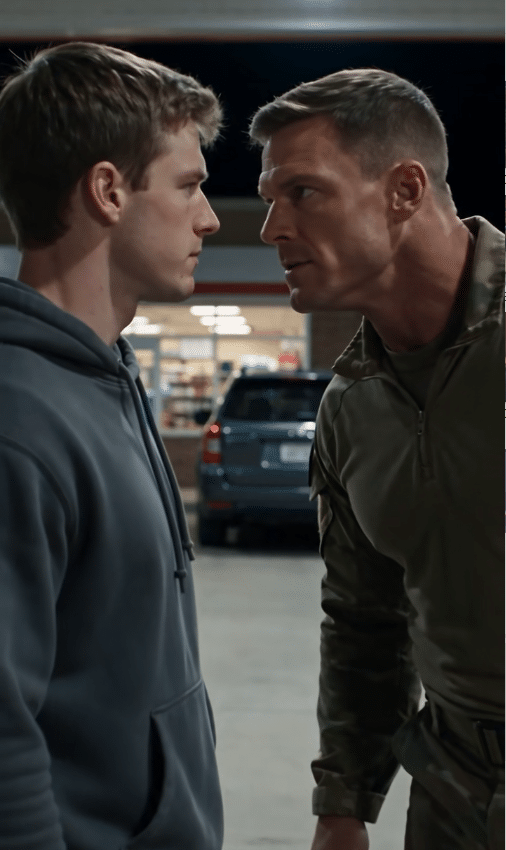
The major barked the order beneath the harsh white lights of a gas station near the military base. His dark civilian jacket hung open over a uniform shirt, and his military boots struck the pavement as he approached a young man in a gray hoodie.
The young man was twenty-six, with short brown hair, blue jeans, and ordinary sneakers. He looked like someone stopping for fuel on his way home, not someone looking for trouble with an armed-forces officer.
“I’m already moving it.”
His answer was calm, almost matter-of-fact.
That was apparently enough to enrage the major.
He had been waiting for a pump, and the brief delay had offended his sense of importance. To him, the young man’s explanation sounded like defiance. He stepped closer, his jaw tightening as if the entire forecourt belonged to him.
A pickup truck idled near the convenience store. Through the bright windows, a cashier watched the confrontation unfold. Another customer stood beside a fuel pump, holding the nozzle motionless as the argument escalated.
The young man made no threatening gesture.
He simply continued trying to move his car out of the way.
The major suddenly punched him hard across the cheek.
The young man’s head snapped sideways. A red mark spread across his cheek, and a faint trace of blood appeared at the corner of his mouth.
Before he could recover, the major kicked him in the stomach.
The young man folded forward, his breath leaving him in a sharp gasp. A second kick struck his ribs, knocking him sideways onto the pavement beside the pump island.
Someone near the convenience-store entrance recoiled.
The major stood over him, breathing hard, his expression filled with the ugly satisfaction of someone who believed he had just taught another person a necessary lesson.
“You don’t make officers wait.”
The words carried across the forecourt.
The young man remained conscious, one arm protecting his abdomen as he struggled to catch his breath. He did not beg. He did not threaten to ruin the major’s career.
He simply looked up at the man who had attacked him.
Under the gas station lights, the major could see that the young man’s expression had changed. The pain was still there, but the confusion had disappeared.
Something colder had taken its place.
The major mistook that silence for submission.
He had no idea that the young man had just decided to make one phone call.
And in three minutes, the entire gas station would learn that the quietest person in a confrontation could be the one with the most extraordinary family connection.
Act II
The young man rolled carefully onto one side and pushed himself up from the pavement.
His ribs hurt when he tried to straighten. He kept one hand against his stomach, breathing slowly until he could stand without losing his balance.
The major watched with an expression of impatience.
He seemed irritated that the encounter had become more complicated than he intended. He had expected the young man to apologize, move the car, and disappear.
Instead, the injured man stood beside the pump island and met his gaze.
There was something deeply unsettling about that refusal to panic.
The major had spent years learning how to use authority to make people comply. In uniform, he was accustomed to having his instructions followed. Even out of uniform, the sight of military clothing and boots often caused civilians to become more careful with their words.
He had come to expect that reaction.
The young man in the gray hoodie had offered him none of it.
That alone seemed to offend him more than the original delay.
He glanced toward the convenience-store windows, where the cashier was still watching. Another customer had taken out a phone, though he remained several feet away.
The major noticed the witnesses and straightened his jacket.
He seemed to believe that looking composed would somehow make what had happened appear justified.
The young man, meanwhile, reached into his pocket.
He removed his phone with careful fingers, his injured cheek visibly reddened beneath the fluorescent lights.
The major gave a contemptuous laugh.
“Who are you calling?”
The young man did not answer.
He selected a contact and raised the phone to his ear.
For a brief moment, he listened.
Then he spoke in a voice so steady that it seemed almost disconnected from the violence that had just taken place.
“Station 14, east highway. Three minutes.”
He ended the call.
That was all.
No name.
No explanation.
No threat.
The major stared at him before breaking into a mocking laugh.
“Three minutes for what, your mommy?”
He delivered the insult with the confidence of a man certain that the situation remained entirely under his control.
The young man lowered his phone.
He did not respond.
That silence irritated the major even more. He wanted an argument, something he could twist into evidence that the young man had provoked him. Instead, he received nothing but a steady gaze and a quiet determination he could not understand.
The injured man remained beside the pump island, protecting his ribs as he breathed.
The major turned toward the fuel pump, apparently ready to forget the confrontation.
Then the sound of approaching engines rose above the ordinary noise of the gas station.
Several vehicles were coming down the east highway.
Their headlights swept across the forecourt, illuminating the fuel pumps, the parked pickup truck, and the young man standing beneath the canopy.
The major glanced toward the road.
At first, he appeared annoyed by the approaching traffic.
Then the first dark military SUV turned into the station.
Another followed.
And another.
The major stopped moving.
Because whatever the young man had arranged, it was no longer something he could laugh away.
Act III
The convoy entered the forecourt in a controlled formation.
Dark military SUVs moved beneath the bright canopy lights, their engines rumbling as they took positions near the pump islands. The customers who had been watching the confrontation turned toward the vehicles.
The cashier stepped closer to the convenience-store window.
The major’s expression shifted from irritation to uncertainty.
Military vehicles near a base were hardly unusual. A convoy arriving at a gas station, however, was not something he could easily ignore, especially when it appeared moments after a civilian had made a mysterious phone call.
The center SUV came to a stop.
Its door opened.
A senior military figure stepped out.
The camera revealed no face.
Only broad shoulders bearing four stars, a dense rack of ribbons and medals, the sharply pressed fabric of a formal uniform, and polished boots touching the pavement.
The effect was immediate.
The major straightened instinctively.
His eyes fixed on the stars.
He knew what they meant. Whatever else he might have believed about the situation, the figure emerging from the center vehicle occupied a level of command far beyond his own.
The senior general began walking toward the pump island.
No announcement accompanied the arrival. No one explained why the convoy had come.
The only sounds were the engines, the closing of vehicle doors, and the measured footsteps approaching across the concrete.
The young man in the gray hoodie did not look surprised.
He remained where he was, one hand near his injured abdomen, his expression calm despite the pain.
The major noticed.
That was when a new thought began to disturb him.
The young man had known exactly where the convoy needed to arrive. He had given a location and a time, then waited without trying to convince anyone that he mattered.
Now a four-star general was walking directly toward him.
The major looked at the young man’s ordinary clothes again.
Gray hoodie.
Blue jeans.
Sneakers.
Nothing about him suggested a military family. He had no visible rank, no uniform, no insignia, and no entourage of his own.
Yet the convoy had arrived for someone.
And that someone appeared to be standing directly in front of him.
The senior figure continued forward, the four stars visible beneath the canopy lights. The camera stayed below the officer’s face, following the decorated shoulders and formal uniform as the distance between the two men narrowed.
The major swallowed.
He searched for an explanation that would restore his confidence.
Perhaps the young man was an important civilian. Perhaps he worked for the government. Perhaps the general had come to deal with some unrelated matter at the station.
But the timing was too precise.
Three minutes.
That was exactly what the young man had said.
The major looked toward the injured man again.
For the first time, he seemed to realize that the phone call had never been a bluff.
It had been a simple instruction to someone who already knew where to find him.
And the approaching general appeared to know precisely whom he had come to see.
Act IV
The senior general continued toward the young man.
The camera revealed only the four-star insignia, the dense decorations across the formal uniform, the pressed trousers, and the polished boots. The officer’s face remained hidden.
The major stood frozen beside the fuel pump.
He had imagined himself as the most powerful person in the confrontation. He had decided that the young man’s lack of visible authority made him a suitable target for his anger.
Now he was watching a four-star general cross a gas station forecourt to reach that same young man.
The contrast was impossible to ignore.
The young man had no uniform to announce his importance. He had no visible rank to command respect. He had not raised his voice or threatened retaliation.
He had simply made a call.
The major’s mind raced through the possible consequences.
He had struck the young man in public. He had kicked him in the stomach and ribs. He had done it in full view of a cashier and several customers, all because he had been forced to wait a little longer than he wanted.
He had not been responding to an attack.
He had not been defending anyone.
He had been angry.
And he had chosen to make that anger someone else’s problem.
The major looked toward the witnesses. The customer beside the pickup truck was still watching, his phone now clearly visible in his hand. The cashier had not returned to the register.
The scene had become something much larger than a disagreement at a gas station.
The senior figure reached the pump island.
The young man stood upright as best he could, although he still guarded his injured ribs. His cheek was swollen and red, and the faint trace of blood at the corner of his mouth remained visible beneath the harsh lighting.
He did not rush forward.
He did not gesture dramatically toward the major.
He simply waited.
That restraint seemed to frighten the major more than an angry accusation would have.
The general’s presence had changed the balance of power, but the young man’s behavior revealed something else: he had never needed to prove himself to the man who attacked him.
The major had demanded obedience.
The young man had refused to confuse obedience with dignity.
The convoy stood behind the senior officer, its dark vehicles reflecting the canopy lights. The cashier and customers remained silent, watching the distance between the general and the injured man disappear.
The major’s earlier confidence was gone.
He looked at the four stars again, then at the young man, trying to connect the two images.
A possibility emerged.
It seemed so unlikely that he almost rejected it.
But the young man’s calmness, the exact timing of the call, and the extraordinary arrival were beginning to fit together in a way that made his stomach tighten.
The major had mocked him for calling his mother.
He had treated him like an insignificant young man who could be bullied without consequence.
He had never considered that the person on the other end of the phone might be the young man’s grandfather.
And now, staring at the decorated uniform approaching him, he was beginning to fear that the truth was exactly what he had failed to imagine.
Act V
The major’s face went pale.
He looked at the senior general’s four-star shoulders, then back at the young man in the gray hoodie.
The pieces were falling into place, and none of them offered him a way out.
The young man had not called for a friend to argue on his behalf. He had not summoned a crowd to frighten the major. He had not tried to win the confrontation by pretending to possess authority he did not have.
He had simply called someone who mattered to him.
Someone who had answered.
The general remained just beyond the major’s immediate reach, his face concealed from view. The convoy stood behind him, and the gas station seemed unnaturally quiet beneath the humming lights.
The major stared at the young man’s ordinary clothes again.
Only minutes earlier, those clothes had helped him decide that the person wearing them was beneath his consideration.
Now the gray hoodie seemed almost irrelevant.
The young man could have been wearing a uniform, a suit, or a battered work jacket. None of it would have changed what the major had done.
He had attacked someone because he believed that person lacked the power to make him regret it.
That belief had been his real mistake.
The major tried to speak, but his mouth remained open for a moment without producing a sound. His eyes moved from the decorated shoulders to the young man’s face, searching for confirmation he was suddenly afraid to receive.
The young man offered none.
He stood quietly, still hurting, but no longer alone.
Then the major finally found the words.
“Your grandfather…?”
The question came out thin and uncertain.
His arrogance had vanished so completely that he barely resembled the man who had issued orders at the beginning of the confrontation.
The camera moved into an extreme close-up of his face.
The young man disappeared from view.
So did the general.
Only the major remained, his expression caught between disbelief and fear as the implications of his own actions settled over him.
He had mocked the young man for calling his family.
Now he was staring at the possibility that the person who had arrived was not merely a senior officer, but the young man’s own grandfather: a four-star general whose presence could turn an ordinary act of bullying into a serious matter demanding answers.
Yet even that relationship was not what made the assault wrong.
The young man had deserved to be treated like a human being before the convoy arrived. He had deserved to move his car without being punched. He had deserved to leave a gas station without being kicked onto the pavement.
His dignity had never depended on his grandfather’s rank.
The major had simply failed to understand that until the consequences were standing in front of him.
His lips remained parted.
The bright lights reflected in his eyes, but the confidence that had filled them only moments earlier was gone.
He had told the young man that officers should never have to wait.
Now he was the one waiting, unable to predict what would happen next.
And for the first time that night, the major understood that wearing a uniform did not place him above accountability.
It made his responsibility greater.
The scene cut to black, leaving his question hanging in the silence.