Act I
“You hit her and don’t apologize?”
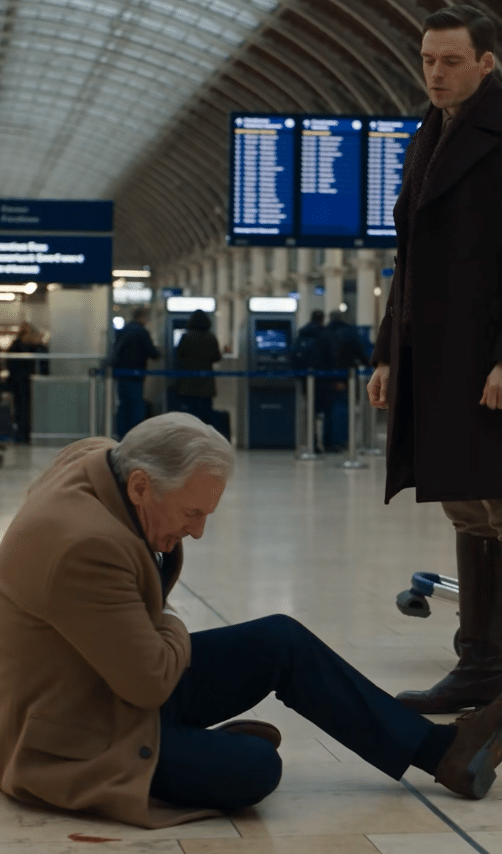
The accusation cut through the roar of the crowded train station. A man in an expensive charcoal coat stood over an elderly traveler whose suitcase lay overturned beside a luggage cart. The older man, dressed in a worn brown overcoat and scuffed leather shoes, looked up without raising his voice.
“I already did.”
That quiet answer seemed to offend the younger man more than an insult could have. He was forty, fit, meticulously dressed, and carried himself with the practiced superiority of someone accustomed to having doors opened before he reached them. A costly scarf rested neatly against his collar, and his polished boots looked absurdly out of place beside the elderly man’s battered suitcase.
The younger man glanced at the suitcase as if it were a personal affront.
Then he kicked it.
The case flew off the cart and slammed against the station floor. Something inside cracked, sending a small, framed photograph skidding beneath a nearby bench. Before the older man could bend to retrieve it, the younger man drove a fist into his face.
The impact snapped the old man’s head sideways. His cheek reddened almost instantly, and a faint trace of blood appeared at the corner of his mouth.
Passengers stopped walking. A woman clutched her child’s hand and pulled him back. A businessman lowered his phone, suddenly unsure whether he should record what was happening or pretend he had seen nothing.
The younger man wasn’t finished.
He planted both hands against the elderly man’s chest and shoved hard. The older man stumbled backward, his feet losing their grip on the polished floor, and crashed onto the concourse with a sharp scrape of his elbow.
For one suspended moment, the entire station seemed to hold its breath.
The younger man straightened his coat.
“Learn some manners before someone teaches you harder.”
The elderly traveler lay still for a moment, gathering his breath. His injured cheek throbbed, and his scraped elbow burned against the cold floor. Yet when he finally looked up, there was no pleading in his eyes.
Only a calmness the younger man could not understand.
The bully mistook that composure for weakness.
He had no idea that the old man was already deciding who needed to hear about what had happened.
And he had less than five minutes before the station doors opened.
Act II
The elderly man’s name was Thomas Hale.
At seventy-two, he had spent most of his life learning the difference between strength and the performance of strength. He had raised a family, buried friends, endured long separations, and watched men with impressive titles make decisions that changed lives they would never personally see.
He had also learned that the loudest person in a room was rarely the one worth fearing.
Thomas traveled alone that afternoon. His brown overcoat had been repaired twice at the cuffs, and the leather handle of his suitcase had darkened from decades of use. Inside were ordinary things: folded shirts, a book with a cracked spine, a few family photographs, and a small envelope he had promised to deliver in person.
Nothing about him suggested power.
That was precisely how he preferred it.
The man who had assaulted him was Lieutenant Colonel Daniel Voss, traveling in civilian clothes. Voss had spent years cultivating the kind of reputation that depended less on what he accomplished than on how people reacted when he entered a room.
He expected deference from subordinates, special treatment from strangers, and immediate apologies whenever he felt inconvenienced. His military rank was supposed to be invisible during civilian travel, but he carried its authority in every impatient gesture.
Even his family had learned to accommodate his temper.
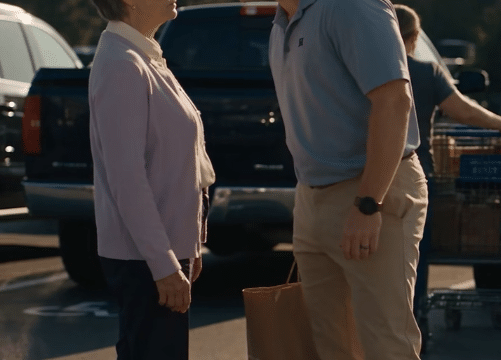
Earlier that day, a woman had accidentally brushed against Voss’s companion near the station’s entrance. The woman apologized immediately. Thomas, who had witnessed the exchange, had quietly helped her gather the items she dropped when Voss’s companion knocked them from her hands.
Thomas had also asked Voss to let the woman pass.
The request had been polite. It had been unmistakably reasonable.
Voss had heard it as a challenge.
He had demanded an apology from Thomas for supposedly disrespecting his family. Thomas had refused to apologize for something he had not done, though he had apologized for the confusion and tried to end the encounter peacefully.
That should have been enough.
Instead, Voss had decided that an elderly stranger in a worn coat was a safe target for his anger.
Now Thomas pushed himself upright, one hand pressed against his chest where Voss had shoved him. He tested his footing, retrieved his suitcase, and carefully picked up the fallen photograph.
The glass was cracked.
It showed a much younger Thomas standing beside a woman with bright eyes and a small boy in a military uniform. The boy’s shoulders were squared, his expression solemn, and his cap sat a little too large on his head.
Thomas brushed the photograph with his thumb.
For an instant, the pain in his face gave way to something older.
Then he slid the photograph back into his coat.
Across the concourse, Voss watched him with a contemptuous half-smile. He seemed disappointed that the old man had stood up without making a scene.
Thomas looked around at the people who had witnessed the assault. Some avoided his eyes. Others watched Voss with open disgust but remained frozen by the uncertainty of what to do.
Thomas did not blame them.
He knew how quickly people calculated the cost of standing up to someone who appeared powerful.
What Voss failed to understand was that Thomas had never needed a crowd to recognize his dignity.
He only needed one person to arrive.
And when Thomas reached for his phone, Voss still believed he was about to make the biggest mistake of his life.
Act III
Thomas’s hand was steady as he unlocked his phone.
His cheek was swelling. A thin line of blood remained at the corner of his mouth, and his elbow stung beneath the sleeve of his coat. But his breathing had settled, and the uncertainty that had briefly crossed his face was gone.
He placed the phone to his ear.
“Central concourse. Gate Twelve. Five minutes.”
That was all.
No name. No explanation. No plea for help.
Thomas ended the call and slipped the phone into his pocket.
Voss stared at him, then laughed.
“Tell your son to bring a lawyer.”
The words carried easily through the surrounding silence. Voss wanted the people watching to hear them. He wanted Thomas to understand that calling someone would change nothing, that whatever authority the old man imagined he possessed could not protect him from the consequences of challenging the wrong person.
But Thomas did not answer.
He bent down and adjusted the damaged suitcase, testing the broken handle. When it would not sit properly on the cart, he simply lifted it by the base. The movement cost him a grimace, but he refused to give Voss the satisfaction of seeing him struggle for longer than necessary.
Then he stood beside Gate Twelve.
Waiting.
Voss’s smile lingered, although something in Thomas’s expression had begun to bother him. The old man wasn’t behaving like someone who had just been beaten in public. He wasn’t shouting for security or threatening to expose Voss. He wasn’t even watching him anymore.
He was watching the entrance.
Voss followed his gaze.
Outside the station’s glass doors, traffic continued to crawl through the city. Taxis pulled away from the curb. Passengers hurried past with rolling luggage. A station employee pushed a cleaning cart around a column, seemingly unaware that anything unusual had happened.
Then a black security vehicle turned sharply toward the entrance.
Another followed.
A pair of command SUVs pulled in behind them, their arrival so coordinated that the people nearest the windows stopped to look. Doors opened. Uniformed security personnel stepped out and began moving with unmistakable purpose.
The atmosphere changed before anyone inside knew why.
Conversations faltered. Heads turned. A station employee lowered the radio in his hand. The passengers who had witnessed the assault shifted aside as if an invisible line had been drawn through the concourse.
Voss stopped smiling.
He had seen official convoys before. He knew the difference between an ordinary arrival and one organized around a person whose time was not to be wasted.
A senior military figure emerged from the vehicles.
The camera never showed the man’s face.
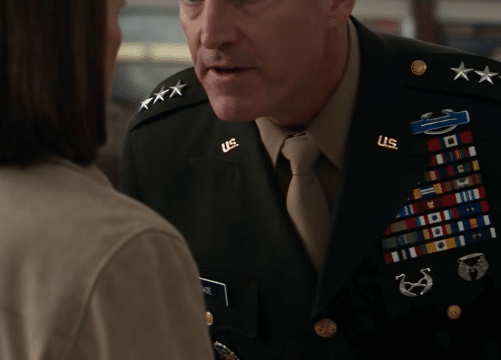
It caught only the decorated shoulders of his uniform, the stars and ribbons across his chest, the sharp crease of his formal trousers, and the polished shoes moving rapidly over the station floor. Security personnel kept pace around him, but the senior figure did not slow down to acknowledge the attention gathering along his path.
He was coming directly toward Gate Twelve.
Toward Thomas.
Voss’s expression tightened.
At first, he seemed to be searching for some other explanation. Perhaps the general was meeting a dignitary. Perhaps an official party was departing from the station. Perhaps the old man had merely happened to make his call at the same moment.
But the senior figure continued forward.
And Thomas, standing beside his battered suitcase, did not look surprised.
Voss suddenly remembered the words he had just spoken.
Tell your son to bring a lawyer.
He had intended the sentence as a threat.
Now, for the first time, he wondered whether it had been a confession.
Act IV
The general’s polished shoes crossed the final stretch of concourse.
The decorated shoulders moved through the crowd without hesitation. The people in the general’s path stepped aside, not because anyone shouted at them, but because the authority surrounding the approaching figure was impossible to mistake.
Thomas remained where he was.
He did not salute. He did not rush forward. He simply lifted his chin slightly, as though he had been waiting for a family member at an ordinary train platform.
That small gesture unsettled Voss more than the convoy had.
He looked from Thomas to the approaching general and back again. His mind began assembling possibilities, each more troubling than the last.
The old man had no visible entourage. No aide carried his luggage. He wore no uniform, no medals, and no expensive watch that might explain the response. He looked like someone’s father returning from a quiet visit, carrying a suitcase that had survived better decades.
And yet a senior general had arrived with military security to meet him.
Voss swallowed.
He tried to recover his composure by straightening his scarf. The gesture looked ridiculous now, a small attempt to repair the image of a man whose confidence was coming apart in front of an audience.
A moment earlier, he had controlled the space through intimidation. People had stepped back when he raised his voice. He had kicked an old man’s suitcase across the floor and struck him while everyone watched.
Now no one was looking at Voss.
Every eye followed the faceless figure approaching Thomas.
The general stopped just beyond the edge of the frame.
The camera remained on the uniform: decorated chest, insignia, ribbons, polished shoes. It offered no face to interpret, no smile to soften the moment, no expression to tell the audience what the general felt.
That absence made the silence heavier.
Thomas adjusted the collar of his brown coat. His cheek was swollen, and the faint blood at his mouth had begun to dry. He looked tired, but not defeated.
The general had come.
That was enough.
Voss’s breathing became shallow. He stared at the stars on the uniform, then at Thomas’s face, trying to reconcile the two images. The elderly civilian he had treated as insignificant was standing in front of someone whose presence could reach across entire chains of command.
And Thomas had called him with only a location and a time.
No explanation had been necessary.
Voss’s thoughts returned to the photograph that had slipped from the suitcase. He remembered the young soldier standing beside Thomas, the posture, the expression, the quiet resemblance he had dismissed as meaningless.
He had not known the man in the picture.
But he knew the kind of family that could produce a general who arrived with that level of security.
He had assumed Thomas was an old man with no influence.
He had assumed that a civilian coat meant civilian weakness.
Most dangerously, he had assumed that his own rank made him untouchable.
Now the consequences of that assumption stood only a few feet away, their face hidden from him and from everyone watching.
Voss tried to speak, but nothing came.
The general did not need to threaten him. Thomas did not need to accuse him. The convoy, the uniform, and the old man’s calm expression had already transformed the encounter.
Voss had spent the last several minutes making sure everyone saw him dominate an elderly stranger.
Now everyone was watching him discover who that stranger was.
And the truth was finally reaching his face.
Act V
Voss’s expression collapsed by degrees.
First, the smugness disappeared. Then the practiced certainty in his eyes gave way to disbelief. Finally, the color drained from his face as he looked at Thomas again, seeing details he had ignored before: the composure, the unhurried movements, the complete absence of fear.
Thomas had never been trying to impress him.
He had simply refused to become what Voss wanted him to be.
The crowd remained silent. The damaged suitcase rested beside the luggage cart, its handle bent at an awkward angle. Somewhere beyond the circle of watching passengers, a departure announcement echoed through the station, reminding everyone that ordinary life had not stopped for the man who had mistaken cruelty for authority.
Thomas’s gaze settled briefly on the senior figure’s decorated uniform.
Then he looked back at Voss.
There was no triumph in his expression. No satisfaction at watching another man become frightened. If anything, he looked disappointed, as though the entire encounter had confirmed something he had hoped not to learn.
Voss shifted his weight.
He could still attempt an explanation. He could claim that Thomas had provoked him, that the suitcase had been in the way, that the confrontation had been misunderstood. He could reach for the familiar language of procedure and rank, searching for a version of events in which his actions became a regrettable misunderstanding instead of a deliberate choice.
But the witnesses had seen the sequence clearly.
The kick.
The punch.
The two-handed shove.
The old man hitting the floor.
And the insult delivered while he struggled to stand.
No title could make those moments disappear.
Thomas lowered his eyes to the cracked photograph inside his open suitcase. He carefully tucked it away, then secured the damaged case against the cart. His hands moved slowly, but they did not tremble.
He had not called his son to punish Voss.
He had called because some lines could not be crossed and then explained away in private. Because a uniform was supposed to represent responsibility, not permission to humiliate strangers. Because a man who used authority as a weapon needed to be confronted by someone who understood what authority was meant to protect.
The general’s arrival made the difference impossible to ignore.
Voss looked at the uniform one last time. His mouth opened slightly, but the first words that came were not an apology. They were the question of a man whose understanding of the world had just broken apart.
“Your son is… him?”
The camera held on Voss’s face.
Nothing else entered the frame.
His eyes widened as the implication settled over him. The general’s face remained unseen, Thomas remained outside the shot, and the crowd disappeared into a blur behind him.
For the first time since the confrontation began, Voss had no command to give, no insult ready, and no confidence left to hide behind.
The last thing he saw was the authority he had believed belonged only to other people.
Then the image cut to black.
Clarify why Thomas waits five minutesReveal the son’s identity more decisively