Act I
“Move. My son’s waiting.”
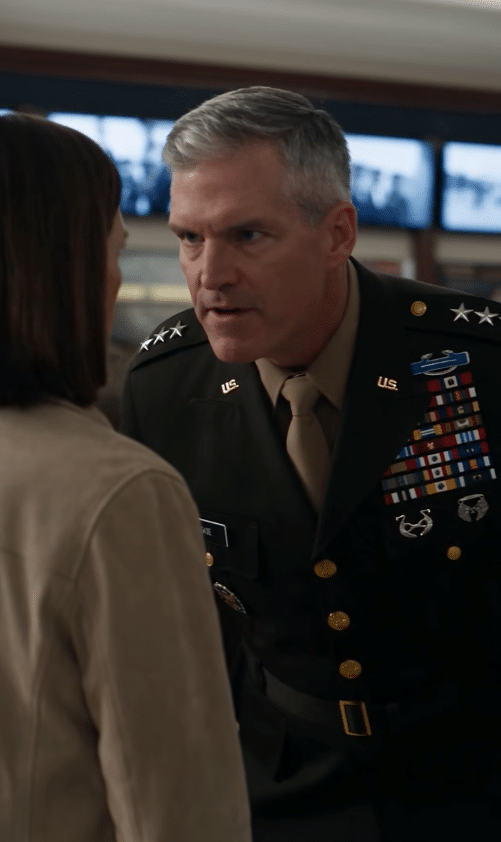
Brigadier General Thomas Whitmore stepped directly into the woman’s path, his decorated service uniform immaculate beneath the bright lights of the military museum lobby. Veterans, cadets, officers, and their families crowded the marble-floored entrance for a public ceremony, but Whitmore seemed to see only one obstacle between himself and what he wanted.
A woman in a beige coat.
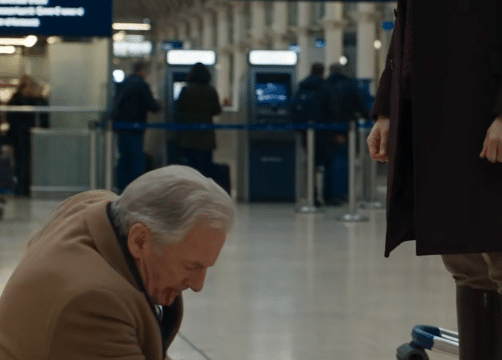
She had shoulder-length brown hair, a cream blouse, navy trousers, and ordinary black flats. She carried no military identification, wore no visible insignia, and appeared to be another civilian attending the event.
Whitmore expected her to step aside.
Instead, she glanced toward the entrance and calmly replied, “He can wait ten seconds.”
The general’s expression hardened.
At fifty-one, Whitmore was accustomed to immediate obedience. His rank opened doors, silenced objections, and made even experienced officers think twice before challenging him. He had spent years cultivating a reputation as a man who expected things done his way.
And he despised being inconvenienced by people he considered unimportant.
“Do you have any idea who you’re holding up?” he demanded.
The woman didn’t answer.
That was enough.
Whitmore grabbed a glass of punch from a nearby reception table and threw it directly into her face. Before the stunned guests could react, he hurled the glass onto the marble floor, where it shattered with a sharp crash.
Then he slapped her hard across the cheek.
Her head snapped sideways. The struck cheek reddened almost immediately, and a faint trace of blood appeared at the corner of her mouth.
Whitmore followed with a forceful kick to her stomach.
The woman doubled over, lost her breath, and dropped to one knee on the polished marble.
A young cadet recoiled. An elderly veteran stared in disbelief. Several officers stood motionless, their eyes darting between the woman and the general who had just assaulted her in front of a room full of witnesses.
Whitmore straightened his uniform.
“Civilians don’t hold up generals.”
The woman remained on one knee for a moment, breathing carefully through the pain.
Then she slowly raised her head.
There were no tears in her eyes. No pleading. No desperate attempt to explain herself to the man standing over her.
She simply looked at him.
Whitmore mistook her silence for submission.
He had no idea that the woman he had just humiliated was about to make one phone call—and that, in four minutes, the entire balance of power in that lobby would change.
Act II
The museum’s marble floor reflected the overhead lights, the display cases, and the stunned faces of the people who had witnessed the assault.
A moment earlier, the lobby had been alive with conversation. Veterans had greeted old friends, families had gathered beside historical exhibits, and young cadets had moved through the crowd with the nervous excitement of attending a formal military ceremony.
Now, everyone seemed afraid to speak.
Whitmore understood the effect his rank had on people.
He had learned that a uniform could do more than identify authority. In the right circumstances, it could make people doubt their own judgment. A civilian might witness something outrageous and still hesitate, wondering whether a decorated general had some justification they did not understand.
Whitmore relied on that hesitation.
He had little patience for people who questioned him, particularly civilians who did not understand the military hierarchy. In his mind, respect was something owed automatically to anyone who wore enough stars or decorations.
He rarely considered whether his behavior deserved it.
The woman in the beige coat had made the unforgivable mistake of refusing to move when he ordered her to.
Now he expected her to apologize.
Instead, she carefully placed one hand against her abdomen and used the other to steady herself against the edge of a nearby display plinth. Her breathing was shallow, and pain tightened her expression, but she refused to give him the reaction he wanted.
Whitmore looked toward the museum doors.
His son was attending the ceremony, and the general had promised to meet him before the opening remarks. He was already late, and the presence of so many senior officers made the delay particularly irritating.
He wanted the confrontation finished.
“Get up and move along,” he snapped.
The woman slowly rose, keeping her movements controlled.
She adjusted her beige coat and wiped the corner of her mouth. Her eyes briefly traveled across the lobby, taking in the broken glass, the reception table, and the faces of the witnesses.
Then she reached into her coat pocket and removed her phone.
Whitmore gave a dismissive laugh.
“What now? Calling security?”
She didn’t answer.
There was something almost unnerving about her composure. She wasn’t looking around for someone to rescue her. She wasn’t attempting to draw the crowd into an argument or threaten the general with a complaint.
She seemed to have made a decision.
Whitmore watched as she unlocked her phone and placed a call.
The woman spoke only once.
“Museum main lobby. Four minutes.”
She ended the call.
Whitmore stared at her.
For a moment, the general seemed unable to decide whether to laugh or become angry again. The call had been so brief that he couldn’t tell whom she had contacted, and she offered no explanation.
“Call whoever makes you feel important.”
He delivered the insult with a sneer, confident that he had regained control.
The woman slipped her phone away.
She didn’t look at the museum doors.
She didn’t check the time.
She simply waited.
Whitmore turned toward the reception area, convinced the incident was over. The witnesses would eventually return to their conversations. His son would arrive. The ceremony would begin, and the woman would disappear into the crowd.
But as he took his first step away, the sound of approaching vehicles reached the entrance.
The main doors began to open.
And the woman in the beige coat didn’t look surprised.
Act III
The first person to notice the change was an elderly veteran standing beside a display of historic military decorations.
He turned toward the entrance as the doors opened wider.
Two aides entered first, followed by the polished shoes and formal trousers of a senior military officer. The crowd instinctively created a path, conversations fading as people recognized the insignia emerging beneath the museum’s bright lights.
Whitmore turned around.
His expression changed when he saw the four stars.
The arriving officer wore a formal uniform decorated with dense rows of ribbons and medals. The camera revealed the shoulder boards, the decorations, the precisely pressed trousers, and the polished shoes—but never the person’s face.
There was no need for an announcement.
The rank was unmistakable.
A four-star general had arrived.
Whitmore immediately straightened his posture. Whatever his personal ambitions, he understood the importance of senior command. A four-star general possessed an authority that made Whitmore’s own position suddenly seem much smaller.
He tried to identify the visitor.
The camera offered no face, only the decorated shoulders moving steadily through the lobby.
The general’s aides followed at a measured pace.
Several officers near the ceremony platform stood straighter. A cadet quietly stepped aside. The elderly veteran who had witnessed the assault watched the arrival with an expression of growing curiosity.
Whitmore adjusted the front of his uniform.
Perhaps the general was attending the ceremony. Perhaps the arrival had nothing to do with the woman. The museum regularly hosted distinguished military guests, and a four-star officer appearing at a public event was not, by itself, extraordinary.
That explanation should have reassured him.
It didn’t.
The woman in the beige coat had made a call.
She had specified a location and an exact arrival time.
And now a four-star general was walking into the same lobby.
Whitmore looked at her.
She stood near the display plinth, her injured cheek still red and her breathing still guarded. Her clothes were ordinary, and she carried no visible indication that she belonged to a prominent military family.
Yet she watched the approaching officer with quiet familiarity.
Not surprise.
Not nervous anticipation.
Recognition.
Whitmore’s stomach tightened.
He searched her face for some clue he might have missed. A familiar surname. A resemblance to someone he had met at a briefing. Something that could explain why she seemed so certain that the senior officer would arrive.
But the woman offered nothing.
She had not announced her family connections. She had not claimed to know anyone important. She had not threatened him with a name or attempted to frighten him with her phone call.
She had simply made the call.
And the general had come.
The arriving figure continued through the lobby, the four stars catching the light as the camera moved from the decorated shoulders to the rows of medals and then down to the polished shoes.
Whitmore’s forced smile began to fade.
He had spent the entire confrontation believing he was the only person in the room whose identity mattered.
Now he was beginning to suspect that the woman he had treated as a nuisance was connected to someone whose name could change everything.
The four-star general was approaching her.
And Whitmore was standing directly between them.
Act IV
The senior officer moved past the museum’s central display, followed closely by the aides.
The camera maintained its strict focus on the uniform, never revealing the general’s face. The four-star shoulder boards remained visible, followed by the ribbons, medals, formal trousers, and polished shoes crossing the marble floor.
The woman in the beige coat remained still.
Whitmore shifted slightly to the side, then stopped himself.
He wasn’t certain whether he should salute, introduce himself, or step forward to greet the arriving officer. Every instinct told him to behave as though he belonged in the center of the moment.
But he could no longer ignore the woman.
She hadn’t called for museum security.
She hadn’t asked someone to contact the ceremony organizers.
She had requested a location and a time from a person who appeared to have arrived precisely as expected.
Whitmore looked toward the approaching figure again.
The general’s aides moved with quiet purpose, and the surrounding officers watched with a mixture of respect and curiosity. No one interrupted the procession. No one demanded an explanation for the arrival.
The senior officer continued directly toward the woman.
Whitmore felt his confidence slipping.
He had spent years believing that rank separated people into categories. Those with authority gave orders. Those without it followed them. Civilians, in particular, were expected to accommodate the demands of senior military personnel without making themselves difficult.
The woman had refused to follow that script.
Worse, she had refused without displaying any authority of her own.
Now the consequences of that refusal were approaching in the form of four stars.
Whitmore’s gaze returned to her face.
She was forty-four, perhaps younger than he had initially assumed. Her brown hair rested neatly against her shoulders, and despite the pain she had endured, she stood with a composure that seemed entirely at odds with the scene around her.
She wasn’t trying to impress anyone.
She wasn’t enjoying his discomfort.
She was simply waiting for someone she trusted.
The senior officer stopped nearby.
Whitmore could see the medals and the stars clearly now. The general’s face remained outside the camera’s frame, preserving the mystery of the arrival.
But the woman’s expression softened almost imperceptibly.
It wasn’t a dramatic smile. It was the smallest change in the eyes, the kind of recognition that passed between people who did not need to explain themselves to one another.
Whitmore saw it.
And something inside him seemed to give way.
He looked from the senior officer to the woman, then back again.
The resemblance wasn’t obvious enough to settle his doubts. The woman’s appearance gave away nothing about her family. She wore no uniform, and she had never mentioned a brother, a general, or a military connection.
But the timing, the familiarity, and the four stars standing before him formed a picture he could no longer dismiss.
He remembered the words she had spoken after he ordered her to move.
He can wait ten seconds.
At the time, he had interpreted them as disrespect.
Now they sounded like the words of someone who had never believed his rank gave him the right to control her.
Whitmore’s face drained of color.
He had assaulted a civilian in a public lobby, surrounded by veterans, cadets, active-duty personnel, and families. He had done it because he assumed nobody powerful would care what happened to her.
He was now looking at a four-star general who had come directly to her.
And the woman was standing beside the very person Whitmore had spent his career trying to impress.
The general’s face remained hidden.
The relationship remained unspoken.
But Whitmore suddenly understood why the woman had needed only four minutes.
Act V
Nobody in the lobby moved.
The senior officer stood beside the woman, visible only from the decorated shoulders to the polished shoes. The four-star insignia remained in full view, an unmistakable reminder of the authority that had just entered the room.
Whitmore stared at the uniform.
His own ribbons seemed to weigh more heavily against his chest. The rank he had used to intimidate a woman minutes earlier now offered no comfort at all.
He looked at her.
She had straightened her beige coat as best she could, though the fabric still showed the marks of the punch thrown into her face. Her cheek remained swollen and red, and one hand stayed close to her stomach.
She looked hurt.
But she did not look defeated.
The general’s presence had not transformed her into someone powerful. It had simply exposed how wrong Whitmore had been to assume she was powerless in the first place.
He had believed her lack of insignia meant she had no meaningful connection to the institution he served.
He had believed her calmness meant she could be bullied without consequence.
He had believed that a civilian standing alone in a museum lobby would have nobody important willing to stand beside her.
Every assumption had failed.
The people who had watched the assault remained silent, their attention fixed on the unfolding encounter. The elderly veteran stood rigidly near the historical display. The cadet who had recoiled at the slap was still watching.
Whitmore had wanted witnesses when he demonstrated his authority.
Now he had witnesses to its limits.
He swallowed and glanced toward the general’s aides, searching for some indication of what would happen next. Nobody offered him reassurance.
The woman did not point at him.
She did not repeat his insults or demand that the general punish him. She did not need to explain the call she had made or tell the room who she was.
Her presence beside the senior officer was enough to destroy the comfortable story Whitmore had told himself.
He had not merely interrupted a stranger.
He had assaulted someone whose family connection to senior command he had never bothered to consider.
And the realization was spreading across his face.
The general’s identity remained concealed, but the relationship was suddenly impossible for Whitmore to ignore. He looked at the four stars, then at the woman, noticing the quiet familiarity between them.
His mouth opened.
For the first time since the confrontation began, the brigadier general seemed unable to find a commanding sentence.
The woman held her ground.
No dramatic speech followed. No one needed to announce her family name. The senior officer’s face never entered the frame.
Whitmore had enough information to understand the mistake he had made.
He stared at the four-star insignia, then turned back toward the woman he had thrown to the marble floor.
His voice came out in a stunned whisper.
“That’s your brother…?”
The camera cut to an extreme close-up of Whitmore’s face.
His arrogance had vanished.
In its place was disbelief, followed by the dawning fear of a man who had finally recognized the consequences of his own behavior.
The screen cut to black.
And the general’s face remained unseen.
Because the most devastating part of the revelation was not that the woman had a four-star general for a brother.
It was that Whitmore had treated her as though she deserved no respect until he discovered whose sister she was.
Reduce repeated descriptions of the generalGive the woman a stronger identity