Act I
“Move. Senior command is waiting.”
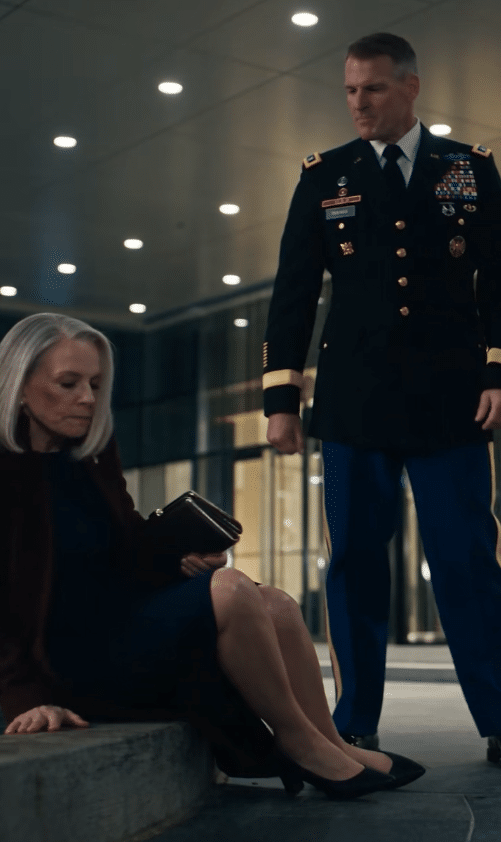
Colonel Andrew Mercer stepped into the woman’s path, his immaculate dress uniform glittering beneath the bright lights of the Grand Meridian Hotel. Officers in formal attire moved through the entrance, chauffeurs hurried between luxury vehicles, and military leaders gathered inside for an exclusive dinner.
The woman wore a burgundy evening coat over a simple black cocktail dress. Silver-blond hair framed her shoulders, pearl earrings caught the light, and a small black clutch rested in one hand.
She looked like any other guest arriving for the evening.
That was precisely why Mercer felt entitled to order her around.
“So am I.”
Her answer was quiet, almost conversational.
Mercer stared at her as if she had committed an unforgivable offense. At forty-six, he had mastered the art of turning ordinary interactions into demonstrations of authority. His formal uniform carried a dense row of ribbons, and the visible colonel’s insignia on his shoulders made sure nobody could mistake his position.
He was accustomed to people stepping aside before he asked.
This woman had not even moved.
“Do you understand what’s happening tonight?” he demanded, glancing toward the hotel entrance. “Senior command is attending. We don’t have time for people who don’t know where they belong.”
She met his gaze without flinching.
Mercer noticed the absence of military insignia on her clothing. No uniform. No visible rank. No aide following behind her. No one announcing her arrival.
In his mind, that settled everything.
He lifted his champagne flute and threw its contents directly into her face and across her neck.
The woman recoiled as the cold liquid soaked her coat. Before she could recover, Mercer hurled the empty glass onto the pavement. It shattered beside the curb, sending nearby guests stumbling backward.
Then he struck her.
The slap landed hard across her cheek.
Her head turned sharply, and the skin on the struck side of her face began to redden. A faint trace of blood appeared at the corner of her mouth.
Mercer wasn’t finished.
He drove a powerful punch into her stomach.
The woman folded forward, struggling for breath, and dropped beside the curb. Her clutch slipped from her hand and landed on the pavement.
Around them, conversations died.
An officer near the entrance froze with his car keys in his hand. A couple emerging from a luxury sedan stopped abruptly. Two uniformed guests stared at Mercer, visibly shocked, but neither stepped forward.
The colonel stood over the woman, adjusting his cuff as though he had merely corrected a minor inconvenience.
“Spouses wait where they’re told.”
The woman pressed one hand against her abdomen and slowly lifted her head.
Her cheek hurt. Her breathing was painful. Champagne dripped from the ends of her silver-blond hair.
Yet there was something in her expression that Mercer couldn’t explain.
She wasn’t frightened of him.
She was looking at him as though she had just learned something important.
And what she did next would turn his little display of authority into the worst mistake of his career.
Act II
For several seconds, the woman remained beside the curb, allowing her breathing to settle.
The hotel entrance was filled with witnesses, but nobody seemed certain what to do. Mercer was a colonel attending a high-level military leadership dinner. His uniform carried enough visible authority to make people hesitate, even when his behavior had crossed every reasonable boundary.
He understood that hesitation.
He had spent years exploiting it.
In his world, status was something to display. The right uniform, the right decorations, the right invitation, and the right people greeting you by name could open doors before you reached them.
He had little patience for anyone who lacked those advantages.
Especially spouses.
To Mercer, military spouses were expected to smile politely, remain out of the way, and allow officers to conduct the business that supposedly mattered. He rarely considered how much those families sacrificed or how many had built lives around the demands of military service.
He saw only a hierarchy.
And he believed himself safely near the top.
The woman in the burgundy coat challenged that worldview simply by refusing to act intimidated.
Even after he assaulted her, she didn’t apologize.
She didn’t ask who he was.
She didn’t threaten to complain to the hotel manager or demand that someone call the police.
Instead, she carefully retrieved her clutch and used the edge of her sleeve to wipe the champagne from her face. When she touched the corner of her mouth, she noticed the faint blood on her fingertips.
Her eyes remained on Mercer.
He shifted impatiently.
“What are you staring at?”
She didn’t answer.
The silence irritated him more than an argument would have. An argument would have given him something to attack, a sentence he could twist into disrespect, an excuse to make himself the injured party.
Her restraint offered him nothing.
Mercer glanced toward the hotel doors, checking whether anyone important had noticed the disturbance. The leadership dinner was already running behind schedule, and he had no intention of allowing an insignificant confrontation to interfere with his evening.
He assumed the woman would leave.
Most people did.
They walked away from men like him because challenging them seemed exhausting, embarrassing, or professionally dangerous. They convinced themselves that silence was the sensible choice.
Mercer had mistaken that silence for permission so many times that he no longer recognized the difference.
The woman slowly rose to her feet, keeping one hand close to her abdomen.
Her movements were careful, but her expression had changed. The shock had passed. What remained was a cold, unmistakable focus.
She looked down at her phone.
Mercer gave a dismissive laugh.
“Are you going to call someone?”
She made no reply.
For the first time, his confidence faltered—not because he felt remorse, but because he couldn’t predict her next move.
She stepped slightly away from the broken glass, unlocked her phone, and made a call.
No frantic explanation followed. No lengthy complaint. No attempt to describe the assault to the person on the other end.
She simply gave a location and a time.
“Grand entrance. Three minutes.”
Then she ended the call.
Mercer stared at her.
Three minutes?
He had no idea who she had contacted, and he didn’t care enough to ask. In his mind, nobody she could summon would matter more than the senior officers already gathering inside.
He straightened his uniform and allowed a mocking smile to return.
He was about to explain exactly how little her phone call meant.
Then the first black military vehicle turned toward the hotel entrance.
Act III
“No one outranks me out here.”
Mercer delivered the words with a smugness that sounded almost rehearsed.
He wanted the surrounding guests to hear him. He wanted them to understand that the incident was over because he had decided it was over.
The woman stood several feet away, her burgundy coat soaked and her injured cheek reddening beneath the entrance lights.
She said nothing.
Mercer interpreted her silence as defeat.
He had no reason to suspect that the next few minutes would strip away the security he had built around his reputation. He didn’t know who she had called, what that person had been doing before the call arrived, or why she had specified such a precise location and time.
He only knew that she had refused to leave.
And he intended to make sure she regretted it.
A low engine rumble interrupted him.
The first black vehicle rolled toward the valet lane, followed closely by a second. Their movement was controlled and deliberate, and the attendants immediately began clearing space near the entrance.
Conversations faltered.
A chauffeur stepped back from a waiting sedan. Several officers turned toward the approaching motorcade, their expressions changing as they recognized the significance of the arrival.
Mercer glanced over his shoulder.
His smile weakened.
The lead vehicle stopped.
A door opened.
The camera caught polished black shoes touching the pavement, followed by the crease of formal military trousers. A decorated uniform emerged from the vehicle, its shoulders bearing four unmistakable stars.
The camera never showed the person’s face.
Instead, it lingered on the details that mattered: the four-star shoulder boards, the dense rows of ribbons and medals, the precise lines of the formal uniform, and the polished shoes moving steadily across the pavement.
The figure stepped away from the vehicle.
Another door closed behind them.
The motorcade remained positioned at the entrance while the senior officer walked directly toward the hotel.
Nobody needed to announce the rank.
Four stars spoke for themselves.
Mercer straightened instinctively.
For years, he had measured every room by identifying the highest-ranking person in it. He knew how to adjust his posture, change his tone, and position himself so that senior officers would see him as a disciplined, dependable subordinate.
He had spent the evening preparing to impress exactly the kind of leadership now approaching.
But his attention kept returning to the woman.
She hadn’t turned to stare at the motorcade.
She hadn’t smiled triumphantly or attempted to draw attention to herself.
She simply stood where she was, watching the approaching figure with the calm expectation of someone who had known precisely when they would arrive.
Mercer felt an unfamiliar chill settle beneath his collar.
He looked at her again.
The soaked burgundy coat. The pearl earrings. The simple black dress. The small clutch she had retrieved from the pavement.
Nothing about her appearance explained why a four-star general would arrive at the exact place and time she had specified.
Unless the explanation had been standing in front of him all along.
The senior officer continued forward.
The ribbons caught the entrance lights.
The four stars remained in view.
And Mercer began to understand that the woman he had treated as an irrelevant guest might have been the one person he should never have underestimated.
Act IV
The approaching footsteps seemed louder than the traffic.
The senior officer crossed the valet lane without hesitation, moving past the hotel attendants and the stunned guests gathered near the entrance.
The camera stayed deliberately above the person’s face, showing only the decorated shoulders, the four-star insignia, the ribbons, the formal trousers, and the polished shoes.
The identity remained concealed.
But Mercer no longer needed to see a face to understand the scale of the problem.
His own uniform suddenly felt less impressive.
The ribbons across his chest, which had served as a source of pride only moments earlier, seemed almost absurd beneath the authority represented by the approaching stars.
He glanced toward the hotel doors.
Several officers who had been heading inside had stopped to watch. One stood rigidly beside the entrance, his attention fixed on the senior figure. Another lowered his conversation to a whisper.
The gathering had become aware that something significant was happening.
And Mercer was standing in the middle of it.
He tried to recover his composure.
Perhaps the general had arrived for the dinner. Perhaps the timing was coincidental. Perhaps the woman had contacted someone else entirely, and the motorcade had nothing to do with her.
He searched for an explanation that would allow him to dismiss what he was seeing.
But the woman hadn’t moved.
She wasn’t looking around for assistance. She wasn’t trying to approach the senior officer or wave for attention.
She waited.
That single detail made every other explanation feel weaker.
Mercer remembered the words she had spoken before he attacked her.
So am I.
At the time, he had heard an insolent response from a woman who didn’t understand the importance of the evening.
Now the words seemed to carry a meaning he had completely missed.
The senior figure drew closer.
The camera showed the four-star shoulder boards again, then the dense ribbons and medals. The polished shoes stopped just beyond the edge of Mercer’s field of vision.
The colonel’s eyes widened.
He looked toward the woman.
She met his gaze without triumph or anger.
Her expression carried no demand for an apology. She didn’t point to her injured cheek or remind him of the champagne soaking her coat. She didn’t need to repeat the call or explain why she had asked for three minutes.
The arrival itself was answering questions Mercer hadn’t yet found the courage to ask.
He began to understand that the woman had never needed to display authority to possess it.
She had not been trying to compete with him.
She had not been fighting for a higher place in his hierarchy.
She had simply refused to accept the humiliating treatment he considered his right to impose.
And when he responded with violence, he had turned an encounter he might have walked away from into something witnessed by an entire hotel entrance.
The motorcade had arrived.
The four stars were real.
And the woman remained standing beside the curb, dignified despite the pain he had caused her.
Mercer felt the blood drain from his face.
His mouth opened slightly, but no words came out.
He looked from the senior officer’s insignia to the woman’s face, desperately searching for confirmation of what he was beginning to suspect.
The camera refused to give him the comfort of a visible answer.
No face appeared.
No voice announced a name.
No one explained the relationship.
Instead, Mercer was left with the one detail he could no longer ignore.
The woman had known exactly when the four-star officer would arrive.
She had called.
And the motorcade had come.
For the first time that evening, Colonel Mercer had no idea what to say.
Act V
The entrance fell into a silence that felt almost physical.
The senior officer remained just beyond the camera’s view, the four-star insignia and decorated uniform providing the only visible confirmation of rank.
The woman stood nearby.
Her silver-blond hair was still damp from the champagne. Her burgundy coat clung slightly at the shoulders, and the redness across her cheek had become impossible to overlook. One hand rested protectively near her abdomen, betraying the pain she had endured.
Yet she held herself with quiet dignity.
She did not rush toward the arriving officer.
She did not cling to them for protection.
She did not need to explain why she had called.
That was what finally broke Mercer’s composure.
He had expected her to behave like someone who needed his permission to remain at the entrance. He had expected her to retreat when confronted by his uniform, his rank, and his contempt.
Instead, she had summoned someone whose authority dwarfed his own.
And she had done so without raising her voice.
Mercer stared at the four stars.
His mind raced through the possibilities. A commanding general. A senior leader attending the dinner. Someone whose presence could change the atmosphere of the entire event simply by stepping out of a vehicle.
But the timing was too precise.
Three minutes.
She had not said, Please help me.
She had not said, Tell them what he did.
She had simply named the location and the arrival time, as though the person on the other end already understood everything necessary.
Mercer looked back at her.
For one brief moment, he seemed ready to speak. Perhaps he intended to explain that there had been a misunderstanding. Perhaps he was preparing to insist that the woman had provoked him.
But the broken champagne flute remained on the pavement.
The witnesses remained near the entrance.
And the evidence of his behavior was written plainly across the woman’s face.
Whatever story he told now would have to compete with what everyone had seen.
His shoulders stiffened, but the movement no longer looked commanding. It looked defensive. His eyes darted toward the hotel doors, where the dinner guests had begun watching with undisguised curiosity.
He had wanted an audience when he humiliated her.
Now he had one.
The woman gave him no further reaction. She stood quietly, allowing the consequences of his own actions to catch up with him.
Mercer looked once more at the four-star insignia.
Then he looked at her.
The realization arrived not as a dramatic announcement, but as a terrible possibility becoming impossible to ignore.
The woman he had dismissed as an unimportant spouse might be connected to the most powerful officer he had ever expected to encounter that evening.
And if she was, then the champagne, the slap, the punch, and the public humiliation were no longer incidents he could wave away as a private disagreement.
They were witnessed acts of misconduct committed in front of the very people whose respect he had spent his career trying to earn.
His lips parted.
The contempt was gone.
In its place was naked disbelief.
“Four stars…?”
The question escaped him before he could stop it.
The camera held on his face as fear replaced arrogance.
Then the screen cut to black.
The general’s face remained unseen.
The woman’s full identity remained unspoken.
And Colonel Mercer was left confronting the one truth he had failed to understand when he first ordered her to move.
The most powerful person at the entrance had never needed to announce herself.
Make her identity and relationship explicitReduce repeated motorcade descriptions