Act I
“They called my name for the medicine.”
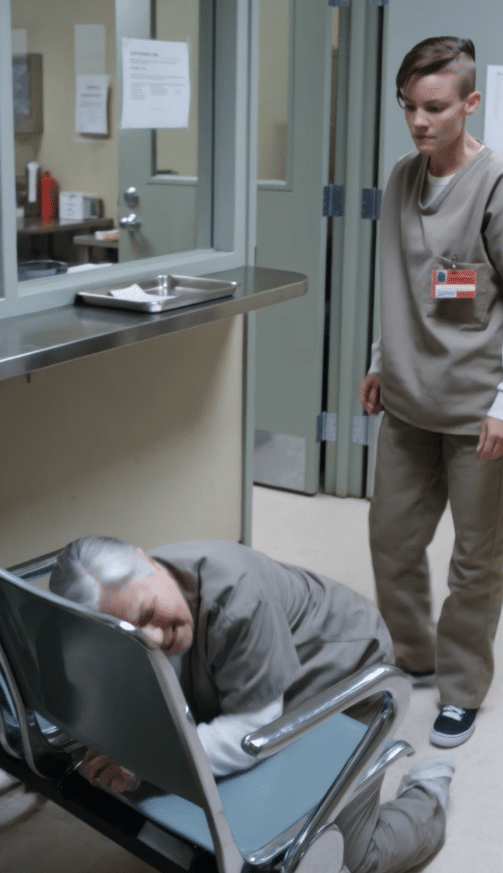
Eleanor Hayes stood beside a row of bolted metal chairs in the prison clinic, clutching a small medicine slip between trembling fingers. Her gray hair was tied low at the back of her neck, and her oversized prison uniform hung loosely from her narrow shoulders. She had been waiting under the harsh white lights for nearly forty minutes when the nurse finally called her name.
Before Eleanor could reach the counter, another inmate snatched the slip from her hand.
“Trash. Old women can wait.”
Thirty-two-year-old Brooke Maddox stepped into Eleanor’s path, holding the paper above her own shoulder as if it were something worthless. Brooke was younger, stronger, and accustomed to making people move simply because she expected them to.
The clinic line fell quiet.
Behind the safety glass, a nurse looked up from the medication records. A junior guard shifted his weight near the doorway, but he did not immediately intervene. Several inmates stared at the floor, already familiar with Brooke’s habit of turning the smallest disagreement into a public display of power.
Eleanor reached for the slip.
“Please. They called my name.”
Brooke pulled it away.
“Did you not hear me? You can wait.”
“My medicine has to be taken on time.”
Eleanor’s voice was weak, but there was no confusion in it. She knew her schedule. She knew the medication window. And she knew that the nurse had called her because her dose was due.
Brooke smiled without warmth.
“You think being old makes you special?”
“No,” Eleanor answered. “I just need my medicine.”
That should have ended the argument.
Instead, it seemed to offend Brooke even more.
For weeks, Brooke had treated the clinic waiting area as if it belonged to her. She pushed ahead of other inmates, demanded the seats she preferred, and expected people to accommodate her moods. Most women chose not to challenge her. The clinic was already an uncomfortable place, and nobody wanted a medication visit to become another source of trouble.
Eleanor had never tried to compete with her.
At fifty-eight, she had learned that quietness could sometimes be mistaken for weakness. Her knees ached after standing too long, and the bright lights often left her with a headache. She carried her medicine slip carefully because missing a scheduled dose could complicate her treatment.
She was not asking for special treatment.
She was asking for the treatment that had already been prescribed.
Brooke looked at the slip, then at Eleanor’s outstretched hand.
“You’ll get it when I say you get it.”
Eleanor tried once more to retrieve the paper.
Brooke stepped out of the line and drove one hard kick into Eleanor’s chest.
The older woman fell sideways beside a metal chair. Her forearm struck the chair leg, leaving a thin trace of blood on her skin.
A sharp metallic clatter rang through the waiting area as the chair shifted against the floor.
Eleanor gasped, struggling to draw a full breath.
Before she could steady herself, Brooke delivered exactly two more kicks into her back and side.
Eleanor winced and curled away, reaching weakly toward the medicine slip near the counter.
The paper had fallen several feet away.
It was such a small thing. A thin piece of paper bearing her name and the instructions that were supposed to help the clinic provide her medication safely.
Now it lay on the floor while Eleanor struggled to move.
Brooke stood over her.
“Weak ones wait behind me.”
An inmate near the end of the line covered her mouth. Another woman took a frightened step backward. Behind the safety glass, the nurse stared in disbelief, while the junior guard finally moved toward the scene.
Then the exam-room door swung open hard.
A metal tray rattled inside the room.
The prison’s chief doctor stepped into the waiting area, wearing a white lab coat over a pale blue shirt. The warden emerged beside him. Both stopped when they saw Eleanor on the floor and the medicine slip lying near Brooke’s feet.
The doctor’s eyes fixed on the paper.
Then he looked at the woman who had kicked Eleanor.
His expression hardened.
“You just became the reason this clinic changes.”
Brooke’s face went still.
She looked at the doctor, then at the warden standing beside him. The confidence that had carried her through the confrontation began to drain from her expression.
“Changes how?”
For the first time, Brooke sounded less like someone giving orders and more like someone afraid of the answer.
And the chief doctor had not come out of his office merely to witness a fight.
He had already been looking into problems inside the clinic.
Eleanor’s medicine slip had just brought those problems into the open.
Act II
Eleanor Hayes had spent most of her adult life being the person who remembered what everyone else needed.
Before prison, she worked as a bookkeeper for a family-owned home renovation business outside Cleveland, Ohio. Her husband, Thomas, handled repairs and estimates, while Eleanor managed invoices, scheduled payments, and kept track of the small details that allowed the business to survive.
They were not wealthy.
They lived in a modest house with a narrow driveway, a small garden, and a kitchen table that had been in the family for more than twenty years. Their daughter, Rebecca, grew up doing homework at that table while Eleanor sorted receipts nearby.
Eleanor liked a life in which things had their proper place.
Bills were paid when they were due. Appointments were written on the calendar. If someone promised to do a job, she believed they should make a genuine effort to complete it.
That belief became complicated when the business began struggling.
A major client failed to pay a substantial invoice, and the company fell behind on payroll and supplier accounts. Eleanor’s husband became increasingly anxious about losing the business. Their savings began to disappear, and the pressure followed them home.
Then an outside accountant suggested a way to make the company’s financial position look healthier while they waited for the client to pay.
Eleanor knew the paperwork was misleading.
She also knew that refusing could mean layoffs, unpaid bills, and the possible loss of the business her husband had spent years building.
She convinced herself that the changes were temporary.
She told herself she was protecting the employees.
She signed documents she should have questioned more carefully.
The temporary solution became part of a larger investigation, and the company records eventually exposed a pattern of false reporting. Eleanor was convicted for her role in approving fraudulent financial statements.
She had not designed the scheme, but she had helped it survive.
Her husband could not bear the public disgrace. Their marriage collapsed under the strain, and Rebecca stopped answering Eleanor’s calls.
Eleanor entered prison carrying more than regret.
She carried the memory of the last conversation with her daughter, when Rebecca had asked why her mother had chosen to protect a business instead of telling the truth.
Eleanor had no defense that could repair the damage.
She had made a choice because she was frightened, and she had allowed fear to make dishonesty seem reasonable.
In prison, she decided that whatever else happened, she would no longer pretend that a good intention erased a bad decision.
That resolution did not make her life easier.
She had to adjust to the noise, the rigid schedules, the loss of privacy, and the constant awareness that other people could make ordinary moments unpredictable. Her health also became harder to manage. The medication she took was part of a prescribed treatment plan, and the clinic schedule gave her one small measure of certainty in an environment where so little belonged to her.
She learned to keep her medicine slip folded neatly in her pocket.
She arrived early for appointments.
She listened carefully when nurses explained changes to her schedule.
And when the waiting area grew crowded, she stood quietly rather than arguing over a chair.
The clinic became a place where she could briefly stop thinking about the past and concentrate on what needed to happen next.
Brooke Maddox saw that quietness differently.
At thirty-two, Brooke had spent years building her identity around the belief that the world respected strength and exploited hesitation. Before prison, she had worked in a warehouse distribution center, where she became known for her willingness to confront coworkers and challenge supervisors.
She was good at identifying other people’s uncertainty.
She knew when someone would argue and when someone would back away.
Over time, she began treating every interaction as a contest in which one person had to dominate the other.
Her conviction had not softened that habit.
Inside prison, Brooke learned that intimidating people could earn her small advantages: a better place in line, a seat she preferred, an extra portion of attention, or the satisfaction of seeing someone abandon an argument.
Those advantages were temporary, but she treated them as proof that her approach worked.
The clinic was particularly useful to her because people arrived there worried, uncomfortable, or desperate to have their needs addressed. Some were in pain. Some feared that a missed appointment would delay treatment. Others simply wanted to receive their medication and return to their units.
Brooke understood that most people did not want to create a scene in a medical setting.
She exploited that reluctance.
If an inmate objected to her cutting the line, Brooke accused them of disrespect. If someone refused to surrender a chair, she called them selfish. If a nurse asked her to follow the queue, she complained that staff were targeting her.
The result was a waiting area where people learned to avoid drawing her attention.
Eleanor had done exactly that.
She had never challenged Brooke’s authority because she did not recognize that Brooke had any legitimate authority over her in the first place.
But she had also never fought for the space she was entitled to occupy.
When the nurse called her name, Eleanor had simply stood up.
That ordinary act threatened Brooke’s carefully maintained position.
The medicine slip became a convenient excuse to remind everyone who controlled the line.
Brooke did not know how much work had already gone into reviewing the clinic’s procedures. She did not know that the chief doctor had begun asking questions about missed medication windows, repeated complaints, and the way inmates were being treated while waiting for care.
She believed the clinic was just another place where intimidation could make the rules bend.
That belief was about to collapse.
Act III
Dr. Samuel Reed had been the prison’s chief medical officer for nearly six years.
At fifty-three, he had treated inmates with chronic illnesses, injuries, and conditions that required careful monitoring. He had also learned that prison medicine depended on more than diagnoses and prescriptions.
A medication order could be correct on paper and still fail a patient if the process surrounding it was unreliable.
A nurse could prepare the proper dose, but an inmate might miss the scheduled window because transportation was delayed. A prescription could be renewed, yet confusion over paperwork might leave someone waiting for clarification. A complaint might seem minor until several similar complaints revealed a pattern.
Samuel had become increasingly concerned about the clinic’s waiting area.
Over several months, staff had documented repeated disruptions in the medication line. Some involved arguments over seating. Others concerned inmates who pushed ahead of the queue or attempted to control who could approach the counter.
At first, the incidents appeared unrelated.
But the complaints shared a troubling feature: several inmates described being intimidated into giving up their place or delaying their appointment. A few had stopped reporting the behavior because they believed doing so would make their daily lives more difficult.
Samuel asked the nursing team to review the records.
He wanted to know whether medication delays were being properly documented, whether inmates were being called in the correct order, and whether staff had a clear process for intervening when intimidation disrupted clinical care.
He also asked the warden, Daniel Price, to review the security arrangements around the waiting area.
Price agreed that the clinic needed to remain accessible and orderly. A prison could not function safely if inmates were allowed to enforce their own unofficial rules through threats or violence.
The review began quietly.
Samuel did not announce that he was investigating a particular inmate. He did not want staff to jump to conclusions or treat every disagreement as evidence of misconduct.
Instead, he gathered the existing records, spoke with clinic employees, and examined how the medication line operated during busy periods.
What he found was not a single dramatic failure.
It was a series of small compromises.
Staff sometimes delayed addressing disruptive behavior because they wanted to keep the line moving. Inmates occasionally surrendered their places to avoid confrontation. Some incidents had been noted informally but not recorded in a consistent way.
No one had intended to create a system in which intimidation determined who received attention first.
But the absence of a clear, consistently enforced process had allowed that possibility to grow.
Samuel knew that changing the procedure would require more than placing another sign on the wall.
The clinic needed a reliable way to verify the queue, document interruptions, protect confidential medical information, and ensure that any urgent clinical need took priority according to medical judgment rather than an inmate’s demands.
He also wanted staff to understand that medication access was not a privilege that stronger inmates could grant or withhold.
It was part of the care process.
Eleanor’s name had appeared in the medication records more than once during the review.
She had not filed an elaborate complaint or accused anyone of a coordinated scheme. On one occasion, she had asked why her appointment was delayed. On another, a nurse had noted that Eleanor seemed anxious about arriving within the prescribed medication window.
The notes were modest.
They did not establish that Brooke had caused every delay.
But they helped Samuel understand that some inmates were experiencing the waiting area as a source of pressure rather than a predictable part of treatment.
That morning, he had been reviewing the clinic’s procedures with the warden when the nurse called Eleanor’s name.
Through the examination-room doorway, Samuel heard the exchange begin.
He did not immediately see the medicine slip in Brooke’s hand. He heard Eleanor say that her name had been called, followed by Brooke’s dismissive response.
Then came the sound of a body striking a chair.
Samuel opened the door.
The tray inside the examination room rattled as he moved past it. He saw Eleanor on the floor, her forearm marked by a thin trace of blood, and the medicine slip near Brooke’s feet.
He also saw the nurse frozen behind the counter and the junior guard moving too late to prevent the assault.
The moment made the problem impossible to treat as an abstract issue of procedure.
This was what a failure to protect the clinic’s basic order could look like.
Samuel’s anger was immediate, but he kept his hands at his sides. He had no intention of turning the incident into another act of force. His responsibility was to ensure that Eleanor received care, that the assault was documented, and that the investigation proceeded properly.
He looked directly at Brooke.
“You just became the reason this clinic changes.”
Brooke stared back, confused.
“Changes how?”
Samuel did not answer her immediately.
He turned to the warden and instructed him to have staff secure the area, preserve the relevant records, and arrange for Eleanor to be assessed. He also directed the clinic team to confirm the status of her scheduled medication and address any immediate medical concerns.
The medicine slip was retrieved and checked.
The nurse confirmed that Eleanor’s name had been called and that her dose was due according to the clinic’s schedule.
Brooke had not been enforcing a medical rule.
She had been preventing another inmate from receiving attention after that inmate’s name had been called.
And she had used violence to do it.
Samuel had entered the waiting area expecting to address weaknesses in a system.
Now he had witnessed an act that showed why those weaknesses could not be ignored.
The clinic would change because it had to.
But Brooke had no idea how far the consequences would reach.
Act IV
The waiting area fell silent as staff moved into action.
The warden directed the junior guard to separate Brooke from the other inmates and ensure that she did not approach Eleanor. A nurse came around the counter to assess the older woman, while another staff member cleared space beside the metal chairs.
Eleanor was conscious but shaken. She struggled to sit upright, and the nurse asked her not to rush while she checked her breathing and examined the injury to her forearm.
“Can you tell me where you feel pain?” the nurse asked.
Eleanor answered as clearly as she could.
Her chest hurt where Brooke had kicked her. Her back and side were sore, and her forearm stung where it had struck the chair leg. The nurse arranged for a more complete medical assessment rather than assuming the visible injury told the whole story.
Eleanor’s medicine remained a priority, but staff first needed to ensure that the assault had not created a condition requiring immediate attention.
Samuel stayed nearby long enough to confirm that the clinical team had taken responsibility for her care.
Then he turned toward Brooke.
“You will follow the warden’s instructions. You will not approach the patient or interfere with her treatment.”
Brooke’s posture changed.
Until then, she had behaved as if the entire clinic were an audience waiting for her next command. Now she stood between the warden and the chief doctor, surrounded by people who were no longer willing to pretend they had seen nothing.
“She was trying to cut in front of me,” Brooke said.
The nurse behind the counter answered before Samuel could.
“She was called by name.”
Brooke turned sharply.
“You stay out of it.”
“That is enough,” the warden said.
His voice was not loud, but it stopped her.
Samuel looked toward the nurse.
“Please document the medication call and the time it was made. Record the interruption, and preserve the clinic’s available incident records.”
He then addressed the warden.
“I want the assault reviewed formally. We also need to examine the earlier reports about disruptions in this area.”
The warden nodded.
There would be no instant verdict based on anger, and no punishment invented in the middle of a crowded waiting room. The incident would be investigated under the facility’s procedures, with witness statements, medical findings, and any available records reviewed.
But no one was going to dismiss what had just happened as a harmless argument over a place in line.
Several inmates provided statements about the confrontation. The nurse confirmed that Eleanor had been called for her medication. The junior guard acknowledged that Brooke had taken the slip and that the assault occurred before staff could separate the women.
The accounts supported one another.
Eleanor had not attempted to seize Brooke’s place. She had not attacked her. She had asked for the medicine slip to be returned after the nurse called her name.
Brooke’s claim that she was defending her position in line could not explain why she had kicked an older woman who was reaching for her own medical paperwork.
The warden ordered a review of the earlier complaints.
Some reports described intimidation in the waiting area. Others involved attempts to control seating or pressure inmates to delay their appointments. Staff examined whether the incidents had been recorded consistently and whether additional safeguards were needed.
The chief doctor also reviewed the medication process with the nursing team.
The clinic would establish clearer procedures for calling patients, verifying medication slips, documenting interruptions, and escalating disruptive behavior. Staff would receive renewed guidance on intervening when intimidation threatened access to care.
Inmates would be told explicitly that no one in the waiting area had authority to decide who deserved treatment based on age, physical strength, reputation, or personal preference.
Urgent medical needs would continue to be handled according to clinical judgment.
Routine medication access would follow a documented process.
And any attempt to obstruct that process through threats or violence would be reported.
The changes were not designed to favor Eleanor or punish Brooke in particular. They were meant to ensure that every inmate could approach the counter without having to negotiate with someone who believed intimidation was a form of authority.
That distinction mattered to Samuel.
He did not want a clinic where frightened people received help only when a senior official happened to walk through the door. He wanted a clinic where the rules worked even when no senior official was present.
Brooke, meanwhile, struggled to understand how quickly the balance had shifted.
She had expected the incident to become a dispute between two inmates. She thought she could offer an explanation, accuse Eleanor of disrespect, and wait for the attention to move elsewhere.
Instead, the chief doctor had personally witnessed the assault.
The warden had seen the medicine slip on the floor.
The nurse could confirm that Eleanor’s name had been called.
And the earlier complaints that Brooke had dismissed as meaningless were now being reviewed as part of a wider pattern of behavior.
The consequences were formalized through the facility’s disciplinary process. Brooke faced review for the assault and for any other misconduct supported by the evidence. Her access to the clinic waiting area was subject to restrictions intended to protect other patients while the matter was addressed.
The final disciplinary outcome would depend on the findings and applicable rules, not on Samuel’s anger alone.
But the incident also changed how the clinic operated.
The waiting area was reorganized to make the queue more visible. Staff were instructed to respond promptly when someone attempted to interfere with another inmate’s place or paperwork. The process for documenting delayed medication visits was strengthened so that repeated disruptions would be easier to identify.
Samuel insisted on one further point.
“Don’t treat this as solved just because one person has been disciplined,” he told the clinic team. “If our procedures leave people afraid to ask for their medicine, then we still have work to do.”
The nurse nodded.
She had been shaken by what happened, particularly by the moment she froze behind the safety glass. She had not caused the assault, but she recognized that staff needed a clear response plan rather than relying on instinct when a confrontation erupted.
The junior guard also had to confront his hesitation.
He had been close enough to hear Eleanor ask for her slip, yet he had not intervened before the violence occurred. The incident was reviewed as part of the broader assessment of the response, including what staff could reasonably have done under the circumstances.
No one was asked to pretend the event had been easy.
They were asked to learn from it.
When the warden later spoke to Brooke about the pending consequences, she tried one last time to frame the situation as a personal conflict.
“She should have waited,” Brooke insisted.
The warden looked at her steadily.
“The nurse called her name.”
“She could have waited another minute.”
“That was not your decision to make.”
Brooke opened her mouth, then stopped.
For once, there was no argument that could turn her actions into an act of authority. She had not protected the clinic. She had not maintained order. She had taken another person’s medical paperwork and used violence to enforce a rule she had invented for herself.
The warden continued.
“You don’t get to decide that someone else’s needs are unimportant because you think they are weaker than you.”
Brooke stared at the floor.
The words were simple, but they stripped away the story she had been telling herself.
She had called her behavior strength.
Everyone else had seen what it was.
Act V
Eleanor received medical attention before returning to her unit.
The clinical team assessed her after the fall and kicks, treated the injury to her forearm, and monitored her symptoms. Her medication was handled according to the clinician’s instructions once they had determined the appropriate next steps.
The process took longer than she had expected.
But for the first time that morning, the delay was not controlled by Brooke’s impatience. It was guided by medical judgment, documented by staff, and explained to Eleanor as the examination proceeded.
She found that difference unexpectedly comforting.
When the nurse brought her the relevant paperwork, Eleanor checked her name and the instructions carefully. It was an old habit from her years as a bookkeeper, the instinct to verify a detail rather than assume that someone else had done it correctly.
The nurse noticed.
“Everything look right?”
Eleanor nodded.
“Yes. Thank you.”
She did not ask for an apology from the entire clinic. She did not demand that every person who had witnessed the assault explain why they had failed to move sooner.
She was tired, sore, and embarrassed by how helpless she had felt on the floor.
But she was also relieved that someone had finally taken the situation seriously.
Before leaving, she asked whether the other inmates would still have to stand in the same line.
Samuel, who had returned to check on her, answered honestly.
“The process is being reviewed. We’ll make changes that help prevent this from happening again, but no system can guarantee that nobody will ever behave badly.”
Eleanor considered that.
“Then the staff need to know when someone is afraid to say something.”
Samuel nodded.
“They do.”
It was not a grand speech, but the exchange stayed with him.
The incident had made clear that safety was not simply the absence of violence. It also depended on whether people believed they could report a problem without being humiliated for it.
Over the following weeks, the clinic introduced its revised procedures. Medication calls were documented more consistently, staff received clearer instructions for handling disruptions, and inmates were reminded that the waiting area was not a place where unofficial hierarchies could determine access to care.
The changes did not transform prison life overnight.
There were still crowded mornings, long waits, difficult conversations, and days when the clinic struggled to keep everything moving smoothly. Staff still had to balance security requirements with the practical demands of treating a large number of patients.
But the line became easier to understand.
People knew where to wait. They knew that the nurse’s call determined whose turn it was. And when someone tried to push ahead or interfere with another person’s paperwork, staff had a clearer process for responding.
The warden also reviewed how complaints were collected and followed up. Inmates who reported intimidation were given a clearer explanation of how their concerns would be handled, and staff were reminded to distinguish between an ordinary disagreement and behavior that threatened safety or access to treatment.
The clinic did not advertise Eleanor as a hero.
She had not asked to become one.
She simply wanted to receive her medicine without being treated as if her age made her less deserving of basic respect.
Yet her experience had become a turning point because it exposed a question the clinic could no longer avoid: what did its rules mean if a frightened patient could not safely follow them?
Samuel continued to oversee the changes. He reviewed incident reports, spoke with the nursing staff, and checked whether delays were being documented as intended.
He also made a point of visiting the waiting area during ordinary medication hours, when the clinic was busy and there was no special meeting scheduled.
He wanted to see whether the new process worked in the conditions that mattered most.
On one of those mornings, he watched an older inmate approach the counter with a medicine slip folded in half. The woman hesitated when another inmate stepped too close, then glanced toward the nurse.
The nurse calmly confirmed the queue and invited the woman forward when her name was called.
Nothing dramatic happened.
No one shouted.
No one was forced to prove that she deserved to be there.
Samuel watched the woman receive her instructions and leave the counter. Then he looked at the revised queue markers and the incident log beside the medication records.
The changes were doing what they were meant to do: making the ordinary process more reliable.
Eleanor, meanwhile, continued to think about the assault.
The physical discomfort faded gradually, but the memory of the waiting area remained. She remembered how the other inmates had covered their mouths and stepped away. She remembered reaching for the slip while her body hurt and knowing that the paper was only a few feet away.
She had been more afraid of losing access to her medicine than of winning the argument.
That realization bothered her.
She had spent years telling herself that keeping quiet was the safest way to avoid conflict. Before prison, that instinct had helped her ignore warning signs in the company’s accounts. She had seen things that needed questioning and convinced herself that raising concerns would only make matters worse.
The consequences of those choices had changed her life.
Now, in a different setting, she had almost accepted another person’s authority to decide whether her needs mattered.
She could not control what Brooke had done.
But she could stop treating her own voice as something she was supposed to surrender.
At a later clinic visit, when a paperwork discrepancy briefly delayed her appointment, Eleanor asked the nurse to check the record. She did not accuse anyone of wrongdoing. She did not raise her voice. She simply explained what she had been told and asked for clarification.
The nurse checked the file and corrected the mistake.
“Thank you for pointing that out,” she said.
Eleanor walked back to her seat with the medicine slip in her hand.
It was an ordinary interaction, almost too small to notice.
For Eleanor, it was a quiet victory.
She had learned that speaking up did not have to mean becoming cruel or combative. She could insist on being treated fairly without treating someone else unfairly in return.
Brooke’s future was less certain.
The assault had damaged her standing with staff, and the disciplinary process forced her to confront the consequences of her behavior. Any future privileges or program opportunities would depend on the applicable rules and whether she could demonstrate meaningful change.
She could not erase the incident by claiming she had been angry.
She could not make Eleanor responsible for being attacked.
And she could not demand immediate trust from people who had watched her use physical strength to frighten an older woman.
For a while, Brooke responded with resentment. She complained that the staff had overreacted and insisted that the entire clinic had turned against her.
But the revised process left fewer opportunities for her to control the line, and the official findings did not change because she repeated her version of events.
Eventually, she had to face a question she had spent years avoiding.
If her authority disappeared whenever people stopped being afraid of her, had it ever been authority at all?
Samuel did not claim that one disciplinary case could change Brooke’s character. He knew that genuine rehabilitation required more than fear of consequences.
But he also knew that compassion did not mean removing consequences from the lives of people who harmed others.
A person could be given the chance to change without being allowed to continue hurting someone while they considered whether to take it.
That principle became part of the clinic’s renewed approach.
The goal was not to humiliate Brooke in return.
It was to protect the people she had harmed, establish the truth, and make it clear that the rules applied to everyone.
Months later, Eleanor stood in the clinic line again.
The lights were still harsh. The metal chairs were still bolted to the floor. The safety glass still separated the medication counter from the waiting area.
Prison had not become a gentle place.
But when the nurse called Eleanor’s name, she was able to step forward without first looking to see whether Brooke would allow it.
The nurse checked her paperwork and prepared the next step in her treatment.
Eleanor held out her hand.
This time, no one snatched the slip away.
She received her medication according to the clinic’s procedure, thanked the nurse, and moved aside for the next person in line.
Samuel watched briefly from the corridor before returning to his office.
The changes he had promised were not finished. There would be more reviews, more training, and more problems to solve. A procedure could be improved, but it would always depend on people choosing to follow it.
Still, the waiting area had become a little more like what it was supposed to be: a place where medical needs were handled according to care, not intimidation.
Eleanor folded her paperwork and placed it carefully in her pocket.
She had once believed that silence could protect her from the consequences of difficult truths. That belief had helped her make choices she could not undo.
Now she understood that silence could also protect the person causing harm.
The day Brooke kicked her, Eleanor had been lying on the floor, reaching for a medicine slip that should never have been taken from her.
The chief doctor had not struck Brooke or threatened her with personal revenge. He had done something more lasting.
He had recognized that the assault was not merely an ugly moment between two inmates. It was proof that the clinic’s rules needed to protect people even when they were frightened, outnumbered, or too exhausted to defend themselves.
Brooke had asked, “Changes how?”
The answer had come through the procedures, the records, the investigation, and the consequences that followed.
The clinic would no longer depend on the hope that everyone in the line would behave fairly.
It would have a process designed to protect that fairness.
And Eleanor would no longer have to mistake silence for the price of dignity.
She had entered the clinic that morning asking for nothing more than the medicine her name had been called to receive.
By the time she left, her ordeal had forced the institution to confront a much larger responsibility.
No one should have to prove they are strong enough to deserve medical care. And no one should be allowed to turn another person’s vulnerability into permission to cause harm.