Act I
“That isn’t my chair. Mine is finished.”
Ethan Walker stood beside a wooden workbench, his brown work gloves dusted with sawdust, one hand pointing toward a perfectly finished chair. Across from him, a crooked chair leaned awkwardly against the bench, one of its legs visibly uneven. The man responsible for it, thirty-six-year-old Travis Cole, was already looking for someone else to blame.
“Trash. You’ll take the blame.”
Travis spoke loudly enough for every inmate in the woodshop to hear. Several men stopped sanding. A worker holding a half-finished chair froze with his hands suspended above the wood, while another slowly set down his sandpaper and pretended to inspect the floor.
Ethan kept his voice steady.
“I didn’t build that one.”
Travis stepped closer, his orange uniform streaked with sawdust, his sleeves rolled up to reveal forearms hardened by years of manual work. He had become the unofficial leader of the labor row by making everyone understand that disagreeing with him could turn an ordinary shift into a miserable one.
“You think anybody cares whose chair it is?” Travis demanded. “The inspection comes in, somebody has to answer for that mess. And it isn’t going to be me.”
Ethan glanced toward the crooked chair, then at the clean, finished sample beside him.
His chair had been measured twice, sanded smooth, and assembled according to the program’s specifications. Every joint was tight. Every leg stood level. It was one of the best pieces he had made since joining the prison woodshop.
Travis’s chair was different.
He had rushed through the assembly, ignored a measurement Ethan had quietly pointed out, and forced the final joint into place before the glue had properly set. Now the leg wobbled, and the entire structure tilted whenever anyone touched it.
The problem was obvious.
So was Travis’s fear.
A charity representative was scheduled to visit the woodshop that morning to inspect furniture being built for a community housing organization. The prison’s rehabilitation program had promised a batch of sturdy chairs, and the manager would be deciding which inmates could remain in the workshop for the next phase.
Travis had already received warnings for careless work and intimidating other participants.
One more serious failure could cost him his place.
Ethan knew this. He also knew that the program mattered more to Travis than he wanted anyone to realize.
But understanding someone’s fear did not mean accepting responsibility for their mistakes.
“That chair isn’t mine,” Ethan repeated. “Look at the finish. Look at the measurements. Mine is right there.”
He pointed again.
Travis’s eyes narrowed.
“Don’t point at anything.”
“I’m just showing you—”
“I said stop.”
Travis moved around the workbench. Ethan stepped back, not because he wanted to submit, but because the narrow aisle left little room between the bench and the stacked lumber.
Other inmates watched from the edges of the room. They had seen Travis humiliate men over minor mistakes before, but this confrontation felt different. The crooked chair was supposed to be part of a formal inspection, and everyone understood what was at stake.
Ethan looked down at the finished sample one last time.
He had built it slowly, carefully, almost stubbornly. The work had given him something he had not felt in years: the satisfaction of making an object that would be useful to someone who had never met him.
Travis saw Ethan’s refusal to accept the blame as a challenge to his authority.
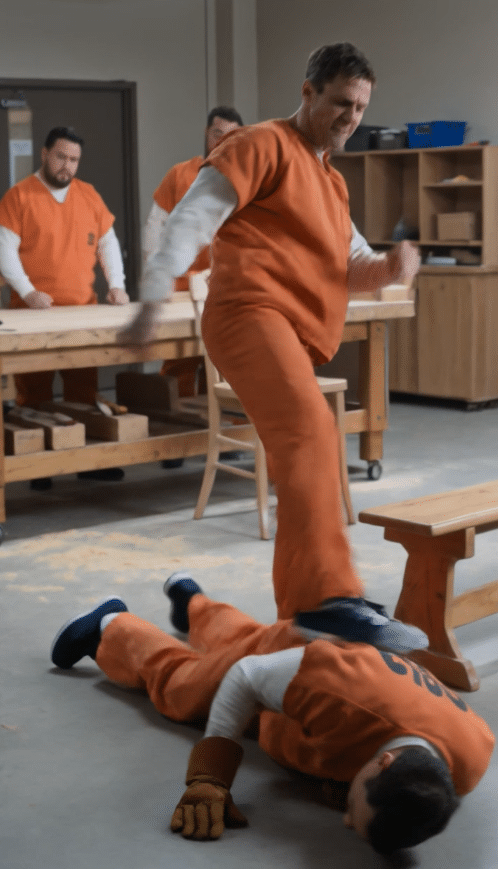
He stepped around the bench and kicked Ethan hard in the chest.
Ethan stumbled backward and fell beside the workbench. His hand struck the wooden edge as he went down, leaving a thin trace of blood across his skin.
For a second, the room seemed to lose its sound.
Then Travis delivered exactly two more kicks into Ethan’s back and side.
Ethan winced, struggling to move away from the bench. Even through the pain, he twisted his body to avoid knocking into the finished chair.
Travis stood over him.
“You build what I tell you to build.”
No one moved.
The other inmates recoiled, some covering their mouths. A man near the sanding station took one involuntary step forward, then stopped when Travis turned his head.
Ethan drew a shaky breath and pressed one gloved hand against the floor.
Travis looked around the woodshop, daring anyone to question him.
Then the door slammed open.
The hinge echoed through the room as a man in a dark blue official jacket entered, carrying a thick program file. Beside him stood a charity representative whose eyes went immediately to the finished chair—and then to Ethan on the floor.
The newcomer was Martin Shaw, the fifty-five-year-old manager responsible for the prison’s rehabilitation workshop.
He did not shout. He did not touch Travis. He simply stopped inside the doorway and looked at the scene as if every detail had confirmed something he had feared.
Then he spoke.
“You just kicked away your own second chance.”
Travis’s expression changed.
The anger remained for a fraction of a second, but confusion began to push through it. His eyes shifted from Shaw to the file in his hand, then to the charity representative standing beside him.
“My second chance?”
For the first time that morning, Travis seemed to understand that the crooked chair was no longer the biggest problem in the room.
He had been worried about losing a place in the workshop.
He had no idea how much more he had just put at risk.
Act II
Ethan Walker had not entered prison believing he was a good man who had simply been misunderstood.
At forty-one, he had spent enough time examining his own decisions to understand how easily excuses could become a second kind of dishonesty. Years earlier, he had worked as a site supervisor for a small contracting company, where financial pressure and poor judgment had gradually become a dangerous combination.
When the company began struggling, Ethan approved paperwork he had not examined closely enough. He convinced himself that the discrepancies were temporary and that his manager would correct them later. Instead, the documents became part of a fraud investigation, and Ethan was convicted for his role in approving false records.
He had not organized the scheme, but he had helped it continue.
The distinction mattered to him, yet he knew it did not erase his responsibility.
His marriage ended during the legal proceedings. His daughter, Lily, was twelve when he went to prison, and the last conversation they had before his transfer ended with her asking whether he had lied to her about being an honest man.
Ethan had not known how to answer.
He could have explained the pressure he had been under, the promises his manager had made, or the way one bad decision had led to another. But he had realized that explaining his choices would not make them disappear.
So he told her the truth.
He had done things he should not have done, and he would have to live with the consequences.
For a long time, that was all he could offer her.
Prison reduced his world to schedules, rules, and the same gray corridors repeated day after day. Ethan learned to keep his head down without surrendering every part of himself. He read when he could, worked whenever an assignment was available, and tried to become someone who could eventually speak to his daughter without asking her to ignore what he had done.
The woodshop was the first place where that effort began to feel tangible.
The rehabilitation program taught inmates how to measure lumber, operate approved equipment under supervision, assemble furniture, and meet quality standards. The chairs and tables they produced were donated to nonprofit organizations serving families transitioning out of shelters and people moving into affordable housing.
The work was practical, demanding, and unforgiving of shortcuts.
A chair could look beautiful and still collapse if one joint was weak. A table could appear level until someone placed weight on the wrong corner. The instructors insisted that each piece be inspected before it left the workshop.
Ethan liked that honesty.
Wood did not care what story a man told about himself. It responded to the work he actually did.
If he measured badly, the joint would be wrong. If he rushed the glue, the assembly would fail. If he made a mistake, he had to correct it.
There was no way to talk a crooked leg into standing straight.
Ethan became one of the workshop’s most reliable participants. He arrived on time, followed instructions, and helped newer workers understand how to avoid common errors. He never acted as if his experience made him more important than anyone else.
When a younger inmate struggled to assemble a chair frame, Ethan showed him how to check the angles instead of taking over the job.
When another worker damaged a board through impatience, Ethan helped him determine whether it could be salvaged.
He believed that learning to build something properly was a small but meaningful way of learning to live differently.
Travis Cole had joined the workshop for reasons that initially sounded similar.
He was thirty-six, physically strong, and capable of working quickly. Before prison, he had been employed by a commercial renovation company, where he had supervised small crews and earned enough money to maintain a comfortable lifestyle.
His conviction had ended that life.
He rarely discussed the details, but other inmates knew he had been involved in a scheme that falsified invoices and redirected payments. Travis insisted that the people above him had received the real benefits while he had taken the fall.
He spoke often about the unfairness of his sentence.
He spoke far less about the decisions he had made.
The workshop offered him something he desperately wanted: a formal record of progress, a recommendation from program staff, and the possibility of qualifying for an advanced rehabilitation placement when he became eligible.
That placement was not a promise of early release. It was an opportunity to demonstrate responsibility, develop useful skills, and build a stronger record for future reviews.
For Travis, however, the distinction had become blurred.
He treated the program as a ladder that he deserved to climb. He wanted the manager to see him as a natural leader, and he expected other inmates to support that image.
When someone questioned his work, he took it personally.
When someone performed better than he did, he found reasons to diminish the achievement.
And when someone refused to accept blame for his mistakes, he viewed that refusal as disrespect.
Ethan had become a particular irritation.
His finished pieces were consistently well made, and instructors had begun using them as examples during quality checks. Ethan did not boast about the attention. That made Travis dislike him even more.
To Travis, quiet competence was a threat because it could not easily be challenged.
He began assigning Ethan the least desirable cleanup tasks whenever supervisors were not nearby. He criticized his measurements in front of the other workers and claimed that Ethan’s careful pace was slowing the entire program.
Ethan initially ignored the behavior.
He had no desire to become the center of a conflict, and he understood that prison disagreements could grow far beyond their original cause. He also knew that Travis was frightened of losing the one opportunity that made him feel he was still moving toward something better.
But Ethan drew a line when Travis began blaming him for mistakes he had not made.
He would help correct an error.
He would not lie about who had caused it.
That difference would soon force Travis to choose between protecting his pride and protecting his future.
He made the wrong choice.
Act III
The charity visit had been scheduled weeks earlier.
A nonprofit called New Start Housing had partnered with the prison to provide furniture for families moving out of temporary shelters. Its representative, Claire Bennett, had helped establish the arrangement after visiting a completed project and discovering that many newly housed families had apartments but very little furniture.
A sturdy chair, a kitchen table, or a small bookshelf could make an unfamiliar space feel like a home.
The program manager, Martin Shaw, had taken the partnership seriously from the beginning.
He believed rehabilitation needed to produce more than attendance records and polite promises. Participants had to learn how to meet expectations when the work was tedious, when no one was watching, and when admitting a mistake would be uncomfortable.
The charity agreed.
Its representatives were not interested in receiving furniture that looked good in photographs but failed after a few weeks of use. They wanted reliable pieces, consistent inspections, and a process that treated quality as a responsibility rather than a performance.
That was why the finished sample chair on Ethan’s bench mattered.
It had been selected as an example of the standard the program was trying to achieve. Its measurements were documented, its joints had been inspected, and its finish was clean without hiding defects beneath unnecessary polish.
Claire Bennett had planned to examine it during the visit.
She had also been asked to discuss whether the next phase of the partnership could include additional training and a broader range of furniture.
For some inmates, that opportunity could mean more time learning a trade. For others, it could lead to a reference for a supervised job-training program after release, subject to eligibility and the organization’s requirements.
Martin had spent the previous week reviewing participant progress.
Travis’s file had not been easy to evaluate.
His practical skills were adequate, sometimes impressive, but his record included repeated concerns about teamwork, refusal to accept correction, and arguments over work assignments. Staff had documented instances in which he had attempted to shift responsibility for mistakes onto other participants.
The manager had already spoken with him about those concerns.
Travis had promised to improve.
He had also asked repeatedly whether his place in the advanced phase was secure.
Martin had explained that the decision would depend on the complete record, not on one good day or one well-made chair.
Travis heard the part he wanted to hear: there was still a chance.
He ignored the part that mattered most: the chance depended on demonstrating genuine change.
On the morning of the charity visit, Travis noticed that the chair he had assembled was visibly crooked. He tried to adjust the leg, then pressed down on the seat as if force could compensate for the uneven joint.
The chair rocked.
He checked the clock.
Claire Bennett was expected within the hour.
Travis could have reported the defect, explained what had gone wrong, and asked whether the chair could be repaired before inspection. He might have lost credit for the piece, and the mistake might have been included in his progress review.
But it would have been an honest response.
Instead, he looked at Ethan’s completed chair.
The idea came to him in an instant.
If he could convince the staff that Ethan had mishandled the work, the attention would shift away from his own failure. Ethan’s careful reputation might even make him seem like the person who should have caught the defect.
Travis began moving the chairs closer together.
Ethan noticed.
“What are you doing?”
“Fixing the lineup.”
“That’s your chair.”
Travis ignored him and dragged the crooked chair toward the inspection area.
Ethan stepped between the bench and the sample chair.
“Don’t put my name on that.”
Travis’s jaw tightened.
“You think being the instructor’s favorite makes you untouchable?”
“I didn’t say that.”
“Then stop acting like you can tell me what to do.”
Ethan pointed to the finished chair.
“That isn’t my chair. Mine is finished.”
Travis’s response came immediately.
“Trash. You’ll take the blame.”
Ethan looked at him for a long moment. He could see the panic underneath the aggression, the knowledge that one more documented failure might cost Travis the opportunity he had been chasing.
But he also saw the familiar calculation: Travis believed that if he made the threat convincing enough, someone else would pay for his mistake.
“I won’t lie for you,” Ethan said.
The words were quiet.
That made them harder for Travis to dismiss.
He stepped around the workbench and kicked Ethan in the chest. Ethan fell beside the bench, his hand striking the wooden edge. A thin trace of blood appeared across his skin.
Then came exactly two more kicks to Ethan’s back and side.
Ethan curled away from the bench, trying to protect the finished chair from being knocked over in the struggle.
Travis stood above him.
“You build what I tell you to build.”
The workers around them were silent. Some had watched Travis intimidate people before, but seeing him attack a man over a crooked chair left them shaken.
Then the woodshop door slammed open.
Martin Shaw entered with the program files already in his hand. Claire Bennett followed, her attention fixed on the finished sample and the scene unfolding beside the bench.
Martin stopped.
His gaze moved from Ethan on the floor to the crooked chair, then to Travis.
For a moment, no one spoke.
Then Martin delivered the sentence Travis had never imagined hearing.
“You just kicked away your own second chance.”
Travis stared at him.
“My second chance?”
Martin opened the file.
“Your participation in the next phase was under review,” he said. “You were being evaluated on your work, your conduct, and your ability to take responsibility.”
Claire looked at the crooked chair again.
“Is this the piece that was submitted for inspection?”
Martin nodded.
“And the finished chair?”
“Ethan’s work,” Martin replied. “It’s been inspected already.”
Travis’s expression faltered.
He had believed he was protecting his future by forcing Ethan to accept the blame. Instead, the man he had attacked was standing beside the strongest evidence of his own competence.
And the people who could evaluate Travis’s conduct had arrived in time to see what he had chosen to do.
Act IV
Martin Shaw did not rush toward Travis.
He did not threaten him or attempt to settle the matter with his fists. He directed staff to secure the area, arrange for Ethan to be assessed by medical personnel, and preserve the relevant records of the incident.
The woodshop’s approved safety procedures required that the work area be cleared and any unsafe equipment or materials be left undisturbed until staff could determine what had happened. The remaining inmates were instructed to step back from the benches.
Claire Bennett remained near the doorway, visibly shaken.
She had visited correctional rehabilitation programs before. She understood that the people participating in them had made mistakes, sometimes serious ones. She also understood that the purpose of rehabilitation was not to pretend those mistakes had never happened.
But she had never believed that a person should be permitted to intimidate another participant into accepting false responsibility.
Martin looked at Travis.
“You will remain here while staff document this incident. You are not to approach Ethan.”
Travis tried to recover his usual confidence.
“He was disrespecting me.”
“Explain exactly what he did.”
“He challenged me in front of everyone.”
“That is not an explanation for assaulting him.”
Travis glanced at the other workers, hoping someone would support his version of events. Most looked away. One man who had spent weeks avoiding Travis’s attention stared at the crooked chair, then quietly said that he had watched Travis assemble it.
Another worker confirmed that Ethan’s chair had been completed separately and had already passed inspection.
Their statements were simple, but they mattered.
Travis had relied on intimidation because he believed fear would keep people from contradicting him. Now the room was full of witnesses who had seen what happened, and the physical evidence made his original excuse difficult to sustain.
Martin instructed the staff responsible for the program to document the condition of both chairs, identify the workers involved, and review the existing quality-control records.
The charity representative asked whether the donation schedule would be affected.
“Not because of a single incident without a proper assessment,” Martin replied. “We will review the furniture and make sure nothing unsafe is delivered. We will also review what happened here.”
He wanted the charity to know that the program’s commitment to quality was not dependent on pretending everything was fine.
Ethan was helped to his feet and taken for a medical assessment. His hand required attention, and staff checked him for other injuries from the fall and kicks. He remained conscious and was able to describe the incident.
Before he left the workshop, he looked toward the sample chair.
“Please don’t let it get damaged,” he said.
Martin’s expression softened.
“We’ll take care of it.”
Ethan nodded and followed the staff member out.
Travis watched him go, his face tightening with a mixture of anger and disbelief. He had expected Ethan to beg, argue, or threaten to report him. Instead, Ethan had remained focused on the work he had made and the truth he had refused to distort.
That restraint made Travis feel more exposed than an insult ever could.
The formal review began that afternoon.
Staff examined the chair’s measurements, the inspection record, and the work assignments. The documentation confirmed that Ethan’s sample had been completed and approved before the confrontation. The crooked chair had been assigned to Travis, and the assembly notes indicated that he had failed to correct a measurement problem identified during the work process.
The evidence did not depend on which inmate had the louder voice.
It depended on the records.
The assault was investigated separately from the quality-control issue. Witness statements and the available evidence were reviewed under the facility’s disciplinary procedures. Travis was given the opportunity to respond to the allegations, but his claim that Ethan had provoked him did not justify the use of force.
The findings also returned attention to the concerns already in his program file.
There had been earlier reports of intimidation, disputes over assignments, and attempts to blame other participants for his mistakes. None of those reports alone had necessarily established the full pattern. Taken together with the new incident, however, they raised serious questions about whether Travis was ready for the advanced rehabilitation placement he had been seeking.
The decision was not made in the heat of the confrontation.
Martin reviewed the record with the appropriate staff and considered the purpose of the program. Travis had shown that he could perform certain tasks, but the advanced phase required more than technical ability. Participants had to work safely, accept correction, and demonstrate that they could be trusted with responsibilities that affected other people.
Travis’s conduct had directly contradicted those requirements.
He was removed from consideration for the next phase, and his continued participation in the workshop was restricted pending the outcome of the disciplinary process. The final consequences were determined through the facility’s established procedures.
No one promised that he would lose every future opportunity.
But his immediate path forward had changed.
When Martin met with him to explain the decision, Travis sat rigidly in his chair.
“You told me this program was supposed to give people a second chance,” he said.
“It is,” Martin replied.
“Then you’re taking mine away.”
“No. You were being considered for an additional opportunity. That opportunity required you to show that you could take responsibility for your actions.”
Travis looked down.
“You don’t know what I’ve been through.”
Martin allowed the silence to settle before answering.
“I don’t need to know every painful thing that happened in your life to know that Ethan did not deserve to be assaulted.”
Travis’s face reddened.
Martin continued, his voice calm.
“Your past may explain some of your anger. It does not give you ownership of another person’s dignity. And it does not make someone else responsible for the mistakes you choose to make.”
Travis had no ready answer.
For years, he had defended himself by describing the people who had betrayed him, the opportunities he had lost, and the ways he believed the system had treated him unfairly. Some of his grievances might have been genuine.
But every time he used those grievances to excuse harming someone else, he made it harder for anyone to believe he was prepared to change.
Martin closed the file.
“You still have decisions to make,” he said. “What happens next depends on what you do with them.”
For the first time, Travis could not blame Ethan’s refusal, the crooked chair, or the charity visit for the consequences in front of him.
The chair had exposed his mistake.
His own behavior had turned it into something far more serious.
Act V
Ethan returned to the woodshop after his injuries had been assessed and staff determined what work he could safely resume.
His hand was sore, and he moved cautiously when he approached the bench. The finished sample chair stood where Martin had promised it would remain, its clean lines and carefully fitted joints unchanged.
Ethan ran his gloved fingers along the edge of the seat.
For a moment, he remembered the fall. He remembered the shock of the first kick, the pain that followed, and the way he had tried to protect the chair even as he struggled to move away from Travis.
Then he looked at the work itself.
It was still good.
That mattered more than he expected.
In prison, so much of a person’s life could become defined by a single label: inmate, offender, troublemaker, disappointment. Ethan knew he could not erase his conviction by building furniture. The chair did not cancel the harm caused by his past decisions, and it did not guarantee reconciliation with his daughter.
But it represented a different kind of choice.
He had measured carefully. He had corrected small errors before they became larger ones. He had done the work honestly, even when someone tried to make dishonesty seem like the easier path.
He wanted to keep making those choices.
Martin arranged for another staff member to check in with Ethan about his recovery and his comfort returning to the workshop. He also made sure Ethan’s account of the assault was included in the formal record and that he was not pressured to withdraw his statement.
Ethan appreciated the care, but he did not want special treatment.
“I just want to keep working,” he said.
“You can,” Martin replied, “as long as we follow the medical guidance and the program rules.”
Ethan nodded.
That was enough.
The incident prompted the workshop staff to review how assignments were recorded and how completed pieces were identified before inspections. Each chair would have clearer documentation showing who built it, which checks it had passed, and whether any defects had been reported.
Staff also reviewed the process for raising concerns about intimidation. Inmates were reminded that disagreements about workmanship should be brought to the appropriate supervisor rather than settled through threats or pressure.
The changes were practical rather than dramatic.
A label on a chair would not make a bully kinder. A new form would not make every witness brave. But better records could make it harder for someone to shift blame without being challenged by facts.
Claire Bennett returned to New Start Housing with a clear report of what had happened and what the facility was doing to address it. She did not abandon the partnership. Instead, she asked for assurance that quality checks and participant safety would remain central to the program.
Martin agreed.
The charity still needed furniture, and the inmates still needed opportunities to learn skills they could use outside prison. But the partnership would continue only if the program upheld the standards it claimed to teach.
The sample chair Ethan had built became part of the next inspection.
Claire tested its stability, checked the joints, and sat down carefully. It held firm. She ran her hand along the smooth edge and nodded to Martin.
“This is the standard we need.”
Martin looked toward Ethan, who stood nearby with his hands resting on the workbench.
“He did the work properly,” he said.
Ethan did not smile broadly or take a bow. He simply nodded and returned to his task.
Praise had once meant very little to him. He had received enough approval in his old life to convince himself that he could trust the people around him without asking difficult questions. Now he understood that a good reputation had to be earned repeatedly, through decisions that were often invisible to everyone else.
The chair was not a miracle.
It was evidence of effort.
As the weeks passed, Ethan continued learning. He helped inspect new pieces, corrected small measurement errors, and taught another inmate how to recognize an uneven frame before the glue set. He remained patient when someone made a mistake, but he did not pretend that a mistake had never happened.
That balance was becoming the most important lesson of the workshop.
Accountability did not mean humiliation.
Correction did not require cruelty.
And helping someone improve did not mean allowing them to harm others without consequence.
Travis had a harder road ahead.
He remained angry about losing consideration for the advanced phase, and at first he continued insisting that Ethan had made him look bad. But the formal findings left little room for that explanation to stand unchallenged.
He had been responsible for the crooked chair.
He had chosen to threaten Ethan.
And he had chosen to use violence when Ethan refused to lie.
Those facts did not define every part of Travis’s life, but they could not be avoided simply because he regretted the outcome.
In later conversations with program staff, Travis was told that any future opportunity would depend on demonstrating sustained behavioral change, following instructions, and taking responsibility for his conduct. There would be no immediate reinstatement based on a promise made in anger or a sudden display of remorse.
For once, the rules were not something he could bend by intimidating the person standing nearest to him.
They were the same rules everyone else had to follow.
One afternoon, Ethan was sanding the final edge of a chair when he noticed a small imperfection in the wood. It was barely visible, but his fingers caught the rough spot as he moved across the surface.
He stopped.
A younger inmate working beside him glanced over.
“It’s probably fine,” the man said. “Nobody will notice.”
Ethan studied the edge.
“Somebody will sit here,” he replied.
He picked up the sandpaper and worked until the roughness disappeared.
The other inmate watched for a moment, then returned to his own chair and checked the joint he had been preparing to ignore.
Across the room, the workshop continued its steady rhythm. Sandpaper moved over wood. Clamps tightened. Staff checked measurements. Finished chairs waited in neat rows for inspection and delivery.
The room had not become perfect.
It had become a place where the truth was harder to push aside.
Ethan knew he still had a long way to go before he could repair his relationship with Lily. He knew that his conviction would remain part of his history, and that the people he had disappointed would not be obligated to forgive him just because he was trying to change.
But he could keep making honest choices.
He could build something carefully. He could admit a mistake. He could refuse to make another person carry the weight of a lie.
And he could stand up for himself without becoming the kind of man who used fear to get his way.
The crooked chair had begun as a small, ordinary failure of workmanship. Travis had turned it into a test of power, convinced that he could force another man to protect his reputation.
Instead, the confrontation revealed precisely what the program had been designed to measure.
Ethan had made mistakes in his life, and he was learning to own them.
Travis had made a mistake in the workshop, and he had tried to make someone else pay for it.
Only one of them had been willing to face the truth.
When Martin Shaw passed the workbench later that week, he paused beside Ethan’s newest chair. He checked the joints, pressed down gently on the seat, and examined the legs against the floor.
Everything was level.
“Good work,” he said.
Ethan looked up.
“Thank you.”
Martin moved on, leaving him to finish the last inspection.
There was no dramatic applause, no instant forgiveness, and no promise that one well-made chair would change the course of Ethan’s life. There was only the quiet satisfaction of completing a job properly—and the knowledge that he had not surrendered his integrity to someone else’s fear.
Travis had asked what happened to his second chance.
The answer was not that he had been denied the possibility of change forever.
It was that a second chance was never a possession he could demand from other people while refusing to respect them in return.
A second chance is an opportunity to prove that you can do better. The moment you use it to force someone else to carry the blame for your choices, you begin destroying the very thing you claim to deserve.