Act I
“She just wanted to see me.”
Daniel Hayes stood beside the visitation table, staring through the thick glass at his elderly mother. Her hand rested against the divider, her eyes wet, her shoulders trembling beneath an old blue cardigan she had worn on the long drive to the prison.
Across from him, Officer Blake Turner checked his watch.
“You heard me,” Turner said. “The visit is over.”
Daniel glanced at the clock. Their scheduled time had nearly expired, but his mother had only just stopped crying long enough to tell him something important. She had driven for hours to see him, carrying a small photograph and a letter she had been afraid to mail.
“Please,” Daniel said. “Just a few more seconds.”
Turner’s expression hardened.
“Trash. Apologize for wasting my room.”
The words landed across the visitation area like a slap, though Turner had not touched him yet. Families sat frozen at the neighboring tables, their conversations dying one by one. A young father holding a child’s drawing slowly lowered the paper in his hands.
Daniel was twenty-nine, dressed in an orange prison uniform that had become loose around his shoulders. He looked exhausted, with short brown hair and the guarded expression of someone who had learned that even a polite request could be mistaken for defiance.
“My mother drove all the way here,” he said quietly. “She just wants to say goodbye.”
“Then she should have managed her time better.”
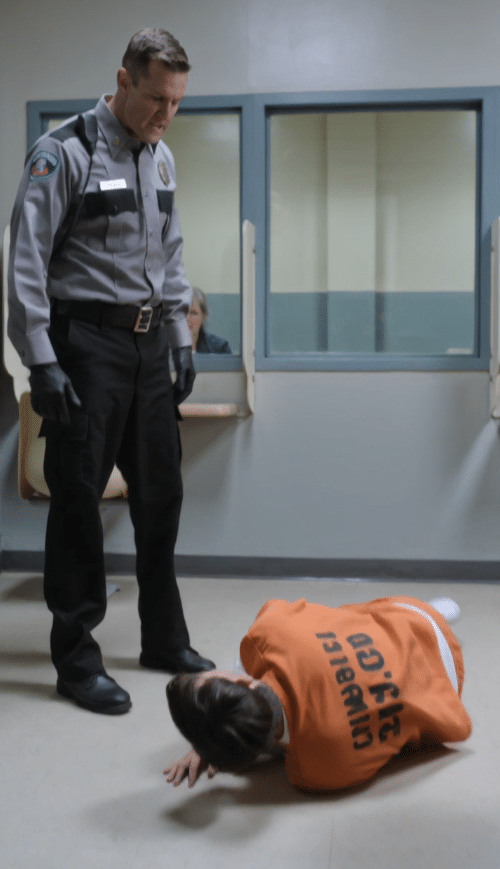
Turner wore a gray correctional uniform, black gloves, and a duty belt. At thirty-nine, he had developed a reputation for treating the visitation room as his personal territory. He spoke to families as if their grief were an inconvenience and to inmates as if their sentences had erased their right to be treated with basic dignity.
He particularly disliked moments he could not control.
Daniel’s mother, Margaret Hayes, had been crying for most of the visit. She was seventy-one, her hands marked by age and years of work, and she had come carrying a lifetime of things she had never managed to say to her son.
Daniel had been convicted of participating in a financial fraud scheme involving a small construction company. He had signed documents he should have questioned, trusted a supervisor who had manipulated him, and failed to recognize the consequences until it was too late.
He had accepted responsibility for those decisions.
But he had also spent months trying to understand why several records that might have explained his role had never been properly examined. His family was struggling to obtain legal assistance, and his mother had come to tell him that someone had finally agreed to review the documents.
Turner knew none of that.
He saw only an inmate who had asked for extra time.
Daniel took a careful breath.
“Please, Officer. Let me finish talking to her.”
Turner stepped closer.
“I told you the visit is over.”
Daniel began to turn away, not wanting to risk losing future visits. Then he looked through the glass again and saw his mother press her palm against it.
She mouthed something he could not hear.
I love you.
Daniel’s face tightened.
He turned back toward Turner. “Just a few more seconds. Please.”
That was when Turner kicked him hard in the chest.
Daniel stumbled backward and fell beside the visitation table. His elbow struck the floor, leaving a thin trace of blood on his skin. For a moment, he lay stunned, struggling to pull air into his lungs.
Behind the glass, Margaret cried out.
Daniel tried to push himself up, but Turner stepped in and delivered exactly two more kicks into his back and side.
Daniel grimaced, his body tightening with pain. Yet even then, he turned his face toward the glass, trying to reassure his mother that he was conscious and still able to see her.
Turner stood over him.
“Visits end when I say they end.”
Other families recoiled. One woman covered her mouth. A younger guard near the control station stood rigid, his face pale, unable to decide whether moving would make matters worse.
Margaret pressed both hands against the glass.
Then the visitation control door snapped open with a sharp electric-lock crack.
The entire room went silent.
A man in a black management coat entered, his large badge catching the cold white light. Two staff members followed him, but he did not need to gesture or raise his voice to make people move aside.
He was Prison Director Robert Whitaker.
His eyes went first to Daniel on the floor, then to Margaret standing behind the glass, and finally to Turner.
The director’s expression became unreadable.
“You just crossed the woman who reached my desk.”
Turner froze.
His mouth opened slightly, but no answer came.
“Reached your desk?”
For the first time that afternoon, the officer who had claimed to control every visit in the room looked genuinely afraid.
Because Margaret Hayes had not simply complained about a rude guard.
She had sent the director a letter containing evidence that could change the future of his entire facility.
And Turner had just attacked her son in front of witnesses, at the precise moment the director arrived to investigate what she had reported.
Act II
Margaret Hayes had never considered herself a woman who complained.
She had spent most of her life working quietly, raising Daniel and his younger sister, Rachel, after her husband died of a sudden heart attack. She cleaned offices in the evenings and worked part-time at a neighborhood bakery on weekends, saving whatever remained after rent, groceries, and school expenses.
When Daniel was arrested, Margaret sold her old car to help pay for legal costs.
She attended his trial wearing the same dark blue suit she had worn to her husband’s funeral. She sat behind the defense table, listening as prosecutors described financial records, false invoices, and payments that had disappeared into a network of accounts.
Daniel had made serious mistakes. He had approved documents without verifying their accuracy, and he had continued trusting his supervisor even when the explanations stopped making sense.
Margaret did not deny that.
What she could not understand was why the case seemed to move so quickly past the evidence that complicated the story.
Daniel’s former supervisor, Martin Voss, had claimed that Daniel knew exactly what he was signing. Yet messages from the company suggested that Voss had repeatedly described the questionable entries as temporary adjustments. A former accountant had also indicated that the company’s internal records were incomplete.
Daniel’s defense team had struggled to obtain all the relevant material before trial. Some records were never presented in the form Daniel believed they should have been, and the former accountant had not testified.
The jury convicted Daniel.
When the sentence was announced, Margaret reached for Rachel’s hand and squeezed it so tightly that her daughter winced.
She did not believe her son had done nothing wrong.
She believed the court might not have heard everything it needed to hear.
For months, she tried to help him from outside the prison. She called legal aid organizations, wrote letters to attorneys, and gathered every document she could find. Many people never responded. Others explained that the case was too complicated for them to take on without funding.
Then, one evening, Margaret found a letter from a civil rights legal clinic.
The clinic could not promise to challenge Daniel’s conviction, but it was willing to conduct an initial review of the records. The attorney assigned to the matter wanted copies of the company correspondence, the trial filings, and a detailed account of what Daniel believed had been overlooked.
Margaret finally had someone willing to listen.
She began organizing the papers at her kitchen table, spreading them beneath the yellow lamp where her husband had once repaired broken appliances. She labeled envelopes, copied dates into a notebook, and called Rachel whenever she needed help understanding a legal term.
The work was slow.
Sometimes Margaret spent an entire evening trying to determine which document belonged with which court filing. Her eyesight tired quickly, and her hands occasionally shook when she was upset.
But she continued.
Daniel’s letters encouraged her to keep going. He never told her he was certain the conviction would be overturned. Instead, he wrote that he wanted the records examined properly, even if the result did not change his sentence.
That honesty mattered to her.
She knew he regretted the decisions that had brought him to prison. What she wanted was the chance for him to answer for what he had actually done, not for a version of events that left important questions unresolved.
The visitation room became the only place where she could look into his face and feel, for a little while, that the distance between them had not swallowed everything.
Their visits were rarely dramatic.
They talked about Rachel’s job, the price of groceries, and the small repairs Margaret still needed to make around the house. Daniel asked whether she was sleeping enough. She asked whether he was eating properly, even though they both knew she could do nothing about the food.
On difficult days, they simply sat together in silence, separated by glass and rules.
For Margaret, those minutes were not a privilege she took lightly. They were the remaining pieces of an ordinary life she was trying to preserve.
Officer Blake Turner had gradually turned those minutes into another source of fear.
He had worked in corrections for nearly a decade and had learned how much power a uniform could carry in a room full of people who were already frightened. He could end a visit, issue a warning, or summon additional staff. Those were legitimate responsibilities.
But Turner increasingly treated the authority of his position as personal ownership.
He corrected families over trivial movements, snapped at inmates who asked questions, and used the threat of shortened visits to make people apologize for things that were not violations.
Some families stopped asking for clarification. Others avoided eye contact when he approached.
A junior officer had once quietly suggested that Turner was being unnecessarily harsh with an elderly visitor who needed extra time to gather her belongings. Turner responded by telling him to focus on his own assignment.
The junior officer learned to remain silent.
Margaret first encountered Turner during a visit when she struggled to hear Daniel through the phone receiver. She asked whether the volume could be adjusted. Turner told her that the equipment was not there to accommodate every family’s difficulties.
She apologized.
On another visit, she began crying when Daniel mentioned that he might not be home for several years. Turner tapped the table and told her to keep the room moving.
Again, she apologized.
But she began paying closer attention.
She noticed that Turner seemed particularly impatient with families who were elderly, emotional, or unfamiliar with prison procedures. She noticed how quickly his tone changed when a supervisor walked through the room.
And she noticed that other people were afraid to challenge him.
Margaret did not want to make Daniel’s life harder. She worried that a complaint might lead to restrictions on his visits or cause Turner to treat him more harshly when she was not there.
So she kept notes.
She wrote down dates, times, and the exact words she could remember. She recorded what had happened and who had been present. She did not embellish the incidents or claim to know what Turner intended.
At first, the notebook stayed in her kitchen drawer.
Then Daniel told her that a visit had been cut short after Turner accused him of being disrespectful for asking a question about the schedule.
Margaret opened the drawer and took out her notes.
She could no longer convince herself that remaining silent was protecting her son.
It might only be protecting the man who frightened him.
Act III
Margaret’s letter to Prison Director Robert Whitaker was not angry.
That surprised him when it reached his office.
He had expected a complaint filled with broad accusations, demands for punishment, or claims that could not be independently verified. Instead, Margaret had included a concise account of several visits, a list of dates, and the names of people who might have witnessed what happened.
She had also attached a copy of a written request she had previously made for clarification about visitation procedures.
Her letter ended with one sentence.
I understand that my son must follow the rules, but I do not believe that a uniform gives anyone permission to humiliate a family or hurt a prisoner.
Whitaker read it twice.
He had served in corrections for more than twenty years and had learned to be wary of both easy accusations and easy excuses. Officers worked in difficult conditions, and complaints could sometimes be incomplete or inaccurate. But a complaint that included dates, specific conduct, and potential witnesses deserved more than a routine response.
He directed the appropriate administrative staff to review the reported incidents and examine the available records.
The review did not begin with a presumption that Turner was guilty. It began with questions.
Were visitation rules being applied consistently? Had any visits been ended without an adequate explanation? Were complaints being recorded properly? Had there been previous concerns about Turner’s treatment of inmates or families?
The director also requested that the relevant surveillance footage be preserved wherever it remained available.
The first records revealed discrepancies between Turner’s explanations and the notes made by other staff members. In one incident, he had reported that a visitor had refused to follow instructions, while a separate account suggested she had simply asked for help with the phone receiver.
The discrepancy was not proof of misconduct by itself.
But it justified further review.
Whitaker assigned the matter to staff who could examine it independently of Turner’s immediate supervisory chain. He also made clear that anyone who reported a concern should not be pressured to withdraw it.
Margaret did not know all this was happening.
She only knew that, after weeks of uncertainty, she received a brief acknowledgment stating that her complaint had been forwarded for review. The message included instructions for providing additional information if she wished.
She printed it and placed it beside Daniel’s legal documents.
Then she prepared for another visit.
She was tired that morning. Her knees hurt, and she had slept poorly after spending hours sorting paperwork. But she wanted to tell Daniel that an attorney had begun examining the company’s records and that there might be a way to request further review.
She carried a small photograph of Daniel as a boy, standing beside his father at a county fair.
She had considered bringing it before, but worried that it would make their conversation too painful. That morning, she decided he should see it.
The visit began quietly.
Daniel smiled when he saw the photograph. He held it close to the glass, pointing out his father’s ridiculous striped shirt and the enormous stuffed bear Daniel had won at a game.
For a few minutes, they laughed.
Then Margaret told him about the legal clinic.
Daniel listened carefully, asking questions about the documents and whether the attorney had made any promises. Margaret told him the truth: no promises, only a willingness to look.
He nodded.
“That’s enough for now, Mom.”
She smiled through her tears.
“I just wanted you to know that someone is listening.”
When the visit approached its scheduled end, Margaret struggled to say what she had come to say. She rested her hand against the glass and told Daniel she was proud that he was trying to face the truth, even when it hurt.
Her hand remained there for several seconds.
That was when Turner approached.
“Time’s up.”
Margaret looked at the clock, then at Daniel.
“I’m sorry. I just need a moment.”
Turner pointed toward the control door.
“Move away from the glass.”
Daniel’s face tightened.
“She just wanted to see me.”
Turner turned toward him.
“Trash. Apologize for wasting my room.”
Daniel asked for a few more seconds.
Turner attacked him.
The incident unfolded in front of families, inmates, and a junior guard who watched in shock. Daniel fell beside the table, his elbow scraping the floor. Turner delivered two further kicks while Margaret cried behind the glass.
No one in the room could mistake what had happened.
And when the control door opened, Director Whitaker saw the aftermath with his own eyes.
He had come to the visitation area as part of the review prompted by Margaret’s letter. He had intended to examine the procedures, speak with staff, and determine whether the reported conduct matched the records.
Instead, he arrived during the very behavior her complaint had described.
Whitaker looked at Margaret, then at Daniel, then at Turner.
“You just crossed the woman who reached my desk.”
Turner’s confidence collapsed.
“Reached your desk?”
The director did not answer with a threat. He ordered the room secured, Daniel assessed by medical staff, and the available evidence preserved. Turner was separated from the people involved while the incident was documented.
Margaret was given a chance to speak privately with a staff member, away from Turner’s presence. The junior guard and other witnesses were identified for separate interviews.
Whitaker’s expression remained cold.
“This is no longer only a complaint,” he said. “It is an incident that requires a full investigation.”
Turner tried to argue that Daniel had been disrespectful.
The director did not debate him in front of the families.
“Your account will be recorded,” he said. “So will theirs. The evidence will be reviewed.”
Then he turned toward Daniel.
For the first time since the assault, Daniel saw someone in authority looking at him without treating him as the source of the problem.
But Whitaker’s intervention was only the beginning.
The investigation would determine whether Turner had violated prison rules, whether previous complaints had been mishandled, and whether his conduct had placed other inmates and families at risk.
And Margaret’s letter had made it impossible for the facility to pretend that the warning signs had never existed.
Act IV
The visitation room was closed temporarily while staff documented the scene and collected the relevant accounts.
Daniel was examined for his injuries. The scrape on his elbow was minor, but he was shaken and sore. Staff checked him for more serious symptoms and recorded what he reported about the assault.
Margaret was still behind the glass when a staff member explained that she could leave the room only after the immediate procedures were completed. She kept looking toward Daniel, searching his face for reassurance.
He lifted one hand.
It was a small gesture, but she understood it.
He was telling her he was still there.
Director Whitaker did not order Turner to explain himself in front of the room. Instead, he directed that the officer be removed from his immediate visitation duties pending review, consistent with the facility’s procedures.
Turner looked stunned.
“You’re taking me off the floor over this?”
“I’m directing an investigation into an alleged assault,” Whitaker replied. “Your conduct will be evaluated through the proper process.”
“He was refusing to leave.”
“Then explain the instructions you gave him and why you used force.”
Turner opened his mouth, then closed it again.
The director continued.
“Your account will be considered. So will the witnesses, the records, and the footage.”
There was no dramatic threat of prison time, no promise that Turner would never work again, and no physical retaliation. Whitaker understood that an investigation had to remain fair, even when the reported conduct was disturbing.
But Turner could no longer control the people who would decide what happened next.
The review expanded beyond the immediate incident.
Investigators examined available video, compared visitation logs, and interviewed the junior guard and several witnesses. They also revisited the incidents Margaret had described in her letter.
Some details were confirmed. Others remained uncertain. But the accumulated records showed a troubling pattern: Turner had repeatedly used his discretion in ways that appeared punitive, and his explanations for certain interactions did not always align with independent accounts.
The assault on Daniel was supported by multiple witnesses and the evidence gathered at the scene. The investigation found that Turner had used force in circumstances that did not justify it and had violated established standards for professional conduct.
Additional findings concerned his treatment of visitors and the way he had exercised his authority during scheduled visits.
The facility initiated formal disciplinary proceedings. Turner was given notice of the findings and an opportunity to respond. He was removed from his visitation assignment, and the final employment consequences were determined through the required process.
His badge did not vanish because the director disliked him.
It became the subject of scrutiny because the evidence showed that he had abused the authority it represented.
For Margaret, the process was emotionally complicated.
She had wanted someone to listen. She had not wanted to become the reason a man lost his career, even if she believed his conduct was wrong.
When Whitaker spoke with her privately, she asked whether her complaint had caused Daniel to be attacked.
“No,” the director said. “The person who chose to use force is responsible for that choice.”
Margaret looked down at her hands.
“I was afraid that if I said something, he would make things worse for my son.”
“That fear is one of the reasons complaints have to be taken seriously,” Whitaker replied. “No family should have to choose between reporting misconduct and worrying that someone will retaliate.”
He did not promise that every future visit would be perfect. He promised that the facility would review the visitation procedures and make sure staff understood that ending a visit did not give them permission to humiliate or assault someone.
The review led to clearer documentation requirements for visits ended early, additional supervisory checks, and renewed guidance on the appropriate use of force. Staff were reminded to report concerns even when the officer involved was more senior or more experienced.
The junior guard who had witnessed the assault was interviewed without Turner present. At first, he struggled to speak. He admitted that he had seen Turner treat visitors harshly before and had worried that challenging him would damage his own position.
He had no excuse for remaining silent, he said.
Whitaker did not pretend that his hesitation was harmless. But he also made clear that the facility needed an environment in which junior staff could report misconduct without fear of personal retaliation.
Accountability had to reach beyond the person who delivered the kicks.
It had to include the conditions that allowed an officer to believe no one would stop him.
Daniel learned about the findings through the staff assigned to his case. He listened carefully, then asked whether the investigation would affect his visits with Margaret.
The answer was that visitation arrangements would be reviewed and that the facility would work to ensure future visits were conducted safely and according to policy.
Daniel nodded.
He had been hurt, but he was more concerned about his mother than about his own bruises.
“She thinks she caused all this,” he said.
The staff member told him that Margaret had been assured otherwise.
Daniel looked through the glass toward the empty visitation tables.
“She shouldn’t have to be afraid to see her own son.”
It was the same concern that had driven Margaret to write the letter.
And it was the reason the director refused to let the investigation end with one officer’s discipline.
Act V
Margaret returned for another visit several weeks later.
She wore the same blue cardigan, though she had sewn a loose button back into place. In her handbag was the small photograph of Daniel and his father, along with a fresh letter from the legal clinic.
She approached the visitation entrance more slowly than before.
The previous visit had left her with memories she could not easily shake: Daniel falling beside the table, Turner standing over him, and the awful helplessness of being separated from her son by glass she could not pass through.
She had considered staying home.
Then she remembered Daniel’s face when she told him that someone had agreed to review his case.
He had not asked her to solve everything. He had simply looked relieved that the question of his conviction might finally receive serious attention.
So she came.
The visitation room looked much the same. The plastic tables were fixed to the floor. The chairs were bolted down. The white lights made everyone look tired.
But the atmosphere felt different.
A staff member greeted Margaret, explained the procedures, and directed her toward the appropriate table. No one snapped at her for taking a moment to put away her handbag. No one treated her grief as a personal inconvenience.
When Daniel entered, he moved carefully but steadily.
For several seconds, mother and son simply looked at one another.
Then Margaret raised the photograph.
“I brought him back,” she said.
Daniel smiled faintly.
He pressed the picture against the glass, and she placed her hand on the other side. This time, she did not pull away immediately.
Neither did he.
They talked about the legal clinic’s latest update. The attorney was continuing to examine the records, and the case remained unresolved. There were still legal hurdles, and no one could promise that Daniel’s conviction would be overturned.
But the documents were being reviewed. The unanswered questions had not disappeared. Margaret’s work had helped bring them to someone willing to examine them carefully.
Daniel listened, then shook his head.
“You’ve done enough, Mom.”
Margaret looked at him with the familiar determination that had carried her through years of hardship.
“I’ll decide when I’ve done enough.”
For the first time in a long while, Daniel laughed.
It was not a loud laugh. It did not erase the years ahead or make the prison feel less real. But it was genuine, and Margaret smiled as if she had been waiting weeks to hear it.
They spoke about ordinary things.
Rachel had found a better job. The roof at Margaret’s house still leaked near the back bedroom. A neighbor had promised to help repair it before winter. Daniel asked whether his mother was eating properly, and she scolded him for worrying about her when he was the one behind bars.
Their time moved toward its end.
When the announcement came, Margaret’s shoulders tensed. For a moment, the old fear returned. She looked toward the staff member, then back at Daniel.
But there was no humiliation, no insult, and no threat.
A staff member explained that the visit was ending according to the schedule.
Daniel stood.
Margaret rested her hand against the glass.
“I love you,” she said.
“I love you too.”
They held each other’s gaze for a few seconds before Daniel turned toward the exit.
This time, he did not have to fall to the floor to prove that he had been heard.
Outside the visitation room, Director Whitaker reviewed the follow-up report. Turner’s case had proceeded through the formal disciplinary process, and the findings had led to consequences for his conduct and his role in the facility. The review of visitation practices was continuing, with supervisors expected to monitor how staff exercised their authority.
Whitaker knew no policy could prevent every act of cruelty.
But he also knew that a system could either reward silence or make it possible for people to speak.
Margaret had reached his desk because she had refused to let fear erase what she had witnessed. Her letter had not demanded special treatment for Daniel. It had asked for something more fundamental: that an inmate be treated as a human being, that a family be allowed to grieve without humiliation, and that an officer’s authority be subject to scrutiny.
The director had listened.
And when he entered the visitation room that afternoon, he had seen for himself what her letter described.
Turner had believed that a uniform made him untouchable. He had mistaken a frightened junior guard’s silence for agreement, an inmate’s restraint for weakness, and an elderly mother’s tears for something he could punish without consequence.
He had been wrong about all three.
Daniel’s legal case was still moving through its own process. The assault investigation could not decide whether he had been wrongly convicted, and the director could not promise a legal outcome. Those questions belonged to the evidence and the courts.
But the visitation room no longer belonged to Turner’s temper.
And Margaret no longer had to carry her notebook in secret, wondering whether speaking up would make her son’s life worse.
When Daniel returned to his housing unit after the visit, he carried the memory of his mother’s hand against the glass. He also carried the knowledge that she had kept going when the process seemed too complicated and the odds too long.
He could not promise her he would come home soon.
He could promise that he would continue working through his appeal, honestly and patiently, while accepting responsibility for the choices he had made.
That evening, Margaret placed the latest letter from the legal clinic on her kitchen table. Beside it lay her notebook, filled with dates and careful descriptions of the visits that had frightened her.
She closed the notebook and rested her palm on the cover.
She had not written those details to destroy someone.
She had written them because silence had begun to feel like surrender.
And when the person with the badge finally looked closely, the truth had been waiting there all along.
Officer Turner believed he controlled the room because he could end a visit. He never understood that real authority is measured not by how easily someone can make a vulnerable person afraid, but by what happens when that person finally dares to speak.