Act I
“I’m just trying to stay warm.”
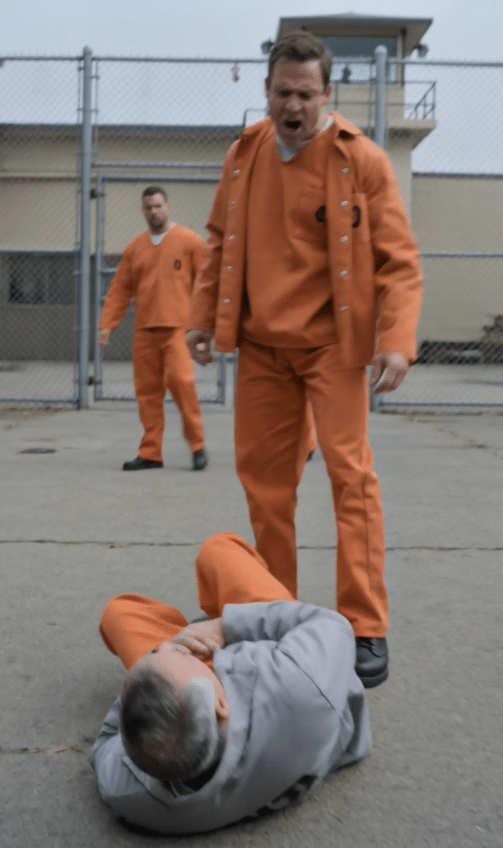
The old man’s voice trembled in the freezing prison yard, but he kept both hands wrapped around his faded gray coat. A narrow patch of weak winter sunlight fell across the concrete beside the steel fence. He had been standing there quietly, trying to ease the ache in his stiff fingers, when Darius Cole decided that even this tiny comfort belonged to him.
“Trash. Old men don’t need comfort.”
Darius was forty-five, broad-shouldered, and accustomed to watching other inmates move aside before he reached them. His orange uniform was neatly arranged, his prison coat looked newer than most, and two younger men hovered behind him, laughing at jokes he had not even finished making.
He pointed at the coat.
“Give it to me.”
The old man blinked, apparently unsure whether he had heard correctly. His name was Walter Bennett. He was sixty-seven years old, with thinning gray hair, a weak posture, and the careful movements of someone who had learned to conserve his energy because his body no longer recovered as quickly as it once had.
“It’s the only coat I have,” Walter said.
Darius stepped closer.
“That sounds like your problem.”
Walter pulled the coat tighter around his chest. He did not curse, threaten, or raise a hand. He simply took one small step backward, trying to preserve the little warmth he had found in the sunlight.
That was enough to enrage Darius.
He drove a hard kick into Walter’s chest.
The old man fell onto the cold concrete, his forearm scraping the ground as his coat slipped from one shoulder. A thin trace of blood appeared along the scrape. His breath caught, and for a moment he could do nothing but stare upward, stunned by the suddenness of it.
The prison yard had gone quiet.
Darius stepped over him and delivered exactly two more kicks, one into Walter’s back and another into his side. Walter winced, curling inward as he tried to pull the coat toward himself and shield his body from the freezing ground.
Several inmates recoiled.
One covered his mouth. Another turned away, but not before Walter saw the fear in his eyes.
Nobody stepped forward.
Darius stood over the old man as if the fallen figure at his feet were an object that had inconvenienced him.
“Give me the coat before you freeze in it.”
Walter’s fingers tightened around the fabric.
He was frightened. He was in pain. And beneath both feelings was a terrible, familiar shame: the shame of needing help in a place where asking for it could make you look weak.
He had spent years believing that if he treated people decently, they would at least recognize his humanity. Prison had already begun teaching him how little that belief could protect him.
Darius leaned down, reaching toward the coat.
Then the steel gate at the far end of the yard swung open with a deafening metallic crack.
A group of officials entered behind a man in a thick black coat and command uniform. His large badge caught the gray daylight. Two senior officers accompanied him, while members of a state inspection team followed with clipboards and sealed document folders.
The man at the front was Chief Superintendent Richard Lawson, a senior authority overseeing the prison’s compliance and conduct review.
He took in the scene without speaking.
Walter on the concrete.
The coat clutched in his shaking hands.
Darius standing above him.
Then Lawson’s eyes settled on the man who had done it.
“You just made your biggest mistake in this yard.”
Darius’s confident expression faltered.
He had spent years believing that prison was a place where strength decided who deserved comfort, who deserved respect, and who could be made to suffer without consequences.
He had no idea that the old man at his feet was connected to a case that had brought the state inspection team to this facility.
And he had no idea that the coat he had tried to steal was about to become the least important thing he had lost.
Act II
Walter Bennett had not always moved slowly.
Before prison, he had spent thirty-four years repairing commercial heating systems across western Pennsylvania. He was the kind of technician who arrived before sunrise, carried spare parts in an old canvas bag, and stayed until the heat worked again, even when the customer had no money left to pay him.
His wife, Margaret, used to joke that Walter could fix a furnace but could never fix the kitchen clock because he kept forgetting to put the tools away.
They had one daughter, Emily, who grew up believing her father could solve almost anything with patience and a little ingenuity.
Then came the winter when everything changed.
Walter had been working as a maintenance supervisor at a residential care facility when management began cutting costs. He discovered that several safety inspections had been falsified and that repairs to a heating system had been repeatedly postponed despite warnings that the equipment was unsafe.
He reported the problem.
The complaints went nowhere.
When a fire broke out in a service area months later, the investigation uncovered a chain of negligence and altered records. Walter had signed one maintenance document before realizing that management had changed the inspection information attached to it. He had failed to verify the final paperwork, and that failure became a central part of the prosecution’s case.
He was convicted of a serious offense related to the falsified records.
Walter never claimed he had done everything right. He had trusted people he should have challenged, signed something he should have checked, and waited too long to understand how deeply the records had been manipulated.
But the full story was more complicated than the sentence suggested.
Several senior administrators had concealed warnings, and one had later admitted privately that Walter had been made the convenient face of a scandal that reached far beyond a single maintenance supervisor. The evidence did not erase Walter’s responsibility, but it raised troubling questions about whether all the people involved had been held equally accountable.
His appeal was still under review.
By the time he entered prison, Walter had lost his job, his home, and his wife. Margaret had died before his sentencing was completed. Emily had tried to remain close to him, but the financial and emotional strain had worn her down.
Their last conversation had ended with a sentence Walter could not stop replaying.
“I love you, Dad,” she had said. “I just don’t know how to keep watching this happen.”
He had told her he understood.
Then he had gone silent for three weeks because he could not bear to hear the disappointment in her voice.
Inside prison, Walter had learned to measure life in small things. A warm cup of coffee. A letter arriving on time. A few minutes of sunlight through the fence. The ability to sleep without waking from the same memory.
The gray coat had been sent to him by Emily after his first month inside.
It was not expensive. It had belonged to her husband, who had lost weight and replaced it with a new one. But Emily had written a note explaining that she wanted her father to have something warmer than the thin prison-issued layer he had complained about during their last call.
It’s not much, Dad, she had written, but at least you’ll be warm.
Walter had read that sentence so many times that the paper had softened at the fold.
He wore the coat whenever the weather allowed it.
Darius Cole noticed.
Darius had once lived in a different world, one of private clubs, expensive cars, and people who returned his calls immediately. His father had built a regional construction business, and Darius had grown up assuming that money could turn almost any mistake into a temporary inconvenience.
He had inherited the confidence but not the discipline.
By his early thirties, he had accumulated debts, broken business partnerships, and become involved in a fraudulent investment arrangement that promised returns far beyond what the underlying projects could support. When the scheme collapsed, investigators traced the money through several accounts connected to companies he had helped manage.
Darius insisted that he had been misled by his partners.
The jury did not accept his defense.
Prison stripped away his expensive suits and familiar comforts, but it did not immediately strip away his sense of entitlement. He began rebuilding his identity around the only currency he could still control: fear.
He demanded seats, favors, food, and obedience. He targeted people who seemed unlikely to retaliate, especially older inmates and newcomers who had not yet established relationships inside the facility.
Walter was an ideal target in Darius’s eyes.
He was elderly, physically vulnerable, and rarely involved in arguments. He kept his possessions carefully arranged and spent much of his time alone. Darius interpreted his quietness as surrender.
The coat made the old man look even more vulnerable.
So Darius began treating it as something he was entitled to take.
The first time he demanded it, Walter pretended not to hear. The second time, he moved away. The third time, Darius made sure other inmates were watching.
Today, he had decided that the sunlight itself belonged to him.
What Darius did not understand was that Walter’s appeal had recently attracted renewed scrutiny after an independent review identified discrepancies in the records used to establish the timeline of the original safety violations.
That review had triggered questions about the prison’s handling of Walter’s medical needs, his vulnerability to intimidation, and whether earlier complaints had been properly documented.
The state inspection team had come to investigate those questions.
They had not arrived because Walter was important in the way Darius understood importance.
They had arrived because the institution had a responsibility to protect an elderly inmate, and there were growing reasons to suspect that it had failed him.
Now, as Richard Lawson stood in the freezing yard, those concerns had become impossible to ignore.
But the most damaging discovery was still waiting inside a file folder.
Act III
Richard Lawson did not raise his voice.
He did not need to.
“Step away from him,” he ordered.
Darius looked from the superintendent to Walter, as though he expected someone to explain why the rules had suddenly changed. For years, he had treated hesitation as weakness and silence as permission. Now the same silence seemed to be closing around him.
He took a step back.
Lawson immediately directed one of the senior officers to assist Walter and instructed the inspection team to document the scene. Another officer secured the immediate area while medical staff were summoned to assess the elderly inmate.
No one struck Darius.
No one needed to.
The superintendent’s presence had changed the balance of the yard because he represented a level of authority that Darius could neither intimidate nor bargain with.
Walter was helped into a seated position. He held the coat against his chest, breathing carefully while an officer examined the scrape on his forearm.
“Can you tell me what happened?” Lawson asked.
Walter glanced at Darius.
The bully’s face was tight with anger, but his eyes had begun to move nervously between the officials.
“He wanted my coat,” Walter said.
“Did you threaten him?”
“No, sir.”
“Did you attack him?”
Walter shook his head.
“I was standing by the fence. I just wanted to stay warm.”
Lawson looked at the officer beside him.
“Record his statement exactly as given.”
That simple instruction unsettled Darius more than any accusation.
The superintendent was not treating the incident as a quarrel between two prisoners. He was preserving evidence.
Darius tried to intervene.
“He’s leaving things out. This is prison. People have to learn how to live here.”
Lawson turned toward him.
“Then you should have learned the difference between living here and making yourself the law.”
The inspection team began taking statements from witnesses. Several inmates who had watched the assault appeared reluctant to speak, but the officials separated them and explained that they would be interviewed individually.
Darius’s two followers were no longer standing behind him.
One had moved toward the wall. The other kept his eyes fixed on the concrete, avoiding both Darius and the officials.
The change was small, but Darius noticed it.
He had built his influence on the belief that people would stand beside him because they feared what might happen if they did not. Now they were calculating whether standing beside him was more dangerous than stepping away.
Lawson requested the facility’s incident records and the documentation of prior complaints involving intimidation in the yard.
A prison administrator approached with a tablet and a sealed folder.
The superintendent reviewed the first pages without changing expression. Then he paused at a record bearing Walter’s name.
It was not the first complaint Walter had made.
Several weeks earlier, he had reported that an inmate had threatened to take his coat and had repeatedly demanded his personal property. The complaint had been logged but classified as a minor interpersonal dispute. No meaningful follow-up had been recorded.
A second note described Walter being pressured to surrender part of his commissary supplies.
That complaint had also been closed.
The records did not establish that the same staff member had knowingly protected Darius, but they raised a serious question about whether warning signs had been dismissed because the victim was elderly, quiet, and unlikely to fight back.
Lawson looked toward the prison administrator.
“Who reviewed these?”
The administrator swallowed.
“We’re checking that now, sir.”
“You should have checked it before today.”
The superintendent returned his attention to the folder.
The inspection had already uncovered gaps in the facility’s complaint-handling procedures. Walter’s case was one of several being examined, but his assault had provided a clear, documented example of what could happen when intimidation was treated as ordinary prison behavior.
The discovery was more serious than Darius realized.
He had assumed the superintendent’s arrival was connected to some privileged inmate or an unrelated administrative matter. He believed the official was angry because he had made a scene in front of visiting inspectors.
He did not yet understand that the inspectors were examining the very system that had allowed men like him to operate unchecked.
Lawson stepped closer, stopping several feet away.
“Mr. Cole, you are being separated from this area while the incident is investigated. You will not approach Mr. Bennett or communicate with him through other inmates.”
Darius tried to recover his usual expression.
“You can’t make a whole case out of a coat.”
Lawson’s reply was immediate.
“This isn’t about a coat.”
For the first time, Darius looked genuinely uncertain.
The superintendent continued.
“It’s about an assault in front of witnesses, a documented injury, and prior complaints that were not properly addressed. The footage and statements will be preserved. The disciplinary process will determine your consequences.”
Darius’s jaw shifted.
He was accustomed to people accusing him of things and then backing down when he challenged them. He had relied on the assumption that the system would eventually become tired of dealing with him.
But Lawson was not there to trade insults.
He was there to establish what had happened, identify what had been missed, and make sure the record could not be quietly buried.
Then he said the words that made Darius’s confidence finally crack.
“You just made your biggest mistake in this yard.”
Darius stared at him.
“My biggest mistake?”
He had no idea that the inspection team’s review had already reached beyond the assault—and that his name had appeared in a separate report connected to the prison’s handling of vulnerable inmates.
The coat had started the confrontation.
It would not be the only thing investigators examined.
Act IV
By the next morning, Darius Cole was no longer free to roam the yard as he pleased.
He had been moved to a separate housing assignment pending the disciplinary process, with restrictions designed to prevent further contact with Walter. The decision was an interim safety measure, not a final finding on every allegation against him.
For Darius, the distinction meant little.
He had always believed that authority was something to challenge until the person holding it became tired enough to compromise. He complained that he was being singled out, that the old man was exaggerating, and that the prison was allowing outside officials to interfere in ordinary inmate disputes.
But the evidence was straightforward.
Walter had been standing near the fence.
Darius had demanded his coat.
Walter had refused to surrender it.
Darius had kicked him in the chest, then delivered two more kicks while he lay on the ground.
Witness statements and available footage supported the sequence. Walter’s medical assessment documented the injury to his forearm and the pain he reported after the assault.
There was no reasonable basis for treating the incident as an accidental collision.
The investigation also examined the earlier complaints.
The findings revealed that Walter had reported intimidation before the assault, but those reports had not received the level of follow-up required by the facility’s own procedures. Investigators did not assume that every unresolved complaint proved misconduct. Instead, they examined the records, interviewed staff, and compared the documented actions with the prison’s policies.
That process exposed a wider problem.
Several complaints involving intimidation had been closed without adequate interviews. In other cases, staff had recorded incidents as minor disagreements even when the allegations suggested repeated pressure or threats.
The failures did not mean every officer had been corrupt or indifferent. Some had followed the procedures available to them, while others had failed to recognize a pattern. But the overall system had made it too easy for repeated intimidation to disappear into separate files.
Lawson ordered corrective action.
The facility would review how complaints were classified, require better documentation when inmates reported repeated threats, and strengthen procedures for assessing vulnerable prisoners. Supervisors would be expected to explain why reports were closed without meaningful follow-up.
The inspection team also recommended that the facility review Walter’s medical and safety arrangements while his appeal and the intimidation investigation continued.
For Darius, the consequences became increasingly difficult to dismiss.
His disciplinary hearing considered the assault, the available footage, witness statements, and the medical documentation. He was given an opportunity to respond, but his explanation that Walter had merely needed to learn the prison’s rules could not justify the violence.
The hearing officer found him responsible for the assault and imposed sanctions under the facility’s disciplinary framework. The separate review of his alleged pattern of intimidation continued where additional evidence was needed.
No one promised that Darius would suddenly become a different person.
No one claimed that one decision would erase every act of intimidation he had committed.
But his ability to control others through fear had been significantly weakened.
His two former followers were interviewed separately. One acknowledged that Darius had repeatedly pressured other inmates to hand over personal belongings. The other admitted that he had witnessed earlier threats but had stayed quiet because he feared becoming a target.
Their statements did not automatically prove every allegation. They did, however, provide investigators with specific incidents to examine and names of potential witnesses.
Darius’s influence had depended on the assumption that no one would risk speaking.
Now people were beginning to talk.
The most important change came from an unexpected place.
Walter, who had spent much of his time trying not to attract attention, agreed to provide a full account of the earlier threats. He did not embellish what had happened or claim to know why every complaint had been mishandled. He described the demands, the words Darius had used, and the times he had been afraid to report an incident because he believed nothing would change.
He also explained why he had kept wearing the coat.
“My daughter sent it to me,” he told the investigator. “It’s something from home.”
The investigator paused before continuing.
“Did you think refusing to hand it over would lead to an assault?”
Walter looked down at his hands.
“I hoped he would get tired of asking.”
That answer stayed with Lawson long after the interview ended.
The old man had not been trying to challenge Darius’s reputation. He had not been making a statement about courage or demanding respect from anyone.
He had simply wanted to keep a gift from his daughter.
And a man who believed himself entitled to everything had decided that even this small comfort could be taken by force.
Lawson visited Walter after the initial findings were completed.
The old man was seated near a window in a supervised common area, his gray coat folded carefully beside him. The scrape on his forearm was healing, but he still moved with caution.
“How are you feeling?” Lawson asked.
“Better than yesterday.”
“Are you comfortable returning to the yard when medical staff clear you?”
Walter considered the question.
“I don’t want to spend the rest of my sentence hiding indoors.”
Lawson nodded.
“Then we’ll make sure your concerns are documented and that the appropriate safety arrangements are in place. You shouldn’t have to choose between getting fresh air and being safe.”
Walter looked at him for a long moment.
“I thought nobody would care about a man my age.”
The superintendent’s expression softened, though his voice remained firm.
“Your age doesn’t make the assault less serious. And your conviction doesn’t make you less entitled to protection.”
Walter looked away, fighting the sudden sting behind his eyes.
For months, he had tried to convince himself that the best way to survive prison was to become invisible. Now someone in authority had told him that he did not need to disappear to deserve safety.
It was a small sentence.
But it reached a part of him that the assault had nearly crushed.
Meanwhile, Darius began to understand what Lawson’s warning truly meant.
His biggest mistake had not been stealing a coat.
It had been assuming that the people he targeted would always remain silent—and that every institution would continue to mistake their silence for consent.
Act V
The first time Walter returned to the prison yard after the medical team cleared him, the winter wind was still cutting across the concrete.
The sky remained gray. The steel fencing cast long shadows over the ground, and inmates moved in slow circles beneath the watchful guard tower.
Nothing about the place looked kinder.
Walter stepped through the door wearing his faded gray coat.
For a moment, he hesitated.
The patch of sunlight near the fence was empty. He could see the place where he had stood before Darius attacked him, and the memory arrived with uncomfortable clarity: the demand, the kick, the concrete, the cold, and the faces of people who had watched.
His fingers tightened around the coat.
Then he walked forward.
He chose a spot near the fence and settled there, carefully shifting his weight until his legs felt steady. The sun was weak, barely more than a pale brightness through the clouds, but it reached his face.
Walter closed his eyes for a moment.
He was still afraid.
Accountability had not erased the memory of pain, and the inspection had not transformed the prison into a place where nothing bad could happen. He understood that the work of improving the facility would take time, and he knew that trust could not be restored by a single official visit.
But the yard was no longer governed entirely by Darius’s demands.
The complaints had been reviewed. The assault had been documented. The disciplinary process had taken place, and the failures in the facility’s handling of earlier reports were being addressed.
Darius could no longer pretend that his reputation gave him the right to decide who deserved warmth, food, or space.
He had lost the freedom to approach Walter while the safety restrictions remained in effect. His disciplinary record reflected the assault, and the continuing review of related allegations meant that his conduct would receive closer scrutiny.
He had not lost every privilege or influence overnight.
But he had lost something he had considered permanent: the assumption that everyone would look away.
A few inmates who had witnessed the assault eventually provided fuller statements. Others began reporting intimidation they had previously dismissed as something they simply had to endure. Not everyone spoke, and not every report led to a finding of misconduct.
Still, the silence had begun to break.
Walter did not celebrate Darius’s punishment.
He did not ask for revenge or take satisfaction in the man’s discomfort. He had spent enough time living with regret to understand that another person’s suffering would not repair his own past.
What he wanted was simpler.
He wanted to wear the coat his daughter had sent him without wondering who would demand it next. He wanted to walk through the yard without calculating every step around another man’s temper. He wanted to finish his sentence with the chance to return to the life that remained outside the prison walls.
A few days later, a letter arrived from Emily.
She had heard that there had been an incident, though the details she received were limited. Her letter was full of questions she tried not to make sound like questions. She wrote about the weather, her work, and a neighbor who had begun bringing over extra food on Sundays.
Near the end, she added a paragraph that made Walter stop reading.
I know things have been hard, Dad. I know I haven’t always known what to say. But I’m glad you’re still there, and I’m glad you told someone what happened. Please don’t think you have to suffer quietly to make up for your mistakes.
Walter read it again.
He had spent months believing that accepting punishment meant accepting whatever else came with it. He had confused accountability with the idea that he no longer deserved kindness.
Emily’s words reminded him that those things were not the same.
He could be responsible for the choices that had brought him to prison and still deserve protection from violence. He could regret the damage done to his family without deciding that he was no longer worthy of their love.
That evening, he wrote back.
He told her that he was healing. He thanked her for the coat and promised to keep it safe. He did not make grand promises about the future or claim that everything was suddenly better.
He simply told her the truth.
For the first time in a long while, he felt able to imagine a day beyond his sentence.
The state inspection continued its work, and Lawson made sure the prison’s response did not end when the officials left the yard. The facility was required to address the weaknesses identified in its complaint procedures and document the corrective steps it took.
For Lawson, the incident was a reminder that an institution’s character was revealed not only by the rules written in its handbook, but by what happened when a vulnerable person needed those rules to mean something.
A prison could not eliminate every conflict.
It could, however, refuse to treat violence as an acceptable way for one inmate to control another.
Darius had believed the yard belonged to him because people were afraid to challenge him. He had mistaken their silence for respect and his ability to frighten them for genuine authority.
The superintendent’s arrival exposed the difference.
When Lawson told him, “You just made your biggest mistake in this yard,” Darius had imagined some secret connection or powerful enemy waiting behind Walter’s quiet expression.
There had been no hidden gang leader. No mysterious prisoner with unlimited influence. No magical escape from the consequences of a conviction.
There had been an elderly man, a worn coat, a documented assault, and an institution finally forced to confront what it had failed to see.
Walter was not important because he could hurt Darius back.
He mattered because he was a human being whose dignity did not disappear when he entered prison.
And the coat mattered because it represented something Darius could never understand: a small piece of home, carried into a place designed to take almost everything away.
One afternoon, Walter stood again in the patch of weak sunlight.
He pulled the gray coat close around his shoulders and watched the clouds drift above the fence. A younger inmate passed nearby, noticed the open space, and kept walking without demanding anything.
No one asked Walter to surrender his coat.
No one told him that old men did not deserve comfort.
The moment was ordinary, quiet, and almost too small for anyone else to notice.
But Walter felt the difference.
He had not won back his freedom. He had not undone his conviction or recovered the years he had lost. There were still hard days ahead, and there were still things he needed to make right.
Yet he no longer believed that suffering in silence was the price he had to pay for his mistakes.
Behind him, the prison doors remained locked.
In front of him, the weak winter sun warmed the faded fabric across his shoulders.
And somewhere inside the facility, Darius Cole was learning the lesson he had tried to force on a sixty-seven-year-old man: being feared is not the same as being powerful, and the moment cruelty is brought into the light, the person who seemed untouchable may finally be the one who has the most to lose.