Act I
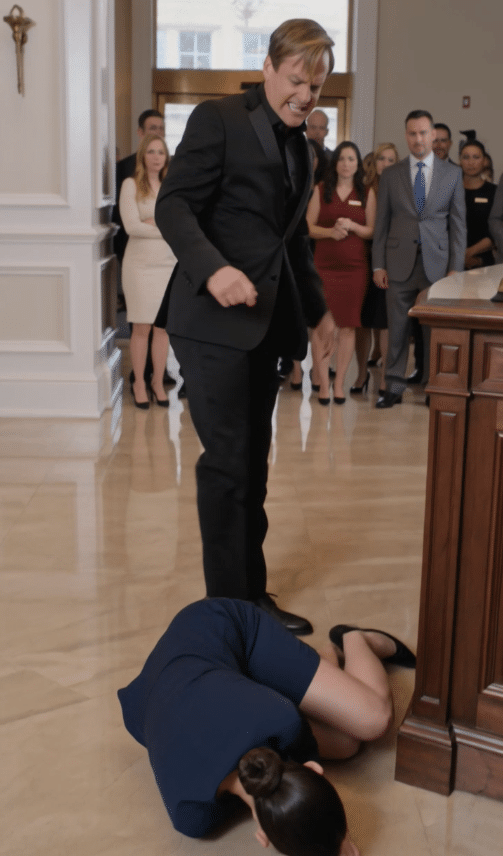
“Trash. Bow to the guests.”
The hotel manager stood over a twenty-seven-year-old front desk clerk, his black suit perfectly pressed, his nameplate gleaming beneath the lobby lights. Behind him, several check-in guests watched in stunned silence as the young woman struggled to get back on her feet beside the jammed key card printer.
All because a machine had stopped working for a few seconds.
“I’m sorry,” Emily Carter had said moments earlier, keeping her voice calm as a family waited for their room keys. “The printer is clearing now.”
The printer whirred, clicked, and finally released the cards.
The problem was solved.
But Richard Hale, the hotel’s forty-five-year-old general manager, wasn’t interested in the solution. He was interested in the fact that someone had witnessed one of his employees make a mistake.
“You embarrassed this hotel,” he snapped. “Do you understand what that means?”
Emily glanced at the waiting guests.
“I apologized to them, sir. Their keys are ready.”
Richard’s expression darkened.
“Did I ask you to explain yourself?”
She lowered her eyes, not out of respect, but because she knew what happened when she challenged him. Richard had a habit of turning minor workplace problems into public interrogations, forcing employees to stand silently while he explained how replaceable they were.
He enjoyed the discomfort.
He especially enjoyed having an audience.
“Bow your head,” he ordered.
Emily stared at him.
“I’m sorry?”
“You heard me. These guests deserve an apology that means something.”
“I already apologized. The printer jammed for a moment, but it’s working now.”
Richard stepped around the end of the front desk and entered the staff area.
“You think you can decide when you’re finished apologizing?”
Emily took a small step backward.
“Sir, I can finish checking everyone in.”
That was when he kicked her forcefully in the chest.
Emily fell beside the key card printer, striking the floor hard enough to send several plastic cards scattering beneath the desk. Her forearm scraped against the edge of a cabinet, leaving a thin trace of blood.
A guest gasped.
A bell attendant froze with his hands still wrapped around a luggage cart. Another receptionist covered her mouth, staring as though she could not believe what she had just witnessed.
Richard barely glanced at them.
Emily tried to sit up, one hand pressed against her chest.
“The printer is clearing now,” she managed to say.
Richard looked down at her with contempt.
“Trash. Bow to the guests.”
Then he kicked her twice more, striking her back and side as she tried to move away from the desk.
Emily curled inward, struggling to protect herself while keeping her legs clear of the scattered key cards. Her breathing turned shallow, and she winced as she tried to push herself away from him.
Richard straightened his jacket.
“Receptionists lower their heads.”
Nobody spoke.
A couple standing near the lobby entrance backed toward the glass doors. The other receptionist looked at the hotel security camera mounted above the desk, then at Richard, and seemed to lose whatever courage she had been gathering.
The manager interpreted their silence as approval.
He had spent years making people afraid to contradict him. He knew that employees depended on their paychecks, that guests didn’t want to become involved in someone else’s conflict, and that a manager’s authority could make even an obvious injustice feel dangerous to challenge.
He believed he controlled the room.
Then a black car appeared outside the glass entrance.
Its brakes shrieked against the pavement.
The vehicle surged toward the lobby doors, and a violent crash shattered the glass across the entrance. Fragments scattered across the tiled floor as the car stopped just inside the doorway.
The lobby fell silent.
The rear door opened.
A silver-haired man in a long black coat stepped out, surveying the wreckage with an expression so cold that even Richard stopped moving.
The man was Thomas Whitmore, the fifty-eight-year-old owner of the hotel.
He looked at Emily on the floor.
Then at Richard.
He crossed the lobby, struck the manager once with a powerful punch, and immediately placed himself between Richard and the injured clerk.
“That stuck key just opened the room I needed to see,” Thomas said.
Richard clutched his face, staring at him in disbelief.
“What room?”
For the first time in years, the general manager had no idea what would happen next.
And the answer had nothing to do with the broken printer.
It had everything to do with a room Richard had spent six months making sure nobody would ever inspect.
Act II
Richard Hale had built his reputation on appearing indispensable.
At forty-five, he had worked in hospitality long enough to understand that most hotel owners cared about three things: occupancy rates, guest satisfaction, and profits. If those numbers looked healthy, owners rarely questioned the person responsible for delivering them.
Richard had learned to make the numbers look healthy.
He knew how to present polished reports, how to explain away complaints, and how to make an ordinary week appear like a triumph of management. He could charm wealthy guests in the lobby, reassure corporate executives in meetings, and deliver speeches about service excellence that made new employees believe they had joined an exceptional team.
Behind closed doors, however, his management style was built on intimidation.
He kept a private list of employees he considered difficult. Some had asked about missing overtime. Others had questioned suspicious billing adjustments or complained that he humiliated staff in front of guests.
Richard labeled them unprofessional.
Then he reduced their shifts, moved them to undesirable hours, or placed formal warnings in their personnel files.
Most eventually resigned.
Those who stayed learned to remain quiet.
Emily had joined the hotel eighteen months earlier, hoping to build a career in hospitality management. She was good at remembering guests’ names, solving booking problems, and helping families who arrived exhausted after delayed flights.
She believed that a hotel lobby should make people feel welcome.
Richard believed it should make people feel impressed.
The difference became obvious whenever something went wrong.
A guest who lost a reservation needed help, not a lecture. A printer that jammed needed clearing, not a public punishment. Emily understood that people remembered how a business treated them when they were stressed.
Richard saw those moments as opportunities to remind employees who held the power.
He had targeted Emily almost from the beginning.
At first, the incidents were small enough to dismiss. He corrected her posture in front of guests, criticized her tone when she spoke politely, and accused her of being careless whenever a task took longer than he expected.
Once, he made her repeat an entire check-in explanation because he thought she had smiled too little.
Another time, he ordered her to remain at the desk after her shift ended, then accused her of poor time management when she asked whether she would be paid for the extra hour.
Emily needed the job, so she kept her responses professional.
Richard mistook that restraint for weakness.
What he didn’t understand was that Emily had begun documenting everything.
She had saved emails containing contradictory instructions, copied shift schedules that had been changed after complaints, and kept notes about the dates when employees were reprimanded for questioning missing payments.
She wasn’t building a case against Richard.
Not at first.
She was trying to protect herself if he ever decided to blame her for something she hadn’t done.
The hotel’s owner, Thomas Whitmore, had no idea how bad the situation had become.
He had inherited the business from his father and spent decades expanding it from a single historic property into a respected boutique hotel group. He believed in personal service, fair employment practices, and the idea that a company’s culture was revealed by the way it treated people who could do nothing for it in return.
But as the business grew, Thomas had delegated more daily operations to regional executives and general managers.
Richard was one of the managers he had trusted.
On paper, the hotel’s performance looked excellent. Guest satisfaction remained high, operating costs were down, and Richard’s reports consistently showed a well-organized operation.
There were reasons for the numbers.
Some were legitimate.
Others were not.
Over the previous six months, the hotel had received a series of confidential complaints about employee intimidation, irregular overtime records, and room charges that did not match the original bookings. Several guests had also reported being moved to different rooms without a clear explanation.
The complaints seemed unrelated until the hotel’s finance director noticed a pattern.
Refunds were being approved under unusual circumstances. Certain rooms repeatedly appeared as unavailable even when housekeeping records suggested they had been cleaned. Payments connected to corporate bookings were being adjusted after the guests had checked out.
Thomas ordered a discreet internal review.
Richard learned that an audit was underway and immediately became more careful. He instructed supervisors to route complaints through his office, discouraged employees from contacting corporate management directly, and began removing older records from the front desk’s shared folders.
He believed he had enough influence to contain the problem.
Then the audit team discovered that one of the most frequently disputed rooms was listed as unavailable on nights when the hotel had supposedly been sold out.
Room 814.
The room had appeared in several guest complaints, but every time someone requested an explanation, Richard claimed the records were incomplete.
Thomas wanted to inspect the matter personally.
He planned to arrive without announcing himself to the management team, review the front desk procedures, and speak privately with the employees who handled reservations.
He had intended to enter through the main lobby and ask for a room key.
Instead, his finance director called while he was on the way.
She had found a document that appeared to connect Richard to the disputed bookings.
Thomas told his driver to continue to the hotel.
By the time the car reached the entrance, he had already decided that Richard would not be warned before the inspection began.
Then he saw the lobby through the glass.
He saw Emily on the floor.
He saw Richard standing above her.
And every concern Thomas had about the hotel became secondary to the person who needed help in that moment.
But as he looked beyond Richard toward the front desk, he noticed something that made the situation even more serious.
The key card printer was still open.
A stack of newly printed cards lay beside it.
And one of them carried a room number Thomas recognized immediately.
814.
Act III
“Call an ambulance,” Thomas ordered.
His voice cut through the lobby.
The bell attendant finally moved, rushing to contact emergency services while another employee retrieved the hotel’s first-aid kit. Thomas stayed between Emily and Richard, refusing to let the manager approach her.
Richard pressed a hand against his face.
“You can’t just come in here and attack me!”
Thomas looked at him.
“You kicked an employee in front of your guests.”
“She was insubordinate.”
“She was fixing a printer.”
“She embarrassed the hotel.”
Thomas glanced at the broken entrance, the scattered key cards, and the guests watching from a distance.
“No, Richard. You embarrassed the hotel.”
The manager’s jaw tightened.
He had spent years believing the owner was too busy to concern himself with daily operations. Thomas appeared at quarterly meetings, reviewed the numbers, and occasionally praised Richard’s performance before returning to the larger business.
Richard had mistaken delegation for ignorance.
He had also mistaken silence for loyalty.
As the staff gathered around Emily, Thomas asked the receptionist to preserve the security footage and ensure that nobody deleted the front desk’s transaction logs. He instructed the hotel to cooperate with the responding authorities and told the manager to remain where he was.
Richard immediately reached for his phone.
“I need to contact legal.”
“You may do that,” Thomas replied. “But you are not going near the records.”
Richard froze.
“What records?”
Thomas did not answer.
He picked up the key card lying beside the printer and examined the number.
814.
The card had been issued only moments earlier, according to the timestamp printed on its accompanying receipt. Yet the hotel’s system had listed that room as unavailable for maintenance.
Thomas turned toward the front desk.
“Who requested this key?”
Nobody answered.
Richard stepped forward.
“That room isn’t relevant to what happened here.”
Thomas slowly looked back at him.
“I haven’t asked you about the room.”
The manager’s expression changed.
It was only a fraction of a second, but Thomas noticed it. So did the receptionist, who had been watching Richard’s face since the owner entered the lobby.
Fear.
Not the fear of someone who had been punched.
The fear of someone who had just heard a question he desperately hoped would never be asked.
Thomas handed the card to his finance director, who had arrived moments after him.
“Secure the access records,” he said. “And get the audit team here.”
Richard shook his head.
“This is ridiculous. You can’t shut down an entire hotel operation because of a printer malfunction.”
Thomas’s expression hardened.
“I’m not investigating a printer malfunction.”
He paused.
“I’m investigating why Room 814 has been marked unavailable for six months while key cards continue to be issued.”
The lobby seemed to contract around them.
One of the guests looked toward the elevators. Another quietly took out his phone, though this time nobody was filming for entertainment.
Richard attempted a laugh.
“Maintenance errors happen. The system isn’t perfect.”
“Then explaining the records should be easy.”
“They’re complicated.”
“Good. The auditors can help us understand them.”
Richard looked toward the office corridor.
Thomas noticed.
“Don’t leave.”
The manager stopped.
For years, Richard had used the threat of termination to keep employees in line. Now he was standing beneath the same security camera that had recorded him attacking Emily, with his employer watching every movement.
The first police officers arrived before he could formulate another explanation.
They spoke with the staff, examined the damaged entrance, and began collecting statements from witnesses. Emily was taken for medical assessment, with a colleague accompanying her.
Before she left, Thomas crouched beside her.
“I’m sorry this happened in my hotel,” he said. “You don’t need to worry about your job. We’ll make sure you’re taken care of.”
Emily looked at him with tired eyes.
“Will he still be my manager when I come back?”
Thomas answered without hesitation.
“No.”
It was the first time that evening her expression softened.
After the medical team took her away, Thomas returned to the front desk.
The finance director had already accessed the preliminary records. She showed him the transactions linked to Room 814 and explained that the room’s maintenance status had been used repeatedly to justify adjustments that should never have occurred.
The room was supposed to be sealed while repairs were completed.
Yet the system showed multiple key cards issued to guests who did not appear in the official occupancy records.
Some charges had been moved to other rooms. Others had been processed as refunds, although the original payments remained in the hotel’s financial system.
The discrepancies had accumulated over months.
And every exception required authorization from someone with managerial access.
Richard.
Thomas stared at the report.
“Have you confirmed the amounts?”
“We’re still reconciling them,” the finance director replied. “But this isn’t a single clerical mistake.”
“Who else has access?”
“Several senior staff members. But the approvals on the disputed transactions are tied to Richard’s credentials.”
Richard heard enough to understand where the conversation was going.
“You’re making a serious accusation,” he said.
Thomas turned toward him.
“Then help us establish the truth.”
“I’ve done nothing wrong.”
“Excellent. You’ll have every opportunity to explain the records.”
Richard looked around the lobby, searching for someone who might support him.
The receptionist who had watched him kick Emily lowered her eyes, then looked up again.
“I can tell them what happened,” she said quietly.
Richard stared at her.
She had worked under him for three years. He had praised her when she followed instructions and threatened to replace her whenever she questioned his decisions.
Now she stepped forward.
“I can also tell them what happened to the overtime records.”
Richard’s face went pale.
Because the jammed printer had not created the investigation.
It had merely interrupted the carefully controlled routine that kept everyone too afraid to speak.
And once the first employee began talking, the others no longer had to wonder whether they would be the only ones.
Act IV
The investigation lasted several weeks.
Thomas did not make a public announcement declaring Richard guilty of every suspected financial violation. He knew the difference between suspicion and proof, and he refused to turn the hotel’s response into another spectacle.
Instead, he suspended Richard’s managerial access, placed him on administrative leave, and instructed an independent team to examine the disputed room records, employee complaints, and financial transactions.
The security footage from the lobby was preserved.
So were the access logs from the key card printer.
The video showed the entire assault, including the moments before Emily fell. It captured her calmly explaining that the printer was clearing, Richard entering the staff area, and the manager attacking her while guests watched.
There was no evidence that Emily had threatened him.
There was no evidence that she had refused to correct the problem.
The footage contradicted every attempt Richard made to describe the incident as a misunderstanding.
His position became increasingly difficult to defend.
But the investigation uncovered something more disturbing than workplace violence.
Room 814 had not been used in the way the hotel’s records suggested.
The room had been placed under a maintenance restriction, but the restriction was repeatedly overridden. Access records showed that key cards had been generated at unusual hours, and financial records revealed that some of the resulting stays had been handled outside normal billing procedures.
The audit team traced several suspicious adjustments to a vendor account used for temporary operational expenses.
That account had been created to pay legitimate emergency costs, such as replacement equipment and urgent repairs. Under Richard’s management, however, it had also been used to process transactions that lacked the required supporting documents.
Investigators found invoices for services that could not be verified and room charges that had been moved between accounts without a clear business reason.
Some records pointed to deliberate manipulation.
Others still required explanation.
But the pattern was no longer consistent with ordinary administrative errors.
When the audit team compared the transactions with employee complaints, another connection emerged.
Several of the staff members who had questioned irregular bookings had later received formal warnings from Richard. Two had been transferred to less desirable shifts. One had resigned after being accused of mishandling a guest account that the audit later found had been altered by someone with managerial access.
The employees had believed their complaints were being ignored because management considered them unreliable.
In reality, their complaints had reached the very person whose decisions they were questioning.
Richard had not simply cultivated a culture of fear.
That culture had made it easier to keep the records unquestioned.
The hotel owner now understood why so many employees had been reluctant to speak. Each person had seen only a fragment of the problem, and Richard had used his authority to make every fragment appear like an isolated mistake.
Emily’s incident had brought those fragments together.
The printer malfunction was minor.
The assault was not.
And the discovery of the disputed key card had given the auditors a specific transaction to examine at the exact moment the hotel could no longer pretend its internal problems were merely personality conflicts.
Richard’s lawyer challenged the investigation, arguing that the hotel was treating ordinary accounting discrepancies as evidence of misconduct. Thomas allowed the review to proceed independently and made clear that the findings would be shared with the appropriate authorities where required.
He did not need to exaggerate the evidence.
The records were troubling enough.
Meanwhile, the hotel began changing the procedures that had allowed Richard to operate with so little oversight.
Employees received a direct channel for reporting misconduct outside their immediate management structure. Access to financial adjustments was restricted, and unusual room-status changes required additional approval.
Thomas also met privately with the employees who had previously complained.
Some were angry.
Others were embarrassed that they had remained silent.
One receptionist admitted that she had watched Richard humiliate employees for years but convinced herself that speaking up would only cost her job.
Thomas did not blame her.
“You were working under someone who had the power to make your life difficult,” he told her. “That responsibility belonged to the person abusing the power, not to the people afraid of him.”
The words spread through the staff more quickly than any official memo.
For the first time, employees began discussing what they had witnessed without immediately checking whether Richard was nearby.
They compared schedules, emails, and recollections of disputed bookings. Several provided additional information to the audit team.
The investigation eventually established that Richard had repeatedly violated hotel policies, falsified explanations for certain room-status changes, and authorized financial adjustments that could not be justified by the supporting records.
The hotel terminated his employment following the internal review.
Any suspected criminal conduct was referred to the appropriate authorities for further investigation rather than settled through a private agreement.
Richard had spent years telling employees that their careers depended on his approval.
Now his own career at the hotel was over.
But the most significant reversal came when the company reviewed its earlier complaints and formally cleared the former employee who had resigned after being blamed for a disputed account.
The hotel offered compensation for the documented employment harm and corrected the relevant personnel records.
For that employee, the decision arrived too late to restore the job she had lost.
But it proved that the official story had not been the whole story.
And for Emily, who was recovering from her injuries and preparing to return to work, it meant something important.
The person who had attacked her was no longer in a position to decide what happened to her future.
Yet Thomas knew that firing Richard was only the beginning.
He still had to face the employees who had been forced to live under his management, and he had to decide whether the hotel would return to business as usual or finally become the kind of place its public image had always promised.
Act V
Emily returned to the hotel nearly a month after the assault.
The entrance had been repaired, the damaged glass replaced, and the lobby restored to its familiar appearance. Guests moved between the front desk and the elevators while the bell attendants arranged luggage carts near the doors.
Nothing about the building suggested that a manager had once used his authority to terrorize the people working inside it.
But Emily noticed the difference almost immediately.
Her new supervisor greeted her by name and asked whether she needed any adjustments to her schedule. The hotel had arranged paid recovery leave and covered the support services promised to her after the incident.
Nobody asked her to apologize for the disruption.
Nobody suggested that she should forget what had happened for the sake of the hotel’s reputation.
And nobody expected her to stand behind the front desk and pretend Richard had simply been a difficult boss.
On her first evening back, Emily approached the key card printer.
For a moment, she hesitated.
The machine looked exactly as it had before: a small plastic device beside the booking terminal, capable of processing hundreds of room keys without attracting anyone’s attention.
She remembered the scattered cards on the floor.
She remembered Richard’s voice demanding that she bow.
Then she remembered Thomas standing between them.
Emily took a breath and switched on the printer.
It worked perfectly.
A guest approached with a reservation confirmation, and Emily greeted him with a professional smile. She checked his booking, verified his identification, and prepared his key cards.
When she handed them over, he thanked her.
It was an ordinary interaction.
For Emily, it felt like reclaiming something that had been taken from her.
Later that evening, Thomas visited the front desk.
He had spent the previous weeks overseeing the audit findings, meeting with staff, and reviewing the hotel’s management structure. The experience had forced him to confront an uncomfortable truth about the company he had built.
He had trusted Richard because the numbers looked good.
He had assumed that a manager who delivered strong financial results understood how to lead people.
He had mistaken a polished operation for a healthy one.
“I’m glad you’re back,” Thomas told Emily.
“Thank you.”
He glanced at the printer.
“I suppose that machine has caused us enough trouble for one lifetime.”
Emily gave a small, reluctant laugh.
“It was never really the machine.”
Thomas nodded.
“No. It wasn’t.”
They stood quietly for a moment, watching guests pass through the lobby.
Then Emily asked the question she had been afraid to ask before returning.
“Do you think things will actually change?”
Thomas did not offer her an easy promise.
“I think they have to. And I know we can’t prove that with a speech or a new policy. We prove it by what happens the next time someone speaks up.”
Emily considered that.
She had heard plenty of managers promise to do better. She knew that a few weeks of attention could disappear as soon as the headlines faded and the pressure eased.
But she had also seen the audit proceed without Richard’s approval. She had seen employees allowed to speak without being interrupted. She had watched the hotel correct records that had harmed people who no longer worked there.
It was not a perfect ending.
It was a beginning she could believe in.
Across the city, Richard Hale was discovering how difficult it was to maintain the image of a successful manager when his authority no longer protected him.
The internal findings had damaged his professional reputation. Former colleagues who once accepted his explanations were now reluctant to recommend him for another leadership role. The ongoing review of the financial irregularities meant that questions about his decisions would follow him beyond the hotel.
He could no longer dismiss every complaint as the work of a disloyal employee.
The records existed.
The footage existed.
And the witnesses had finally spoken.
Richard had believed that power meant being able to make other people lower their heads.
Thomas understood something different.
Power meant being responsible for what happened when nobody else was willing to intervene.
The difference had been visible from the moment the owner entered the lobby. Richard had seen an injured employee and an opportunity to reinforce his authority. Thomas had seen a person who needed protection.
Neither man had needed to explain his character.
Their actions had already done it.
Months later, the hotel introduced a new employee recognition program, but Emily never considered herself a hero. She had not uncovered the financial irregularities through some brilliant investigation. She had simply tried to do her job, kept records when she felt unsafe, and refused to let Richard’s version of events become the only version anyone heard.
The real change came when the people around her finally had the freedom to tell the truth.
The receptionist who had once covered her mouth became one of the first employees to speak during the independent review. The bell attendant who had frozen during the assault completed a witness statement. Other staff members described incidents they had previously believed were too small to report.
Together, their accounts revealed a pattern that no single employee could have exposed alone.
And it all began with a machine that refused to print a key card.
Richard had thought the malfunction made Emily look incompetent.
Instead, it exposed the weakness in his own leadership.
The key card had opened no mysterious door by itself. It had simply pointed the auditors toward a room whose records did not make sense, while the assault had removed the last excuse for delaying the investigation.
When Thomas said, “That stuck key just opened the room I needed to see,” he was talking about more than Room 814.
He was talking about the hidden space between what the hotel claimed to be and what its employees had been forced to endure.
Richard had spent six months keeping that space hidden.
He had controlled the reports, intimidated the staff, and convinced himself that the owner would never look closely enough to discover the truth.
But one moment of cruelty had brought the entire structure into view.
In the end, the broken glass was repaired, the printer was replaced, and the lobby returned to business.
The real damage had been done long before the crash at the entrance.
It had been done every time an employee was told to stay silent, every time a complaint was buried, and every time a manager confused authority with permission to humiliate another human being.
Richard had demanded that Emily lower her head because he believed she had embarrassed him.
Instead, his own actions forced him to answer questions he could no longer control.
And when he finally asked Thomas, “What room?” he was asking the wrong question.
The room was only where the evidence began.
The truth had been standing behind the front desk all along.