Act I
“Please keep your hands away from me.”
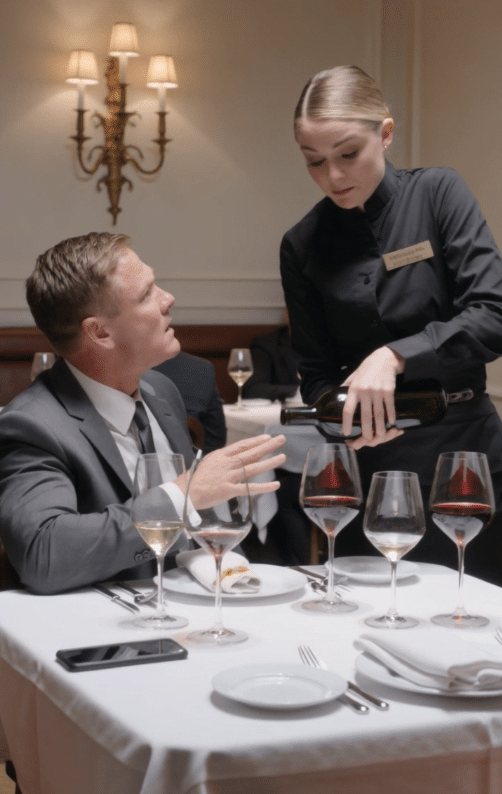
The young waitress stood beside the VIP table, one hand gripping a white service cloth and the other steadying a bottle of red wine. The crystal glasses shimmered beneath the warm golden lights of Manhattan’s most exclusive dining room, but nobody at the table was looking at the wine anymore.
They were watching the man in the expensive gray suit.
At forty-eight, Richard Blackwell had built a fortune in commercial real estate and developed the sort of confidence that made people move aside before he even asked. His gold watch caught the light as he leaned back in his chair, his business partners seated on either side of him. He looked like a man accustomed to hearing yes—and accustomed to punishing anyone who dared say no.
The waitress, Emily Hayes, was twenty-six. Her blonde hair was tied neatly behind her head, her black uniform was spotless, and her expression remained professionally composed despite the hand Richard had just placed against her lower back.
She stepped away from him.
“Sir, I need a little room to finish pouring.”
Richard smiled at his partners as though she had just delivered a joke.
“Did you hear that? She needs room.”
One of the men gave an uncomfortable chuckle. The other stared at his menu, although the wine list had been closed for several minutes.
Emily kept her eyes on the bottle label. She had been checking the vintage before pouring because Richard had insisted on a particular bottle, and the restaurant’s standards required her to verify it before serving.
The delay had lasted seconds.
Richard had treated it like a personal insult.
“Come closer,” he ordered.
Emily held her position.
“I’m sorry if the service has been slower than you expected. I can finish pouring from here.”
His smile disappeared.
“Trash. I paid for service.”
The words were loud enough to carry beyond the VIP table. A couple at the next table stopped speaking, and a nearby server slowed with a tray balanced in one hand.
Emily felt the familiar pressure behind her ribs, the warning that told her a customer was no longer simply angry. She had worked in fine dining long enough to recognize the moment when politeness stopped calming a situation and started feeding someone’s sense of control.
“Sir, I’m here to serve your table,” she said carefully. “But you cannot touch me.”
Richard rose from his chair.
For a fraction of a second, Emily thought he might finally understand what she had said. Then his face tightened, and he drove a hard kick into her chest.
She fell beside the wine table.
The bottle rattled against the metal serving stand, and the crystal glasses trembled without breaking. Emily struck the floor on her elbow, scraping the skin badly enough to leave a thin red trace. The service cloth slipped from her fingers and landed near the leg of Richard’s chair.
A woman at the next table gasped.
Richard barely glanced at her.
He stepped away from the VIP chair and delivered exactly two more kicks, one to Emily’s back and another to her side. She winced and pulled her arm away from the table leg, trying to create distance between herself and the polished shoes above her.
Nobody moved.
His business partners sat frozen, their expressions caught somewhere between shock and disbelief. A waiter near the wine rack opened his mouth but said nothing. Several diners watched with their hands pressed over their lips, as though the scene had become something too dangerous to acknowledge.
Richard straightened his jacket.
“Serve closer when I tell you,” he said.
Emily struggled to lift her head. Pain made the dining room blur around the edges, but she could still hear the soft clink of silverware at a distant table.
The worst part was not the pain.
It was the silence.
She had spent years believing that if she remained calm, professional, and careful enough, people would eventually recognize that she deserved respect. Now she lay on the floor of a restaurant where every detail cost more than she could comfortably afford, surrounded by people who had the money to intervene and the fear to remain seated.
Then a metal door slammed open behind the wine rack.
The restaurant’s owner emerged from the cellar, his face transformed by what he had just witnessed.
And Richard Blackwell was about to discover that the table he believed could buy him anything was the one place where his money could no longer protect him.
Act II
Emily Hayes had learned early that people often judged a person’s worth before learning anything about their life.
She grew up in Queens, the daughter of a single mother who worked long shifts as a hospital receptionist. Their apartment was small, their budget unforgiving, and every unexpected expense seemed to arrive precisely when they could least afford it.
Emily’s mother taught her two rules that never changed.
The first was to keep her promises.
The second was never to confuse kindness with weakness.
Emily had carried both rules into adulthood. She paid her bills on time, worked double shifts when necessary, and saved what she could toward a degree in hospitality management. She hoped one day to run a restaurant of her own, a place where staff members would be respected and guests would feel welcome without believing that welcome meant ownership.
Fine dining had not been her first choice.
It had simply offered the best combination of reliable income, health insurance, and opportunities to learn how a serious restaurant operated. Emily studied the wine list, memorized ingredients, and learned to recognize the subtle differences between a customer who needed help and one who wanted an audience for his anger.
She was good at her job.
Her manager trusted her with important tables, and regular guests often requested her because she remembered their preferences without making them feel watched. She knew which customers preferred a quiet service and which liked a little conversation. She understood that true hospitality was not about flattery. It was about attention.
That was why she had checked Richard’s wine bottle instead of simply pouring it.
He had ordered a rare vintage from the restaurant’s cellar, and Emily wanted to be certain the bottle matched his request. The few seconds she spent reading the label were a small act of care.
Richard saw only a delay.
His life had taught him that most problems could be solved by paying someone enough money, threatening to take that money away, or making the person across from him feel too embarrassed to resist.
He had grown up in a comfortable suburban home and entered commercial real estate through connections established by his father. He worked hard, certainly, but his greatest skill was knowing how to make powerful people feel important while making less powerful people feel replaceable.
Over time, that habit became his philosophy.
He treated private clubs as kingdoms, restaurant reservations as personal favors, and employees as extensions of the service he had purchased. When someone resisted him, he rarely considered whether he was wrong. He assumed the person had forgotten their place.
His business partners had learned to tolerate this behavior.
One of them, Martin Cole, had worked with Richard for nearly a decade. Martin knew Richard could be generous when generosity served his interests and vicious when his authority was challenged. He had witnessed humiliating outbursts at meetings and watched junior employees apologize for mistakes they had not made.
Martin had always told himself that it was not his responsibility to correct another man’s personality.
That evening, he would discover the cost of that excuse.
The restaurant itself was called Bellamy, a celebrated Manhattan establishment known for its carefully sourced ingredients, an exceptional wine cellar, and a clientele that included artists, executives, diplomats, and old New York families.
Its owner, Daniel Laurent, was fifty-two and one of the city’s most respected sommeliers. He had spent years studying vineyards across Europe, apprenticed under demanding masters, and eventually built a restaurant around a simple belief: a fine dining experience should make people feel more human, not less.
Daniel had seen wealthy guests demand special treatment. He had handled complaints about temperatures, reservations, wait times, and bottles that failed to meet expectations.
He had never considered any of those things an excuse to abuse his staff.
Behind the scenes, he maintained a strict policy: employees were expected to provide excellent service, but no employee was expected to accept harassment or physical intimidation as part of the job.
The policy had cost him a few high-spending customers over the years.
He considered that a reasonable price.
Richard, however, was not merely another difficult guest.
For months, he had been negotiating a private business arrangement with Daniel involving the restaurant’s second location and a proposed hospitality venture in a historic Manhattan property. Richard’s real estate group controlled access to a building Daniel had been considering for expansion, and the two men had been discussing terms through lawyers and financial advisers.
The proposed partnership promised to be lucrative.
It also required trust.
Daniel had not yet signed the final agreement. He wanted to examine the financing structure, confirm the property’s legal position, and make sure the project would preserve the standards that had built Bellamy’s reputation.
Richard had interpreted the delay as hesitation he could overcome.
He believed Daniel needed the deal more than he did.
That evening’s dinner had been arranged to settle the final terms. Richard brought two business partners, ordered an expensive bottle, and expected the restaurant owner to join them personally.
Instead, Daniel had gone into the cellar to inspect a shipment before it was served.
While he was below ground, Richard decided that the young waitress at his table was the easiest person in the room to control.
He had no idea that his behavior would reach the one man whose confidence he needed most.
And when Daniel came up the cellar stairs, he was not thinking about wine.
He was thinking about the woman on the floor.
Act III
The cellar door struck the wall with a metallic bang.
Daniel Laurent came through the entrance at a near run, moving between the wine displays and the VIP tables without stopping to ask what had happened. He had heard the shouting from below, followed by the unmistakable sounds of someone striking the floor.
When he reached the table, Emily was still curled beside the serving stand.
Richard stood above her, adjusting his gray jacket.
Daniel took in the scene in a single glance: the displaced chair, the trembling glasses, the service cloth on the floor, and Emily’s face tightened with pain.
“Step away from her.”
Richard turned, annoyed.
“Daniel. Good. Perhaps you can explain to your employee how to treat a paying guest.”
Daniel did not answer the insult. He moved directly between Richard and Emily, then crouched beside the waitress.
“Emily, can you hear me?”
She nodded.
“Don’t try to stand. We’re getting medical help.”
Daniel signaled the nearest manager to call emergency services and secure the dining room. Then he rose, keeping himself between Emily and Richard.
“What happened here?” he asked.
Richard gave a dismissive wave.
“An unfortunate misunderstanding. She took too long with the wine, then became argumentative when I asked her to do her job.”
Daniel looked at the bottle.
The label had been checked correctly. The vintage was the one Richard had ordered.
“You assaulted her,” Daniel said.
Richard’s expression hardened.
“Careful.”
It was a familiar warning, delivered by a man accustomed to making other people reconsider their words. He glanced toward the two partners seated at the table, expecting them to help restore the balance.
Neither spoke.
Richard turned back to Daniel.
“I spend a great deal of money here. I expect the service to reflect that.”
Daniel’s voice remained steady.
“You paid for dinner. You did not pay for the right to touch her, threaten her, or kick her while she was on the floor.”
Richard laughed sharply.
“Don’t be dramatic. This is between a customer and your staff.”
“No,” Daniel said. “It became my responsibility the moment you hurt someone in my restaurant.”
Richard stepped closer.
“You’re risking a very profitable relationship over a waitress?”
The question hung in the air.
Daniel had built Bellamy through decades of difficult decisions. He understood exactly what Richard was offering him: money, property access, expansion, and the possibility of turning a respected restaurant into a much larger enterprise.
He also understood what Richard was asking him to surrender.
The moment Daniel accepted the idea that profit justified looking away from an assault, every employee who trusted him would know that his principles lasted only until they became expensive.
He thought of Emily’s mother, waiting for her daughter to come home after a shift. He thought of the young staff members who had taken jobs at Bellamy because they believed they would be safe there. He thought of the years he had spent building a restaurant where a server could report a problem without being told to smile through it.
Then he looked at Richard.
“You’re right about one thing,” Daniel said. “This relationship is at risk.”
Richard’s eyes narrowed.
Before he could answer, Daniel struck him once across the face with a forceful punch.
Richard stumbled back, catching himself against the edge of the VIP table. His hand flew to his mouth, where a small trace of blood appeared at the corner of his lip.
A crystal glass rattled beside his elbow.
His business partners rose halfway from their chairs, then stopped, stunned by the sudden reversal.
Daniel did not pursue Richard or strike him again. He immediately returned his attention to Emily, positioning himself between her and the man who had attacked her.
“Stay back,” he told Richard. “You are not going near her again.”
For the first time all evening, Richard seemed unable to find the right words.
Daniel’s breathing was heavy, but his voice was controlled when he finally spoke.
“That hand just ended your table, your deal, and your name in this room.”
Richard stared at him.
“My deal?”
Daniel’s expression carried none of the satisfaction Richard might have expected from a rival winning a fight. It was the expression of a man who had just watched an opportunity turn into a liability.
“You came here tonight expecting me to sign a partnership agreement,” Daniel said. “You expected this dinner to prove that we could trust each other with a major investment.”
He glanced at the table.
“Instead, you showed me exactly what you do when you believe someone has no power to stop you.”
Richard looked toward Martin and the other partner.
They were no longer sitting beside him as allies. They stood apart, their faces pale, watching him as though they were seeing a stranger wearing a familiar suit.
Daniel continued.
“The agreement has not been signed. It will not be signed tonight. And I will not enter a business partnership with someone who treats another human being this way.”
Richard pressed his hand over his mouth.
“You can’t throw away a deal worth millions because of one incident.”
“One incident?” Daniel repeated.
He looked at Emily, who was being carefully helped into a seated position by the manager.
“You kicked a woman because she asked you not to touch her.”
For a moment, even the distant murmur from the rest of the restaurant seemed to vanish.
Richard had spent years believing that his reputation made him untouchable. Now the two men whose approval he needed most were looking at him with open disbelief.
But Daniel’s decision was only the beginning.
The partnership had involved far more than a dinner reservation, and Richard’s own business partners were about to make a choice that would leave him with no one to blame but himself.
Act IV
The police arrived while the restaurant manager was arranging medical assistance for Emily.
Daniel provided the staff with instructions to preserve the security footage and document the incident. The restaurant’s manager recorded the names of witnesses, including the diners who had seen Richard’s conduct from the neighboring tables.
Emily was examined and advised to receive further medical evaluation for the pain in her chest and side. Her scraped elbow was cleaned and dressed. Daniel made sure she was not asked to return to work or discuss the incident before she was ready.
Richard, meanwhile, tried to turn the situation back into a negotiation.
He pulled Daniel aside as officers began speaking with witnesses.
“You need to think carefully about this,” he said quietly. “There are people who will hear about what happened here. You could lose more than a property deal.”
Daniel regarded him without blinking.
“Are you threatening me?”
“I’m explaining reality.”
“No. You’re trying to make me afraid of the consequences of holding you accountable.”
Richard lowered his voice further.
“You have a business to protect. I can help that business grow. One employee’s complaint doesn’t have to destroy something we’ve spent months building.”
Daniel glanced toward the dining room.
Emily was sitting with the manager, her face pale but composed. The woman who had been standing near the wine rack was giving a statement. A waiter who had initially frozen was now explaining what he had seen.
“This business is worth protecting,” Daniel said. “That is why the agreement is over.”
Richard’s composure cracked.
“You can’t make that decision alone.”
“The agreement is not signed. My lawyers will notify yours.”
“You’re making a mistake.”
“Perhaps. But I won’t make it by pretending I didn’t see what you did.”
Across the room, Martin Cole had heard enough.
He had spent nearly ten years working beside Richard, helping negotiate leases, structure investments, and secure financing. He had witnessed the arrogance, the temper, and the casual contempt for people who could not offer him anything.
Until that night, Martin had told himself that Richard’s behavior was a private flaw unrelated to business. As long as contracts were profitable and commitments were met, he believed he could keep the partnership separate from the man.
But watching Richard try to bargain his way out of an assault changed something.
The same instinct that made Richard dangerous to a waitress could make him dangerous to a business partner. A man who believed consequences applied only to other people would eventually bring that belief into a contract, a negotiation, or a financial decision.
Martin approached Daniel.
“I want to make something clear,” he said. “I did not approve of what happened. I should have intervened sooner.”
Daniel nodded but did not absolve him.
“You should have.”
Martin accepted the answer.
Then he turned to Richard.
“Our firm cannot proceed with the proposed joint venture under the current circumstances.”
Richard stared at him.
“Don’t be ridiculous.”
“The decision will be reviewed by our partners and counsel,” Martin said. “But I will not recommend that we continue with this arrangement.”
“You’re choosing a waitress over a business worth millions?”
Martin’s jaw tightened.
“No. I’m choosing not to tie our business to someone who thinks money gives him permission to do this.”
The words seemed to strike Richard harder than Daniel’s punch.
He looked at the other partner, expecting resistance. Instead, the man quietly confirmed that he would support a formal review before any agreement moved forward.
Richard’s deal was no longer merely in danger because Daniel had withdrawn from it.
His own partners had begun to question whether working with him was worth the risk.
That distinction mattered.
Daniel could end his restaurant’s involvement. He could refuse Richard’s money and cancel future reservations. But the partners had their own responsibilities, their own legal advisers, and their own reasons to reassess the relationship.
No single outburst automatically erased a successful career. Yet a pattern of intimidation, documented evidence, and the loss of trust among people who had once defended him could do real damage.
Richard had spent years accumulating influence.
In a few minutes, he had shown everyone what that influence looked like when he believed nobody could challenge him.
As the officers finished their initial interviews, Daniel returned to Emily.
She was quiet, her hands folded in her lap. The pain had begun to settle into a deep ache, and the shock of what had happened seemed to be arriving only now that the room was calmer.
“I’m sorry,” she said.
Daniel looked at her in surprise.
“For what?”
“For the dinner. The guests. The deal.”
He pulled a chair closer but did not sit until she gave a small nod.
“Emily, none of this is your fault.”
“I should have found a way to calm him down.”
“You asked him to keep his hands off you. That was not unreasonable.”
She looked toward the VIP table, where Richard was speaking with the officers, his face rigid with anger.
“I thought everyone would just let it happen.”
Daniel followed her gaze.
“I’m sorry that they did.”
It was an honest answer, and that made it more comforting than any polished promise.
Daniel knew he could not undo the moment when Emily had looked around the room and found nobody moving toward her. He could not promise that every future customer would be decent or that every witness would be brave.
He could, however, make sure that Bellamy would not punish her for what Richard had done.
“You will be paid while you recover,” he said. “You can take whatever time you need. And when you’re ready, we’ll discuss what you want to do next.”
Emily nodded, fighting back tears.
For the first time that evening, she felt that she did not have to prove she deserved protection.
But the most important consequence of the night would come the next morning, when the story of Richard Blackwell’s dinner reached the people whose trust he had spent years taking for granted.
Act V
By morning, Richard’s carefully managed world had begun to shift.
The restaurant did not release Emily’s private information or turn her injury into a publicity campaign. Daniel refused to exploit the incident for attention, instructing his staff to cooperate with investigators and leave the legal process to the appropriate authorities.
But the restaurant had several witnesses, and the incident was not something Richard could simply dismiss as a private disagreement.
His business partners requested an emergency meeting. Their attorneys reviewed the proposed investment, the status of the unsigned agreement, and the risks of continuing a relationship with someone whose conduct had now raised serious questions about his judgment.
The partners did not need to agree with every decision Daniel had made to reach their own conclusion.
They needed to decide whether Richard remained someone they could trust.
That question was harder to answer than he expected.
For years, Richard had assumed that people tolerated his behavior because they respected his success. He had never seriously considered that some of them stayed close because challenging him was inconvenient, or because they believed the next profitable deal would compensate for the discomfort.
Now the calculation had changed.
One partner stepped away from the proposed venture. Another insisted that future negotiations would require a different leadership structure and independent legal oversight. Martin, who had spent years defending Richard’s temper as an unfortunate personality trait, refused to recommend the partnership in its current form.
Richard remained wealthy. He retained his properties, his investments, and the right to defend himself through the legal process.
But he could no longer assume that every room would welcome him simply because he could afford to enter it.
His private club reservations became harder to secure. Invitations that once arrived automatically stopped appearing. People who had laughed at his jokes began remembering other moments they had once dismissed: the assistant he had humiliated in a meeting, the contractor he had threatened over a minor delay, the junior employee whose career he had tried to damage after being contradicted.
The incident at Bellamy did not create all those memories.
It gave them a context.
For the first time, people began comparing notes.
Richard’s lawyers advised him to stop contacting restaurant employees and allow the legal process to proceed. His company issued no grand public declaration, and there was no instant collapse of his entire business empire. Real consequences rarely arrived as neatly as they did in the stories he once believed happened only to other people.
They arrived through meetings, questions, contracts placed on hold, and colleagues who no longer accepted his word without verification.
The proposed deal with Daniel Laurent never moved forward.
Daniel’s lawyers formally withdrew from negotiations, citing the collapse of trust necessary for a partnership. Richard protested, arguing that a private dinner should not determine the future of a major investment. But the deal had never been signed, and Daniel had every right to refuse to enter a business relationship he no longer believed was sound.
The decision cost Richard a valuable opportunity.
More importantly, it cost him the certainty that his money could make other people overlook his behavior.
Emily returned to Bellamy after her recovery, though she initially found the dining room difficult to face. The wine rack, the VIP table, and even the soft golden lights reminded her of the night she had fallen beside the serving stand.
Daniel offered her the option of moving to a different section or taking a longer break.
She chose to return to her usual role.
“I don’t want that table to become something I’m afraid of,” she told him.
Daniel respected the decision.
The restaurant also reviewed its procedures for dealing with abusive customers. Staff members received clearer guidance on when to call a manager, how to protect themselves, and when a guest’s behavior required immediate removal and police involvement. Managers were instructed to intervene early rather than leave individual servers to manage escalating situations alone.
Emily helped with the review.
Her suggestions were practical and specific. She wanted employees to have a clear signal for requesting assistance, a reliable way to document inappropriate behavior, and an explicit assurance that refusing unwanted physical contact would never be treated as poor service.
Daniel approved the changes.
“You understand the room better than most people,” he told her.
Emily smiled faintly.
“I understand what it feels like when everyone is watching and nobody wants to be the first to move.”
Daniel had no answer that could make that experience acceptable.
So he listened.
Months later, Emily began taking evening classes toward her hospitality management degree. Bellamy helped cover part of the tuition through its employee development program, an opportunity she had earned long before the incident and continued to qualify for through her work.
She remained a server because she liked the connection with guests, but she began learning the operational side of the business as well. She studied staffing, budgeting, supplier relationships, and the decisions that shaped a restaurant long before the first guest sat down.
She was building toward the future she had wanted all along.
One evening, Daniel found her checking a bottle label at the service station before taking it to a table.
“Still checking every bottle?” he asked.
“Every one.”
“Even when the guest is impatient?”
Emily looked at him.
“Especially then.”
He laughed, and she smiled back.
At another table, a guest waited while a server carefully verified the vintage of a wine. The man glanced at his watch, then began to complain. For an instant, Emily felt the old tension rise.
Then she watched the manager approach the table, calm and attentive, ready to help before the situation could turn ugly.
The server was no longer alone.
Across Manhattan, Richard Blackwell continued to live with the consequences of his choices. He could explain the incident to himself in a hundred ways, blame the pressure of the deal, insist that Daniel had overreacted, or tell his remaining associates that the world had become too sensitive.
None of those explanations could change what the witnesses had seen.
He had been asked to keep his hands to himself.
He had answered with violence.
And when the people around him finally understood what that revealed, they stopped treating his wealth as proof of his character.
Daniel had lost a lucrative opportunity, but he had protected the principle on which his restaurant depended. Emily had endured a frightening night, but she returned to a workplace that no longer expected her to trade her dignity for a paycheck.
The crystal glasses at Bellamy were replaced on the table. The wine was cleared away. The chairs were straightened, and the dining room returned to its familiar glow.
Yet something fundamental had changed.
Richard had entered the restaurant believing he had paid for more than a meal. He believed he had purchased obedience, silence, and the right to decide how another person should behave.
He left with the one thing he had never learned how to purchase: the respect of people who knew exactly what he was capable of.
And when he looked back at that night, the question that haunted him was not why Daniel had ended the deal.
It was why he had ever believed that a woman serving wine was worth less than the man drinking it.