Act I
“Trash. Clean it for my viewers.”
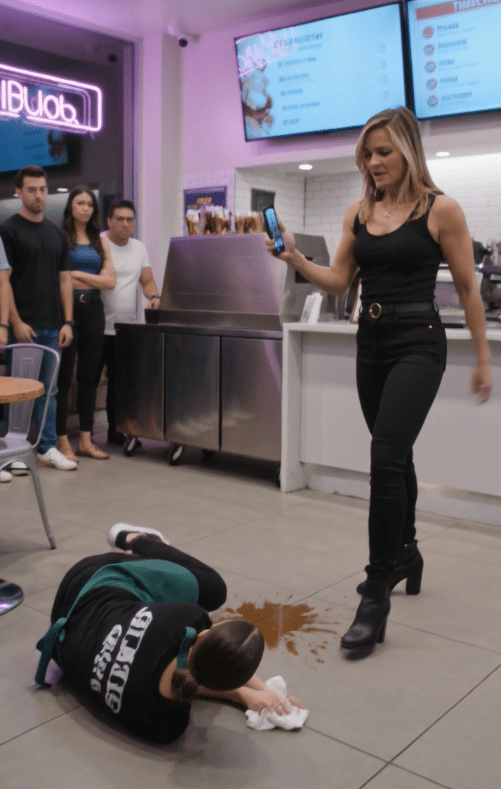
The words came from a young woman in a white crop top as she pointed her phone at a twenty-year-old employee kneeling beside a sticky customer table.
The boba shop was crowded that evening. The bright menu board glowed above the counter, the blender hummed behind the register, and customers waited for their drinks beneath the warm storefront lights. But nearly everyone had stopped paying attention to the menu.
They were watching the woman with the ring light.
Her name was Madison Blake, a twenty-seven-year-old TikTok personality whose videos revolved around luxury purchases, expensive restaurants, and confrontations with employees she claimed had ruined her day. Her followers loved her dramatic reactions. Her sponsors loved the views.
Madison had learned that outrage was profitable.
A bad meal could become a viral video. A delayed order could become a public scandal. And an employee who looked frightened on camera could turn an ordinary complaint into content that attracted hundreds of thousands of viewers.
Tonight, she had found another opportunity.
Her brown sugar milk tea contained slightly fewer tapioca pearls than she expected.
The employee behind the counter, Emily Brooks, had apologized immediately and offered to add more pearls at no charge. Emily was twenty, exhausted from a long evening shift, and trying to finish her work before the shop’s closing rush.
It should have been a thirty-second problem.
Instead, Madison tilted her phone toward the drink and announced to her livestream that the shop had cheated her.
Emily leaned forward politely.
“I can add more pearls for you.”
Madison barely looked at her.
“You heard me. I paid for a full drink.”
“And I’ll fix it for you,” Emily replied. “It won’t cost you anything.”
That answer should have ended the argument.
Madison needed it to continue.
She glanced at the comments racing up her screen, then picked up the plastic cup and deliberately poured the remaining milk tea across the table.
Brown sugar syrup spread over the surface. Tapioca pearls rolled toward the edge. The liquid dripped onto the floor beside a customer’s chair.
Madison gasped theatrically and turned the camera toward the mess.
“Look at this. Look at what they made me deal with.”
Emily stared at the spilled drink.
For a second, she seemed too stunned to speak.
Then she grabbed a towel.
“I’ll clean it up.”
Madison smiled at the phone.
“Everybody watch this. This is what happens when businesses don’t train their employees properly.”
Emily approached the table and bent down to wipe the syrup from the floor.
That was when Madison stood up.
Without warning, she kicked Emily forcefully in the chest.
Emily fell backward beside the table, her elbow striking the floor. Her towel slipped from her hand, and a thin trace of blood appeared across her palm as she tried to catch herself.
A customer near the window covered her mouth.
Someone whispered, “What is wrong with her?”
Madison kept filming.
Emily struggled to sit up, breathing carefully as she tried to understand what had just happened.
“I can add more pearls for you,” she repeated, her voice unsteady.
Madison stared down at her.
“Trash. Clean it for my viewers.”
Then she stepped closer and kicked Emily twice more, striking her back and side.
Emily recoiled, pulling her hand away from the wet floor. A chair scraped against the tiles as nearby customers pushed themselves backward.
Nobody moved to intervene.
Some were frightened. Others seemed unable to process the fact that a woman who had been complaining about a drink was now attacking the person who had offered to fix it.
Madison raised her phone higher.
“Make drinks from the floor,” she sneered. “Maybe you’ll finally learn how to do your job.”
Her livestream was still running.
Thousands of people were watching.
Madison believed that meant she was winning.
Then a black car braked sharply outside the glass storefront.
The front door swung open, and the bell above it rang loudly.
A man in a black jacket entered, his expression hardening as he took in the overturned chair, the spilled drink, and Emily lying on the floor.
He was Daniel Reed, the forty-five-year-old founder and owner of the boba chain.
His eyes moved to Madison’s phone.
Then to the injured employee.
He crossed the shop in several quick steps, delivered one decisive slap across Madison’s face, and immediately placed himself between her and Emily.
“That livestream just poured your sponsorship down the drain,” he said.
Madison stumbled back, one hand flying to her cheek.
For the first time since she had started filming, she seemed unable to remember what to say.
“My sponsorship?” she whispered.
She had built her career on making other people look powerless.
What she didn’t know was that the man standing in front of her controlled a business relationship worth more than every viral video she had ever posted.
And the camera she had turned on Emily was about to become the most damaging witness of her life.
Act II
Madison Blake had not always been famous.
Three years earlier, she had been working as a part-time social media assistant for a small clothing retailer in Los Angeles. She was good at recognizing what made people stop scrolling, and she understood how quickly an ordinary disagreement could become entertainment.
Her first viral video had involved a restaurant refusing to replace a meal she claimed was cold.
The restaurant eventually apologized, although its staff disputed her account. The video attracted millions of views, and Madison discovered something that would shape everything that followed.
Anger traveled faster than fairness.
Her follower count increased. Small brands offered free products. Soon, she was receiving payment to promote skincare, clothing, drinks, and lifestyle products.
She stopped thinking of herself as someone who made videos.
She began thinking of herself as someone who could make businesses afraid.
Madison’s audience grew because every complaint was presented as a battle between an ordinary consumer and a company that believed it could get away with anything. She rarely showed the conversations that preceded her outbursts. She edited aggressively, selected the most emotional moments, and described herself as an advocate for customers who were being ignored.
Sometimes, she genuinely exposed poor service.
Other times, she manufactured a confrontation when a normal interaction failed to provide enough drama.
The difference mattered less to her as long as the numbers kept rising.
By twenty-seven, Madison had a carefully curated apartment, a designer wardrobe, and a management agency that negotiated sponsorship deals on her behalf. She had also become increasingly dependent on the outrage that had made her successful.
A quiet review received modest engagement.
A confrontation could triple it.
And a confrontation that appeared to show an employee disrespecting her could become the foundation of an entire week’s content.
Her followers rarely saw what happened after the camera stopped recording.
They didn’t see her demanding free products in exchange for deleting negative videos. They didn’t hear the threats she made when a business refused to cooperate. They didn’t know how many managers had offered refunds simply because they feared becoming the subject of her next livestream.
Madison told herself she was holding businesses accountable.
The truth was that she had become addicted to the feeling of control.
Emily Brooks lived in a completely different world.
She worked at the boba shop five evenings a week while taking community college classes during the day. Her mother had recently reduced her working hours because of a back injury, and Emily had taken on additional shifts to help cover rent and household expenses.
She was tired more often than she admitted.
But she liked her job.
The shop was one of the few places where she felt useful without being judged by her grades or the size of her bank account. She knew which customers preferred less sugar, which students needed extra time to decide, and which regulars came in after difficult days simply because the familiar smell of tea and brown sugar made them feel better.
Her manager trusted her.
She had never been written up for misconduct.
And she had never imagined that a customer might deliberately create a mess, attack her, and broadcast the entire encounter as entertainment.
Daniel Reed understood the importance of employees like Emily.
He had opened his first boba shop twelve years earlier with money borrowed from his older brother and savings accumulated from a decade of working in restaurants. The first location had six tables, an aging refrigerator, and a handwritten menu taped to the counter.
Daniel had worked every position himself.
He had cleaned floors after closing, replaced broken equipment, and delivered ingredients when suppliers failed to show up. He remembered customers who treated employees like human beings, and he remembered the ones who believed that paying a few dollars entitled them to command everyone around them.
As the chain expanded, he made one rule nonnegotiable.
No employee would be required to accept abuse simply because a customer had money, influence, or an audience.
The company trained managers to resolve ordinary complaints generously. If a drink was wrong, they replaced it. If an order was delayed, they apologized. If an employee made a mistake, they corrected it.
But physical violence was different.
Daniel had terminated customer accounts over threats before, and he had personally intervened when staff members were harassed.
What he did not know was that Madison had already approached his marketing team about a potential sponsorship.
Her agency had pitched a campaign built around a series of visits to popular food and beverage brands. The concept promised authentic reactions, customer engagement, and access to a young audience that traditional advertising struggled to reach.
Daniel’s marketing director had been skeptical.
Madison’s videos generated impressive views, but several brands had complained about the unpredictable nature of her content. Her team wanted a generous fee, free products, and complete creative control.
Still, the potential reach was enormous.
A preliminary agreement had been drafted, but Daniel had not personally approved the final campaign.
He wanted the company to review Madison’s previous work before committing.
That review was supposed to take place the following week.
Instead, he had arrived at the Los Angeles location to meet the store manager about a separate expansion plan.
He had been in the car when his phone began vibrating with urgent messages from the marketing director.
Someone had sent him a link.
Madison Blake was livestreaming from one of his stores.
The message beneath the link contained only six words.
She’s attacking one of our employees.
Daniel watched the footage before he reached the parking lot.
He saw the drink being poured.
He saw Emily bend down to clean it.
And he saw Madison’s foot strike the young worker before the livestream angle jerked toward the ceiling.
Daniel entered the shop before he had fully decided what he would say.
He knew one thing with absolute certainty.
Emily would not be left alone with the woman who had attacked her.
But once he looked directly into Madison’s phone, he realized the damage extended far beyond the shop floor.
The livestream had already begun spreading beyond her followers.
And among the people watching was the executive who had negotiated Madison’s most lucrative sponsorship deal.
Act III
“Turn that phone off,” Daniel ordered.
Madison clutched it tighter.
“You can’t tell me what to do. I’m a customer.”
Daniel looked at the spilled drink.
“Customers don’t get to assault employees.”
“She was disrespectful.”
“She offered to fix your order.”
Madison glanced toward the other tables, searching for someone who might support her version of events.
Nobody did.
The woman who had covered her mouth earlier was now staring at Madison with open disgust. A young man near the counter had his own phone raised, recording what was happening from a distance.
Madison’s expression tightened.
“Do you know who I am?”
Daniel didn’t answer immediately.
He crouched beside Emily and asked whether she could breathe comfortably. He called for the manager to contact emergency medical services and instructed another employee to preserve the shop’s security footage.
Only after making sure Emily was being attended to did he stand again.
“I know exactly who you are,” he said.
Madison lifted her chin.
“Then you know this is going to cost you.”
Daniel glanced at the livestream.
“It’s already costing you.”
She gave a brittle laugh.
“You think your little shop can threaten me? My audience is bigger than your entire company.”
Daniel reached into his jacket and removed his phone.
He opened an email.
The sender was the head of partnerships at Brightline Media, the agency representing Madison’s largest beverage sponsorship.
The proposed campaign was valued at several hundred thousand dollars over twelve months, with additional performance bonuses tied to views and brand engagement. Madison had been preparing to announce the partnership to her followers.
Her manager had already told her that the deal would transform her career.
Daniel turned his screen toward her.
“Your sponsorship agreement includes a conduct and brand-safety clause.”
Madison stared at him.
“What does that have to do with anything?”
“Everything.”
The preliminary partnership had been negotiated on the understanding that Madison’s content would promote hospitality, customer experience, and responsible brand engagement. Her agency had assured the sponsor that her confrontational style would remain within professional boundaries.
The sponsor had not agreed to fund public harassment.
And it certainly had not agreed to be associated with an influencer who attacked a service worker on camera.
Daniel had been copied on the final review because his chain was one of the proposed campaign partners. He had not yet signed the agreement, but the incident had changed the situation completely.
He had already sent the livestream to the partnership executive.
A reply had arrived moments before he entered the shop.
The sponsor was suspending the campaign review and requesting an urgent meeting with Madison’s representatives.
Daniel looked directly at her.
“That livestream just poured your sponsorship down the drain.”
Madison’s confidence faltered.
“You can’t cancel my sponsorship.”
“I don’t control your contract with them. But I can tell you that my company will not participate in a campaign built around someone who treats our employees this way.”
“You’re twisting what happened!”
Daniel turned toward the phone.
“Your viewers saw what happened.”
For the first time, Madison looked at her livestream comments.
The screen was moving too quickly for her to read everything, but several messages stood out.
She kicked her.
The worker offered to fix it.
Is this real?
Someone call the police.
Other viewers had begun posting recordings of the assault from different angles. The clip of Madison deliberately pouring out the drink was circulating alongside the footage of Emily on the floor.
Madison’s face drained of color.
She had expected viewers to praise her for exposing poor service. Instead, the audience she had cultivated to punish other people was turning its attention toward her.
She tapped the screen repeatedly, trying to end the livestream.
Daniel stepped between her and Emily.
“Don’t go near her again.”
Madison looked past him at the injured employee.
“She ruined my drink!”
Emily, still seated on the floor while the medic examined her, slowly lifted her head.
“No,” she said.
Her voice was quiet.
“You ruined it.”
The words were simple, but they landed harder than a scream.
Madison stared at her.
Emily continued.
“I offered to fix it. You poured it out because you wanted me to look stupid on camera.”
For a moment, Madison seemed genuinely confused.
She had spent so long treating other people as characters in her videos that she could not understand why Emily was speaking as if the situation belonged to her too.
“You don’t understand how social media works,” Madison snapped.
Emily looked at the phone.
“I understand that you wanted people to laugh at me.”
The shop fell silent again.
Daniel watched Madison’s expression change.
Anger had been her first defense. Mockery had been her second. Now she was confronted with a truth she could not edit out of the footage.
She had not exposed a dishonest business.
She had manufactured a humiliation, attacked someone who was trying to help her, and broadcast the evidence herself.
But Daniel had one more reason to be certain that Madison’s career was about to change.
The proposed sponsorship was not the only agreement connected to the incident.
His company had been preparing to sign a nationwide promotional partnership with the same beverage group, a deal that would have expanded its reach into hundreds of stores.
Madison’s agency had used that upcoming partnership to persuade the sponsor that she could serve as the public face of the campaign.
Now the brand had to decide whether it wanted its name associated with her.
And the answer would affect far more than one influencer’s next paycheck.
Act IV
By the time the medical team finished assessing Emily, the footage had spread across multiple platforms.
The original livestream had been captured by viewers before Madison could shut it down. Short clips showed her pouring the drink across the table, kicking Emily, and ordering her to clean the mess for the audience.
The most damaging moment was not the assault itself.
It was the moment immediately before it.
Emily had offered to replace the pearls for free.
There was no confusion about what the employee had said. No hidden context that could turn the interaction into an argument over poor service. No reasonable explanation for what happened next.
Madison’s own camera had captured the offer.
And her own voice had delivered the insults.
Within hours, her management agency was receiving messages from brands asking whether the video was authentic. Her representatives initially described the incident as an unfortunate confrontation that had escalated unexpectedly.
That explanation lasted less than an afternoon.
A second recording showed Madison deliberately pouring out the drink before Emily approached with the towel. Another captured the employee trying to move away after the first kick.
The evidence made the agency’s carefully worded statement sound absurd.
Daniel, meanwhile, focused on protecting his employee.
He arranged for Emily to receive medical care, ensured the store’s surveillance footage was preserved, and instructed the company’s human resources team to offer her paid leave while she recovered. The company also provided access to support services and confirmed that she would not lose her job because of the incident.
He did not ask her to forgive Madison.
He did not ask her to return to work quickly to avoid upsetting customers.
He simply made it clear that her safety came first.
That mattered more than Emily could explain.
She had grown up watching people with money receive special treatment. She had seen managers blame employees for customer complaints, even when the customer was clearly in the wrong. She had learned to apologize before she fully understood what had happened because it was often the fastest way to keep a situation from becoming worse.
Daniel’s response challenged everything she had expected.
For once, the person with the most power in the room was using it to protect someone who had almost none.
The sponsorship consequences arrived the next morning.
Brightline Media announced that it was suspending its negotiations with Madison pending a review of the incident. The beverage company also paused a separate campaign featuring her image while its legal and marketing teams examined the footage.
The announcement did not claim that every allegation against Madison was true. It simply stated that the behavior shown in the livestream was incompatible with the company’s expectations for its public partners.
For Madison, the distinction offered little comfort.
She had been counting on the sponsorship to finance a major expansion of her brand. Her team had planned a series of promotional appearances, a merchandise launch, and a new line of lifestyle content.
Without the deal, those plans were suddenly uncertain.
Her manager urged her to issue a direct apology.
Madison refused.
She posted a statement claiming that she had been provoked, that the situation had become more complicated than viewers understood, and that social media was encouraging people to judge her without hearing her side.
The response made matters worse.
Viewers replayed the footage of Emily offering to fix the drink. They compared Madison’s explanation with the video showing her deliberately spilling it. People who had never heard of the boba chain began asking why a customer would attack an employee over a few missing pearls.
Madison deleted the statement.
Then she posted another.
This time, she apologized for losing her temper but insisted that the incident had been exaggerated.
That apology also failed.
She had spent years teaching her audience to demand accountability from businesses. Now that the same audience was demanding accountability from her, she seemed unable to understand why a carefully worded statement wasn’t enough.
Behind the scenes, the situation was becoming more serious.
The shop had preserved the original livestream, security footage, and statements from employees and customers who had witnessed the incident. Daniel’s legal team was cooperating with the appropriate authorities, while Madison’s representatives were trying to determine how the assault allegations might affect her professional agreements.
Her sponsorship was eventually terminated under the contract’s applicable provisions after the brand completed its review.
The decision was not made because Daniel had personally ordered it.
It was made because the sponsor no longer believed Madison was a suitable representative for its business.
That distinction was important.
Daniel had not needed to control every company in Madison’s life to change her future. He had simply refused to lend his own business to someone who had demonstrated such contempt for the people keeping it running.
And the consequences continued to spread.
Other brands reviewed their contracts. Event organizers reconsidered appearances. Her management agency began distancing itself from the controversy.
Madison had once believed that any publicity was good publicity.
Now she was learning that attention could become a liability when the audience saw the person behind the performance.
But the most important confrontation had not yet happened.
Three weeks after the assault, Madison’s legal representative contacted the boba chain with a proposal.
She wanted to meet Emily privately.
She wanted to apologize.
And she wanted the company to help arrange the meeting before another public statement damaged her reputation further.
Daniel agreed to pass the request along.
But he made one condition.
Emily would decide whether the meeting happened.
Act V
Emily did not answer immediately.
For several days, she kept the request on her phone without opening it again. She was recovering physically, but the memory of the shop floor returned whenever she heard a chair scrape sharply against tile or saw someone raise a phone toward an argument.
She had never wanted to become famous.
She didn’t want strangers discussing her injuries or turning her worst evening into a debate about whether she had deserved what happened. She wanted to finish her classes, help her mother with the bills, and return to a job where customers came in for tea rather than conflict.
Eventually, she agreed to meet Madison.
Not at the shop.
Not in front of cameras.
And not because she believed an apology would repair everything.
She wanted to hear what Madison would say when she could no longer perform for an audience.
They met in a private office at the chain’s headquarters, with Daniel present at Emily’s request. Madison arrived without her usual ring light, dressed plainly and carrying no visible phone.
For the first time, she looked less like an influencer and more like someone who had not slept properly in weeks.
Emily sat across from her.
Madison stared at the table.
“I know I can’t undo what happened,” she began.
Emily waited.
“I was angry about the drink, and I wanted to make a point. Then everything got out of control.”
Emily’s expression did not change.
“Everything didn’t get out of control by itself.”
Madison swallowed.
“No. It didn’t.”
It was the first time she had acknowledged the choice directly.
She explained that she had become obsessed with maintaining engagement. Her management team tracked which videos attracted the most viewers, and confrontations consistently performed better than ordinary reviews. She had begun entering businesses expecting something to complain about.
If an employee made a mistake, she exaggerated it.
If the employee offered a solution, she sometimes rejected it because the argument made better content.
She knew it was wrong.
But she had convinced herself that the audience wanted authenticity, and that her success depended on giving people what they wanted.
Emily listened without interrupting.
Finally, she asked the question she had been carrying since the night of the assault.
“When you kicked me, did you think I wasn’t a real person?”
Madison’s eyes filled with tears.
She looked down.
“I think I stopped thinking about you as a person at all. I was thinking about the video.”
Emily felt something tighten in her chest.
It was the first honest answer she had heard.
And it was also the most disturbing.
Madison had not attacked her because the drink was wrong. She had attacked her because, in that moment, the employee’s fear mattered less than the content she believed she could create from it.
The phone had turned a human being into a prop.
And Madison had forgotten that the person on the other side of the camera could be hurt.
“I don’t know if I can forgive you,” Emily said.
Madison nodded.
“I understand.”
“No, I don’t think you do. You lost a sponsorship. You lost followers. People are angry with you, and maybe you’ll never have the same career again. But I had to go home and explain to my mother why I was hurt at work. I had to wonder whether I could walk into that shop again without being afraid.”
Madison’s tears began to fall.
Emily continued.
“You made a choice. I have to live with what happened because of it. An apology doesn’t make those two things equal.”
Daniel remained silent.
This was not his conversation to control.
Madison wiped her face and nodded again. This time, she did not try to defend herself.
“I know.”
The meeting ended without a dramatic reconciliation.
Emily did not hug Madison. She did not promise to forgive her. She simply stood, thanked Daniel for giving her the space to speak, and left the room.
For Emily, that was enough.
She had finally said what she needed to say without being interrupted, mocked, or turned into content.
Over the following months, Madison faced the consequences of the assault and the termination of her sponsorship. The legal process proceeded separately from the commercial decisions made by her former partners, and she was required to answer for her conduct rather than rely on the popularity she had once used as a shield.
Her audience diminished.
Some followers left permanently. Others continued watching, curious to see whether she would change. Her agency ended its representation after concluding that the relationship was no longer viable.
Madison eventually released a longer statement accepting responsibility for the incident. This time, she did not blame the drink, the employee, or the pressure of social media.
She acknowledged that she had deliberately created a confrontation, physically harmed someone who was trying to help her, and used an audience to intensify the humiliation.
The statement did not restore her sponsorship.
It did not erase the footage.
But it was the first time she had spoken about what happened without attempting to make herself the victim.
Daniel, meanwhile, introduced a new policy across the boba chain. Employees received clearer procedures for handling abusive customers, access to management support, and explicit permission to step away from situations that became threatening.
The company also established a process for reviewing incidents involving customer harassment, ensuring that workers would not be pressured to tolerate abuse for the sake of a sale.
Emily eventually returned to work.
On her first evening back, she stood behind the counter beneath the bright menu board, preparing drinks while the familiar sounds of the shop settled around her.
A customer approached and asked for brown sugar milk tea with extra pearls.
Emily smiled and entered the order.
When she handed over the cup, the customer thanked her.
It was an ordinary exchange.
No camera was pointed at her. No one demanded an apology for entertainment. No one treated her kindness as an opportunity to demonstrate power.
For the first time in weeks, Emily felt the simple relief of being allowed to do her job.
Later that night, Daniel stopped by the counter.
“How are you feeling?” he asked.
“Better,” she said. “Not completely. But better.”
He nodded.
“You don’t have to prove anything by coming back.”
“I know.”
Emily looked toward the table where the drink had been spilled.
The furniture had been cleaned and rearranged. The floor had been polished. To a new customer, there would have been nothing unusual about the spot.
But Emily remembered.
She remembered offering to add more pearls for free. She remembered the towel in her hand and the shock of being kicked when she believed she was helping resolve a complaint. She remembered the people who had frozen because they were afraid, and the moment the front door opened and someone finally stepped between her and the woman attacking her.
She also remembered Madison’s final question.
“My sponsorship?”
Madison had asked it with the same disbelief she had shown when Daniel entered the shop.
She had understood that her career might be in danger. She had not yet understood why.
The sponsorship was only one consequence.
What she had really lost was the illusion that popularity could protect her from accountability. She had believed her audience made her powerful enough to control any interaction, that a phone could turn an ordinary worker into a target, and that the person behind the counter had no choice but to endure whatever she demanded.
She was wrong.
The employee she had treated as a prop had a family, a future, and a life that mattered beyond the boundaries of a screen.
And the man who had walked through the glass door had refused to let that life be reduced to a viral moment.
Daniel had not saved Emily because she was famous or influential.
He had stepped in because she was being hurt.
That was the difference between his power and Madison’s.
One had been used to protect a person.
The other had been used to humiliate one.
In the end, Madison’s own livestream revealed the truth she had spent years hiding behind outrage and carefully edited stories.
She had wanted the world to watch a worker clean up a spilled drink.
Instead, the world watched her expose herself.
And the most expensive thing she lost that night was never the sponsorship.
It was the belief that she could make someone else feel small without eventually having to face what she had done.