Act I
“Trash. You don’t belong in this room.”
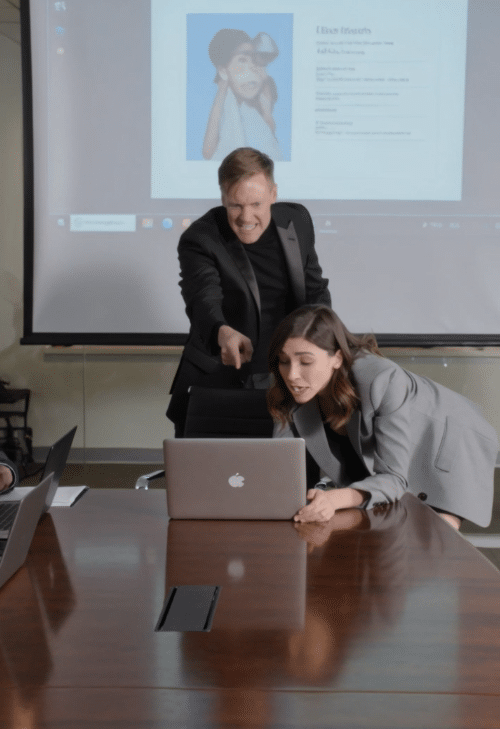
The words echoed across the glass-walled conference room just as twenty-four-year-old Sophie Bennett struggled to catch her breath on the floor.
A laptop lay tilted beside a chair. A few sheets of paper had scattered beneath the long table, and the giant presentation screen still displayed the slide that had triggered everything: a single page with a slightly different font from the rest of the deck.
That was it.
One font.
One tiny inconsistency in a presentation that had taken Sophie three sleepless nights to perfect.
Yet standing over her was Marcus Hale, the thirty-five-year-old founder of one of Silicon Valley’s most celebrated startups, a man whose face appeared on business magazine covers and whose interviews attracted millions of views. He wore a black turtleneck beneath an expensive blazer, his expression twisted with the fury of someone who believed that the smallest imperfection was a personal attack on his authority.
Sophie had tried to fix the mistake.
She had even apologized for the oversight.
But Marcus hadn’t wanted an apology. He wanted an audience.
And he had one.
Six investors sat around the conference table. Two co-founders watched from the far end, while employees stood near the glass walls with laptops pressed against their chests. Every person in the room had come to witness a billion-dollar opportunity take shape.
Instead, they were watching a young woman being punished for a font.
“I can correct the font right now,” Sophie said, her voice trembling despite her attempt to remain professional.
She reached toward her laptop.
Marcus moved first.
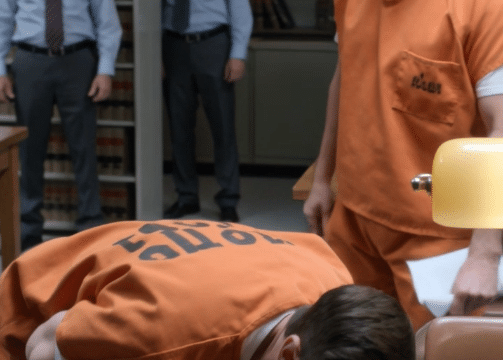
He rose from his chair, stepped in front of the screen, and kicked her forcefully in the chest.
The impact knocked Sophie backward. She fell beside the conference chair, her palm striking the floor as the laptop slid dangerously close to the edge of the table.
A thin trace of blood appeared across her hand.
For one stunned second, the room seemed to lose all sound.
Then someone inhaled sharply.
A woman investor covered her mouth. One of the co-founders pushed his chair back, but stopped before standing. A young employee near the door stared at Marcus with an expression that suggested he was witnessing something he would remember for the rest of his life.
Marcus barely glanced at Sophie.
“Trash,” he repeated. “You don’t belong in this room.”
Sophie tried to sit up.
Her chest hurt, and her hands shook as she reached for the laptop. Even now, her first instinct was to protect the work she had spent days creating.
Marcus interpreted her silence as defiance.
He stepped closer and delivered exactly two more forceful kicks to her back and side. Sophie recoiled, instinctively pulling away while trying to keep the laptop from sliding off the table.
Nobody intervened.
The investors had come to evaluate a company, not challenge its founder. The employees had mortgages, families, and careers tied to a man who had publicly dismissed entire teams for far less than what they were witnessing.
Marcus straightened his blazer.
“Designers apologize below founders.”
He said it slowly, as though he were explaining an unbreakable law of nature.
Sophie looked up at him.
There were tears in her eyes, but she refused to let them fall. She had spent years trying to earn a place in rooms where people like Marcus spoke and people like her listened.
She had believed that competence would eventually make her impossible to dismiss.
Now she understood how little competence mattered to someone who needed other people to feel small.
Marcus turned toward the investors.
“This is what happens when people forget their place. If I allow this kind of carelessness, the entire company becomes mediocre.”
Nobody answered.
Then the glass conference door swung open hard enough to strike the adjoining wall.
Every head turned.
A man in his sixties entered wearing a navy suit, a white shirt, and no tie. He carried no briefcase, made no announcement, and did not appear surprised by the tension in the room.
His name was Richard Whitmore.
He was the lead investor who had financed Marcus’s company when it was little more than an ambitious pitch deck and an unfinished prototype. His firm had supplied the capital that allowed Marcus to hire his first engineers, secure his headquarters, and transform a risky idea into a business valued at hundreds of millions of dollars.
Richard’s gaze moved across the room.
He saw the overturned chair.
The scattered papers.
The blood on Sophie’s palm.
Then he looked at Marcus.
Before the founder could speak, Richard crossed the room and drove one decisive punch into his face.
Marcus stumbled backward, clutching his mouth.
Richard immediately stepped between him and Sophie.
“That font just showed me which founder can’t lead.”
Silence swallowed the room.
Marcus stared at the man who had helped make him rich, his expression changing from outrage to disbelief.
“Can’t lead?” he whispered.
He had spent years believing that money made him untouchable.
He was about to discover that the people who funded his empire had been watching him far more closely than he realized.
And the mistake that threatened to destroy him had nothing to do with typography.
It had to do with a name hidden inside the company’s founding documents.
A name Marcus had spent four years trying to erase.
Act II
To understand why Richard Whitmore’s arrival changed the atmosphere so completely, one had to understand the company Marcus Hale had built.
Four years earlier, Hale Technologies had been a modest startup operating out of a rented office in San Francisco. Marcus had a compelling idea for software that could help businesses automate complex financial decisions, but he lacked the money, the engineering team, and the industry connections needed to turn the idea into a functioning product.
He had confidence, however.
An almost limitless supply of it.
Marcus could enter a room of skeptical executives and leave them believing that refusing to invest in him would be a mistake they would regret for the rest of their lives. He understood how to tell a story about the future, how to make uncertainty sound like inevitability, and how to convince people that his ambition was evidence of his genius.
Richard Whitmore had been one of the first people to recognize the potential in that talent.
He had spent decades investing in young companies, and he knew that a founder needed more than a clever idea. The best founders could attract extraordinary people, admit when they were wrong, and build something that could survive beyond their own personalities.
Marcus had seemed to possess those qualities.
He was persuasive, tireless, and willing to take risks that more cautious executives avoided. Richard invested, then helped introduce Marcus to additional investors who supplied the capital for the company’s rapid expansion.
For a while, the partnership worked.
Hale Technologies hired engineers, opened a larger office, and attracted clients across the country. Its valuation rose with every new announcement, and Marcus became a familiar face at startup conferences.
But success changed the way he treated the people around him.
At first, it was subtle.
He interrupted employees during meetings. He rewrote other people’s presentations and delivered them as if he had created every idea himself. When an engineer challenged a deadline, Marcus accused him of lacking ambition.
Soon, humiliation became part of the company’s culture.
Employees learned that mistakes were not opportunities to improve but opportunities for Marcus to demonstrate his superiority. Meetings became performances in which everyone tried to avoid becoming the next example.
Sophie Bennett had joined the company eleven months earlier.
She was twenty-four, talented, and unusually good at translating complicated ideas into clean, persuasive visual presentations. Her designs helped investors understand products that engineers sometimes struggled to explain in plain English.
She didn’t have a famous surname or an elite business school degree.
Her father repaired commercial air-conditioning systems in Ohio. Her mother worked as a public school administrator. Sophie had paid for much of her education through scholarships and part-time jobs, and she had moved to California with enough savings to cover three months of rent.
She knew what it meant to worry about money.
She also knew that a single professional mistake could have consequences far beyond the office.
When she received the offer from Hale Technologies, she believed she had finally found a place where hard work would matter more than connections.
For the first several months, she was right.
Her designs received praise from the marketing team. A product launch she helped prepare attracted favorable attention from major clients. Even Marcus complimented her work once, telling her that she had an instinct for making complicated things look inevitable.
Sophie remembered the comment because praise from Marcus was rare.
She did not know that his attitude toward her would change after she asked a question about an old presentation.
Several weeks before the investor meeting, Sophie had been assigned to organize the company’s founding archive. The marketing department wanted to prepare a retrospective presentation celebrating the startup’s origins.
While reviewing old files, she found two versions of the original pitch deck.
The first listed Marcus Hale as the sole founder.
The second, dated several months earlier, included another name beneath his.
Ethan Cole.
Sophie recognized the name from a handful of old internal documents. Ethan had supposedly been an early contractor who left before the company launched. His employee profile had disappeared from the modern system, and his contributions were rarely mentioned in company materials.
But the original deck suggested something different.
It described Ethan as the architect of the company’s core technical concept, with Marcus responsible for business development and fundraising.
The distinction was important.
If the original arrangement had included ownership rights or contractual obligations, the discrepancy between the documents could have serious legal consequences.
Sophie did not assume wrongdoing.
She sent a discreet message to the legal operations manager asking whether the old files should be preserved before the marketing team finalized the retrospective.
Within an hour, Marcus summoned her to his office.
He closed the door and asked why she had been digging through historical records.
Sophie explained that she was organizing the archive and wanted to make sure the presentation was accurate.
Marcus listened without interrupting.
Then he told her that old documents were often incomplete, that Ethan had never been a real founder, and that the company had moved on.
He instructed her to use the approved materials.
Sophie obeyed.
But she saved the original files in the company’s designated archive rather than deleting them.
She believed that was the responsible thing to do.
Marcus believed it was a threat.
And by the morning of the investor presentation, he had convinced himself that the young designer was not simply careless.
He believed she knew something that could cost him control of the company.
The wrong font gave him the excuse he needed to make an example of her.
He had no idea that Richard Whitmore had already discovered the same discrepancy.
And Richard had not entered the conference room merely to watch a presentation.
He had come to ask Marcus one question.
Where had Ethan Cole gone?
Act III
Richard did not raise his voice.
He didn’t need to.
After instructing the room to give Sophie space, he asked the company administrator to call the building’s medical team. He then turned toward the investors and requested that nobody leave until the incident had been documented.
Marcus was still holding his face.
“You just assaulted me in front of my board,” he said.
Richard looked at him without flinching.
“And you assaulted an employee in front of your investors.”
“She made a mistake.”
“She made a formatting mistake.”
“She embarrassed the company.”
Richard glanced at the screen.
“Your reaction is what embarrassed the company.”
Marcus opened his mouth, then closed it again.
He had spent years learning how to control conversations. He knew how to redirect questions, attack a critic’s credibility, and make people feel that disagreeing with him was a sign of weakness.
But Richard was not an employee hoping for a promotion.
He was the lead investor, and he had spent the previous month reviewing the company’s governance, financial records, and original intellectual property agreements.
The questions he had found were increasingly difficult to explain.
Richard had initially requested the review because Hale Technologies was preparing for another major funding round. The company had grown quickly, and several institutional investors wanted a clearer account of its early intellectual property and ownership arrangements.
What began as routine due diligence had uncovered inconsistencies.
A technical contribution attributed to Marcus in the current company history had originally been credited to Ethan Cole. An early licensing agreement appeared to have been amended after its initial execution. Several internal records described Ethan as a co-creator, while later presentations referred to him as a temporary contractor.
The differences did not automatically prove fraud.
But they were too significant to dismiss.
Richard had asked Marcus for an explanation.
Marcus provided one.
He claimed Ethan had abandoned the project, surrendered his rights, and accepted a final payment in exchange for leaving the company. The remaining documentation, he insisted, was merely outdated administrative material.
Richard had asked for the signed release.
Marcus promised to deliver it.
Then he postponed the meeting.
Twice.
When Richard’s legal team asked for the original contract, the company supplied a scanned copy missing several pages. A second version contained a signature but lacked the attachment that supposedly defined the transfer of intellectual property.
Richard had begun to suspect that someone was hiding the original agreement.
Then Sophie’s archival inquiry reached the company’s legal operations manager.
The message was brief, professional, and completely unaware of the larger investigation underway. But it confirmed that an early version of the founding deck still existed inside the company’s records.
Richard requested a copy.
What he saw contradicted Marcus’s account.
Now, standing beside the conference table, he looked at the founder.
“Where is Ethan Cole?”
Marcus’s expression hardened.
“I told you. He left.”
“Then you should have no difficulty producing the signed release.”
“My legal team is handling it.”
“Your legal team has been handling it for three weeks.”
Marcus glanced at the other investors.
“This is a private business matter. We can discuss it without an audience.”
Richard shook his head.
“You made it a public matter when you decided to turn an employee’s minor mistake into a demonstration of power.”
The medical team arrived and began checking Sophie. She was conscious, shaken, and clearly in pain. As one of the medics examined her hand, she looked toward the laptop lying beside the chair.
“Please don’t close the presentation,” she said.
Richard turned toward her.
“Why?”
“The original deck is in the archive. I can show you the version I found.”
Marcus went pale.
It was the first visible sign that his anger had been covering something much more dangerous.
“Sophie,” he said sharply, “you are not authorized to discuss confidential company documents.”
Richard stepped closer to the table.
“She is not going to discuss anything until the medical team has finished examining her. But after that, if she has relevant information, I intend to hear it.”
Marcus shook his head.
“You can’t let a junior designer interfere with corporate governance.”
Richard’s answer was immediate.
“Corporate governance is precisely why I intend to hear her.”
Sophie looked down at her hands.
She had not wanted to become part of a fight between executives. She had wanted to do her job, correct the slide, and return to the design revisions waiting on her desk.
Now the founder of her company was staring at her as though she had betrayed him by remembering a document that existed.
She took a breath.
“The original deck wasn’t the only thing I found.”
Marcus went completely still.
Sophie explained that the archive contained an early product demonstration, a set of dated design notes, and a series of emails exchanged before the company officially incorporated.
The materials appeared to show that Ethan had developed the original prototype and created the first technical framework. Marcus had worked on the business model, investor outreach, and commercial strategy.
Both men had contributed.
But the company’s current history presented the work as Marcus’s alone.
Richard listened carefully.
“Did you copy those files?”
“I preserved the originals in the archive. I didn’t alter them or send them outside the company.”
“Can you identify where they are stored?”
“Yes.”
Marcus slammed his hand against the table.
“Enough!”
Several people flinched.
“You’re going to let her destroy everything I’ve built because she found a few old files?”
Richard faced him.
“No. I’m going to find out whether what you built was built honestly.”
Marcus looked around the room for support.
He found none.
The investors were no longer watching him with admiration. They were studying him with the cautious attention usually reserved for a business risk that might be far larger than anyone had anticipated.
Then Richard opened the folder he had brought into the room.
Inside was a copy of the original investment agreement, along with a clause Marcus had apparently hoped nobody would ever need to invoke.
The clause gave the investors the right to suspend certain founder privileges and initiate an independent governance review if credible evidence emerged of material misrepresentation, misconduct, or misuse of company assets.
Richard placed the document on the table.
“Your font problem is the least of your problems,” he said.
Marcus stared at the page.
Because now he understood what Richard had been trying to tell him from the moment he entered the room.
The investor had not come to negotiate another funding round.
He had come prepared to take away Marcus’s control.
Act IV
The meeting did not end with a dramatic resignation.
It ended with paperwork.
That was what frightened Marcus most.
Richard instructed the board’s counsel to begin the formal review process. The company would preserve its original records, suspend any attempt to modify the founding archive, and appoint independent investigators to examine the intellectual property agreements.
The assault would be documented separately.
Marcus protested at every step.
He accused Richard of acting out of personal resentment. He claimed Sophie had manipulated the documents to make him look guilty. He insisted that the company was being punished for an internal personnel dispute.
But the room had changed.
The investors who had once nodded along with his explanations began asking direct questions. Why had the original agreement never been produced? Why did the company’s public history differ from its earliest records? Why had a routine archival inquiry resulted in a confrontation with the founder?
And why had Marcus believed that a designer’s mistake justified physical violence?
He had no answer that satisfied them.
Sophie was taken to receive medical care, and the company arranged for her to be accompanied by a colleague who had finally found the courage to step forward after Richard intervened. Her laptop was secured as evidence, and the original files were preserved for the review.
Before she left, Richard approached her.
“I am sorry this happened in a room where everyone should have been protecting you,” he said.
Sophie looked at him, surprised.
She had expected another corporate apology filled with careful language about workplace standards and organizational values.
Instead, he spoke like a person who understood that a room full of silent witnesses had its own responsibility.
“Why did you come in when you did?” she asked.
Richard took a moment before answering.
“I was already on my way to confront Marcus about the founding records. I had no idea he would do this.”
He glanced toward the conference room.
“But I know what happens when people believe their authority makes them immune to consequences. If nobody challenges that belief, eventually it becomes the culture.”
Sophie nodded slowly.
She was not ready to forgive the company.
She was not even sure she wanted to return.
But for the first time since Marcus had kicked her to the floor, she felt that someone was willing to listen without demanding that she make the situation easier for everyone else.
The following morning, the board announced that Marcus would step aside from certain executive responsibilities while the independent review proceeded. The decision was temporary, but it was a devastating public signal.
For years, Marcus had presented himself as the indispensable center of Hale Technologies. He had persuaded employees that the company could not survive without his vision and convinced investors that his leadership was the primary reason for its success.
Now the board was examining whether that leadership had depended on taking credit for someone else’s work.
The investigation widened.
The original emails showed that Ethan Cole had repeatedly requested a formal agreement defining his contributions to the company. In one message, he warned Marcus that the company’s founding documents did not accurately describe the development of the original product.
Marcus replied that they would resolve the matter after the next funding round.
In another exchange, Ethan expressed concern that the company was presenting his technical work as the exclusive creation of its founder.
The replies became increasingly hostile.
Eventually, Ethan’s access was revoked, and the company announced that he had departed to pursue other opportunities.
But the independent investigators discovered something more troubling.
A document described as Ethan’s signed release had been assembled from separate pages, and the signature required further authentication. The evidence did not immediately establish who had altered the document or whether the changes had been intentional, but it was enough to trigger a deeper examination of the company’s original ownership records.
Marcus insisted that his former co-founder had voluntarily walked away.
Then the investigators located Ethan.
He was living in Portland, working as a software consultant, and had spent years avoiding the startup world. When contacted, he initially refused to participate.
He had already been through one dispute with Marcus, and the experience had left him convinced that the company would always protect the more powerful man.
But when he learned that the original archive had survived, he agreed to provide the documents he had kept.
His records included an early technical specification, dated development logs, and emails discussing the division of responsibilities between the two men.
Together, the materials painted a more complicated picture than either Marcus’s public narrative or his critics had initially suggested.
Marcus had indeed contributed substantially to the business. He had raised money, recruited employees, and persuaded investors to take a chance on an unproven idea.
But Ethan had helped create the technology that made the company valuable.
The question was whether Marcus had deliberately concealed that contribution and whether the company had used documents that failed to reflect the original agreement.
If the allegations were substantiated, the consequences could reach far beyond Marcus’s position as CEO.
They could affect the company’s intellectual property rights, its investor disclosures, and its future valuation.
The man who had humiliated Sophie over a font was now facing questions about the foundation of his entire empire.
Yet the most damaging evidence did not come from Ethan’s files.
It came from a recording of a conversation Marcus had held with a senior executive months earlier.
In the recording, Marcus discussed the need to keep the original founding documents out of the next investor presentation. He described the old ownership dispute as a distraction and insisted that reopening it would create unnecessary complications.
The recording did not, by itself, prove every allegation.
But it contradicted his claim that he had never been concerned about the discrepancies.
When Richard heard it, he made his decision.
The temporary restrictions on Marcus’s authority would remain in place, and the board would begin the process of appointing an interim chief executive.
Marcus had built his identity around being the person nobody could replace.
Now the company was preparing to operate without him.
And the woman he had treated as disposable had become one of the people whose careful work helped uncover the truth.
Act V
Six months later, Sophie returned to the Hale Technologies headquarters.
The glass walls were still there. The conference table had been replaced with a larger one, and the presentation screen displayed a new company strategy rather than another funding pitch.
But the atmosphere had changed.
Employees spoke more openly in meetings. Questions were no longer treated as personal attacks, and the company had introduced independent reporting procedures for workplace misconduct.
The reforms were not perfect.
Some people still distrusted leadership. Others had left during the turmoil and never returned. Rebuilding a workplace culture was slower than replacing an executive or rewriting a policy.
Still, the company was finally confronting problems it had spent years ignoring.
Marcus Hale was no longer CEO.
After the independent review established serious discrepancies in the historical ownership records and documented his conduct toward Sophie, the board removed him from his executive role. The company also referred the disputed documents and related financial matters for further legal review.
The findings did not establish that Marcus had personally committed every act alleged against him. The legal questions surrounding the original agreement remained subject to their own process.
But the board concluded that he could no longer be trusted to lead the company while those matters were being resolved.
Ethan Cole’s contributions were formally acknowledged, and the company negotiated a settlement with him after reviewing the original technical records and ownership arrangements.
For the first time, the company’s public history reflected the fact that its success had not come from one man’s ambition alone.
It had been built by people whose names had disappeared from the story.
Sophie received a written apology for the assault and a commitment that she would not face retaliation for participating in the investigation. She had also been offered the opportunity to return to her original role under the new management structure.
She accepted, but not because she believed the company had suddenly become perfect.
She returned because she wanted her work to be judged by its quality, not by the whims of someone who believed a job title made him superior to everyone around him.
On her first day back, she entered a conference room and opened her laptop.
A new presentation was waiting.
She examined the title slide, then the second page, then the third.
The fonts matched.
She smiled faintly.
Not because she feared making another mistake, but because she finally understood that a mistake should never have been a reason for someone to treat her as less than human.
Richard visited the office later that afternoon.
He had become the chair of the board’s oversight committee, helping guide the company through its restructuring while the remaining legal questions were addressed.
He found Sophie reviewing the final slides.
“Everything consistent?” he asked.
She looked up.
“Almost. One heading is a little too small.”
Richard glanced at the screen.
“Then make it bigger.”
She laughed.
It was a small, ordinary exchange. But to Sophie, it represented something she had almost stopped believing in: a workplace where a problem could simply be a problem.
Before leaving, Richard asked whether she had heard from Ethan.
She had.
He had sent her a brief message thanking her for preserving the archive rather than dismissing the old files as irrelevant. He had explained that for years he had believed his work would be remembered only by the handful of people who had been present at the beginning.
Now, at least, the record was being corrected.
Sophie kept the message.
She had not set out to expose a founder or change the direction of a company. She had simply noticed a discrepancy, asked a reasonable question, and refused to destroy records that did not fit the approved story.
The rest had followed because someone finally decided that the truth deserved to be heard.
Marcus, meanwhile, had been forced to confront a reality he had spent years avoiding.
He had believed leadership meant control. He had confused fear with respect and silence with loyalty. He had treated every challenge as an insult because admitting that someone else might be right threatened the image he had built of himself.
His downfall did not begin with Richard’s punch.
It began when he decided that a young designer’s dignity mattered less than his own embarrassment.
The punch had merely made the power shift impossible to ignore.
And that was why his final question in the conference room continued to haunt the people who witnessed it.
“Can’t lead?”
He had asked it as though leadership were something he could lose only through a technicality, a boardroom maneuver, or a hostile investor.
But the truth was simpler.
He had lost the room long before Richard walked through the door.
He had lost it when he kicked an employee for making a tiny mistake. He had lost it when six investors watched him and realized that the man pitching a future of innovation could not control his own cruelty. He had lost it when his employees understood that the culture he had built depended on everyone being too frightened to speak.
And he had lost it when the woman he called trash became the person who helped reveal what he had hidden.
In the end, the font was never the problem.
It was merely the smallest imperfection in a company that had spent years pretending its founder was flawless.
And when that illusion finally broke, everyone in the room discovered who had really been holding the company together.