Act I
“Trash. Pick it up like a dog.”
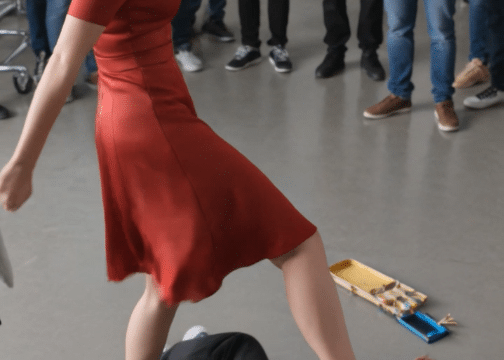
The insult rang across the country club’s pristine tennis court, drawing every eye toward the net. A white tennis ball rested on the green surface near the service line, while nineteen-year-old Emily Carter stood several feet away in her green polo, white tennis skirt, and worn sneakers.
She had been late by seconds.
Not minutes. Not even long enough for the players to lose their rhythm. She had been collecting another ball near the corner of the court when the young man in white demanded a replacement, and now he was staring at her as though she’d committed an unforgivable offense.
His name was Blake Harrington.
At twenty-two, Blake had never needed to wonder whether people would forgive him. His father was a major club member, his family name appeared on donor plaques inside the glass clubhouse, and his friends had spent years laughing at his jokes before deciding whether they were funny.
Blake dropped another tennis ball at Emily’s feet.
“Pick it up.”
Emily glanced at the ball, then at the other attendants waiting near the fence. She could feel the spectators watching. Some wore sunglasses. Others held drinks beneath the shade of the clubhouse terrace.
“I’m sorry,” she said. “I was getting the other ball.”
Blake’s smile disappeared.
Emily bent to retrieve the ball, but she refused to crawl or lower herself any further than the job required. She was an employee, not an animal, and she had no intention of pretending otherwise just because someone rich had ordered her to.
Blake stepped toward the net.
Then he kicked her hard in the chest.
Emily crashed onto the court beside the white boundary line. The breath vanished from her lungs, and the tennis ball rolled away as her hands struck the green surface. Her knee scraped against the court, leaving a thin trace of blood.
For a moment, she could do nothing but gasp.
The club members fell silent.
A woman near the fence covered her mouth. One of Blake’s friends took a startled step backward, his laughter dying before it could become a sound.
Emily tried to sit up.
Blake moved closer.
“I’m sorry,” she managed again, her voice shaking. “I didn’t mean to—”
He kicked her twice more, once in the back and once in the side.
Emily winced and pulled her hand away from the court, struggling to protect herself without making the pain worse. Her eyes filled with tears, but she refused to beg him.
Blake stood over her, adjusting his expensive bracelet as though the interruption had inconvenienced him more than the assault had.
“Ball girls stay under rich families.”
His friends stared. The club members stared. Even the court manager, visible behind the clubhouse glass, appeared frozen.
Nobody came forward.
Emily looked around at the faces surrounding the court and understood something she had never wanted to learn: people could watch cruelty happen in broad daylight and still convince themselves that doing nothing was the safest choice.
Then the clubhouse doors burst open.
A tall man in a navy blazer and white trousers strode outside, his expression so controlled that it was more frightening than anger. The court manager hurried behind him, struggling to keep pace.
It was Arthur Whitmore, the sixty-two-year-old owner of the country club.
He saw Emily on the ground.
He saw Blake standing over her.
And he saw the tennis ball resting just beyond the white line.
Arthur crossed the court with startling speed. He moved between Blake and the injured attendant, shielding Emily from the young man’s view.
Blake opened his mouth.
Arthur struck him once with a forceful punch to the face.
Blake stumbled backward, clutching his cheek. A thin trace of blood appeared at the corner of his mouth as the entire court recoiled.
Arthur didn’t strike him again.
He turned toward Emily first, making sure Blake could no longer reach her.
Then he looked at the young man who had just assaulted an employee in front of dozens of witnesses.
“That ball just bounced your family off this club.”
Blake stared at him.
His confidence had vanished so completely that he looked like someone who had just discovered the ground beneath him was not solid.
“My family?”
For the first time in his life, Blake Harrington was afraid of what his last name might cost him.
And he had no idea that his father had already given Arthur Whitmore a reason to make that decision.
Act II
Emily Carter had taken the summer job because her family needed the money.
Her mother, Denise, worked as a nursing assistant at a rehabilitation center outside Stamford. Her father had been a high school baseball coach until a back injury forced him to leave the job he loved. Their bills had not waited for him to recover, and Emily had learned to work whenever an opportunity appeared.
She was saving for college.
Her dream was to study physical therapy, inspired by the years she had watched her father struggle through rehabilitation. She wanted to help people recover the strength and independence that injuries could steal from them.
The country club paid better than most seasonal jobs in the area, and the hours were flexible enough for her to take a summer course. The work wasn’t glamorous. She collected balls, carried equipment, kept the courts clear, and answered impatient players who sometimes spoke to her as though she were part of the furniture.
Still, she liked the game.
She admired the discipline of tennis, the patience it demanded, and the way a player had to recover from one bad point before the next one began.
What she disliked was the assumption that everyone on the court deserved respect except the people keeping it ready.
Blake Harrington embodied that assumption.
His father, Richard Harrington, had been a member of the club for nearly twenty years. He had donated money to the junior tennis program, sponsored tournaments, and helped fund a renovation of the clubhouse lounge.
His name appeared on a brass plaque near the entrance.
Blake had grown up believing the plaque was more than a record of generosity. To him, it was proof that the rules applied differently to his family.
If he arrived late, staff members adjusted the schedule. If he damaged equipment, someone else arranged the replacement. If he insulted an employee, his father usually dismissed it as youthful arrogance.
“He’s under pressure,” Richard would say. “He’s learning how to handle himself.”
But Blake had reached twenty-two without learning the one lesson that mattered.
Other people were not responsible for absorbing his frustration.
His friends encouraged him because standing beside Blake offered advantages. They were invited to private events, introduced to influential members, and allowed to use facilities unavailable to ordinary guests.
Laughing at his cruelty was the price of admission.
And Blake knew it.
The ball attendants were his favorite targets. He liked giving contradictory instructions, then blaming them for following the wrong one. He made them wait while he finished conversations, then complained that they were slow. If someone objected, he reminded them that his family had been coming to the club longer than they had been alive.
Emily had witnessed this behavior during her first month.
She had also seen the staff react to it.
Some employees laughed nervously. Others found reasons to leave the area. One older attendant told Emily that the safest approach was to keep her eyes down and never let Blake think she was challenging him.
Emily tried to follow that advice.
She was polite. She was quick. She learned the court assignments and memorized the players’ preferences. When she made a mistake, she corrected it without arguing.
But she would not humiliate herself to make Blake feel powerful.
That was what he hated most about her.
She wasn’t rude. She wasn’t rebellious. She simply refused to behave as though her dignity belonged to him.
The country club’s owner, Arthur Whitmore, had noticed a different problem.
For months, he had received reports that seasonal employees were leaving before their contracts ended. Their reasons varied, but the underlying complaints were remarkably similar: wealthy members’ children were allowed to mistreat staff, supervisors failed to intervene, and employees who complained were quietly assigned fewer hours.
Arthur had built the club over four decades, transforming a struggling local property into one of the region’s most prestigious private sporting venues. He had always believed that luxury meant more than manicured lawns and expensive memberships.
It meant trust.
Members trusted the club to protect their families’ privacy. Guests trusted it to provide a safe environment. Employees trusted that the people in charge would not abandon them when a powerful member became difficult.
Those promises had begun to crack.
Arthur ordered a confidential review of staff complaints and court incident reports. He also requested a meeting with the club’s general manager to discuss a proposed restructuring of membership privileges.
That morning, he arrived earlier than expected.
He had been inside the clubhouse when he heard raised voices through the open terrace doors. Then came the sharp, unmistakable sound of someone hitting the court.
He stepped outside in time to see Blake standing over Emily.
The decision that followed would change more than one young man’s life.
Because Arthur had not only been investigating misconduct.
He had been reviewing the Harrington family’s place in the club itself.
Act III
Blake had expected Arthur Whitmore to reprimand him.
Perhaps the owner would complain about the disruption, tell him to cool down, and privately apologize to Richard Harrington for the scene. That was how these things usually worked.
Instead, Arthur remained between Blake and Emily while the court manager rushed to call for medical assistance.
“Don’t move her,” Arthur instructed the manager. “Get the medical team here and have someone contact emergency services.”
Emily was conscious but visibly shaken. She tried to push herself upright, then stopped when pain tightened across her chest and side.
Arthur crouched nearby without touching her.
“Can you hear me?”
She nodded.
“Help is coming. You don’t need to stand.”
Emily looked at him as though she were still trying to understand why he was speaking to her instead of the young man who had attacked her.
Behind Arthur, Blake recovered enough to find his voice.
“You just punched me!”
Arthur turned slowly.
“You kicked an employee on the ground.”
“She disrespected me!”
“She was late by a few seconds.”
“She works here!”
The words escaped Blake before he could think better of them.
For a moment, Arthur said nothing.
Then his expression hardened.
“Yes,” he replied. “She works here. That is why she deserves to be safe here.”
Blake glanced toward his friends, expecting them to support him. They stood in a loose group beside the net, suddenly fascinated by the court surface.
“You don’t understand,” Blake insisted. “My father has been a member here for twenty years. He helped pay for half the improvements on this property.”
Arthur’s eyes narrowed.
“And you believe that makes this your court?”
“I believe it means you should know who you’re dealing with.”
“I do.”
Arthur looked toward the court manager.
“Secure the footage from every camera covering this court and the surrounding walkways. Record the names of everyone who witnessed the incident. No one leaves until they’ve provided a statement.”
The manager nodded and hurried away.
Blake’s expression shifted from anger to disbelief.
“You can’t do that.”
“I own the club.”
“My father is one of your biggest members.”
“And that,” Arthur said, “does not give you ownership of another human being.”
The medical team arrived and began examining Emily. Arthur stepped aside to give them room, but he stayed close enough to ensure that nobody approached her without permission.
Blake watched him, his face growing red.
“You’re making a huge mistake.”
Arthur looked at him.
“No. The mistake was allowing you to believe that money made you untouchable.”
The court fell silent again.
Blake tried to laugh, but the sound came out thin and uncertain.
“You’re going to throw me out because of a ball girl?”
Arthur didn’t answer immediately.
He looked past Blake toward the clubhouse, where the Harrington family name appeared on a plaque beside the entrance to the members’ lounge.
Then he looked back at the young man.
“I’m going to make a decision based on what you did, what the evidence shows, and what this club is willing to tolerate.”
Blake swallowed.
For the first time, he understood that the punch was not the most dangerous thing that had happened to him that morning.
Arthur was taking the incident seriously.
And the owner had the authority to do far more than remove Blake from a single court.
As Emily was carefully helped onto a stretcher, Arthur asked whether she wanted someone contacted. She gave him her mother’s number, and he ensured the call was made.
He did not ask whether she had provoked Blake.
He did not suggest that she should have obeyed his humiliating demand.
He did not tell her that wealthy members were difficult to manage.
He simply made sure she received care.
Then he turned to the witnesses.
“Anyone who saw what happened should tell the truth. Your membership, your friendships, and your position here will not change what the cameras recorded.”
Several people lowered their eyes.
One of Blake’s friends looked as though he might be sick.
Arthur continued.
“This club has rules. They apply to employees, guests, members, and members’ families. Especially when someone believes those rules don’t apply to them.”
Blake stared at him, the blood at the corner of his mouth beginning to dry.
“My family?”
He repeated the words as if saying them again might restore the protection he had always taken for granted.
Arthur’s answer was waiting inside the clubhouse.
And Richard Harrington was about to learn that his son’s behavior was not the only thing under review.
Act IV
Richard Harrington arrived at the club less than an hour later.
He came through the clubhouse entrance in a navy golf shirt and tailored trousers, carrying his phone and wearing the expression of a man who expected the inconvenience to be explained away before lunch.
He had already received three calls.
The first was from Blake, who insisted that Arthur had attacked him without cause. The second was from a friend who had witnessed the confrontation. The third came from the club’s general manager, who told him only that a serious incident had occurred and that Arthur wanted to speak with him.
Richard expected an apology.
Instead, he found his son sitting in a private office with an ice pack against his face, while Arthur stood near the window and the general manager arranged a folder of documents on the table.
“What happened?” Richard demanded.
Blake rose halfway from his chair.
“Dad, he punched me and said he’s throwing our family out.”
Richard turned toward Arthur.
“Is that true?”
“I struck your son once after he assaulted a nineteen-year-old employee,” Arthur replied. “That was wrong of me, and I will address my own conduct through the appropriate process. But it does not erase what he did.”
Richard stared at him.
“You hit my son?”
“Yes.”
“And you expect me to sit here and accept that?”
“No. I expect you to look at the evidence.”
Arthur placed a tablet on the table.
The video showed the court from two angles. It captured Emily arriving with the ball, Blake dropping it at her feet, and the young woman bending to pick it up. It showed Blake kicking her in the chest and then delivering two further kicks while she lay on the ground.
There was no confusion about what had happened.
Richard watched without speaking.
When the footage ended, he looked at his son.
“Tell me there’s more to this.”
Blake’s jaw tightened.
“She was disrespectful.”
“She was getting another ball,” Richard said.
“She made me wait.”
“For how long?”
Blake didn’t answer.
Richard turned back toward the tablet.
The footage had lasted less than a minute.
It had also destroyed every excuse he had prepared.
Arthur opened the folder.
“I’ve been reviewing staff complaints for several weeks. Your son’s incident is not the reason the review began, but it has made the problems impossible to ignore.”
Richard’s expression changed.
“What complaints?”
“Reports of intimidation, harassment, and repeated mistreatment of employees by members and their guests. Several involve your son.”
Richard looked at Blake again.
“You told me these were misunderstandings.”
“They were.”
“Were they?”
Blake looked away.
Arthur explained that the club’s board had been reviewing membership conduct and the privileges associated with certain accounts. Richard’s family had received informal warnings before, but those warnings had been treated as isolated problems rather than evidence of a pattern.
The new review had changed that.
The board had already approved a formal process for suspending members whose conduct threatened the safety or dignity of staff and guests. Richard had been informed that the policy would apply equally to every family, regardless of donations or length of membership.
Now the club had video evidence of a serious assault, multiple witnesses, and earlier complaints that required investigation.
Richard leaned back in his chair.
“You’re talking about suspending my membership?”
“I’m talking about the consequences of what happened,” Arthur replied. “Your son’s access to the club is suspended immediately, pending the conduct review. The board will decide whether your family’s membership can continue under the club’s rules.”
Richard’s face darkened.
“My family has supported this place for twenty years.”
“And the club has provided your family with privileges for twenty years. Neither fact grants anyone permission to assault an employee.”
Richard looked at his son.
Blake seemed smaller now, stripped of the friends who had laughed at his insults and the spectators who had watched him act without consequence.
“Dad, you can’t let him do this.”
Richard closed his eyes briefly.
He had spent years smoothing over Blake’s behavior. Every time a teacher complained, every time a staff member described an ugly incident, Richard found a reason to believe his son had been misunderstood.
He told himself that protecting Blake was a father’s responsibility.
But watching the video, he had finally seen what that protection had become.
It had taught his son that other people could be hurt without consequence.
Richard turned toward Arthur.
“I want a copy of the footage and the full review.”
“You’ll receive the materials through the formal process.”
“And Blake?”
“He will not return to the club while the suspension is in effect. The board will determine the final outcome after reviewing the evidence and hearing from the witnesses.”
Richard looked at his son again.
For once, he did not promise to make everything disappear.
Outside the office, the club manager was collecting written statements. Several witnesses who had been silent on the court were now describing what they had seen. Blake’s friends had begun admitting that his behavior toward the attendants was not new.
One of them acknowledged that they had laughed because they were afraid of becoming his next target.
That statement became part of the investigation, too.
Within days, the board voted to terminate the Harrington family’s membership after reviewing the footage, the witness accounts, and the documented pattern of misconduct. The decision followed the club’s formal process and was communicated in writing.
Richard was given the opportunity to respond.
He did.
But no amount of money could turn the video into something else.
Blake had not been expelled because he was rich.
He had lost his privileges because he had treated a person as though she had no right to stand up.
And the family name he had used to intimidate others could no longer protect him from the consequences.
Act V
Emily returned to the club several weeks later.
Her injuries had required rest and medical attention, and the first days after the assault were harder than she had expected. Even after the pain began to fade, the memory of Blake standing above her remained sharp.
She had replayed the scene in her mind more times than she wanted to admit.
The ball rolling away.
The crowd stepping backward.
The strange, awful silence before Arthur arrived.
For a while, she wondered whether she should simply find another job. She could finish the summer somewhere else, avoid the court, and never again have to walk past the place where she had been attacked.
But the club’s management contacted her before she made a decision.
They apologized for failing to create an environment where seasonal staff felt safe reporting mistreatment. They offered to cover the appropriate medical expenses, reviewed the incident with the staff, and made changes to how complaints involving members would be handled.
More importantly, they asked Emily what she needed in order to feel comfortable returning.
Nobody told her to move on.
Nobody asked her to protect the club’s reputation.
She was given a choice.
Emily decided to return.
Not because she had forgotten what happened, and not because she wanted to prove that she was fearless. She returned because the job still mattered to her, and she refused to let Blake decide where she was allowed to stand.
On her first morning back, Arthur met her near the courts.
He wore the same navy blazer and white trousers he had worn on the day of the assault. But this time, he approached slowly, giving her room to decide whether she wanted to speak.
“How are you feeling?” he asked.
“Better,” Emily replied. “Still a little nervous.”
“That makes sense.”
She looked toward the court where it had happened.
“Will things actually change?”
Arthur did not offer her a grand promise.
“They should have changed before you were hurt,” he said. “All I can do now is make sure we take responsibility and keep proving that the rules mean something.”
Emily considered that answer.
It was the first one she had heard that didn’t ask her to trust blindly.
She nodded.
Over the following months, the club introduced clearer conduct procedures for members and guests, improved staff reporting channels, and required managers to document complaints rather than dismiss them informally. Employees were told explicitly that they could report misconduct without losing shifts or facing retaliation.
The changes were not dramatic in the way the assault had been dramatic.
They were quieter.
A supervisor intervened when a member began berating a young attendant. A complaint was recorded instead of brushed aside. A seasonal worker who reported inappropriate behavior was thanked rather than warned to be more careful.
Each action was small.
Together, they began to change the culture.
Emily continued working through the summer, saving money for college. She spent her breaks studying anatomy and reviewing the requirements for her physical therapy program. The court remained a place of hard work, but it no longer felt as though one wealthy guest could decide whether she deserved respect.
One afternoon, a new attendant struggled to collect a ball that had rolled close to the fence. A player called impatiently for another, and the young worker flinched.
Emily recognized the expression.
She walked over and helped retrieve the ball.
“Take your time,” she said. “The court isn’t going anywhere.”
The younger attendant smiled with visible relief.
Across the property, the Harrington family name was removed from the membership roster. Richard, facing the consequences of his own failure to confront his son’s behavior earlier, was left to decide what kind of father he wanted to be when money and influence could no longer make the problem disappear.
Blake, meanwhile, had lost the private courts, the easy access, and the audience that had made his arrogance feel like power. He could no longer summon employees and expect them to obey simply because his father knew the owner.
The club did not publish a triumphant announcement about his downfall.
It didn’t need to.
The people who had witnessed the assault remembered it. So did the employees who had once been told to keep their heads down. And so did Emily, who had learned that standing up for herself did not always mean winning the argument in the moment.
Sometimes it meant refusing to accept the role someone else had chosen for you.
Near the end of the summer, Emily collected a stray tennis ball from the edge of the court and rolled it gently in her palm. Its yellow felt was worn from use, its surface marked by the rough green court.
It was an ordinary ball.
A few ounces of rubber and felt.
Yet one afternoon, it had become the thing that exposed an ugly truth about wealth, entitlement, and the people who mistook silence for permission.
Blake had dropped it at Emily’s feet because he believed she belonged beneath him.
Arthur had looked at that same ball and seen the moment the club had to choose what it stood for.
And in the end, the most important thing that bounced off the court that day was not the tennis ball.
It was the Harrington family’s belief that their name could protect them from anything.
For years, Blake had thought rich families stood above everyone else.
Now he had learned the truth.
Money might open the clubhouse doors. It could never give him the right to make another human being crawl.
Make Arthur’s punch legally believableTighten the repeated moral statements