Act I
“Trash. You’ll pay for that bottle.”
The words cut through the rooftop bar just as the last notes of a jazz song faded into the night. Beneath the glittering Los Angeles skyline, surrounded by crystal glasses, designer suits, and people who had spent more on a single dinner than most families spent in a month, a wealthy man stood over a shattered bottle of rare whiskey and demanded that a bartender kneel.
The bartender, a thirty-year-old man named Daniel Hayes, stared at the broken glass scattered across the polished floor. His black shirt and vest were immaculate, his brown hair neatly combed, and his hands still carried the practiced calm of someone who had spent years serving demanding customers without letting them see how much their behavior could hurt.
But this time, the situation was different.
The man responsible for the mess was Richard Vance, a forty-five-year-old property investor who had spent the evening telling anyone who would listen that half the neighborhood would eventually belong to him. His black blazer fit perfectly, a gold watch flashed beneath his cuff, and the whiskey in his glass had made an already inflated ego almost impossible to contain.
He had been leaning against the glass counter, gesturing grandly while explaining a redevelopment project to two guests. Then his elbow struck the rare whiskey bottle beside him.
The bottle toppled.
It hit the counter’s edge, bounced once, and shattered on the floor.
For a fraction of a second, Richard looked down at the mess with genuine surprise. Then his expression changed. He turned toward Daniel as if the bartender had reached out and deliberately destroyed something precious.
“What the hell is wrong with you?” Richard demanded.
Daniel glanced at the counter, then at the bottle’s broken neck. He had been standing several feet away, polishing a glass when the accident happened. The security camera above the bar had an unobstructed view of the entire counter.
“Sir, you knocked it over with your elbow,” Daniel said carefully. “I’m going to secure the area and check the inventory.”
Richard’s face darkened.
“Do you know what that bottle costs?”
“Yes, sir.”
“Then you know you can’t afford it.”
A few guests stopped talking. One woman lowered her cocktail. A man near the rooftop windows looked over his shoulder, then quickly pretended he hadn’t been watching.
Richard noticed the attention and seemed to draw strength from it. He had spent years learning that people often mistook confidence for authority, and that a loud enough accusation could make an innocent person look guilty.
“You’re going to pay for it,” he announced. “Every cent.”
Daniel swallowed his frustration. “The camera will show what happened.”
It was a reasonable answer. A calm answer. The sort of answer a sensible person would have accepted.
Richard heard it as a challenge.
“Trash,” he spat. “You’ll pay for that bottle.”
Daniel pointed toward the camera mounted above the counter, not aggressively, but simply to indicate that there was no need for an argument. Richard followed the gesture, looked up at the small black lens, and seemed to take its existence as a personal insult.
Then he came around the bar.
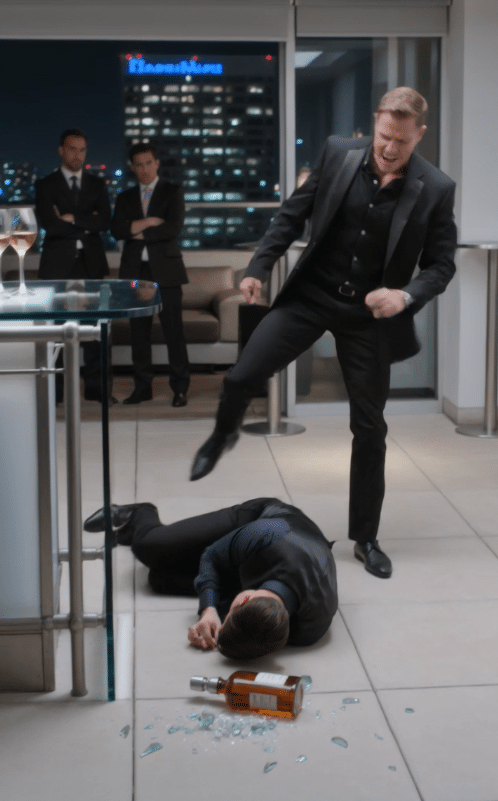
Daniel had barely enough time to step back before Richard struck him with a hard kick to the chest. Daniel stumbled backward and fell behind the counter, his shoulder hitting the floor as glass rattled somewhere beside him.
The room erupted in startled gasps.
For a moment, Daniel couldn’t catch his breath. The lights above him blurred, and the pain spreading through his chest made it difficult to understand what had just happened.
Richard leaned over the edge of the bar.
Instead of stopping, he kicked Daniel twice more, striking his back and side as the bartender tried to pull himself away. A thin trace of blood appeared along Daniel’s forearm where he had scraped it against the floor.
The second kick echoed through the suddenly silent rooftop.
Richard straightened his jacket.
“Pour drinks from the floor,” he ordered.
Nobody laughed. Nobody moved.
Daniel lay behind the counter, one hand pressed against his side, struggling to breathe normally. Above him, the camera continued recording.
And from behind the glass door leading to the VIP security area, someone had just heard the alarm.
Richard believed the entire rooftop belonged to men like him. He had no idea who was about to walk through that door.
Act II
For years, Daniel Hayes had believed that professionalism meant absorbing the things other people couldn’t be bothered to control.
He had learned it early, working in restaurants where customers snapped their fingers instead of saying his name, where a spilled drink could cost a server a week’s tips, and where managers sometimes apologized to the person who had caused the trouble because that person had arrived in an expensive car.
Daniel had once dreamed of opening a bar of his own. He had studied spirits, learned the history of whiskey production, and spent his days off visiting distilleries whenever he could afford the trip. He knew the difference between a bottle that was merely expensive and one that represented decades of craftsmanship.
But life had taken him in a different direction.
His father became ill, medical bills accumulated, and Daniel set aside his plans to help his family. He took extra shifts, worked private events, and became the kind of bartender managers trusted with their most demanding guests.
He rarely complained.
He had come to understand that the people who treated service workers badly were often testing a simple question: How much can I get away with if nobody important is watching?
Richard Vance had built his social life around that question.
He wasn’t a celebrity, and he wasn’t a household name. But in certain circles across Los Angeles, he had become a familiar presence: a property investor who sponsored charity dinners, attended private openings, and talked about neighborhoods as though they were chessboards waiting for him to move the pieces.
He was good at making ordinary business sound like destiny.
At dinner parties, he described himself as a visionary. In meetings, he reminded people how many jobs his developments could create. At bars, he told strangers that he had the ear of influential people.
And when someone disagreed with him, he made sure they understood the cost of doing so.
That evening, Richard had arrived at the rooftop bar with two potential investors and a promise of exclusivity. He had told them that the venue was one of his favorite places in the city, a place where he knew the owner personally and where his requests never went unanswered.
It was an exaggeration.
He had visited several times, but he had never met the owner. The staff recognized his name because he tipped generously when people flattered him and complained loudly when they didn’t.
Still, Richard had convinced himself that familiarity was the same thing as influence.
The rare whiskey bottle had been placed on the counter earlier that evening as part of a private tasting display. It was insured, carefully documented, and scheduled to be shown to a group of collectors later that month.
Richard had asked about it twice. When the bartender explained that the bottle wasn’t available for casual service, Richard had laughed and said money should make things easier, not harder.
Now the bottle was broken, and the man who had knocked it over had decided that someone else would pay.
Daniel tried to sit up behind the counter.
His breathing came in short, uncomfortable bursts. He looked toward the guests, hoping someone might call for help, but their faces seemed frozen between fear and disbelief.
They were not all cruel people. Some looked horrified. One guest had already taken out her phone, though she seemed uncertain whether to call emergency services or record what was happening.
But nobody had stepped forward.
Richard stood above the fallen bartender, adjusting his gold watch as if the incident had been an inconvenience in an otherwise pleasant evening.
“You should be thanking me,” he said. “I could have you fired before midnight.”
Daniel looked up at him.
He wanted to answer. He wanted to tell Richard that no job was worth this, that no bottle could justify being kicked on the floor, that there was a difference between being wealthy and being entitled to another person’s dignity.
Instead, he reached toward the edge of the counter and tried to steady himself.
Richard interpreted the silence as surrender.
“That’s what I thought.”
Then the VIP security door swung open.
The sound was sharp enough to turn every head in the room.
A small internal alarm chirped as a man in a navy suit and long dark coat stepped through, followed by two security officers. He was fifty-seven, silver beginning to show at his temples, with a face that had grown accustomed to being listened to without raising its voice.
His name was Alexander Reed.
He owned the rooftop bar, the private lounge behind it, and the hospitality group that operated several of the city’s most exclusive venues. Unlike Richard, Alexander rarely discussed what he owned. The people who needed to know already knew.
His eyes moved from the shattered bottle to Daniel on the floor.
Then he looked at Richard.
The expression on his face changed.
Not into outrage. Not yet.
It became something colder.
Richard had spent the evening trying to prove he was the most powerful man in the room. Now the one man whose opinion actually mattered was looking directly at him.
Act III
Alexander crossed the distance in seconds.
One of the security officers moved toward Daniel, but Alexander reached the bar first. He positioned himself between the injured bartender and Richard, making it unmistakably clear that Richard would have to go through him to get any closer.
“Don’t move,” Alexander said.
Richard blinked, momentarily thrown by the interruption.
“Excuse me?”
“You heard me.”
For the first time that evening, Richard seemed unsure how to respond. He was accustomed to people becoming smaller when he raised his voice. Alexander did not become smaller.
Richard gestured toward the floor.
“This employee destroyed an extremely expensive bottle. I was trying to make him understand the consequences.”
Alexander glanced at the broken glass.
Then he looked at Daniel, who was now being helped into a seated position by a member of the staff. The bartender’s face was pale, and he was breathing cautiously, but he was conscious.
“What happened?” Alexander asked him.
Daniel tried to answer, but the pain made him pause.
“He knocked the bottle over,” he said. “I told him the camera would show it. Then he came around the bar.”
Alexander’s gaze shifted toward the security camera.
“Good,” he said quietly. “It will.”
Richard let out an incredulous laugh.
“You’re taking his word over mine?”
“No,” Alexander replied. “I’m going to look at the evidence.”
That should have ended the argument.
Instead, Richard stepped closer, his face flushed with alcohol and indignation.
“Listen, I invest in this neighborhood. I bring people here. I know people who can make your life difficult. If you think you can embarrass me in front of everyone over a bottle, you’re making a serious mistake.”
Alexander stared at him.
Behind Richard, the guests had begun to understand that this was not a disagreement between a customer and a manager. The owner had arrived, the security team was present, and the man who had been issuing orders moments earlier was suddenly trying to negotiate his way out of consequences.
Then Richard made the mistake that would follow him long after the night ended.
He pointed toward Daniel.
“Look at him. He’s a bartender. Replace him. I’ll cover the bottle, and we’ll pretend this never happened.”
Daniel heard every word.
Even through the pain, he felt something sink inside him. Not because Richard had insulted his job, but because Richard seemed genuinely unable to understand why money could not settle what he had done.
Alexander took one measured step forward.
“You think this is about a bottle?”
“It’s about business,” Richard snapped. “Everything is business.”
“No,” Alexander said. “That’s what people tell themselves when they’ve forgotten that other people are human beings.”
Richard scoffed.
He glanced toward the guests, looking for the familiar signs of support. But the faces that had once smiled at his stories were now watching him with wary disbelief. A woman near the windows held her phone at chest height. Another guest had moved away from the counter, making space for the security team.
Richard noticed the phones.
His confidence wavered, but he tried to hide it behind another sneer.
“Put those away,” he ordered the guests. “This is a private matter.”
No one obeyed.
Alexander turned briefly toward Daniel.
“Stay where you are. Medical help is being called.”
Then he faced Richard again.
“You assaulted a member of my staff. You damaged property, threatened an employee, and tried to force him to accept blame for something the cameras can verify.”
Richard’s mouth tightened.
“I barely touched him.”
The lie landed in the room like another broken glass.
Alexander’s eyes moved toward the security camera once more.
“Then the recording should be very helpful to you.”
One of the security officers had already begun securing the area and contacting the appropriate personnel. Another was checking that the recording had been preserved. No one needed to argue about what had happened. The evidence was already there.
Richard, however, was still convinced that this could be fixed by identifying the right person to intimidate.
He lowered his voice.
“Do you know who I am?”
Alexander’s expression did not change.
“Yes,” he said. “And I know exactly what you’re doing.”
For the first time, Richard looked genuinely unsettled.
Then he made a sudden movement toward Alexander, raising a hand as if to shove past him and reach the bar again.
Alexander reacted with one forceful punch to Richard’s face.
Richard stumbled backward into the counter, clutching his mouth. A small trace of blood appeared at the corner of his lip, and his gold watch struck the glass with a sharp clink.
Gasps rose around the rooftop.
Alexander immediately turned back toward Daniel, putting himself between the bartender and Richard once more. His attention returned to the injured man rather than lingering on the confrontation.
For a moment, nobody spoke.
Then Alexander looked at Richard and delivered the sentence that would become the defining moment of the night.
“That bottle was insured. Your reputation isn’t.”
Richard stared at him, one hand covering his mouth.
“What?”
Alexander did not raise his voice.
“You heard me.”
The owner turned toward his security team and told them to keep the area clear, preserve the footage, and cooperate with the responding authorities. Daniel was the priority now. The bar’s medical kit was brought out, and staff were instructed to keep him still until medical professionals could assess his injuries.
Richard stood beside the counter, looking from one face to another.
He had expected to be forgiven.
He had expected an apology, perhaps even a discount on his next visit.
Instead, the room was beginning to move on without him.
But the most devastating consequence had not yet reached him. It was waiting in the footage, the phones, and the business relationships he had spent years building on a carefully polished image.
Act IV
By the time emergency medical personnel arrived, the rooftop bar had changed completely.
The music had been turned off. Guests were being guided away from the affected area, and the shattered whiskey bottle had been photographed before staff began securing the scene. The atmosphere that had seemed glamorous an hour earlier now felt stark and exposed.
Daniel was taken for medical evaluation. He was frightened, sore, and embarrassed by how difficult it had become to stand, but he was no longer alone. A staff member stayed beside him while Alexander made sure the incident was being documented properly.
For years, Daniel had been the person expected to make difficult nights easier for everyone else.
Now, for once, someone else was taking responsibility for him.
Alexander did not promise that everything would be fine. He did not offer a dramatic speech about loyalty or pretend that a few words could undo the assault. He simply made sure Daniel received help, that witnesses were identified, and that the security footage was preserved.
That quiet, practical response meant more than Daniel could have explained.
Across the room, Richard was beginning to understand that his usual tactics were failing.
He had tried charm first, then intimidation, then denial. Each had worked for him often enough that he had mistaken them for a kind of law. But nobody was rushing to protect his image now.
One of the investors who had arrived with him stepped away and began making a phone call.
The other refused to meet Richard’s eyes.
“Don’t do this,” Richard muttered when he noticed. “You know how business works.”
The investor ended the call.
“I know how risk works,” he replied.
It was the first honest answer Richard had heard all night.
His property venture depended on trust. He needed lenders to believe his numbers, partners to believe his promises, and investors to believe he could manage people without creating unnecessary liabilities. His reputation was not merely a vanity project. It was part of the machinery that kept his deals alive.
And now several people had watched him assault a worker over a bottle he had knocked down himself.
Worse, they had watched him try to buy his way out of it.
The footage would establish what happened at the bar. The guests’ recordings captured parts of the confrontation from different angles. Their accounts, combined with the security video, would make it difficult to recast the incident as a harmless misunderstanding.
Richard finally turned toward Alexander.
“You’re going to regret this,” he said, though the threat sounded weaker than he intended.
Alexander regarded him without anger.
“I’m not making decisions about your reputation,” he said. “You did that yourself.”
Richard’s eyes narrowed.
“You can’t ban me from everywhere.”
“No,” Alexander answered. “But you won’t be coming back here.”
He instructed his team to revoke Richard’s access to the venue and its associated private events, subject to the property’s procedures and any necessary review. The incident would be referred to the relevant authorities, and any future business arrangements would be assessed on the facts rather than on Richard’s demands.
It was not a grand public execution of his career.
It was something more believable, and perhaps more damaging: a series of ordinary decisions by people who no longer wanted to take a risk on him.
One investor asked to postpone their meeting.
The other sent a brief message to his business partners saying the evening had ended unexpectedly and that he would not be proceeding with the proposed arrangement until the situation was reviewed.
A guest who had spent the night listening to Richard brag about his influence quietly told Alexander that she had recorded the confrontation. She offered to provide the video if it was needed.
Richard watched her do it.
His hand remained over his mouth.
The anger in his eyes was slowly being replaced by calculation. He was trying to determine how much had been seen, who had recorded it, and whether he could persuade anyone to delete the evidence.
But the camera above the bar had already recorded the entire sequence.
There was no version of the evening in which Daniel had knocked over the bottle. No version in which Richard had merely lost his temper verbally. No version in which the bartender’s calm warning justified what followed.
And there was no version in which Richard could make the room forget.
When a member of the responding team asked him to remain available while the incident was addressed, Richard looked toward the VIP door as if he expected it to open again and reveal someone powerful enough to rescue him.
No one came.
The owner who had struck him was now focused on the employee he had injured. The guests who had once seemed eager to impress him were watching from a distance. His own business associates were already thinking about what the incident might mean for them.
For the first time, Richard could not make himself the center of the room simply by demanding it.
Then he saw the woman near the windows lower her phone and look directly at him.
Her expression was not angry.
It was disappointed.
Somehow, that was worse.
Richard had spent years making people fear the consequences of crossing him. Now he was about to discover what happened when people stopped fearing him at all.
Act V
Daniel returned to work several days later, moving more cautiously than before.
The medical evaluation had given him answers about his injuries and a plan for recovery. He still felt discomfort when he reached too far or turned too quickly, and the memory of falling behind the bar remained sharper than he wanted to admit.
He had also begun to notice how differently people reacted when he entered a room.
Some coworkers asked if he was all right. Others apologized for freezing when Richard attacked him. One young server admitted that she had been afraid to move because she thought Richard might turn on anyone who intervened.
Daniel did not blame her.
He knew what fear looked like. He had seen it on the faces of guests who had watched him fall, and he had felt it himself when Richard came around the counter.
What bothered him most was how quickly he had tried to apologize in his own mind.
He had wondered whether he should have said less, whether he should have avoided pointing out the camera, whether keeping his head down might have prevented the assault.
Alexander understood that feeling better than Daniel expected.
A week after the incident, the owner invited him into a quiet office overlooking the city. There was no elaborate ceremony, no photographer, and no speech about how one dramatic moment had changed everything.
Alexander simply asked Daniel how he was recovering.
Then he asked whether he still wanted to pursue his interest in spirits and hospitality management.
Daniel hesitated.
“I always thought I’d open a place of my own someday,” he admitted. “But that feels a long way off.”
“Maybe,” Alexander said. “Or maybe the next step is closer than you think.”
He explained that the company had been reviewing its training program for staff who wanted to move into beverage management. Daniel’s knowledge, consistency, and professionalism had already made him a strong candidate. The incident had not created his abilities; it had merely made the people around him pay attention.
Alexander offered him a place in the program, with paid training and the opportunity to help develop future whiskey tastings at the venue.
Daniel looked down at his hands.
For years, he had been so focused on getting through each shift that he had stopped thinking about what might come after them. The offer did not erase what Richard had done, but it reminded Daniel that the worst moment of his life did not have to define the rest of it.
“Why are you doing this?” he asked.
Alexander leaned back in his chair.
“Because you were doing your job before someone decided that made you less human than him. And because you deserve a future that isn’t limited by the way he treated you.”
Daniel had no immediate answer.
He simply nodded, fighting to keep his voice steady.
Meanwhile, Richard’s life did not collapse in a single cinematic instant. There was no magical announcement that every business in Los Angeles had turned against him. Real consequences rarely arrive that neatly.
They arrived in emails, postponed meetings, unanswered calls, and cautious conversations.
The investors who had witnessed the incident stepped back from the deal. Other partners asked for clarification after hearing about the confrontation. Richard’s representatives attempted to frame the episode as a private dispute that had been blown out of proportion, but the available footage contradicted his account.
The story spread through the circles where he had once enjoyed easy access. People who had laughed at his boasts began asking what had really happened. Invitations became less frequent. His name, once a shortcut to a conversation, became a reason to ask additional questions.
He was no longer the man who could enter a room and assume everyone wanted something from him.
He was the man people wanted to understand before trusting.
The bar formally ended his privileges at the venue, and the incident proceeded through the appropriate channels. Alexander’s own decision to strike Richard also came under scrutiny, because owning a business did not place anyone above the law. The recordings, witness accounts, and medical documentation became important evidence, and the matter was left to the proper process rather than settled by either man’s influence.
That distinction mattered.
Alexander had protected Daniel, but the punch did not make him a judge. His responsibility was to ensure safety, preserve the evidence, and support his employee—not to decide the legal outcome himself.
When Daniel learned that the incident was being handled through those channels, he felt a strange relief.
For once, the truth did not depend on who could shout the loudest.
Several weeks later, Daniel stood behind the same glass counter during a private whiskey tasting. The rare bottle that had shattered that night had been replaced through the venue’s insurance arrangements, and a new display stood in its place.
The overhead security camera remained where it had always been.
Daniel noticed it, then looked away.
He was no longer watching it because he feared another accusation. He was simply aware that the truth had been recorded when it mattered.
A guest approached the counter and asked him about the whiskey’s history. Daniel began explaining the distillery, the aging process, and the reason collectors valued the bottle. His voice grew steadier as he spoke, and soon the guest was listening with the kind of attention that had once been reserved for Richard’s business stories.
For a moment, Daniel remembered the command that had echoed through the bar.
Pour drinks from the floor.
He remembered the pain, the humiliation, and the terrible silence of people who had been afraid to help. He also remembered the sound of the VIP door opening, and Alexander’s voice cutting through the room.
That bottle was insured. Your reputation isn’t.
The sentence had become a story people repeated, but Daniel understood something that the slogan alone could never capture.
A reputation was not a luxury watch or a tailored jacket. It was not a list of powerful acquaintances or a collection of expensive reservations. It was the sum of what people discovered about you when you believed there would be no consequences.
Richard had believed money could make other people carry the weight of his mistakes.
Daniel had been forced to carry the consequences of someone else’s cruelty.
Yet in the end, the man who had fallen behind the bar was the one given a chance to rise, while the man who had stood above him was left facing the truth he had tried to crush.
And somewhere in the city, beneath the bright lights of another expensive room, Richard Vance would have to confront a question that no investor, lawyer, or gold watch could answer for him.
Not how much he was worth.
Not how many people he knew.
But who he had become when he thought nobody could stop him.