Act I
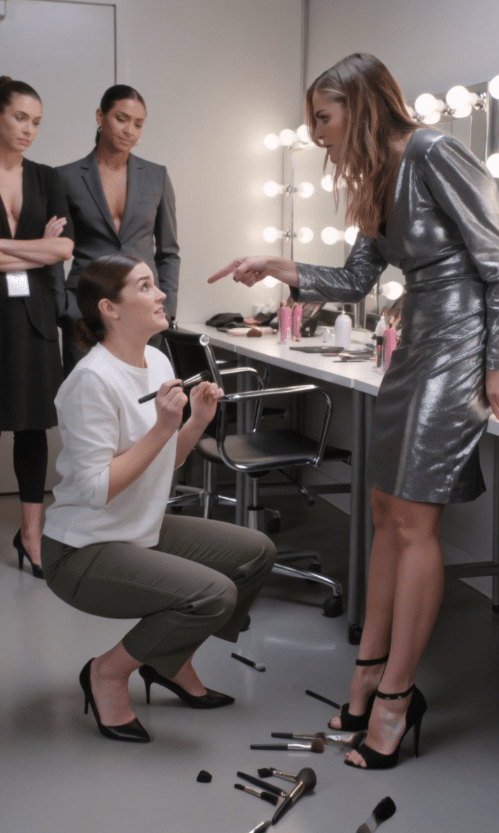
“Trash. Kneel before you touch my face again.”
The command rang through the backstage makeup room just minutes before the most anticipated fashion show of New York Fashion Week. Under rows of bright mirror bulbs, models sat in silk robes, stylists hurried between makeup stations, and assistants rushed garments toward the runway. Yet every movement seemed to stop when Victoria Sterling, the show’s most celebrated model, turned her cold gaze on the woman holding an eyeliner brush.
At thirty-four, Victoria was accustomed to being treated like the most important person in any room. Her silver silk dress shimmered beneath the lights, her heels clicked sharply against the floor, and her name appeared on billboards from Manhattan to Los Angeles.
She had built a career on her striking face, a carefully cultivated public image, and the ability to make powerful people believe that working with her was a privilege.
The makeup artist standing before her was named Claire Bennett. At twenty-eight, Claire had spent nearly a decade learning the craft of transforming faces without erasing the people beneath them. Her brown hair was tied into a low bun, her black outfit was practical and spotless, and her makeup tool belt held brushes arranged with the precision of a surgeon’s instruments.
Claire had been working since dawn.
She had already prepared several of the show’s leading models, repaired a broken compact, and helped a young assistant recover after a wardrobe emergency. She was tired, but she remained focused. The show’s creative team trusted her because she was careful, dependable, and calm under pressure.
Then Victoria suddenly turned her head while Claire was applying eyeliner.
The brush slipped just enough to leave a tiny smudge near the outer corner of Victoria’s eye.
Claire immediately pulled back.
“I can fix it in ten seconds,” she said. “Please keep your head still for just a moment.”
Victoria stared at herself in the mirror.
The mark was barely noticeable. A few strokes would have corrected it completely.
But Victoria was not looking at the mark anymore.
She was looking at Claire’s reflection.
“Did you just tell me what to do?”
“No. I’m sorry. You turned unexpectedly, and I can correct it right away.”
Victoria rose from the makeup chair.
“I have a runway appearance in minutes. Do you understand what that means?”
“Yes, of course.”
“Then get on your knees and apologize before you touch my face again.”
Claire froze.
Around them, several stylists exchanged nervous glances. One model slowly lowered the magazine she had been reading. A junior assistant reached for a makeup sponge, then stopped when Victoria’s eyes swept across the room.
Claire swallowed.
“I’m happy to fix the eyeliner, but I won’t kneel to apologize for an accident.”
The silence that followed felt almost physical.
Victoria’s expression hardened. In her world, people were allowed to make mistakes only when they were important enough to be forgiven. A makeup artist was supposed to absorb blame, smile, and make the problem disappear.
Claire’s refusal felt like rebellion.
“Do you know how many artists would kill for the chance to work on me?” Victoria demanded.
“I’m just trying to help you.”
“Trash.”
The word came out quietly, which somehow made it worse.
Before Claire could step away, Victoria drove a hard kick into her chest. Claire stumbled backward and fell beside the makeup chair, sending brushes scattering across the floor.
One of her palms scraped against the hard surface, leaving a thin red trace. The eyeliner brush rolled beneath a table, and a small bottle rattled against the edge of a makeup case.
A model gasped.
Claire tried to sit up, stunned by the sudden pain. She had barely managed to move when Victoria stepped over the scattered brushes and delivered exactly two more kicks, one to Claire’s back and another to her side.
Claire curled inward, trying to protect herself without reaching blindly into the tools scattered around her.
Nobody intervened.
The stylists retreated against the makeup wall. A young assistant covered her mouth, her eyes wide. Several models looked toward the runway doorway, silently hoping someone with authority would appear.
Victoria adjusted the silver fabric of her dress.
“Brush girls apologize from the ground,” she said.
Claire looked up at her, struggling to breathe comfortably.
For a moment, she saw her own reflection in the mirror above the station: a woman in black on the floor, surrounded by expensive products, while the person who had hurt her stood beneath the brightest lights.
Then the runway door burst open.
Stage light spilled into the makeup room, and the rhythmic instructions coming through the production headsets suddenly stopped.
The woman entering from the corridor was not another model, stylist, or assistant.
She was the creative director responsible for the entire show.
And she had just heard enough to make a decision that would change the course of Victoria Sterling’s career.
Act II
Claire Bennett had never been interested in becoming famous.
She had grown up in a modest home outside Philadelphia, where her mother worked as a hairdresser and her father repaired commercial air-conditioning systems. Money was sometimes tight, but their home was full of small rituals: Sunday breakfasts, birthday cakes made from scratch, and conversations around the kitchen table that lasted long after the dishes had been cleared.
Claire’s mother had taught her to notice what made people feel confident.
A haircut could help someone walk into a job interview with their head held high. A little makeup could make a nervous teenager feel beautiful for the first time. A careful touch could help someone recognize themselves in the mirror after months of grief or illness.
Claire had grown to love that transformation.
She trained at a respected makeup academy, worked wedding jobs on weekends, and spent evenings practicing techniques on friends who were willing to sit still while she experimented. Her first professional kit had been assembled one purchase at a time, funded by savings from part-time jobs and the occasional gift from her mother.
It was not glamorous.
But it was hers.
By the time she was twenty-five, Claire had begun securing backstage work at regional fashion events. She learned how to create a look in minutes, how to adapt when a model’s skin reacted badly to a product, and how to remain steady when an entire production seemed to be falling apart.
The work was physically exhausting. The hours were unpredictable, and the pressure could be brutal. Yet Claire loved the moment before a model stepped onto the runway, when the makeup, clothing, lighting, and confidence finally came together.
She believed the best artists knew how to make someone feel powerful without making anyone else feel small.
That belief would be tested by Victoria Sterling.
Victoria’s rise had been fast and spectacular. Discovered in her late teens, she became the face of several luxury campaigns before she turned twenty-five. Photographers admired her ability to hold a pose, designers praised her striking presence, and magazines described her as a woman who could command a room without speaking.
Success brought money, attention, and access.
It also surrounded Victoria with people who had learned to agree with her before she finished speaking.
When she complained about a hotel, someone found another. When she disliked a photographer’s direction, the team changed the schedule. When she arrived late, assistants were told to adjust. Every inconvenience became a problem for someone else to solve.
At first, the behavior seemed like ordinary celebrity impatience.
Over time, it became something more corrosive.
Victoria began to believe that the rules applied differently to her. Her image was her business, she told herself, and anyone whose work touched that image was responsible for protecting it at any cost.
She could be charming when cameras were present. She remembered names when doing so helped her career and praised young designers when the right people were listening.
Behind closed doors, however, she often treated staff as if they were interchangeable tools.
A stylist who disagreed with her lost future bookings. An assistant who failed to answer a late-night message was accused of being unprofessional. A junior photographer was publicly humiliated after asking her to repeat a pose.
Most people stayed silent.
They feared losing work, damaging their reputations, or being labeled difficult by the people who controlled access to the industry.
Claire had heard rumors about Victoria before the show.
She had also heard stories about the creative director, Evelyn Shaw, who had a reputation for demanding excellence but refusing to tolerate cruelty.
At forty-nine, Evelyn had spent more than twenty years building fashion productions that attracted international designers, major sponsors, and influential editors. She had begun as an assistant stylist, carrying garment bags through crowded studios, and had worked her way into leadership by understanding both the artistry and the machinery behind a show.
She knew how much labor went into every image that appeared effortless.
She knew the seamstress who repaired a gown minutes before a walk. The assistant who found a missing accessory. The makeup artist who stayed late to correct a look because a model had developed an unexpected reaction.
Evelyn had never believed that fame made someone indispensable.
Her productions had rules. Staff were expected to behave professionally, but no one was permitted to use their position to intimidate or humiliate others. When complaints were raised, she expected management to investigate them rather than dismiss them as the price of working with stars.
Victoria had been warned before.
A previous stylist had requested not to be assigned to her after a series of hostile incidents. A hairdresser had complained about being shouted at in front of the team. The production office had documented the concerns, but Victoria’s agency insisted that she was under enormous pressure and that the problems were being exaggerated.
Evelyn had agreed to one final opportunity.
Victoria was the headline model for the show, and several sponsors had built their promotional plans around her appearance. Removing her would create logistical difficulties and invite questions from the press.
But Evelyn had made one thing clear to her team: if another serious incident occurred, the show would not sacrifice its staff to preserve a celebrity’s image.
Victoria had dismissed that warning as a formality.
She believed the show needed her more than she needed it.
She believed Claire would apologize, kneel if necessary, and repair the eyeliner while everyone watched.
And she believed nobody in that room would risk confronting her.
She had mistaken silence for loyalty.
The runway door opened, and the person who had the authority to decide who walked that night stepped into the light.
Act III
Evelyn Shaw entered the makeup room with her production headset still on, a sharp white suit cutting a clean line through the crowded space.
She had been in the runway corridor reviewing the opening sequence when she heard the commotion through her headset. At first, she thought a model had fainted or a wardrobe issue had delayed the lineup.
Then she heard Victoria’s voice.
She heard the word trash.
And she heard the impacts.
By the time Evelyn reached the doorway, Claire was on the floor beside the makeup chair, and Victoria stood above her as if the interruption were an inconvenience.
Evelyn’s expression changed.
“Step away from her.”
Victoria turned, irritation flashing across her face.
“Evelyn, thank God. This artist has completely lost control of the situation.”
Evelyn did not look at her.
She moved toward Claire first, stepping between the injured makeup artist and the scattered tools.
“Claire, can you hear me?”
Claire nodded, her face pale.
“Don’t try to stand yet,” Evelyn said. “Someone call medical assistance. Now.”
The room finally began to move.
A production assistant hurried toward the corridor. Another knelt at a safe distance from Claire and asked whether she could breathe comfortably. Someone gathered the makeup brushes from the floor, careful not to crowd her.
Evelyn rose and faced Victoria.
“What happened?”
Victoria gave a disbelieving laugh.
“She smudged my eyeliner and then refused to apologize. I have a runway appearance in minutes, and I cannot be expected to tolerate this kind of incompetence.”
Evelyn looked at the mirror.
The smudge was almost invisible.
“You kicked her?”
Victoria folded her arms.
“She was being disrespectful.”
“That was not my question.”
Several people stared at the floor. Others watched Victoria, waiting to see which version of her would appear: the charming professional who spoke to the press, or the furious woman who expected everyone else to absorb her anger.
Victoria chose the second.
“She needed to understand that my face is not a practice canvas.”
“And you thought kicking her was an appropriate response?”
“I did what I had to do.”
Evelyn stood completely still.
The answer was more revealing than any denial could have been. Victoria was not confused about what she had done. She was not even particularly ashamed. She believed the offense Claire had committed justified the punishment.
Evelyn stepped closer.
“You had a minor makeup issue. She offered to correct it. You demanded that she kneel, and when she refused, you assaulted her.”
Victoria’s jaw tightened.
“Be careful, Evelyn. The show has sponsors. My agency has contracts. There are people who will not be happy if you turn this into a scandal.”
For years, Victoria had used the threat of consequences to control people. She understood the power of a sponsor’s phone call, a canceled booking, or a headline that made a brand nervous.
She expected Evelyn to understand those pressures and back down.
Instead, Evelyn looked at her as though the last remaining doubt had just disappeared.
“You are worried about a scandal,” she said. “I am worried about the person you hurt.”
Victoria rolled her eyes.
“Oh, please. She’s a makeup artist. You can replace her.”
The words seemed to travel farther than Victoria intended.
Claire, still sitting on the floor, closed her eyes briefly. A few assistants exchanged glances, and one of the models turned away in disgust.
Evelyn’s hand moved.
She delivered one sharp slap across Victoria’s face.
The sound cracked through the room.
Victoria staggered half a step and lifted her hand to her cheek, her expression blank with shock. Her mascara had smudged slightly at the corner of one eye, and a faint mark appeared near her mouth.
For the first time that afternoon, she looked less like an untouchable star and more like a person who had never imagined that anyone would dare challenge her.
Evelyn immediately turned back toward Claire, positioning herself between the injured woman and Victoria.
“Stay away from her,” she said.
Then she faced Victoria again.
“That brush just decided who walks tonight.”
Victoria stared at her.
“Who walks?”
The question escaped before she could stop it.
Evelyn’s voice remained cold.
“The runway is a privilege. It is not a license to abuse the people who make the show possible.”
Victoria glanced toward the doorway. Beyond it, stage lights illuminated the runway, where photographers, buyers, editors, and guests were waiting for the first model to appear.
Her name was printed on the show’s opening schedule.
Her image had been used in promotional materials. Her agency had told her that this appearance would help secure a major international campaign.
She had assumed all of it guaranteed her place.
Now she was looking at the only person who could change the lineup.
But Evelyn’s decision was not going to be made because of a slap, an argument, or a bruised ego.
It would be made because Victoria had revealed something no campaign could conceal.
Act IV
Evelyn did not announce Victoria’s removal immediately.
She first made sure Claire was receiving care and that the production team had documented what happened. The event’s medical staff examined Claire and recommended further evaluation because of the force of the assault and the pain she was experiencing.
Evelyn instructed the production manager to preserve any available backstage footage, collect witness statements, and contact the appropriate authorities.
Then she asked Victoria to step into the adjoining office.
Victoria followed, still holding her cheek.
“This is absurd,” she said as the door closed. “You cannot seriously be considering canceling my appearance over a misunderstanding.”
Evelyn remained standing.
“What part was the misunderstanding?”
Victoria hesitated.
“The eyeliner. She made a mistake.”
“And you kicked her.”
“She provoked me.”
“How?”
Victoria looked away.
Evelyn waited.
“She refused to apologize.”
“She offered to fix it.”
“She challenged me in front of everyone.”
Evelyn’s expression did not change.
“So you believe an employee who refuses to kneel deserves to be kicked?”
Victoria exhaled sharply.
“I believe people should understand their responsibilities. I am the face of this show. Everyone knows how much depends on my appearance.”
Evelyn walked to the desk and picked up the printed running order.
“You are one of the faces of this show. You are not the show itself.”
Victoria laughed bitterly.
“You think you can replace me five minutes before the runway?”
“I can change a lineup.”
“You’ll have photographers asking questions. Sponsors will want explanations. My agency will call every person they know.”
“Then we will explain that a model assaulted a member of the production team, and we responded appropriately.”
Victoria stared at her.
“You would really do that to me?”
Evelyn set the running order down.
“You did this to yourself.”
For the first time, Victoria’s confidence faltered. She tried to soften her voice, shifting from anger to persuasion.
“Evelyn, listen. I’ve had a difficult day. I’m exhausted. There has been pressure from the campaign team, from my agency, from everyone. I lost my temper. It was wrong, but you don’t need to destroy my career over it.”
“Your career is not the decision I am making,” Evelyn said. “I am deciding whether you can remain part of this production safely and professionally.”
Victoria’s eyes narrowed.
“That is the same thing.”
“No. It is not.”
Evelyn opened the office door and called in the production manager.
She instructed him to remove Victoria from the evening’s lineup, notify her agency that her participation had been suspended pending review, and begin arranging a replacement. The decision would be documented, and any further professional consequences would follow the show’s contractual procedures.
Victoria went pale.
“You can’t be serious.”
“I am.”
“You have no idea what this will cost.”
Evelyn looked directly at her.
“I know exactly what it costs to let someone believe they can hurt another person without consequences.”
The production manager left to carry out the instructions.
Victoria remained motionless, her hand still against her cheek. She had spent years preparing for this kind of moment by cultivating relationships with people who could protect her from embarrassment. She had never prepared for a situation in which the person with the final decision simply refused to be intimidated.
Then she reached for the last weapon she understood.
“My sponsors will pull out.”
“Any sponsor who objects to an employee being protected can speak with our legal and production teams,” Evelyn replied.
“My agency will sue.”
“They can contact our counsel.”
“You’re choosing a makeup artist over the star of your show.”
“I am choosing the safety of my team over the demands of someone who assaulted a member of it.”
Victoria’s mouth tightened.
Outside the office, the backstage room was moving again. The production manager was reorganizing the lineup, and stylists were checking the looks of the remaining models. The show would be delayed briefly, but it would continue.
That realization frightened Victoria more than the removal itself.
She had imagined the runway waiting helplessly without her. She had pictured the organizers panicking, the sponsors calling, and Evelyn eventually returning to beg her to appear.
Instead, the production was adapting.
A model named Sofia Reyes, who had been scheduled for a later segment, was being considered for the opening walk. She had the right measurements for the first look and had rehearsed the choreography earlier that week.
The team would need to make adjustments, but the show would survive.
Victoria had not understood how much of her perceived power depended on everyone around her pretending she was irreplaceable.
As the production manager passed the office carrying a revised running order, Victoria caught sight of the page.
Her name had been crossed out.
She looked at the empty space beside it, then toward the runway door.
“Who walks?” she whispered.
No one answered her.
Because the answer no longer belonged to her.
Act V
The fashion show began several minutes later than scheduled.
The delay was explained as a backstage adjustment, and the audience settled as the lights dimmed. Music rose through the venue, photographers lifted their cameras, and the first model stepped onto the runway.
It was Sofia Reyes.
She wore the opening look with a quiet confidence that made the audience lean forward. Her walk was controlled, her expression composed, and the garment moved exactly as the designer had intended.
The show continued.
There were no dramatic announcements about Victoria’s removal, no public argument, and no attempt to turn Claire’s suffering into entertainment. The production team focused on getting the models safely through the lineup while the incident was handled privately and formally.
Backstage, Claire had been taken for medical evaluation. Evelyn checked on her before returning to the runway corridor, promising that no one would pressure her to minimize what had happened.
Claire listened quietly.
“I don’t want people saying I ruined the show,” she finally said.
Evelyn shook her head.
“You did not ruin anything. You were doing your job.”
“But I was the one who made the mistake.”
“You made a tiny makeup mistake. That is why we have makeup artists, extra time, and people who know how to correct things. What happened afterward was a choice Victoria made.”
Claire looked down at her hands.
The scrape on her palm had been cleaned and bandaged. Her chest still hurt, and the memory of the kicks came back in fragments: the floor rushing toward her, the scattered brushes, the faces turned away.
“I kept waiting for someone to help,” she admitted.
Evelyn’s expression softened.
“I know.”
“I thought if I stayed calm, she would stop.”
“You should never have had to find the perfect words to make someone stop hurting you.”
Claire looked up.
It was the first time anyone had said something that made the experience feel less like a personal failure. She had spent the hours since the assault wondering whether she should have left sooner, raised her voice, or called for help before the first kick.
Evelyn reminded her that responsibility belonged to the person who chose to attack her, not to the person who had tried to avoid a confrontation.
Over the following days, the production company completed its review. Witness accounts and available footage were preserved, and the incident was referred to the appropriate authorities. Victoria’s agency was notified of the suspension, and her participation in future productions would be reconsidered according to the relevant agreements and findings.
The consequences were not decided by a single dramatic speech.
They unfolded through formal meetings, contract reviews, and conversations that Victoria could no longer control.
Several brands paused planned appearances while they assessed the situation. Her agency requested a meeting, and its representatives asked questions about the incident that could not be answered with a polished statement about stress or misunderstanding.
Victoria had built her public identity around discipline, elegance, and control.
The evidence showed a very different side.
Her career did not disappear overnight, but the assumption that she could demand any treatment she wanted became much harder to maintain. Some collaborators declined to work with her. Others required clear behavioral expectations before considering future projects.
The people who had once excused her temper began to reconsider the incidents they had dismissed.
A former stylist came forward with a written account of an earlier confrontation. An assistant described being threatened after questioning an unreasonable request. Another worker explained that she had remained silent for fear of losing future bookings.
None of those accounts erased the need for a fair review. But together, they raised a question that Victoria could no longer avoid: had the incident backstage been an isolated failure, or had it exposed a pattern that the industry had been reluctant to confront?
Victoria’s representatives urged her to apologize.
At first, she resisted.
She drafted a statement about the pressures of fashion week, the exhaustion of the schedule, and the importance of treating everyone with kindness. It sounded polished enough to pass through a publicist’s office, but it avoided naming what she had done.
Her team sent it back.
The problem, they explained, was not the wording. It was the refusal to accept responsibility.
For the first time, Victoria had to consider that the usual tools of reputation management could not undo the experience of the people she had hurt.
Meanwhile, Claire began rebuilding her confidence.
She took time away from work and returned gradually, first helping with smaller projects before accepting another major backstage assignment. Evelyn made sure the production team had clear procedures for reporting abuse, and Claire contributed suggestions based on what she had experienced.
She asked for a designated staff contact during shows, clearer escalation rules, and an explicit policy that no artist would be expected to continue working with someone who threatened their safety.
The changes were practical, not glamorous.
But they gave employees a way to seek help before a situation became dangerous.
Several months later, Claire was invited to lead the makeup team for a smaller runway presentation. She arrived early, laid out her brushes, and checked each station under the bright mirror bulbs.
A young assistant approached her, nervous about a model who had been complaining about her look.
“I don’t know what to do if she starts yelling,” the assistant admitted.
Claire remembered standing beside Victoria’s chair, holding the eyeliner brush while the room seemed to close around her.
“You don’t have to handle it alone,” she said. “Tell me what’s happening, and we’ll deal with it together.”
The assistant’s shoulders relaxed.
It was a small moment, but Claire understood its importance. Fear thrived when people believed they had no options. Support began when someone made it clear that they did not have to face a difficult person by themselves.
Before the show, Evelyn visited the makeup room.
She looked at the rows of brushes, the carefully arranged palettes, and the artists moving from station to station. Then she stopped beside Claire.
“How are you feeling about tonight?”
Claire considered the question honestly.
“Nervous. Excited. A little of everything.”
“That sounds about right.”
Claire smiled.
“I’m ready.”
And she was.
When the runway lights came up, she watched the first model walk out with a sense of pride that had nothing to do with fame. Every look represented hours of quiet work by people the audience would never see. Every confident step depended on a team that had done its job behind the scenes.
Claire had always understood that.
Now she understood something else.
A person’s importance was not measured by how many people obeyed them. It was measured, in part, by what they did when they believed they had the power to make someone else afraid.
Victoria had walked into the makeup room believing her celebrity made her untouchable. She had treated a tiny smudge as an offense that justified humiliation, and a makeup artist’s refusal to kneel as a challenge that had to be crushed.
But the eyeliner had never been the real issue.
The real issue was the belief that another person’s dignity could be demanded as payment for a service.
Evelyn’s decision did not solve every problem in the fashion industry, and one removed model could not guarantee that every worker would be treated fairly. But it made one boundary unmistakable: no show, no contract, and no celebrity was more important than the people whose work made it possible.
On that night in New York, Victoria had asked Claire to kneel before touching her face again.
Instead, the runway moved forward without her.
And the woman she had tried to humiliate walked away with something far more valuable than a place in the spotlight: the knowledge that her talent mattered, her boundaries mattered, and she never had to earn the right to be treated like a human being.