Act I
“That was assigned to me.”
The seventy-year-old man barely finished speaking before the woman in the white trench coat snatched the final food bag from his hands.
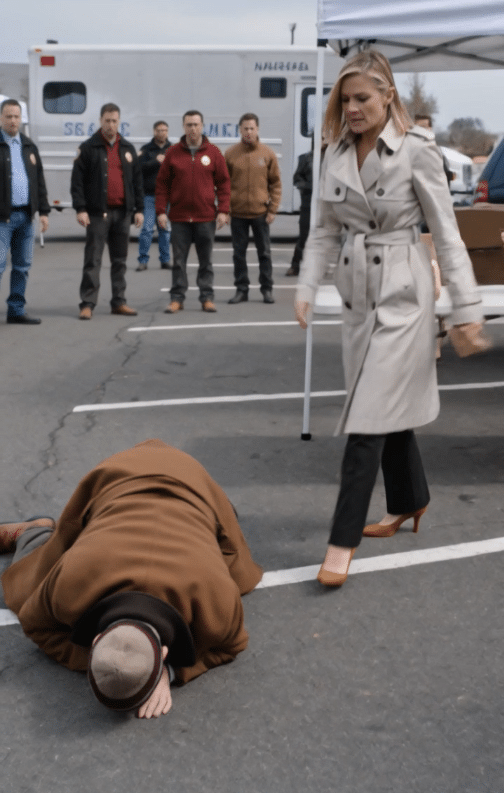
Behind her, an expensive black SUV sat beside the relief trucks, its rear compartment already packed with supplies. Her leather handbag hung from one arm, and her polished boots remained spotless despite the mud scattered across the school parking lot.
The old man stood beside the folding table in a faded brown coat and a knit cap. He held his aid voucher tightly, as if the small piece of paper were the only thing keeping his world from slipping any further away.
The woman glanced at him with open disgust.
“Trash. You don’t even work anymore.”
“My voucher says I’m next,” he replied quietly.
She looked at the paper, then at his worn clothes.
“And I said I need this.”
The volunteer behind the table hesitated. The food bag contained canned goods, bread, bottled water, and a few basic necessities. It was the last one scheduled for distribution before the next relief truck arrived, and the old man had waited nearly two hours for it.
“Ma’am, he was assigned that bag,” the volunteer said. “We have to follow the vouchers.”
The woman turned toward him.
“Do you know who I am?”
The volunteer swallowed.
“I’m just trying to make sure everyone gets what they’re entitled to.”
“Then do your job and stop wasting my time.”
Her name was Vanessa Caldwell, a forty-nine-year-old businesswoman whose company owned commercial properties throughout the county. She was accustomed to people recognizing her, stepping aside for her, and finding ways to accommodate her demands.
She had arrived at the tornado relief site with a vehicle full of supplies for her employees. She had already collected more than her household needed, but she wanted extra provisions in case her staff could not return to work immediately.
Vanessa considered that sensible preparation.
She considered the old man’s food bag a resource she was entitled to take.
“I’ve been standing here since morning,” the man said. “My storage shed was destroyed. Most of what I kept in there is gone.”
Vanessa’s expression did not soften.
“Then you should have planned better.”
He stared at her.
The tornado had torn through his neighborhood three days earlier. It had ripped roofs from houses, thrown branches through windows, and scattered belongings across yards that had once looked ordinary. The little storage shed behind his home had collapsed, destroying tools, preserves, and boxes of possessions he had spent years collecting.
He had lost enough to feel ashamed of needing help, even though the people running the relief site had assured him that the vouchers were there for precisely this reason.
Now, in front of a line of survivors, a woman who already had an SUV full of supplies was telling him he did not deserve dinner.
“Please,” he said. “I’m not asking for anything extra. That bag was assigned to me.”
Vanessa stepped closer.
“You’re not listening.”
“I am listening. I’m just asking for what’s mine.”
Her eyes narrowed.
For Vanessa, the problem had never been the food. It was that an elderly man in a threadbare coat had refused to accept her decision as final.
She leaned forward and said, “Eat after people who still matter.”
Then she kicked him forcefully in the chest.
The old man fell beside the folding table, clutching his voucher as the food bag slipped from his hands. His elbow struck the pavement, leaving a thin trace of blood against his skin.
The volunteer cried out.
A woman standing behind the line covered her mouth. Two tornado survivors stepped backward, staring in disbelief. Even the local officers nearby seemed frozen for a moment by the sheer absurdity of what they had just witnessed.
The old man tried to push himself upright.
Vanessa moved closer and kicked him again, striking his side.
He curled in pain, protecting the voucher in his hand.
She delivered a second follow-up kick to his back.
“Eat after people who still matter,” she repeated.
The words seemed to silence the entire parking lot.
The man lay on the ground, breathing painfully, his knit cap pushed crookedly over his forehead. The stolen food bag rested near Vanessa’s boots.
No one had imagined that a dispute over emergency supplies could become this.
Then a government vehicle stopped sharply beside the relief trucks.
The rear door opened, and a man in a black suit beneath an official emergency coat stepped out. Security personnel and relief officials followed him toward the distribution tables.
He was sixty years old, and the expression on his face changed the moment he saw the fallen man.
He did not ask who was wealthy.
He did not ask who had connections.
He looked at the food bag, the voucher, and the old man struggling to rise.
Then he walked directly toward Vanessa.
She turned to face him, still convinced that she could explain everything away.
She had no idea that the person approaching her was the one official she had spent the previous week desperately trying to reach.
And he had just witnessed the one act she could never afford to have him see.
Act II
The man in the emergency coat was Governor Thomas Whitaker, the elected governor of the state.
He had spent the morning visiting communities damaged by the tornado, meeting local emergency coordinators, and reviewing the distribution of food, temporary housing, and repair assistance. His visit to the school parking lot had not been announced publicly because he wanted to see how the relief operation was functioning without an elaborate ceremony built around his arrival.
He had expected shortages.
He had expected exhaustion, confusion, and residents struggling to understand what help was available.
He had not expected to find an elderly survivor lying beside a food table while a well-dressed woman stood over him.
Thomas rushed forward and delivered one forceful slap to Vanessa’s face, stopping her beside the stolen bag. He immediately placed himself between her and the old man.
“Stay away from him.”
Vanessa staggered half a step, one hand flying to her cheek. Her expression was a mixture of outrage and disbelief.
A faint trace of blood appeared at the corner of her mouth.
“Are you insane?” she demanded.
Thomas did not answer her immediately.
He turned toward the relief workers.
“Get medical assistance here now. Make sure he doesn’t have to move until someone has assessed him.”
One of his staff members hurried to call the medical team stationed near the trucks. Another officer moved toward the table to preserve the voucher and identify the witnesses.
Thomas crouched a short distance from the old man.
“Sir, can you hear me?”
The man nodded, though his face tightened with pain.
“My name is Thomas Whitaker. Help is coming. What’s your name?”
“Arthur,” the old man managed. “Arthur Miller.”
“All right, Arthur. Just stay where you are for now.”
Arthur looked toward the food bag.
“I didn’t do anything.”
The words were so quiet that Thomas nearly missed them.
Thomas felt his jaw tighten.
“You don’t need to explain yourself right now. Let the medical team take care of you.”
Arthur glanced at the voucher still clenched in his hand.
“But I was next.”
“I can see that.”
Thomas looked up at the volunteer.
“Was this bag assigned to Mr. Miller?”
“Yes, Governor,” the volunteer said. “He presented his voucher, and I handed it to him. Ms. Caldwell took it from him.”
Vanessa stared at the volunteer.
“You’d better be careful.”
Thomas stood.
“Do not threaten the staff.”
Vanessa’s hand remained pressed against her cheek.
“You just struck me in front of witnesses!”
Thomas met her gaze.
“And this incident will be documented. The appropriate authorities will handle what happened here.”
“You have no idea who I am.”
“I know that an elderly man was on the ground when I arrived.”
“You’re taking his side without hearing mine!”
“I heard enough to see that he needs medical attention.”
The governor’s security detail began moving bystanders away from the immediate scene, creating room for the medical team. Thomas asked that the distribution records be preserved and that the witnesses be identified before they left.
He did not know Arthur personally.
He had never met the elderly man, never visited his home, and never heard the story of his damaged storage shed. Until that moment, Arthur had been one of thousands of residents affected by the tornado.
But the governor did not need to know someone’s name to recognize when that person was being abused.
Vanessa, however, was beginning to realize that the man in front of her was not a local volunteer she could intimidate into silence.
She looked past him at the government vehicle.
Then she looked at the officials who had accompanied him.
Her confidence faltered.
“Governor?” she said.
Thomas did not acknowledge the title as if it were a compliment. He was watching the medical team approach Arthur.
Once the responders began their assessment, he turned back toward Vanessa.
“That bag was assigned to him,” he said. “He had the proper voucher, and you took it.”
“He wasn’t working. He doesn’t have a company to run. I have employees who depend on me.”
“Then you should understand the importance of following an agreed process.”
Vanessa let out a sharp, disbelieving laugh.
“My employees need food, too.”
“And you already have supplies in that vehicle.”
She glanced toward the SUV.
“That doesn’t mean I can’t take a little more.”
Thomas looked at her for a long moment.
“You didn’t take a little more. You took the last bag assigned to a man who lost part of what he owned in this storm.”
“He can get another one.”
“The next shipment has not arrived.”
“Well, that’s not my fault.”
Thomas’s expression grew colder.
“No. But what you chose to do to him is your responsibility.”
Vanessa looked around the parking lot, searching for someone who might support her. The survivors were no longer merely shocked. They were watching her with the grim recognition of people who had been reminded that disaster did not make everyone kinder.
Some people brought supplies.
Some people carried boxes.
And some people arrived with more than they needed and still decided that a stranger deserved less.
Vanessa had always assumed that being important meant being able to take charge of a situation.
For the first time, she was discovering that the title of an office could belong to someone who refused to be impressed by hers.
But the governor’s next words would reveal that the food bag was only the beginning of her trouble.
Act III
Vanessa Caldwell had not come to the relief site merely to collect supplies.
She had another reason for wanting to be seen helping after the tornado, although she preferred not to describe it that way.
Her company, Caldwell Commercial Holdings, owned several large properties in the region. One of them was an aging distribution complex on the edge of a flood-prone industrial district. For years, Vanessa had been trying to secure a lucrative state-backed redevelopment agreement that would transform the site into a logistics hub.
The proposed project promised new jobs, improved transport access, and a significant return for the company.
It also required state approval, environmental review, and a transparent bidding process.
Vanessa was not accustomed to waiting for decisions she considered inevitable.
The previous week, she had submitted a request for a meeting with the governor’s economic development team. She wanted the state to reconsider the timing of the review and give her company a more direct path toward approval.
Her proposal had stalled.
There were unresolved questions about the project’s financing, its infrastructure requirements, and whether the company could meet the proposed employment commitments. The governor’s office had not rejected the plan, but it had not approved it either.
Vanessa interpreted the delay as a personal slight.
She believed that her company had earned special consideration because it had invested in the state and employed hundreds of people. She was also convinced that the right meeting, with the right officials present, could move the process forward.
So when the tornado struck, she saw an opportunity.
She had already loaded her SUV with supplies for her employees. She decided that a public appearance at a relief site might demonstrate her company’s commitment to the community while giving her another chance to speak with influential officials.
She imagined photographs of volunteers beside her vehicle, perhaps a brief conversation with a local leader, and a few well-placed comments about rebuilding the region.
She had not expected the governor to arrive without advance notice.
And she certainly had not expected him to witness her attacking an elderly man.
Thomas Whitaker had no reason to know any of this when he stepped out of his vehicle. He had not come to the relief site to confront Vanessa, investigate her company, or settle a dispute over a development proposal.
He had come to review the emergency response.
But when one of his advisers recognized Vanessa and quietly mentioned the pending project, the governor’s expression became more serious.
“Caldwell Commercial?” Thomas asked.
“Yes,” the adviser replied. “Her company has a redevelopment proposal under review. She requested a meeting with the economic development team last week.”
Thomas looked toward Vanessa.
She caught the exchange.
For the first time since he had arrived, her face showed something more troubling than anger.
Recognition.
“You know about my proposal?” she asked.
Thomas answered carefully.
“I know your company has a request under review.”
“Then perhaps we should discuss it somewhere more appropriate.”
“Not now.”
“Governor, this is a misunderstanding. I was trying to collect supplies for my employees.”
Thomas glanced at the SUV, where boxes and bags were packed behind the rear seats.
“Then the distribution records will help establish what happened.”
Vanessa stiffened.
“My company has done a great deal for this community.”
“That can be considered separately from this incident.”
“Separately?” she repeated. “You cannot seriously be suggesting that an argument at a relief table has anything to do with a business proposal.”
“It has nothing to do with whether your proposal deserves approval,” Thomas said. “That decision must be made on its merits. But I will not ask anyone to ignore an incident because the person involved has a company that wants something from the state.”
Vanessa stared at him.
She had spent days trying to get someone in his administration to take her meeting request seriously. Now she had his attention, but not in the way she had intended.
“You’re threatening my business over a bag of food?”
“No. Your business proposal is still subject to its normal review. The assault will be handled through the appropriate process. Neither should be used to manipulate the other.”
“That is ridiculous.”
“Then you should have nothing to fear from an impartial review.”
Vanessa opened her mouth, but no immediate answer came.
Behind them, a relief official was speaking with the volunteer who had assigned Arthur the bag. Another staff member had begun recording the names of witnesses. A local officer was preserving the distribution records and arranging for statements to be taken.
The process was no longer something Vanessa could redirect with a sharp voice or an impatient gesture.
She looked toward Arthur.
He was being helped onto a stretcher for further assessment, his voucher resting in a clear evidence sleeve. The food bag had been set aside so the staff could establish exactly what had happened to it.
For a moment, Vanessa seemed to recognize the absurdity of the scene: her SUV was full of supplies, yet she had assaulted a man over the final bag in a public distribution line.
But the realization did not last.
“I was frustrated,” she said. “Everyone is stressed after a disaster.”
Thomas nodded once.
“That is true.”
“People lose their tempers.”
“That is also true.”
“So why are you treating me like I’m some kind of criminal?”
“Because frustration does not explain away violence.”
He let the words settle.
“The storm has damaged homes, destroyed property, and frightened families. People here are doing their best to help one another. You had an opportunity to do the same.”
Vanessa glanced at the waiting survivors.
“You don’t know anything about my situation.”
“No,” Thomas said. “And I don’t need to know every detail of your life to know that Mr. Miller was entitled to the bag he was given.”
The governor turned toward his adviser.
“Make sure the economic development team continues its review under the established criteria. No special treatment, and no retaliation. I want the incident report handled separately and independently.”
The adviser nodded.
Vanessa heard every word.
She had expected the governor’s attention to be an advantage. Instead, he had drawn a clear line between the power she wanted and the conduct she had chosen.
Her business would not automatically lose its proposal because of a confrontation at the relief site. But neither would it receive a shortcut, a private favor, or a protective shield because she was wealthy.
The proposal would stand or fall on the evidence, the requirements, and the ordinary rules that applied to every applicant.
And that meant the one thing Vanessa had counted on—her ability to persuade powerful people to make exceptions—was suddenly unavailable.
Then Thomas turned toward her again.
“That bag just reached the desk you were begging for last week.”
Vanessa went pale.
“My request?” she said. “Who are you?”
For the first time, the question was not about the governor’s identity.
It was about how much he knew.
And the answer was more than she could safely dismiss.
Act IV
The words spread through the small crowd faster than any official announcement.
The governor knew about Vanessa’s pending request.
Her company had a proposal before the state, and she had been trying to arrange a meeting. Now, in the middle of a tornado relief site, she was facing the same official whose attention she had wanted—only he had arrived after witnessing her worst behavior.
Vanessa pressed one hand against her cheek.
“You cannot use your office to punish someone because you don’t like them,” she said.
Thomas looked at her steadily.
“I agree.”
The answer caught her off guard.
“The state’s review of your project will follow the established process,” he continued. “The incident will be documented on its own facts. I won’t direct either process to produce a result simply because I’m angry.”
Vanessa seemed unsure how to respond.
She had expected a threat. A personal feud would have given her something familiar to fight. She could call attorneys, accuse the governor of bias, and portray herself as the target of political retaliation.
But Thomas had refused to turn the development proposal into a weapon.
He had also refused to use it as a reason to excuse her.
“Then why bring up my request at all?” she demanded.
“Because you asked who I was, and your adviser explained the connection. I am making it clear that your pending business with the state does not give you special privileges here.”
“My company creates jobs.”
“And that proposal will be evaluated according to its merits.”
“I provide for hundreds of people.”
“Then you should understand why accountability matters.”
Vanessa’s face tightened.
She glanced toward the SUV again, where her supplies were visible through the open rear compartment. Her employees had not asked her to take food from an elderly survivor. They had not asked her to humiliate him or strike him. They had not asked her to use their needs as an excuse for behavior they might never have witnessed.
She had made those decisions herself.
The local officers began speaking with witnesses, ensuring that each account could be recorded without pressure from the other people involved. Thomas instructed his staff to preserve the relief site’s records and leave any legal determination to the proper authorities.
He did not order Vanessa’s company to be shut down. He did not announce that her proposal would be rejected. He did not promise that the slap he had delivered would have no consequences for him either.
Instead, he asked the officers to proceed according to their procedures and made himself available to provide his own account of what he had witnessed.
That surprised Vanessa almost as much as the governor’s arrival.
“You’re going to give a statement?” she asked.
“Yes.”
“Against me?”
“About what I saw.”
She shook her head.
“This is unbelievable.”
Thomas looked toward Arthur’s stretcher.
“What happened to him is unbelievable.”
The medical team was preparing to transport Arthur for further examination. He remained conscious, but he was in pain and visibly shaken. One responder had retrieved his knit cap, while another ensured that his voucher and personal belongings were kept together.
The food bag had been recovered.
The volunteer had checked its contents and confirmed that nothing had been damaged. After the necessary documentation was completed, the team arranged for Arthur to receive the supplies he had originally been promised, along with additional assistance based on his needs.
It was a small correction to a much larger wrong.
But when the volunteer approached him, Arthur looked at the bag with an expression that was almost embarrassed.
“I don’t want anyone getting into trouble because of me,” he said.
The volunteer knelt beside the stretcher.
“You didn’t do anything wrong, Mr. Miller.”
“I just came for food.”
“And you were entitled to it.”
Arthur looked down at his voucher.
He had spent most of his life working with his hands. He had repaired fences, patched roofs, and maintained the little property where he had raised his children. He had never thought of himself as a person who needed much from anyone.
The tornado had changed that in a matter of minutes.
Now a stranger had treated his age and poverty as evidence that he no longer mattered.
Arthur’s eyes filled.
“I don’t know why she was so angry with me.”
The volunteer’s expression softened.
“I don’t think it was about you.”
That was the truth Arthur would struggle to accept.
He had done nothing to deserve the attack, yet he had been the person forced to absorb its consequences. His clothes, his age, and his need for food had become excuses for someone else’s arrogance.
Thomas heard the exchange and approached the stretcher.
“Mr. Miller, I want you to know that the relief program is here for people in your situation. You followed the process. You presented your voucher. You were entitled to receive that bag.”
Arthur looked at him.
“Does that really matter?”
“It matters very much.”
The governor paused before continuing.
“The purpose of this operation is to help people recover, not to make them prove that they’re worthy of help.”
Arthur’s expression trembled.
He nodded once, unable to find the words he wanted.
Vanessa watched from several feet away.
For a moment, she seemed smaller than she had when she arrived. Her white trench coat, designer boots, and leather handbag had not changed, but the confidence with which she had entered the parking lot was gone.
She could still defend herself through the proper channels. She could still contest allegations, explain her intentions, and have the facts reviewed.
What she could no longer do was pretend that the incident had been a harmless disagreement over supplies.
The witnesses had seen it.
The records would preserve it.
And the governor had made it clear that neither wealth nor political access would be allowed to rewrite what happened.
As the medical team prepared to leave, Thomas turned toward the relief coordinator.
“Review the remaining distribution plan. I want to know how many households are still waiting and what supplies we can move here before nightfall.”
“Yes, Governor.”
“And make sure every voucher is honored according to the program rules.”
The coordinator nodded and began issuing instructions to the volunteers.
Within minutes, the site was moving again. Food bags were counted, the waiting list was checked, and additional supplies were requested from a nearby distribution center. The survivors who had frozen during the confrontation slowly returned to their places.
The work did not stop because one person had behaved cruelly.
It continued because the people waiting in line still needed help.
Vanessa looked at the relief trucks, then at the government vehicle beside them.
For once, she was not the person deciding what happened next.
And that was when she finally understood how little control she had over the consequences of her own choices.
Act V
By the following morning, Arthur Miller was receiving medical care and arranging help for the damage caused by the tornado.
The assault had left him shaken, and his injuries required proper evaluation. The relief team made sure he had access to the assistance available through the local recovery program, including food supplies and information about replacing damaged belongings.
His storage shed was still gone.
The boxes of tools and personal possessions destroyed in the tornado were still scattered memories rather than things he could reach for.
No speech from the governor could change that.
But Arthur was no longer facing the aftermath alone.
The relief coordinator connected him with a local recovery worker who explained how to document his losses and apply for assistance. Volunteers helped him organize the next steps without making promises they could not guarantee.
When Arthur returned to the distribution site later that week, the staff recognized him.
One of the volunteers brought over a food bag and checked his voucher before handing it to him. The process was ordinary, just as it should have been.
Arthur accepted the bag with both hands.
“Thank you,” he said.
“You’re welcome, Mr. Miller.”
He looked at the volunteer for a moment.
“I don’t want special treatment.”
“You aren’t getting special treatment,” the volunteer replied. “You’re getting what the program promised you.”
Arthur lowered his eyes, then nodded.
For the first time since the tornado, he allowed himself to believe that accepting help did not mean surrendering his dignity.
The investigation into the confrontation proceeded through the appropriate channels. Witness statements were collected, the relief records were preserved, and officials reviewed the incident according to their responsibilities. Any legal consequences would depend on that process rather than on a public declaration made in the heat of the moment.
Governor Whitaker also directed his staff to keep Vanessa’s business proposal separate from the incident.
The state would evaluate the project based on its financial, environmental, and employment requirements. The governor would not secretly alter the outcome to punish her, and he would not intervene to protect her from legitimate scrutiny.
That distinction mattered.
Justice was not supposed to mean that the powerful could choose whom to punish. It meant that the rules should not bend simply because someone had money, influence, or the ability to make a phone call.
Vanessa’s company remained subject to the same review standards as every other applicant. Her request for a special meeting did not entitle her to approval, and her conduct at the relief site did not give the state permission to ignore its own procedures.
She could argue her case.
She could present evidence.
She could answer questions about her proposal.
But she could no longer expect her status to do the work for her.
The public reaction was difficult for her to escape. Several witnesses had recognized her from local business events, and the incident became a subject of discussion throughout the community. Some people were angry that a woman arriving with a vehicle full of supplies had taken food from a man whose home had been damaged. Others were disturbed by the violence itself, especially because it had happened at a place designed to help survivors.
Vanessa’s first instinct was to defend herself.
She told people that the storm had created confusion, that her employees needed provisions, and that the governor had made the situation worse by intervening physically. She insisted that the incident did not reflect the way she ran her company.
But whenever she described it as a misunderstanding, she encountered the same uncomfortable question.
If it had been a misunderstanding, why had she taken the bag after the volunteer explained who it belonged to?
If she had only been frustrated, why had she attacked an elderly man?
And if she truly believed she was helping her employees, why had she decided that their needs gave her permission to hurt someone else?
Those questions did not disappear when she changed the subject.
For the first time, Vanessa had to confront the gap between the person she believed herself to be and the person her actions had revealed.
Arthur, meanwhile, had no interest in becoming a symbol of the governor’s visit.
He wanted to repair what he could, replace what he had lost, and return to a life in which a trip to collect food did not feel like a test of whether he deserved to exist.
One afternoon, a recovery volunteer asked whether he had heard anything more about the incident.
Arthur shook his head.
“I leave that to the people handling it.”
“Are you angry?”
He considered the question.
“Yes,” he admitted. “I am.”
Then he looked down at his hands.
“But I’m tired of giving that woman more of my days than she already took.”
The volunteer said nothing for a moment.
Arthur adjusted his knit cap.
“I’ve lost enough this week. I don’t want to lose the rest of myself being angry.”
It was not forgiveness. He did not pretend that the assault had been harmless or that he owed Vanessa an easy absolution.
It was simply a decision to keep moving.
The tornado had taken his shed, damaged his property, and scattered the routines that had made his life feel stable. Vanessa had added humiliation and pain to an already difficult week.
But she would not get to decide what happened next.
He would continue applying for assistance. He would rebuild what he could. He would accept help when he needed it and offer it when he was able.
And he would remember that his worth had never depended on whether he was still working, how much money he had, or whether he could afford to fill an SUV with emergency supplies.
A few weeks later, Governor Whitaker returned to the region for another recovery briefing. He met with local officials, reviewed progress on damaged infrastructure, and heard reports from the teams helping residents navigate repairs and temporary housing.
Arthur was not present at the meeting, and the governor did not pretend to know how the old man would rebuild his life.
But when asked what the relief operation had taught him, Thomas spoke about the responsibility that came with public service.
“Disasters reveal how much people depend on one another,” he said. “Our job is to make sure help reaches people fairly, especially when they have very little left.”
He did not name Vanessa.
He did not boast about the confrontation.
He did not turn the incident into a story about his own courage.
He spoke about the people still waiting for food, the families trying to return to damaged homes, and the need to make emergency assistance reliable enough that residents would not have to fight for what they had been promised.
That was the work that mattered.
The final food bag had been a small thing, but the decision to take it had exposed a much larger belief: that some people mattered more because they were wealthy, employed, connected, or powerful.
Vanessa had acted as though Arthur’s age and poverty made him expendable.
She had assumed that her employees’ needs outweighed his, that her status entitled her to ignore the rules, and that the people around her would be too intimidated to challenge her.
She had been wrong.
The governor’s arrival had not made Arthur worthy of help. Arthur had been worthy of help before the government vehicle entered the parking lot, before the witnesses gasped, and before Vanessa realized who had seen her.
The voucher had been enough.
His need had been enough.
His humanity had been enough.
And that was the part Vanessa could never explain away.
She had arrived at the relief site with more supplies than she needed and left without the one thing she had expected her money to guarantee: control over the people around her.
Arthur left with something less dramatic but far more important.
He had been reminded that needing help did not make him trash. Losing his job, damaging his property, or growing old did not erase his right to be treated with dignity.
The governor’s words had drawn a line between influence and responsibility, but the deeper truth had been there from the beginning.
A food bag was never a measure of who mattered most.
It was a promise that, in the aftermath of disaster, no one should have to prove they were rich enough, young enough, or important enough to deserve a meal.
And the woman who had tried to take that promise away discovered that the most damaging thing she could lose was not a business opportunity or a meeting with a powerful official.
It was the illusion that her status made her untouchable.
Because when the storm destroyed the familiar world around them, Arthur Miller had needed only one bag of food to get through another difficult day.
Vanessa Caldwell had an SUV full of supplies.
And somehow, she was the one who believed she had nothing to spare.