Act I
“That’s my meal ticket.”
The twelve-year-old boy stood beside the cafeteria aid table, staring at the sandwich and carton of milk a wealthy woman had just snatched from his hands.
His old gray coat hung loosely over his shoulders, and the straps of his worn backpack had begun to fray. He had waited until every other student had been served, hoping the final meal would still be there when his turn came.
Now the woman in the expensive black coat was holding it out of his reach.
“Trash,” she said coldly. “My child wants it.”
The boy blinked, certain he had misunderstood her.
A school volunteer stood behind the table, one hand still resting on the clipboard where the boy’s meal ticket had been checked. The sandwich had been assigned to him according to the school’s distribution rules. It was the final meal available that afternoon, and the volunteer had handed it to him only seconds earlier.
“Ma’am,” the volunteer began, “that meal was already given to—”
“I know what happened.”
The woman didn’t even turn around.
Her name was Vanessa Caldwell, and she had spent years learning how to make people feel foolish for questioning her. She was forty, impeccably dressed, and carried a leather handbag that cost more than some families spent on groceries in a month.
Her son, Oliver, stood beside her, wearing a clean school uniform and an expensive backpack. He had barely looked at the food before his mother took it. He wasn’t hungry. He had eaten a full meal at home before she picked him up.
But Vanessa had seen the aid table while walking through the hallway, and the idea that something was being distributed for free had offended a peculiar part of her pride.
If her son wanted something, she believed he should have it.
If someone poorer wanted the same thing, she believed they should learn to wait.
The boy swallowed.
“Please,” he said. “I haven’t eaten since breakfast.”
Vanessa finally looked at him.
“That sounds like your family’s problem.”
The words struck him with a familiar sting. His name was Noah Bennett, and he had grown accustomed to hiding his hunger from classmates. His mother worked irregular shifts at a nursing home, and his father had left when Noah was eight. Some weeks, money stretched far enough. Other weeks, it did not.
The school lunch assistance program had become a quiet safety net.
Noah hated needing it. He hated the way students sometimes glanced at the meal tickets in his hand. He hated pretending he wasn’t hungry when the cafeteria ran out before he reached the front of the line.
But he had never been ashamed of his mother. She worked until her feet hurt, came home exhausted, and still found the energy to ask about his homework.
She had taught him that being poor was not the same as being dishonest, lazy, or unworthy.
So Noah lifted his chin and tried again.
“That’s my meal ticket. The volunteer checked it.”
Vanessa gave a short laugh.
“And I’m telling you that my child wants this.”
“But he already ate.”
Oliver’s eyes darted toward Noah.
“Mom,” he murmured, “I don’t even want it.”
Vanessa’s face tightened.
“Don’t contradict me.”
Oliver fell silent.
Noah looked at the sandwich. His stomach ached, and the smell of bread made him suddenly aware of how hungry he really was.
“Please give it back.”
Vanessa stepped closer.
“Do you have any idea who you’re speaking to?”
“No, ma’am. I just want my lunch.”
That answer should have ended the argument. It should have reminded a grown woman that she was standing in a public school hallway, arguing with a child over a sandwich and a carton of milk.
Instead, Vanessa heard defiance.
Her expression hardened. She looked at the volunteer, then at the students gathering nearby, as if the entire hallway had insulted her by witnessing the exchange.
“Children need to learn that the world doesn’t revolve around them,” she said.
Noah reached toward the meal.
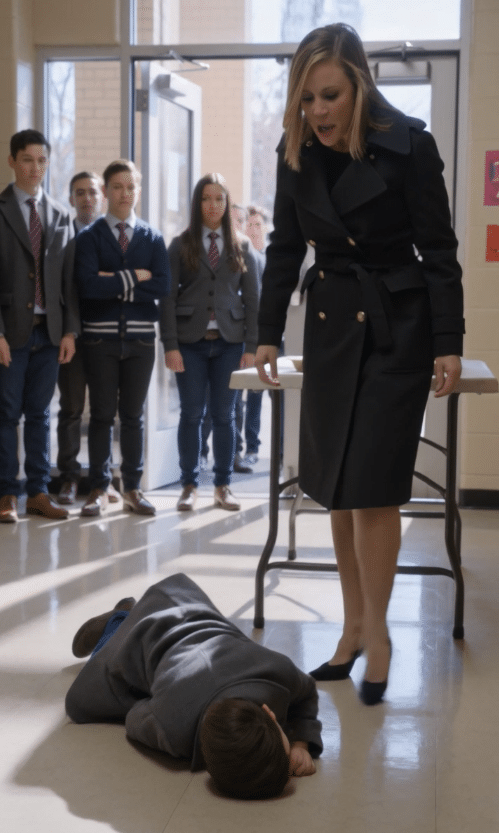
Vanessa kicked him forcefully in the chest.
The boy fell beside the table, his backpack sliding off one shoulder. The milk carton rolled beneath a plastic chair, and the sandwich landed near the leg of the table. Noah caught himself with one hand, scraping his palm against the floor.
For a moment, he could not understand why he was lying down.
Then the pain reached him.
He tried to push himself upright, but Vanessa stepped closer and kicked him again, striking his side.
A frightened gasp rose from the students.
Noah reached for the meal ticket that had slipped from his fingers.
Vanessa delivered a second follow-up kick to his back.
“Eat after children who matter,” she said.
The hallway went silent.
Parents covered their mouths. Students stepped backward. A staff member froze beside the cafeteria doors, staring at the woman who had just attacked a twelve-year-old over a lunch that cost almost nothing.
Oliver stood motionless, his face pale.
He had seen his mother angry before. He had watched her argue with waiters, berate delivery drivers, and dismiss people she considered beneath her.
But he had never seen her do something like this.
Noah lay on the floor, breathing unevenly, his scraped palm pressed against his coat. His meal ticket was a few feet away. The sandwich remained untouched beside the table.
Then the hallway doors swung open.
A tall man in a gray suit entered with the school principal walking just behind him. His long coat was still unbuttoned, and a district identification badge was clipped near his lapel.
He took one look at the boy on the floor.
Then he looked at Vanessa.
His expression changed.
And the woman who had spent her entire life believing that money could protect her from consequences was about to discover just how wrong she was.
Act II
The man was Richard Hale, the fifty-six-year-old superintendent of the school district.
He had spent nearly three decades working in public education, beginning as a classroom teacher before becoming a principal, then an administrator, and eventually the person responsible for overseeing schools across the district.
He had seen overcrowded classrooms, families struggling with rent, children arriving at school exhausted, and teachers buying supplies with money from their own pockets.
But the moments that stayed with him were often the smallest.
A student pretending not to be hungry.
A child wearing the same shoes through an entire winter because a parent had to choose between replacing them and paying the electricity bill.
A young person quietly giving away half a sandwich because another student had nothing.
Richard knew that a meal assistance program was never just about food. It was about ensuring that a child’s financial circumstances did not become another barrier to learning.
That afternoon, he had been visiting the school to discuss funding for an expanded student support initiative. The principal, Dr. Helen Morris, had been showing him the cafeteria and the after-school program when the commotion reached the hallway.
They had arrived just in time to see the aftermath.
Richard moved quickly toward Vanessa.
He delivered one forceful slap across her face, stopping her from advancing toward Noah. Vanessa recoiled, raising a hand to her cheek, stunned by the sudden interruption.
Richard immediately stepped between her and the boy.
“Don’t you dare go near him again.”
His voice was sharp enough to cut through the stunned silence.
He turned to the principal.
“Get the nurse. Call his parent. Have the school document everything, and preserve any hallway footage.”
Dr. Morris was already moving.
“Of course.”
She crouched beside Noah, careful not to pull him to his feet.
“Noah, can you hear me?”
He nodded, eyes bright with tears he was desperately trying to hold back.
“Does it hurt to breathe?”
“A little.”
“Okay. Don’t rush to stand up. The nurse is coming.”
Richard looked toward the staff members who had witnessed the assault.
“I need the facts recorded exactly as they happened. Who gave him the meal?”
A volunteer stepped forward, visibly shaken.
“I did. Noah had the meal ticket. It was the last sandwich and milk, and I gave it to him. Then the woman took it.”
Vanessa lowered her hand from her cheek.
“Excuse me?”
Richard turned toward her.
“You heard me. Stay away from the child.”
“You just hit me!”
Richard’s jaw tightened.
“And a child is on the floor because you kicked him.”
“He was being disrespectful.”
“He asked you to return his lunch.”
“He challenged me in front of everyone.”
“He is twelve.”
Vanessa looked around, expecting someone to support her. She had spent years using outrage as a weapon, and she knew how to make a room uncomfortable enough that people would rather agree with her than endure another minute of her anger.
But the hallway offered her no rescue.
The volunteer stared at the floor, gathering her composure. Several students remained near the cafeteria doors, watching with frightened, wide eyes. Dr. Morris was focused entirely on Noah.
Even Oliver had begun to cry silently.
Vanessa noticed him and immediately changed her tone.
“Oliver, come here.”
He did not move.
“Oliver!”
He flinched at the sharpness of her voice.
Richard saw it.
“Let him stand where he feels safe.”
Vanessa stared at him.
“You don’t get to tell me how to handle my own child.”
“Right now, I’m responsible for the safety of everyone in this school.”
“I’m a parent.”
“And he is a student.”
Richard glanced at the food on the floor.
“You took a meal that had been assigned to another child. Then you assaulted him when he asked for it back.”
Vanessa gave a disbelieving laugh.
“You’re going to make an entire incident out of a sandwich?”
“No,” Richard said. “You did that yourself.”
The sentence left her briefly speechless.
The nurse arrived with the school counselor and began assessing Noah. They checked his condition, asked him simple questions, and arranged for further medical evaluation because of the force of the assault and his reported pain. A staff member retrieved the milk carton but left the other items in place until the scene had been documented.
Noah kept glancing at the sandwich.
Richard noticed.
“Don’t worry about the food right now,” he told him gently. “We’re going to make sure you’re taken care of.”
Noah looked up.
“Am I in trouble?”
The question hit Richard harder than Vanessa’s insults had.
“No,” he answered immediately. “You did nothing wrong.”
Noah’s mouth trembled.
“My mom said I should always show my ticket.”
“You did exactly what you were supposed to do.”
For a few seconds, Noah looked as though he might cry. Then he lowered his face, embarrassed by the attention.
Richard did not press him to speak.
He knew that children who had been humiliated in public often needed something more than reassurance. They needed adults to stop treating them like exhibits in someone else’s argument.
He asked the counselor to give Noah some privacy and remained nearby while the nurse continued her assessment.
Vanessa, meanwhile, was losing control of the situation.
She glanced toward the principal.
“Dr. Morris, tell him who I am.”
The principal rose slowly.
“I know who you are, Mrs. Caldwell.”
“Then explain that this is a misunderstanding.”
Dr. Morris looked at Noah, then at the meal ticket on the floor.
“I watched enough to know that it was not.”
Vanessa’s face went pale with anger.
“You cannot be serious.”
“I am.”
For the first time, Vanessa seemed to realize that the principal was not going to protect her from the consequences of what she had done.
But she still believed that Richard’s anger was merely personal.
She did not yet understand why the superintendent had been so horrified by the sight of a stolen lunch.
Nor did she know that her family had been connected to a district decision that Richard had been reviewing for weeks.
A decision involving the very school where she had just attacked a hungry child.
Act III
Vanessa Caldwell was not simply a wealthy parent.
Her husband, Thomas Caldwell, owned a regional construction and property management company that had recently sought a major contract connected to district facilities. The proposal involved renovating several aging school buildings and expanding support spaces for students.
It was the kind of project that could bring significant revenue to a contractor and favorable publicity to the family behind it.
Vanessa had accompanied her husband to civic receptions and school fundraising events. She was familiar with the district’s senior administrators, and she had learned to speak about education in the language of investment, leadership, and community impact.
At public events, she praised the importance of giving children a strong start.
In private, she often spoke about schools as though they were extensions of her family’s status.
She wanted Oliver placed in the most prestigious classes. She complained when school events were not organized to her liking. She expected teachers to answer her messages quickly and administrators to accommodate her schedule.
Most of the time, staff members managed her behavior quietly because they wanted to avoid unnecessary conflict.
Richard knew the Caldwell name because the construction proposal had been submitted for review. He did not personally select contractors, and the superintendent’s office was required to follow procurement rules designed to prevent favoritism.
The proposal was still under consideration.
Richard had been asking for additional documentation concerning project costs, subcontractor qualifications, and the company’s record of completing comparable work. Those questions were routine parts of the review, not accusations of misconduct.
Vanessa had interpreted the delays as a lack of respect.
She believed the district should understand what her family could contribute and make the process easier.
She had no idea that Richard had come to the school that afternoon partly to discuss how limited funding should be allocated between building improvements and student support services.
The lunch program was one of those services.
It had started as a small after-school initiative for students who stayed late for tutoring, clubs, or transportation. Over time, staff had noticed that some children were remaining at school partly because they knew they could get something to eat.
The district had expanded the program, but resources remained limited. The school relied on careful meal counts, community donations, and modest grants to make sure that students who needed food could receive it.
The final sandwich was not a symbol of the district’s failure.
It was evidence that someone had planned the distribution, checked the meal ticket, and tried to get food to a child who needed it.
Richard had been discussing ways to expand the program so that staff would have more flexibility when demand exceeded expectations.
Then he had walked into the hallway and seen Vanessa take the meal away from Noah.
She had treated the boy as though his hunger were an inconvenience and his need were an insult.
For Richard, the incident revealed a question that no contractor’s presentation could answer.
What did a family truly believe about public education when no one important was watching?
He looked toward Vanessa.
“Mrs. Caldwell, do you understand why this is being treated seriously?”
“Because you’ve decided to humiliate me.”
“No. Because a child was assaulted.”
“He was rude.”
“He asked you to return something that belonged to him.”
Vanessa folded her arms.
“You are ignoring the bigger picture. My family has supported this community for years.”
Richard’s expression remained controlled.
“Your family’s business proposal is being reviewed under district procedures. This incident will be documented separately, and the appropriate authorities will be notified.”
She stared at him.
“You wouldn’t dare bring my husband into this.”
“I haven’t. I’m telling you that no one will use a pending business proposal to shield anyone from the rules.”
Vanessa’s confidence flickered.
She had expected Richard to care about the Caldwell family’s connections. She had assumed that mentioning her husband’s company would remind him that powerful people were entitled to certain courtesies.
Instead, he was drawing a clear boundary.
“Are you threatening our contract?” she demanded.
“No decision about that contract will be made here in a hallway. It will be handled through the proper review process. But no one will receive special treatment because of a family name.”
The principal listened in silence.
Richard continued.
“Staff will preserve the footage and record the witness statements. The school will contact Noah’s parent, and the district will cooperate with any formal investigation. His meal assistance and educational support will not be affected by what happened today.”
Vanessa looked toward the boy.
Noah was sitting with the nurse, his scraped palm being cleaned while the counselor spoke quietly beside him. His gray coat was folded over the back of a chair. His backpack rested on the floor, one strap twisted beneath it.
The sight seemed to irritate Vanessa more than it should have.
“You’re going to reward him for making trouble?”
Richard turned fully toward her.
“He is not making trouble. He is the child you hurt.”
For the first time, Vanessa had no immediate response.
Oliver stood a few feet away, staring at his mother with a look she had never seen on his face before.
It wasn’t embarrassment about his clothes or fear of being reprimanded at school.
It was disappointment.
“Mom,” he said quietly, “I told you I didn’t want the sandwich.”
Vanessa spun toward him.
“Not now.”
“But he was hungry.”
“I said not now!”
Oliver recoiled.
Richard’s attention shifted to the boy, and his expression softened.
“Oliver, you don’t have to answer any questions right now. The counselor can help you if you need to talk.”
Vanessa stepped between them.
“Stop talking to my son as though I’m not standing here.”
“Then stop making him responsible for your behavior.”
The words hung in the air.
Vanessa’s face flushed.
She had spent years telling Oliver that people who had less money were usually less disciplined, less capable, or less deserving. She had taught him that his family’s position gave him an advantage he should never have to question.
But now he had watched his mother take food from a child who needed it, then attack that child for asking for it back.
No amount of money could make the scene look respectable.
And Oliver could not pretend he had not seen it.
Vanessa turned toward Richard again, searching his face for some sign that he might soften, apologize, or admit that he had gone too far.
Instead, she saw something far more dangerous to her than anger.
She saw a man who had stopped caring about her family’s influence.
Then Richard spoke the words that would change the entire afternoon.
“That sandwich just showed me which family should leave this district.”
Vanessa went still.
“Leave this district?”
For the first time, the question sounded less like a challenge than a frightened plea.
Because she had just realized that the consequences might reach far beyond a single school hallway.
Act IV
Richard did not repeat the threat or raise his voice.
He turned toward Dr. Morris.
“Please make sure Noah receives the support he needs. I also want the incident reported through the district’s established procedures. No one should contact the family to pressure them into dropping a complaint.”
The principal nodded.
“I’ll handle it.”
“And make sure Oliver has access to the counselor if he needs it.”
Vanessa’s eyes widened.
“You are not going to put my son into some investigation.”
“No one is blaming Oliver for what you did,” Richard replied. “He is a child, too.”
The answer left her with nowhere to direct her anger.
She had expected the superintendent to treat the entire family as a problem or to threaten Oliver’s place at school. Instead, Richard was separating the child from the adult who had caused the harm.
That distinction made her feel more exposed.
She could argue that she was a protective mother. She could insist that her son deserved the best. But it was difficult to make those claims while Oliver stood several feet away, unable to look at her.
The nurse finished cleaning Noah’s scraped palm and asked him about his pain. The school counselor stayed close while arrangements were made to contact his mother. Staff kept the other students away from the immediate area, and the volunteer wrote down what she had witnessed.
Richard watched carefully to make sure the response remained focused on Noah’s safety rather than the spectacle around Vanessa.
The district would have to review the incident. The school would have to follow its reporting obligations. The construction proposal would continue through its separate process, with the same standards applied to every bidder.
There would be no instant cancellation announced in the hallway, no secret bargain, and no promise that one dramatic confrontation could settle every question.
But there would be a record.
And that record would not disappear because Vanessa was accustomed to getting her way.
She took out her phone.
“My husband will hear about this.”
Richard nodded.
“He should hear an accurate account.”
“You have no idea what this will do to our family.”
Richard looked toward Noah.
“I know what your actions have already done to a child.”
Vanessa opened her mouth, but the words seemed to tangle before they emerged.
She looked around for a friendly face. The parents who had once greeted her warmly at school events now stood at a distance. The staff members she had expected to obey her were focused on their duties. Even the principal, who had always tried to keep difficult situations calm, was no longer offering her a private escape from public accountability.
The security officer approached and asked Vanessa to accompany him to the administrative office while the incident report was completed. He explained that the school needed to document what had happened and arrange the next steps.
Vanessa protested.
“I am not being escorted anywhere like a criminal.”
“You’re being asked to come to the office so we can complete the report,” he said. “Please cooperate.”
She glanced at Richard.
“Are you going to let him do this?”
Richard’s expression did not change.
“The school has procedures. They apply to everyone.”
Vanessa followed the officer, but she walked stiffly, her hand still resting against her cheek. She looked back once toward the cafeteria table.
The sandwich remained where it had fallen.
That small, ordinary object seemed to mock everything she had tried to claim about herself. She had not been protecting her son. She had not been solving a problem. She had taken something from a hungry child simply because she could.
And when the child objected, she had punished him for refusing to accept humiliation.
At the administrative office, the school began documenting the incident. The principal arranged for the relevant footage to be preserved, and the district notified the appropriate officials. The family would be informed of the process, and any investigation would proceed according to the applicable rules.
Richard also made one thing explicit: no student would lose access to meals, classes, or support because a parent had influence or because another family had less.
The Caldwell family’s construction proposal remained subject to its independent review. The district would examine the documentation and qualifications it had requested before making any award. If the company met the requirements, its proposal would be assessed on its merits. If it did not, its name and connections would not rescue it.
Vanessa had expected the district to fear losing her family’s business.
Instead, the district was determined not to let a business relationship interfere with student safety.
By the following morning, the school had contacted Noah’s mother and arranged a meeting with the principal and counselor. They discussed his immediate needs, how the incident would be addressed, and what support would help him feel safe returning to school.
Noah was quiet during the meeting.
He kept rubbing the edge of his clean bandage with his thumb.
His mother sat beside him, visibly shaken but trying not to frighten him further. She apologized for not having been there, though she had done nothing wrong and could not have known what would happen.
Noah leaned against her arm.
“I just wanted my lunch,” he whispered.
She closed her eyes for a moment.
“I know, sweetheart.”
The principal assured them that Noah would not be blamed for asking for the meal assigned to him. The school would also review how staff could respond more quickly if a student was being threatened.
Richard did not promise that the district could prevent every act of cruelty.
He promised that this one would not be ignored.
For Noah, that was the first step toward believing that the hallway might one day feel ordinary again.
For Vanessa, it was the beginning of a reckoning she could no longer control.
Act V
The story did not end with a dramatic announcement that the Caldwell family had been expelled from the district.
Real consequences required more than a powerful official’s anger.
The school completed its incident report, preserved the available evidence, and cooperated with the appropriate authorities. The district followed its procedures for addressing the assault and protecting the students involved. Vanessa was not permitted to turn the event into a private disagreement that could be settled with a donation or a carefully worded apology.
The construction proposal involving her husband’s company was reviewed separately by the officials responsible for procurement. They considered the required documentation, qualifications, and other relevant factors. Richard did not personally award or cancel the contract as punishment for Vanessa’s behavior.
Instead, he made sure that the review remained independent and that no one inside the district used the family’s influence to interfere with the process.
The Caldwell name did not grant immunity.
Nor did the incident automatically determine every business decision connected to the family.
What changed was that the district had a documented reason to reinforce its boundaries. Public resources would be allocated according to established rules, student safety would remain a priority, and no family would receive special treatment because it could afford to demand it.
Vanessa found that reality more difficult to accept than any public reprimand.
She was accustomed to people calling her back, smoothing over misunderstandings, and making sure she left a room feeling important. Now she had to answer questions about an incident she could not explain away without contradicting witnesses.
Her husband was furious when he learned what had happened.
Not because he was suddenly concerned about Noah, but because the incident threatened to damage the family’s standing in the community. He demanded to know why Vanessa had allowed a minor dispute to become a formal matter involving the district.
For once, she had no polished response.
She could not tell him that she had been misunderstood. The staff had watched her take the meal. The students had heard her words. The footage showed what happened after Noah asked for it back.
And Oliver had seen everything.
That was the consequence Vanessa found hardest to manage.
At home, she tried to explain that the situation had been exaggerated, that the boy had been disrespectful, and that the superintendent had deliberately embarrassed her.
Oliver listened without interrupting.
Then he asked a question she had not expected.
“Would you have done it if he were rich?”
Vanessa stared at him.
“What?”
“If he had a big house and expensive clothes, would you have taken his lunch?”
She began to answer, then stopped.
Oliver looked down at his hands.
“I told you I didn’t want it. He was hungry, Mom.”
Vanessa felt anger rise in her chest, but beneath it was something unfamiliar: the knowledge that her son was no longer accepting her version of events simply because she was his mother.
“I’m trying to teach you how the world works,” she said.
Oliver shook his head.
“No. You’re teaching me that people don’t matter if they don’t have money.”
He walked away before she could respond.
For the first time, Vanessa’s influence over her own household seemed less certain than the influence she had spent years trying to project in public.
She had wanted Oliver to grow up confident, respected, and successful. She had confused those qualities with never having to be challenged. She had taught him that people with money deserved better treatment, then demonstrated exactly what she believed when a child with less asked her to return a sandwich.
Now her son had seen the cost of that lesson.
Meanwhile, Noah was trying to return to ordinary life.
His mother walked him to school for the first few mornings. The counselor checked in with him, and the staff made sure he knew where to go if he felt uncomfortable. He was offered the same meal support as before, without being singled out or asked to recount the incident for anyone who did not need to know.
The first afternoon he returned to the cafeteria, he hesitated at the entrance.
The familiar smells of food drifted through the hallway. Students were laughing near the doors, and a volunteer was setting out the remaining sandwiches and milk.
For a moment, Noah remembered the sound of the carton rolling across the floor.
He remembered Vanessa’s voice telling him to eat after children who mattered.
His fingers tightened around his backpack strap.
Then the volunteer behind the table saw him.
“Hi, Noah,” she said gently. “Your meal ticket is all set.”
She checked his ticket, handed him a sandwich and milk, and smiled as though this were an ordinary afternoon.
Because it should have been.
Noah looked at the food.
“Thank you,” he said.
He carried it to a table and sat down. At first, he ate slowly, glancing toward the hallway whenever footsteps passed. But the minutes went by, and no one took anything from him. No one demanded that he prove he deserved his lunch. No one told him that another child’s comfort mattered more than his hunger.
Eventually, he relaxed enough to finish eating.
The sandwich was simple. The milk was cold. The cafeteria was noisy, and a student at the next table was complaining about homework.
It was an ordinary school afternoon.
For Noah, that ordinary afternoon was a victory.
A few days later, Richard visited the school again to review the district’s student support programs. He asked the staff how the meal distribution process could be improved when demand exceeded supply. The school began evaluating ways to keep emergency meals available and to make sure that students could ask for help without feeling exposed.
Richard also spoke with Noah’s mother, thanking her for trusting the school to support her son.
She thanked him for taking the incident seriously.
“I don’t want him to think the world is always going to be like that,” she said.
Richard looked toward the hallway, where students were leaving class in noisy clusters.
“It won’t always be fair,” he replied. “But he should know that unfairness doesn’t mean he has to accept being treated as less than anyone else.”
His words stayed with her.
The district could not remove every obstacle from Noah’s path. It could not guarantee that no adult would ever judge him by his coat, his family’s income, or the contents of his lunch bag.
But it could make sure that the adults entrusted with his education understood their responsibility.
It could preserve the meal program. It could respond when a student was harmed. It could insist that wealth did not purchase a different set of rules.
And it could remind every child in that hallway that a person’s dignity was not measured by the price of their backpack.
Vanessa eventually had to confront the fact that the most damaging part of the incident was not the superintendent’s response.
It was what she had revealed before he ever arrived.
She had seen a hungry child holding the last sandwich and decided that his need meant nothing. She had heard him ask for his meal back and interpreted the request as an insult. She had mistaken his poverty for weakness and her own privilege for permission.
Then she had discovered that there were people who would not look away.
Richard Hale’s words had frightened her because she believed they meant her family could lose its place in the district.
But his deeper message was simpler.
No family was entitled to a place of honor at the expense of a child who needed help.
No donation could purchase the right to humiliate someone.
And no amount of money could transform cruelty into good parenting.
The Caldwell family would continue to face the appropriate reviews and consequences. The school would continue to support Noah. Oliver would have to decide what kind of person he wanted to become after seeing what his mother had done.
None of those outcomes could undo the pain of that afternoon.
But they could determine what happened next.
Weeks later, Noah stood at the cafeteria aid table again. This time, there were enough meals for everyone in line.
He held his ticket in one hand and his backpack strap in the other, waiting patiently as the volunteer checked each student’s name.
When his turn came, she handed him a sandwich and milk.
Noah thanked her and stepped aside for the next child.
There was no dramatic music, no crowd holding its breath, and no powerful official standing nearby to defend him.
There was simply a boy receiving the meal he had been promised.
And that was how it should have been all along.
Vanessa had once believed that a sandwich was too small a thing to matter.
But it had exposed the difference between having power and having character. It had shown her son that kindness was not weakness, that need was not shameful, and that a child did not have to earn the right to be treated like a human being.
Noah had never asked for special treatment.
He had asked for his own lunch.
The real disgrace was that a grown woman had needed the entire district to witness her cruelty before she understood that it had never belonged to her to take.