Act I
The last carton of milk had barely reached the young mother’s hands when a man in an expensive leather jacket snatched it away.
“Hey!” the volunteer exclaimed, reaching instinctively toward the nearly empty table.
The mother froze. Her sleeping toddler rested against her shoulder, one small hand curled into the collar of her faded blue jacket. In her other hand, she still held the valid aid voucher that had earned her the final carton.
“Please,” she said, taking a careful step forward. “My baby needs that milk.”
The man looked at her as though she had asked him for the keys to his house.
He was forty-four, impeccably dressed, and wearing a silver watch that caught the fluorescent light whenever he moved his wrist. His polished shoes looked absurdly out of place on the scuffed floor of the church basement, where families stood in line beside nearly empty shelves of canned vegetables, bread, and donated groceries.
“Trash,” he said. “Your baby can wait.”
The words carried across the room.
A volunteer stopped sorting cans. An elderly woman near the bread table slowly lowered her shopping bag. At the far end of the basement, a little boy looked up from the crackers his mother had just received.
The young mother swallowed.
“My voucher says I’m eligible,” she explained quietly. “The volunteer gave it to me.”
The man glanced at the paper as if it were something dirty.
“Do you know how much my time is worth?”
She didn’t answer.
“My housekeeper couldn’t get to the store before the storm. That’s why I’m here. I need a few things for the house.”
The volunteer stared at him.
“This is a food bank, sir. We’re distributing emergency supplies to families who need them.”
“And I’m telling you I need the milk.”
The mother shifted her sleeping child higher against her shoulder. Her name was Hannah Miller, and she was twenty-nine years old. She had spent the morning stretching the last of her groceries, the afternoon waiting for a bus, and the better part of an hour standing in line at the church basement because the pantry was nearly out of everything.
She had not come looking for charity because she enjoyed asking strangers for help.
She had come because the alternative was going home with too little food for her son.
“Please,” she said again. “He hasn’t had enough today.”
The man’s expression hardened.
“Feed him after real families.”
Hannah stared at him, stunned by the casual cruelty of the words.
“He is a real family,” she whispered.
For an instant, the room seemed to hold its breath.
The man stepped closer, his leather jacket creaking as he moved. Hannah instinctively turned her body to keep her child protected between her shoulder and chest.
“Give me the milk,” he demanded.
She tightened her grip on the carton.
“I can’t.”
His face twisted with anger.
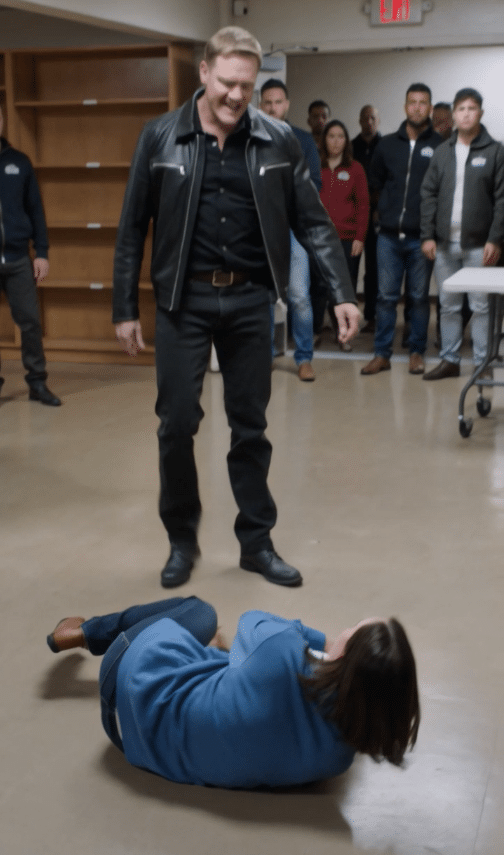
Then he drove a forceful kick into her chest.
Hannah fell sideways beside the food bank table, twisting as she went down so that her sleeping child remained protected against her. The milk carton slipped from her hand and rolled across the floor. Her forearm scraped against the edge of the table, leaving a thin trace of blood.
Her son woke with a startled cry.
The man did not stop.
He stepped toward her and kicked her once in the back and side. Then he delivered a second follow-up kick while she curled protectively around her child.
Hannah gasped, struggling to keep her son secure.
The room erupted in soft cries of shock.
Several people covered their mouths. A volunteer backed into the shelves, knocking a can onto the floor. Someone near the entrance whispered, “Oh my God,” but nobody moved quickly enough to intervene.
The man stood over Hannah, breathing hard.
“Feed him after real families,” he repeated.
Hannah clutched her crying child and tried to push herself away from him. She was frightened, in pain, and desperately trying to understand how asking for a carton of milk could have brought her to the floor.
Then a door swung open at the rear of the basement.
A tall man in a navy suit and black overcoat emerged from the storage room, accompanied by the food bank’s volunteer lead. He had been reviewing inventory records when the shouting began.
He took one look at Hannah on the floor.
Then he saw the man standing over her.
The expression on his face changed so sharply that the volunteer lead stopped speaking mid-sentence.
The man coming out of that storage room had built the entire food bank from nothing—and what he did next would expose the difference between a person who donated food and a person who understood why it mattered.
Act II
His name was Thomas Reed, and at fifty-seven, he was one of the most successful businessmen in the region.
He owned a logistics company that operated warehouses and distribution centers across several states. He had built his fortune through years of long hours, difficult negotiations, and the kind of discipline that left little room for excuses.
But the church food bank was the one project he never treated like a business.
Twenty years earlier, Thomas had watched his younger sister struggle to feed her two children after her husband abandoned the family. She worked two jobs, yet there were weeks when rent, utilities, and groceries competed for the same dollars.
Thomas had money by then, but he had been young enough to believe that financial problems could always be solved by working harder. He remembered his sister sitting at her kitchen table, calculating the cost of milk, bread, and medicine on the back of an envelope.
He remembered how she apologized for needing help.
That memory had changed him.
When she eventually recovered financially, Thomas helped establish a small pantry in the basement of a neighborhood church. It began with donated canned food and a folding table. Over the years, it grew into a network of volunteers, grocery partnerships, and emergency distribution programs.
Thomas paid for storage, transportation, refrigeration, and supplies whenever donations fell short. He never asked recipients to tell their stories in public. He never wanted people to feel they had to perform their suffering to deserve a meal.
The food bank had one simple purpose.
If a family needed food, the volunteers would do everything reasonably possible to help them get it.
Now Thomas stood in the doorway, watching a wealthy man attack a mother who had come for a carton of milk.
He moved immediately.
The man turned just as Thomas reached him. Thomas delivered one forceful punch to his face, sending him stumbling backward. Before the man could approach Hannah again, Thomas stepped between them.
“That is enough!”
His voice filled the basement.
The man clutched his face, stunned by the sudden intervention.
“Who the hell do you think you are?”
Thomas did not answer him immediately. He crouched beside Hannah, keeping himself between her and the attacker.
“Ma’am, can you hear me?”
Hannah nodded, her eyes fixed on her son.
“Is he hurt?” she asked urgently.
The volunteer lead knelt nearby and gently helped her steady the child without pulling him from her arms.
“We’re going to make sure you’re both all right,” the volunteer said.
Thomas looked toward the other staff members.
“Call emergency services. Tell them a mother has been assaulted while holding her child. We need medical assistance immediately.”
A volunteer hurried toward the office phone.
Thomas then turned to the man.
“Step away from her.”
The man lowered his hand from his face. Anger had begun to replace his initial shock.
“You hit me!”
Thomas held his ground.
“You attacked a woman who came here for food.”
“She wouldn’t give me the milk.”
“She had a valid voucher.”
“I needed it!”
“For your housekeeper?” Thomas asked.
The man blinked.
The volunteer lead had heard enough of the argument to understand what he had meant. She pointed toward the carton lying beneath the table.
“You told us you wanted supplies for your housekeeper. We explained that the last carton was allocated to a family with a child.”
The man looked around the room.
“That doesn’t mean she gets to tell me what to do.”
Thomas rose slowly.
“No. It means this place has rules designed to make sure the people who need help have a fair chance to receive it.”
The man laughed bitterly.
“Rules? You run a basement full of donated groceries. You think that makes you important?”
Thomas glanced toward the empty shelves.
“No. The people who come here make this place important.”
The answer seemed to irritate the man more than any insult could have.
He straightened his leather jacket, then pointed at Hannah.
“She made a scene over a carton of milk.”
A volunteer stared at him in disbelief.
“You kicked her.”
“She should have handed it over.”
Thomas’s expression hardened.
“Listen carefully. You are going to stay away from this woman and her child. The police have been called, and the incident will be documented.”
The man looked toward the door as if he were considering leaving.
Thomas noticed.
“You may wait for the authorities to arrive. The staff will cooperate with their investigation, and the footage from our security cameras will be preserved.”
The man’s eyes flicked toward a camera mounted above the storage entrance.
For the first time, he seemed to understand that this was not simply a room full of frightened strangers who could be intimidated into silence.
The food bank had records. The volunteers had seen what happened. And the man standing between him and Hannah was not going to make the incident disappear to protect a wealthy donor.
Thomas turned away from him and knelt beside Hannah again.
“What’s your name?”
“Hannah,” she whispered.
“I’m Thomas. Help is on the way.”
She looked down at the milk carton.
It had rolled beneath a chair, its cardboard side dented but intact.
“I’m sorry,” she said suddenly.
Thomas frowned.
“Why are you apologizing?”
“I didn’t want trouble. I only came because I needed the milk.”
Her voice cracked on the final word.
Thomas felt a familiar ache in his chest. He had heard that apology before—from his sister, from struggling parents, from people who had learned to treat their own needs as an inconvenience to everyone around them.
“You did nothing wrong,” he told her.
Behind him, the man scoffed.
Thomas looked over his shoulder.
“That milk just told me exactly what kind of man you are.”
The man stared back, his jaw tightening.
“What the hell are you?”
Thomas did not answer.
Not yet.
Because the man’s greatest mistake had not been assuming he could take the last carton of milk.
It was assuming that the people who depended on the food bank had no one willing to stand up for them.
And when the volunteer lead opened the donor records, she discovered that the man had been using his wealth to build a reputation that looked very different from the one now standing in front of them.
Act III
The man’s name was Richard Caldwell.
He was forty-four, the founder of a private property investment firm, and a familiar face at charity dinners throughout the city. His company sponsored local events, funded scholarship programs, and regularly appeared on lists of businesses praised for their community involvement.
Richard liked being known as generous.
He enjoyed the photographs of himself handing over oversized donation checks. He liked hearing speakers thank him from a stage. He especially liked the way people changed their tone when they discovered how much his company was worth.
To him, charity was part of a successful person’s public image.
The food bank had seemed like another opportunity to reinforce that image. He had made a substantial donation the previous year, and his name had appeared in a printed acknowledgment displayed near the entrance.
He remembered it clearly.
What he did not remember was the name of a single family the pantry had helped.
When Thomas stood to face him, Richard pointed toward the shelves.
“You should be thanking people like me,” he said. “Without donors, places like this wouldn’t exist.”
Thomas remained quiet for a moment.
“Did you donate money to this food bank?”
Richard seemed surprised by the question.
“Yes.”
“Then that donation helped purchase food and keep the pantry operating. It didn’t buy you the right to take supplies away from people who qualify for them.”
Richard’s jaw tightened.
“You’re twisting my words.”
“No. I’m explaining what your donation did—and what it did not do.”
The volunteer lead approached with a clipboard. She had begun recording the incident and had asked another staff member to preserve the security footage.
“Mr. Reed,” she said, “the carton was assigned to Hannah’s voucher. We have the allocation recorded.”
Thomas nodded.
“Keep that record with the incident report.”
Richard looked from the clipboard to Thomas.
“Mr. Reed?”
The name appeared to register at last.
Thomas Reed was not simply a wealthy businessman who had wandered into a church basement. He was the founder of the pantry, the person who had funded its expansion, and the man whose company supplied much of the transportation that kept its emergency food deliveries moving.
Richard’s expression changed, but only briefly.
“So you’re the founder,” he said. “Good. Then we can settle this.”
Thomas waited.
Richard lowered his voice.
“I made a donation to this organization. I can make another one. We can all agree that things got out of hand, and nobody needs to turn this into a public spectacle.”
Thomas stared at him.
“You think this is about money?”
“Everything is about money at some point.”
“Not this.”
Richard gave a dismissive wave toward Hannah.
“She was upset. I was upset. There was a misunderstanding.”
Hannah lifted her head.
She was still holding her child close, and the effort of speaking seemed to cost her something.
“I told you the milk was for my baby.”
Richard looked at her.
“And I told you I needed it.”
“You kicked me.”
He rolled his eyes.
“You fell.”
The volunteer lead’s face tightened.
“We all saw what happened.”
Richard turned on her.
“Stay out of this.”
Thomas stepped between them.
“Do not threaten my staff.”
Richard gave a bitter laugh.
“Your staff? These volunteers are sorting cans in a church basement. You think they can do anything to me?”
The elderly woman near the bread table finally spoke.
“They can tell the truth.”
Richard turned toward her.
She was small, with silver hair and a cardigan buttoned to the throat. Her hands trembled around the handles of her shopping bag, but she met his eyes.
“I saw you take the milk,” she said. “I saw her ask for it back. And I saw you kick her.”
Richard looked away.
The young volunteer near the storage door spoke next.
“I saw it too.”
Then another recipient nodded.
“So did I.”
The room changed.
Not because everyone suddenly became brave, but because one person had broken the silence and shown the others that they did not have to protect Richard from the consequences of his own actions.
The volunteer lead checked the camera system and confirmed that the incident had been recorded from the moment Richard snatched the milk carton. The footage would be preserved and provided to investigators as appropriate.
Richard’s face tightened.
“You can’t just hand over footage of me without considering my privacy.”
Thomas replied evenly, “The incident will be handled according to the law and our procedures. Nobody here is going to delete evidence to protect your reputation.”
Richard took a slow breath.
Then he reached for the most familiar weapon in his arsenal.
“You don’t want to make an enemy of me, Thomas. My company has relationships with half the businesses in this city. I can make things difficult for your operation.”
The threat hung in the room.
Thomas thought of the pantry’s unpaid bills, the refrigeration equipment that needed maintenance, and the deliveries that had to be scheduled around volunteers’ working hours. He knew exactly how vulnerable a charitable organization could be when a wealthy person decided to punish it.
But he also knew what would happen if he allowed that fear to determine how the pantry treated its guests.
“Any donation you made was meant to help people,” he said. “If you now want to withdraw future support, that is your decision. It does not change what you did here.”
Richard looked genuinely offended.
“You’d rather lose money than resolve this sensibly?”
“I’d rather tell the truth than sell someone else’s dignity to keep a donor comfortable.”
For the first time, Richard seemed unable to produce an immediate reply.
Then his phone began to ring.
He glanced at the screen and saw the name of his business partner. He answered with an irritated breath.
“What?”
The voice on the other end was tense.
“Richard, are you at the church food bank?”
“Why?”
“Someone has sent us a video. Tell me it isn’t you.”
Richard went still.
He looked toward the camera above the storage entrance, then toward the young volunteer who had already given his statement.
“It’s a misunderstanding,” he said.
His partner interrupted.
“The video shows you kicking a woman who is holding a child.”
Richard turned away from the room.
“I’ll explain later.”
“No. The board is asking questions now. Our compliance officer wants the details, and our public relations team has been told not to issue anything until we know what happened.”
Richard ended the call without saying goodbye.
For several seconds, he stared at his phone.
His wealth had always seemed to create distance between his actions and their consequences. He had assumed that anyone who challenged him could be managed through a private conversation, a financial offer, or a reminder of what he could take away.
But the evidence was already outside his control.
And the next person through the basement door would make it clear that Thomas Reed was not the only one who had decided Richard Caldwell’s money could no longer shield him.
Act IV
The police arrived while the volunteers were still documenting the incident.
Thomas met them at the entrance and explained what he had witnessed. The volunteer lead provided the voucher record, confirmed that the milk had been allocated to Hannah, and described the sequence of events. Several recipients agreed to give statements.
Richard immediately began arguing that he had been assaulted first.
Thomas did not pretend his own punch was beyond scrutiny. He told the officers exactly what he had done and when, and he agreed to cooperate with any review of his actions.
Protecting Hannah did not give him the right to invent facts or interfere with the investigation.
But it also did not erase Richard’s conduct.
The officers separated the witnesses and began gathering their accounts. A paramedic examined Hannah, who was in pain but conscious and able to answer questions. Her child was frightened and crying, yet appeared responsive as the medical team assessed him.
Hannah held him close while one of the paramedics checked her scraped forearm and asked about her symptoms.
“Is my baby okay?” she asked.
“We’re going to check him carefully,” the paramedic replied. “We’ll also make sure you’re evaluated.”
Thomas stayed nearby but gave the medical team room to work.
Richard watched the scene with growing frustration.
“You’re treating me like a criminal,” he complained to one of the officers.
“We’re investigating an alleged assault,” the officer replied. “We’ll hear from everyone involved.”
“My lawyer will be here in ten minutes.”
“You’re entitled to legal advice.”
Richard seemed to expect more from the statement, but the officer returned to the questions.
Meanwhile, the volunteer lead retrieved a folder containing the food bank’s donation records. Richard’s company had sponsored a holiday food drive the previous year, and his name appeared prominently on the public acknowledgment.
Thomas glanced at the folder, then closed it.
“That donation was real,” he told the volunteer lead. “Record it accurately. We are not going to erase the good it did, and we’re not going to let it excuse what happened today.”
The volunteer nodded.
Richard overheard him.
“Finally, someone here understands how this works.”
Thomas looked at him.
“Don’t mistake honesty for forgiveness.”
Richard’s expression hardened.
The police continued gathering statements. The security footage was preserved, and the volunteers were instructed not to alter or circulate the original recording while the investigation proceeded.
As the minutes passed, the basement filled with the quiet sounds of paperwork, medical questions, and people giving accounts of what they had seen.
It was a far less dramatic process than Richard had expected.
No one shouted him into submission. No one announced a punishment before the facts had been reviewed. The consequences were beginning through ordinary steps: preserving records, documenting injuries, interviewing witnesses, and notifying the appropriate people.
For a man accustomed to controlling a room, the lack of immediate resolution was almost unbearable.
He looked at Thomas.
“You could stop this.”
“No.”
“You could tell them this was a private matter.”
“It happened in a public food bank, in front of witnesses.”
“You could at least tell them I support your organization.”
“I will tell them the truth about your donation if they ask. I will also tell them the truth about what I saw.”
Richard’s voice dropped.
“You have no idea what this could cost you.”
Thomas thought of the pantry’s nearly empty shelves. He thought of the mothers who arrived with toddlers on their hips, the older people who carried their groceries home in plastic bags, and the volunteers who returned every week even when there was barely enough food to distribute.
He knew that donations could disappear. He knew that one angry benefactor could create months of financial difficulty.
He also knew that the pantry would become worthless if people had to fear being humiliated or attacked while asking for help.
“I know exactly what it could cost,” he said. “That’s why we have to do this properly.”
The paramedics eventually finished their initial assessment and arranged further medical evaluation for Hannah. Before she left, she looked toward the milk carton, which had been placed safely on the table.
“Can I still take it?” she asked quietly.
The volunteer lead looked stricken.
“Of course.”
She retrieved the carton and placed it carefully in a bag with the other supplies Hannah was eligible to receive. Another volunteer brought a small package of diapers and some bread, checking the inventory before adding them.
Thomas watched Hannah accept the bag.
There was no triumph in her face. No satisfaction that the man who had hurt her was finally being questioned. She looked exhausted and worried, her attention fixed on her child.
Richard noticed the exchange.
“You’re making me look like I came here to steal from babies,” he said.
Thomas turned toward him.
“You came here for supplies that were not allocated to you. When you were told no, you attacked the person who needed them.”
“I wanted milk.”
“You wanted it more than you respected her safety.”
Richard’s face flushed.
“You think you’re better than me because you run a charity?”
“No,” Thomas said. “I think we’re both responsible for what we do when someone tells us we can’t have what we want.”
That answer left Richard staring at him.
For the first time, the food bank founder had not spoken about poverty, generosity, or the purpose of the pantry. He had spoken about responsibility—and he had included himself.
Thomas knew the police would review his punch. He knew the food bank would have to cooperate with any inquiries. He knew the company might lose future donations from people who disliked the attention.
He was prepared to face those questions.
What he would not do was ask Hannah to accept humiliation in exchange for keeping the pantry financially comfortable.
As the officers continued their work, Richard’s business partner arrived. He did not approach Thomas with a donation offer or a demand to settle the matter privately. Instead, he asked to speak with Richard and advised him that the company would conduct its own review of the incident.
Richard looked at him in disbelief.
“You’re taking their side?”
“I’m telling you that we need to understand what happened before making any statements.”
“I’m the one who made this company successful.”
“And that doesn’t make this disappear.”
Richard fell silent.
The food bank’s founder watched the exchange without satisfaction. He had no desire to destroy Richard’s business or turn a violent incident into a personal war.
He wanted Hannah safe, the evidence preserved, and the pantry’s rules respected.
The rest would have to be decided through the proper process.
But when the room finally began to empty, Hannah asked Thomas one question that reached deeper than all of Richard’s threats—and reminded him why the food bank had been created in the first place.
Act V
The medical team took Hannah and her son for further evaluation.
The child had been frightened by the fall and the sudden noise, but he remained responsive. Hannah was sore and shaken, and the doctors wanted to assess her injuries carefully rather than dismiss them as minor. She answered their questions while holding her son close whenever the staff allowed it.
Thomas waited until the initial examination was complete before asking whether she wanted someone from the food bank to contact a family member.
“I don’t have anyone nearby,” Hannah said.
“Would you like us to help arrange transportation home when the doctors say you’re ready?”
She nodded, then looked embarrassed.
“I don’t want to take more than I need.”
Thomas sat in the chair beside her.
“You don’t have to apologize for needing help.”
Hannah looked down at her son’s small hand, which had curled around one of her fingers.
“I used to think if I worked hard enough, I wouldn’t end up here,” she admitted. “I took every shift I could. I cut back on everything. I kept telling myself that next month would be easier.”
Her voice faltered.
“Then the rent went up, my hours got cut, and I started running out of groceries before payday. I thought people would look at me differently if I came to the food bank.”
Thomas listened.
“What happened today wasn’t your fault,” he said. “And asking for food doesn’t make you less deserving of respect.”
Hannah wiped her eyes with the sleeve of her blue jacket.
“I know that in my head. I just don’t always feel it.”
Thomas thought of his sister at the kitchen table, apologizing for needing help even when she had spent every waking hour trying to provide for her children.
He had built the pantry partly because he wanted to spare other families that same shame.
Yet he understood now that a building full of donated food could not, by itself, remove the fear people carried through its doors. The way volunteers spoke, the way vouchers were handled, and the way staff responded when someone was threatened all mattered just as much.
“Can I ask you something?” Hannah said.
“Of course.”
“Why did you help me?”
The question was simple. It had no accusation in it, no demand for a promise, no expectation that he would offer her a speech.
Thomas took a moment to answer.
“Because you needed help, and someone was hurting you. That should have been enough for anyone in that room to act.”
Hannah glanced toward the door.
“Everyone was scared.”
“I know.”
“Maybe I would have been scared too.”
Thomas nodded.
“Fear is real. But it shouldn’t be the end of the story.”
He did not tell her that every bystander had failed her, or pretend that courage was easy when violence erupted without warning. Instead, he promised that the food bank would review how volunteers should respond to threats and how they could summon assistance quickly without putting themselves or other recipients in greater danger.
He also made sure Hannah knew that the pantry’s help was not conditional on speaking to reporters, appearing in photographs, or agreeing to become the face of a campaign.
She was free to recover privately.
That mattered to her more than he expected.
In the weeks that followed, the investigation proceeded. The witness accounts, security footage, and medical records were reviewed by the appropriate authorities. Thomas cooperated with the inquiry into his own intervention, while the food bank continued to preserve the records and follow the requests made by investigators.
Richard’s conduct also reached his business partners and the leadership of his investment firm. They reviewed the footage and the circumstances surrounding the incident, considering their own policies and professional obligations. His public reputation suffered, but no single meeting settled every question about his future.
The law would determine any criminal consequences. The company would determine its own response under its standards. The food bank would not pretend to control either outcome.
What it could control was what happened next inside its own walls.
Thomas authorized emergency funds to replenish the pantry’s milk supply and essential groceries. The volunteer lead worked with local stores to establish a backup arrangement for days when donations fell short. Staff reviewed how vouchers were allocated and made sure that families would not be promised supplies that had already run out.
They also introduced clearer procedures for handling confrontations, including when to call emergency services and how to protect children and vulnerable recipients while waiting for help.
Thomas insisted that the changes be practical, not performative.
“People don’t need a new poster telling them we care,” he told the volunteers. “They need to know that when they come here, the system will work.”
The pantry began to recover from the strain of the incident. Donations arrived from neighbors who had seen the news, but Thomas asked the staff not to turn Hannah’s suffering into a fundraising spectacle. They accepted support gratefully and continued distributing food according to need.
Months later, Hannah returned to the church basement.
Her blue jacket was still worn at the cuffs, but she looked less exhausted than she had that afternoon. Her son, now more alert and curious, sat beside her in a stroller while she checked in at the volunteer table.
The volunteer who had given her the last carton of milk recognized her immediately.
“It’s good to see you again,” she said.
Hannah smiled.
“It’s good to be here without an ambulance waiting outside.”
The volunteer laughed softly, then helped her complete the usual check-in.
There was no special line for her. No camera waiting to record the moment. No announcement that the pantry’s founder was about to arrive.
She received the supplies listed on her voucher, including milk, bread, and a small bag of groceries. The shelves were better stocked than they had been on the day of the assault, though the volunteers still had to count every carton and can carefully.
Before Hannah left, Thomas came out from the storage room.
He greeted her warmly and asked how she and her son were doing.
“We’re getting by,” she said. “Some days are still hard. But we’re getting by.”
Thomas nodded.
“I’m glad.”
She glanced toward the milk table.
“I used to feel ashamed coming here. Now I think about how many people are trying to make sure families don’t go without.”
“That’s what it should be,” Thomas replied.
Hannah looked at her son, who was reaching toward the bag of groceries.
“I still remember what that man said. That my baby could wait.”
Thomas’s expression grew solemn.
“He was wrong.”
“I know.” She paused. “I just wish he had understood that before he hurt someone.”
Thomas did not offer a grand answer. There was no sentence that could make the memory disappear or guarantee that Richard would become a different person.
But he could make sure the pantry continued to serve families without asking them to prove that their hunger was worthy of compassion.
That was the promise he had made when he helped create it, and it was the promise he intended to keep.
Richard Caldwell had entered the basement believing his wealth entitled him to the final carton of milk. He had treated a mother asking for help as if she were an obstacle, and he had mistaken the silence of frightened bystanders for permission.
But the carton had never belonged to the richest person in the room.
It belonged to the family whose voucher had been accepted, under the rules designed to make sure limited supplies reached people who needed them.
And Hannah had never needed to be powerful, famous, or connected to deserve protection.
She had needed food for her child.
The food bank existed for precisely that reason.
When Thomas looked at the nearly empty shelves after closing time, he no longer saw only an inventory problem or a challenge for the next donation drive. He saw a room full of people who had arrived carrying worries they rarely spoke aloud—and a responsibility to ensure that asking for help did not become another thing they had to fear.
The true test of generosity was never how much money a person could donate while people were watching.
It was what that person believed other human beings deserved when there was only one carton left.
Richard had answered that question with cruelty.
Hannah had answered it by protecting her child.
And Thomas, standing once again beside the food bank’s storage shelves, knew which answer would shape the future of the place he had built.
Because a carton of milk could feed a child for a day.
But dignity, once defended and made part of the way a community treated its most vulnerable people, could change far more than one afternoon.