Act I
“Please, I just need to sit.”
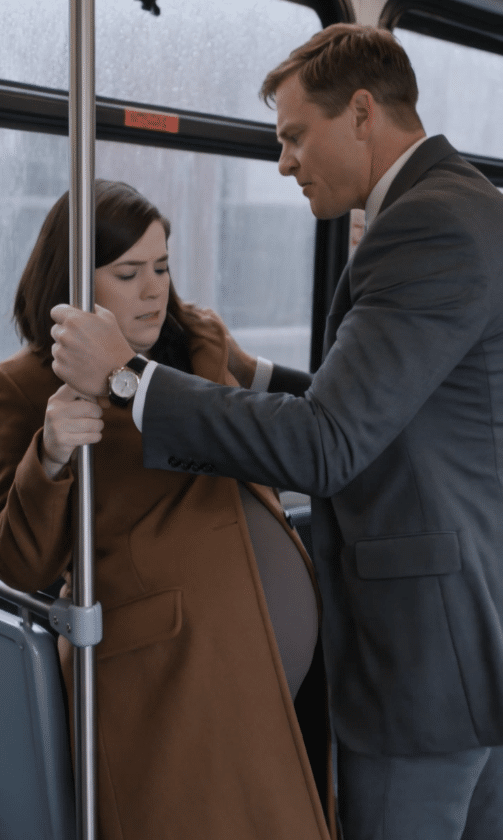
The pregnant woman’s voice was barely audible above the rain hammering the roof of the city bus. One hand gripped the cold metal pole, while the other rested protectively beneath her swollen belly. Her brown coat was worn thin at the elbows, and water dripped from its hem onto the already slippery floor.
There was only one empty seat near the front door.
The driver had gestured toward it moments earlier, noticing the woman struggling to keep her balance as the bus lurched through traffic. But before she could reach it, a man in an expensive gray suit had pushed past two passengers and dropped into the seat.
His leather laptop bag rested across his knees. His polished shoes occupied the space where the pregnant woman had been standing, and his expression suggested that the entire bus was inconveniencing him personally.
When she asked if he would mind letting her sit, he looked her up and down.
“Trash,” he said. “Stand like everyone else.”
The word landed harder than the rain against the windows.
Several passengers glanced at one another. An elderly man tightened his grip on the overhead rail. A young woman near the rear door lowered her phone, startled by the cruelty of the remark.
But nobody spoke.
The pregnant woman swallowed. She was eight months along, exhausted from a long day, and had spent the afternoon traveling between appointments while trying to make a little money last until payday. She had not asked for money, special treatment, or even an apology.
She had asked for a seat.
“Sir, please,” she tried again. “I’m having trouble standing.”
The businessman gave a short, humorless laugh.
“Then you should have planned better.”
He said it loudly enough for the people around them to hear. He wanted an audience, and he had one. The bus seemed to shrink around his voice, every passenger suddenly aware of the space between them and the man in the expensive coat.
The woman reached for the pole as the bus hit a pothole. Her body swayed, and she instinctively wrapped her free arm around her belly.
That small movement appeared to irritate him even more.
He stood abruptly.
For one suspended second, she seemed to believe he had finally decided to give up the seat. Her shoulders relaxed, and she began to turn toward it.
Instead, he drove a forceful kick into her upper chest.
She stumbled sideways, struck the metal pole, and fell hard onto the wet floor. Her arms folded around her belly before the rest of her body could settle. A sharp gasp escaped her lips, and a thin trace of blood appeared on her forearm where it had scraped against the floor.
The bus fell silent.
The man did not stop.
He stepped toward her and delivered another kick to her back and side. Then came a second, exactly as cruel and deliberate as the first, while she remained curled around her unborn child.
“Earn a seat before asking for one,” he said.
The words seemed to hang in the damp air.
Passengers pressed themselves against the walls. One woman covered her mouth with both hands. Someone whispered for the driver to stop, but nobody had yet found the courage to move toward the woman on the floor.
The businessman straightened his coat as if he had merely settled an argument over a parking space.
Near his polished shoe, the woman lay trembling, one hand over her belly and the other pressed against the floor. She was conscious, frightened, and struggling to catch her breath.
Then the brakes shrieked.
The bus lurched toward the curb, and the doors swung open.
A tall man in a long black coat stepped aboard, rain glistening on his shoulders. A route inspector followed close behind him.
The newcomer looked at the passengers, then at the woman on the floor.
Finally, his eyes settled on the businessman.
And everything about his expression changed.
The man who had just boarded was about to make the entire bus understand that the seat was the least expensive thing the bully had taken that day.
Act II
The newcomer was Daniel Mercer, the city’s fifty-five-year-old transit director.
His face was familiar to the people who worked in the transportation department, but not necessarily to the thousands of ordinary passengers who used the buses every day. He rarely appeared in public without a schedule in his hand or a meeting waiting on his calendar. That afternoon, he had been visiting several routes affected by the storm, accompanied by a route inspector who had been documenting delays and dangerous road conditions.
Neither man had expected to witness an assault.
Daniel had stepped onto the bus expecting to ask the driver about a reported braking problem. Instead, he found a pregnant woman on the floor, a crowd of terrified witnesses, and a businessman standing above her with the cold composure of someone who believed consequences were reserved for other people.
The inspector started forward.
Daniel moved first.
He crossed the short distance between himself and the businessman and struck him once, a forceful punch that sent the man stumbling backward. The businessman clutched his face, shocked less by the pain than by the fact that someone had dared to challenge him.
Daniel immediately placed himself between the attacker and the woman.
“Don’t move,” he ordered.
For the first time since the argument began, the businessman looked uncertain.
“What the hell is wrong with you?” he demanded, still holding his face. “He attacked me!”
The lie was so immediate that several passengers stared at him in disbelief.
Daniel did not answer the accusation. He turned toward the woman.
“Ma’am, can you hear me?”
She nodded faintly.
“Don’t try to stand up. Help is coming.”
He crouched beside her without pulling at her arms or attempting to lift her. His own coat brushed the wet floor as he checked whether she could speak comfortably. Her face had gone pale, and her hand remained firmly pressed against her belly.
“Is the baby moving?” he asked gently.
“I… I don’t know,” she whispered. “I just need to know if she’s okay.”
Daniel’s expression tightened.
He looked toward the driver. “Call emergency services. Tell them we have an assault victim who is eight months pregnant. Give them our exact location.”
The driver was already reaching for the radio.
Then Daniel looked at the route inspector.
“Secure the vehicle’s recordings. Preserve the camera footage and identify every witness. Nobody deletes anything, and nobody leaves without giving the investigators a way to contact them.”
The businessman let out an incredulous laugh.
“You can’t do this to me.”
Daniel slowly rose to his feet.
The transit executive badge on his chest caught the light from the open doors. Until then, the businessman had seemed to regard the entire bus as an audience for his own importance. Now he looked at the badge, then at the inspector, and finally at the passengers who had witnessed everything.
His confidence began to fracture.
“Do you know who I am?” he demanded.
Daniel’s voice remained level.
“No. And right now, that doesn’t matter.”
The businessman adjusted his expensive coat with a shaking hand.
“My company has contracts with this city. I know people in the mayor’s office. You have absolutely no idea what you’re getting yourself into.”
Daniel glanced down at the woman, who was still struggling to breathe evenly.
“I know exactly what I’m looking at.”
He turned back to the man.
“A woman who is eight months pregnant asked you for a place to sit. You humiliated her, kicked her to the floor, and kicked her again while she protected her unborn child.”
The words were not shouted. They did not need to be.
Every passenger heard them.
The businessman looked around for someone who might support him. He found only lowered eyes, clenched jaws, and people who had finally stopped pretending they had not seen what happened.
Then the woman made a small sound of pain.
Daniel turned away from the businessman immediately and knelt beside her again.
For a moment, the authority of his position meant nothing. He was simply a man trying to reassure a frightened stranger while waiting for an ambulance.
“What’s your name?” he asked.
“Emily,” she whispered. “Emily Carter.”
“Emily, stay with me. The paramedics are on their way.”
She closed her eyes briefly, then opened them again.
“I didn’t want to cause trouble.”
Daniel looked at her as if she had said something far more devastating than the attack itself.
“You didn’t cause this,” he said. “He did.”
Behind them, the businessman was beginning to understand that the passengers were no longer afraid of him.
But he still believed there was one thing that could save him.
His money.
And when he finally reached for his phone, he made a call that would expose just how much he had misunderstood the man standing between him and Emily.
Act III
“Get me Richard,” the businessman snapped into his phone.
His name was Grant Whitmore, and he had spent fifteen years building a reputation as a ruthless commercial property developer. His company owned office buildings, retail complexes, and several properties leased to municipal contractors. Grant had become accustomed to getting what he wanted by making other people worry about what would happen if they refused him.
He did not think of himself as a bully.
In his mind, he was a man who understood the world as it really worked. Money opened doors. Influence softened rules. People who lacked both had to accept whatever space remained.
The bus was simply another place where he expected that arrangement to hold.
“Richard, I need you to contact the transportation department,” he said, turning away from the woman. “There’s been an incident. An employee assaulted me.”
Daniel heard him but did not interrupt.
Grant lowered his voice, assuming that the passengers could no longer hear him over the rain.
“Find out who this guy is. I want him suspended before the end of the day.”
At the front of the bus, the route inspector had already begun documenting the scene. The driver provided the vehicle number and confirmed the time of the incident. A passenger who had initially been too frightened to speak quietly offered to share what she had witnessed.
Grant noticed.
“You people need to be careful,” he said, pointing at them. “False statements can ruin your lives.”
The young woman near the rear door flinched.
Daniel stood.
“Do not threaten witnesses.”
Grant turned toward him.
“I’m protecting myself.”
“No. You’re trying to frighten people into silence.”
Grant gave him a contemptuous smile.
“You have a badge and a uniformed inspector. Congratulations. You work for the city. That means I pay your salary.”
Daniel did not react.
“Through taxes and contracts, perhaps. That doesn’t make you my employer.”
For the first time, Grant appeared unable to find a quick response.
Then he spotted the inspector’s small recording device.
“Turn that off.”
The inspector continued writing.
“I said turn it off!”
“Your request has been noted,” the inspector replied. “The incident is being documented.”
Grant’s face reddened. He took a step toward the inspector, then stopped when Daniel moved between them.
“You’ve made a serious mistake,” Grant said to Daniel. “You hit me. There are cameras everywhere. I’ll have your job, your pension, everything.”
Daniel held his gaze.
“You may file any complaint you believe is justified. The footage will be preserved, and the incident will be reviewed.”
“You think that scares me?”
“No.”
The single word landed with surprising force.
Daniel looked toward Emily again. The paramedics had not yet arrived, and every passing second seemed to deepen the tension inside the bus. The rain blurred the windows until the city outside looked like a watercolor painting being washed away.
Grant followed Daniel’s gaze.
“She’s probably fine,” he muttered. “People fall on buses every day.”
A man near the rear finally spoke.
“She didn’t fall. You kicked her.”
Grant spun around.
“Stay out of this.”
“No,” the man answered, his voice trembling but audible. “I should have said something earlier.”
The admission changed the atmosphere.
The elderly passenger stepped forward next. He had watched the assault from a few feet away, unable to move quickly enough to intervene. Now he gave the inspector his name and offered to describe what he had seen.
Then the young woman raised her phone.
“I recorded part of it,” she said.
Grant went still.
She explained that she had begun recording when he called Emily trash. She had captured his refusal to give up the seat, his insults, and the attack that followed. Her hands were still shaking, but she no longer lowered the phone when Grant looked at her.
“I didn’t know what to do,” she admitted, looking at Emily. “I’m sorry.”
Emily managed a small nod.
The apology did not undo what had happened. But for the first time since she had fallen, she was no longer surrounded entirely by strangers pretending not to see her.
Grant looked from the phone to the inspector’s notes.
“This is ridiculous,” he said. “You don’t know the full story.”
Daniel answered quietly.
“Then you should have no objection to an investigation.”
Grant’s phone vibrated. He glanced at the screen, expecting the rescue he had demanded.
Instead, a message appeared from his business partner.
Call me. Now. I just heard what happened on your bus.
Grant stared at it.
He had spent years building a public image of discipline, success, and respectability. His company sponsored charity dinners, appeared in business magazines, and advertised its commitment to the communities in which it operated.
One video could threaten that image.
One witness could contradict his version.
And a dozen witnesses, a preserved bus recording, and a city official standing in front of the victim could turn a private outburst into a public reckoning.
Still, Grant believed he could negotiate his way out.
He straightened his tie and forced a smile.
“Director Mercer, isn’t it?” he said, finally recognizing the name on the badge. “Now that we understand who we are, perhaps we can handle this professionally.”
Daniel’s expression did not change.
“Professionally would have meant leaving her the seat.”
Grant’s smile vanished.
Then Daniel said the sentence that made the businessman look at the badge again.
“That seat just cost you more than a ride.”
Grant had no idea how literal those words would become—or how quickly his own phone would begin delivering the consequences he had spent his life avoiding.
Act IV
The ambulance arrived minutes later.
Paramedics boarded the bus carrying medical equipment and a stretcher. Daniel stepped aside to give them room, explaining what he had witnessed without exaggerating or leaving out the details. The route inspector directed passengers toward the doors while the driver secured the vehicle.
Emily remained conscious, but she was frightened and in pain. She answered the paramedics’ questions as best she could, repeatedly asking whether her baby would be all right.
One of the paramedics stayed close to her.
“We’re going to get you checked as quickly as possible,” she said. “You don’t need to worry about answering everything perfectly. Just tell us what you’re feeling.”
Emily nodded, tears gathering at the corners of her eyes.
As the paramedics prepared to move her, she looked toward Daniel.
“Will he be there when I come back?”
The question was so small that Daniel almost missed it.
He understood what she meant. She was afraid that once she was out of sight, the man who had attacked her would simply walk away, protected by his money and the silence of strangers.
“I can’t promise what the authorities will decide,” he said honestly. “But I can promise that the evidence will be preserved and that what happened here will be reported.”
Emily searched his face.
“Thank you.”
Daniel shook his head slightly.
“You don’t owe me thanks for doing what should have been done from the beginning.”
The paramedics carefully transferred her to the stretcher and carried her toward the ambulance. The route inspector accompanied them long enough to provide the incident details, while the driver remained behind to cooperate with the investigation.
Grant watched from the front of the bus.
He was no longer shouting. His face was tense, his phone clenched so tightly that his knuckles had gone pale.
“Director Mercer,” he called, attempting one final time to regain control. “You and I should talk privately.”
Daniel turned.
“There will be an official process.”
“You’re making this much bigger than it needs to be.”
“You kicked a pregnant passenger while she was on the floor.”
“It was a misunderstanding.”
“Was the first kick a misunderstanding? The second? The third?”
Grant’s mouth opened, but no answer came.
Daniel continued.
“Your actions will be reviewed by the appropriate authorities. The footage will be made available to investigators, and the witnesses will be contacted. Any decisions about charges or penalties will be made through the proper process.”
Grant looked toward the passengers, hoping someone would object to the severity of the response.
No one did.
The route inspector approached him with a request for identification and contact information. Grant refused at first, insisting that his attorney would handle everything. But the inspector calmly explained that the details would be included in the incident report and that police would determine the next steps.
Grant eventually handed over his identification.
Then his phone rang again.
This time, he answered.
“What?”
His business partner’s voice was loud enough for the nearest passengers to hear.
“Tell me you didn’t do what that video shows.”
Grant turned away.
“You don’t know what happened.”
“I’ve seen the video, Grant. I’ve seen you kicking a pregnant woman on a public bus.”
“It was an argument. She’s exaggerating.”
“The video shows what it shows.”
Grant lowered his voice and moved toward the door.
His partner continued, sounding less angry than alarmed.
“Our municipal clients are already asking questions. The board wants an emergency meeting. And the compliance team says we need to preserve all communications related to the contracts. Do not call anyone and tell them to delete anything.”
Grant’s face drained of color.
“Are you threatening me?”
“I’m telling you to stop making this worse.”
The call ended.
For several seconds, Grant simply stared at the screen.
The city contracts he had boasted about were not personal favors he could command at will. They were governed by agreements, oversight, and rules that did not disappear because a wealthy man became angry on a bus. His company might face scrutiny over its conduct, and any consequences would depend on what investigators and the relevant decision-makers found.
Nothing had been decided yet.
But the machinery of accountability had begun to move.
Daniel watched Grant absorb the news.
“Your business relationships are not my concern,” he said. “The safety of the passengers on this system is.”
Grant looked up sharply.
“You’re enjoying this.”
“No.”
Daniel glanced toward the open doors through which Emily had been carried.
“I’m thinking about a woman who was afraid to ask for a seat because she knew how people like you might treat her.”
For a moment, Grant appeared almost offended by the accusation.
Then he looked at the passengers again.
The elderly man stood near the door, shoulders squared. The young woman held her phone in both hands. Another passenger had written down the names of witnesses who were willing to cooperate.
They were ordinary people, and none of them possessed the wealth or influence Grant had spent years accumulating.
Yet every one of them had something he could not buy back from them.
The truth of what they had seen.
Daniel turned to the route inspector.
“Make sure the footage is secured and the vehicle is removed from service if necessary for the investigation. The driver and passengers should have support, too.”
The inspector nodded.
Grant gave a bitter laugh.
“You think one woman and a bus full of strangers can destroy me?”
Daniel faced him one last time.
“No. Your choices are what may do that.”
The police arrived shortly afterward to take statements and assess the situation. Grant was not handed a verdict on the spot, and Daniel did not pretend that he could dictate one. The evidence would have to be examined, the witnesses interviewed, and the law applied.
But Grant’s freedom from scrutiny had ended.
As the officers began asking questions, he looked toward the rain-swept street and seemed to realize that no phone call could erase the footage, silence every witness, or turn the woman on the floor into the villain of his story.
For the first time in his life, the consequences of his actions were no longer waiting for someone else to absorb.
And while Grant fought to protect his reputation, Emily was facing a much more important question in a hospital examination room: whether her baby was safe.
Act V
At the hospital, Emily lay beneath a warm blanket while a medical team examined her.
The hours that followed felt longer than the entire bus ride. She answered questions, underwent the assessments her doctors considered necessary, and tried not to read too much into every pause or change of expression.
Her partner, Michael, arrived with rain still clinging to his jacket. He had been at work when the call came, and he reached her bedside pale and breathless.
“Emily?”
She turned her head.
The moment she saw him, the composure she had been holding together finally broke.
Michael took her hand carefully, avoiding the places where the paramedics had treated her scrapes.
“I’m here,” he whispered. “I’m right here.”
“I thought something happened to her,” Emily said. “I couldn’t tell if she was moving. I couldn’t—”
Her voice broke.
Michael pressed her hand against his cheek.
“Don’t think about the worst thing yet. Let the doctors check. We’re here now.”
A physician eventually returned with an update. The team was continuing to monitor Emily and the baby because of the assault and her pregnancy, but they had not found a reason to conclude that the baby had been lost. The doctors explained what they would watch for and what symptoms would require immediate attention.
It was not a magical promise that everything would be easy from that moment forward. Emily still hurt, and the fear would not vanish in a single conversation.
But she was no longer alone with it.
She closed her eyes and cried quietly as Michael held her hand.
Across the city, the video from the bus was already spreading.
The clip was difficult to watch, even without sound. It showed a pregnant woman asking for a seat, a wealthy man refusing, and the terrible moments that followed. It also showed the transit director stepping between them and protecting her while other passengers finally began to speak.
Some viewers focused on the director’s punch and argued that officials should never take justice into their own hands. Others praised his immediate intervention, while many asked why the passengers had remained frozen until he arrived.
The debate was complicated, but one fact was not.
The assault had been witnessed. The footage existed. The people on the bus had names and statements to give.
The city transit department confirmed that the incident had been referred to the appropriate authorities and that the recordings would be preserved. Investigators began reviewing the evidence, while Grant’s company faced questions from its own leadership and business partners.
His contracts were not instantly canceled, and he was not condemned by a social-media vote. The legal process would take its course.
But the public image he had carefully maintained began to crack.
People who had once praised his confidence now watched the footage and wondered whether the man they had admired was simply someone who had never expected to be told no. Business associates demanded answers. His company’s board required a formal account of the incident. His lawyers advised him not to contact witnesses or make public claims that might complicate the investigation.
For once, Grant had to wait while other people decided what happened next.
Daniel, meanwhile, returned to the transit department and submitted his own account of the incident, including the fact that he had struck Grant. He cooperated with the review of his conduct rather than pretending that his position placed him beyond scrutiny.
He knew his intervention would be questioned. He also knew that the assault on Emily demanded a serious response independent of what he had done afterward.
The bus recordings, the passenger’s phone video, and the witness statements became central pieces of the investigation.
Daniel also ordered a review of how drivers and transit staff were trained to respond when passengers faced violence or medical emergencies. A city bus was not a courtroom, and a transit director could not be present every time someone vulnerable was threatened. The system needed procedures that gave people a better chance of receiving help before a situation became catastrophic.
Weeks later, Emily received a message through the transit department asking whether she would be willing to speak with officials reviewing passenger safety.
She agreed.
When she arrived at the meeting, she wore the same brown coat she had been wearing that rainy afternoon. The scrape on her forearm had healed, leaving only a faint mark. She walked more slowly than she once had, but she carried herself differently.
Daniel greeted her at the door.
“I’m glad you came.”
Emily looked around the room. Several officials were waiting with notebooks and folders, ready to listen.
“I don’t want people to remember me only because I got hurt,” she said.
Daniel nodded.
“Then tell us what you want them to remember.”
She took a breath.
“I want people to understand that asking for help shouldn’t be humiliating. I didn’t get on that bus expecting someone to rescue me. I just needed a place to sit for a few minutes.”
Her voice trembled, but she continued.
“And when he attacked me, everyone saw it. They were afraid. I understand that. But I want the next person in that situation to know there is a way to ask for help, and that someone will respond.”
No one interrupted.
Emily looked down at her hands.
“I was embarrassed when I asked for that seat. I thought people would look at my coat and decide I wasn’t worth listening to. Afterward, I felt embarrassed for being on the floor while everyone watched.”
Daniel leaned forward.
“You had nothing to be embarrassed about.”
“I know that now,” she replied. “But I didn’t know it then.”
Those words stayed with the people in the room long after the meeting ended.
In the months that followed, the investigation proceeded through the appropriate channels. Grant faced the consequences determined by the evidence and the authorities, while his company reviewed its internal standards and its relationship with public contracts. Daniel’s intervention was examined separately, because protecting a victim and using force were matters that required honest scrutiny, not convenient excuses.
The story did not end with a single dramatic punch or a powerful man’s promise.
It ended through records that could not be erased, witnesses who finally spoke, and a woman who refused to let the worst moment of her life become the only thing people knew about her.
When Emily eventually returned to the bus route, the rain had stopped.
She boarded slowly, one hand resting on her belly and the other holding the rail. The driver recognized her and gave her a quiet nod. Near the front, a passenger rose from the last available seat.
“Here,” the woman said. “Please, take mine.”
Emily hesitated.
Then she smiled and sat down.
Nobody applauded. No cameras were waiting. There was no dramatic speech, no powerful official appearing through the doors, and no crowd turning toward a man in an expensive suit.
There was only a seat offered without contempt.
For Emily, that small kindness mattered more than anyone in the city could have known.
Because the real lesson of that terrible afternoon was never that a wealthy man could be frightened by someone with a bigger badge. It was that dignity should not depend on wealth, status, or the presence of an authority figure willing to intervene.
Grant had believed the world belonged to whoever could force others to move aside.
He had mistaken silence for agreement, vulnerability for weakness, and money for permission.
But the woman he had kicked to the floor had asked for only one thing.
A place to sit.
And in the end, it was not her poverty that defined the story, nor his wealth, nor even the badge that made the passengers fall silent when Daniel Mercer boarded.
It was the moment the people who had watched from the walls finally decided that what they had seen mattered.
The seat had been empty for only a few seconds.
The consequences of what happened beside it would last far longer.