Act I
“Trash. You are too dumb to sell vegetables.”
The woman’s voice rang across the little roadside farm stand, sharp enough to silence the customers waiting beside the baskets of fresh tomatoes and sweet corn.
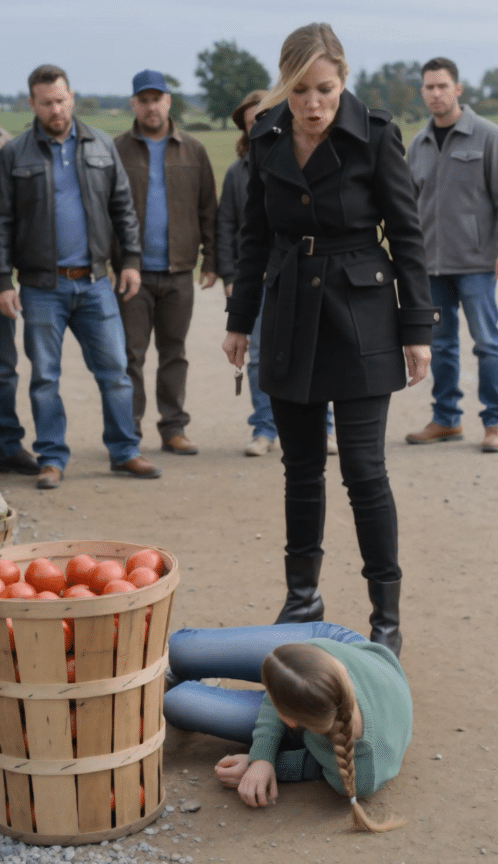
Fifteen-year-old Lily Bennett stood behind the wooden counter, her fingers gripping the edge of an old weighing scale. Her faded green sweater had a small tear near one cuff, her jeans were dusted with dirt, and her blond hair was braided down her back. She looked up at the elegantly dressed woman standing in front of her, then glanced at the vegetables scattered across the scale.
“The scale is sticking. I can weigh it again,” Lily said quietly.
The woman in the black designer coat let out a contemptuous laugh.
“Do you expect me to believe that?”
“I’m sorry. It worked a minute ago.”
“I don’t care what it did a minute ago. I care about what I’m paying for.”
Lily carefully removed the tomatoes and placed them back in the basket. The old scale had been part of her grandmother’s farm stand for more than twenty years. Its metal platform sometimes caught when the weight shifted, especially on humid afternoons, but it had always been reliable enough for the small business.
Lily was already reaching for the adjustment knob.
She only needed a few seconds.
The woman refused to give her even that.
Her name was Victoria Harrington, a forty-six-year-old real estate investor who drove an expensive white SUV and considered herself far too important to waste time at a roadside farm stand.
She had stopped because she wanted fresh tomatoes for a dinner party that evening. The supermarket produce, she claimed, looked lifeless, and a colleague had recommended the little stand along the rural highway.
Victoria had expected fresh vegetables, quick service, and perhaps a pleasant conversation with a farmer.
What she had not expected was a teenage girl operating an old scale.
“Is there no adult here who knows how to run this place?” she demanded.
Lily swallowed.
“My grandmother is in the back, checking the corn. I can get her if you’d like.”
“You should have done that before wasting my time.”
“I was trying to fix it.”
Victoria leaned over the counter, looking at the tomatoes as if they had personally offended her.
“Honestly, what kind of business lets a child handle money and measurements? This is ridiculous.”
Lily felt her cheeks grow hot.
The customers waiting behind Victoria exchanged uncomfortable glances. An older man shifted his grocery bag from one hand to the other, while a woman standing near the handwritten price board quietly shook her head.
Nobody said anything.
Lily had grown accustomed to people assuming that because she was young, she couldn’t possibly know what she was doing. She had learned to answer politely, double-check her work, and avoid arguing with customers who mistook patience for weakness.
“My grandmother taught me how to weigh everything,” she explained. “I just need to reset it.”
Victoria’s mouth twisted.
“You’re too dumb to sell vegetables.”
Lily lowered her eyes.
She could hear her grandmother’s voice in her memory.
Never let someone else’s bad manners convince you that yours don’t matter.
So she took another breath and reached for the tomatoes.
That was when Victoria kicked her.
The blow struck Lily in the chest and sent her stumbling backward. She fell beside the baskets, catching herself with one hand against the rough ground. A sharp sting ran through her palm, leaving a thin trace of blood where the skin had scraped.
The scale rattled against the wooden counter.
Several tomatoes rolled across the dirt.
For a moment, Lily could only stare at the woman who had attacked her.
She had been trying to fix a scale.
She had apologized.
She had offered to weigh the vegetables again.
And somehow, none of it had mattered.
Victoria stepped closer and delivered two more forceful kicks as Lily struggled to protect herself.
A woman gasped.
Someone near the parked SUVs covered their mouth. Another customer took a frightened step backward, staring at the scene with wide eyes.
Victoria straightened her black coat.
“Count dirt if numbers are too hard,” she said coldly.
Lily remained on the ground, trembling and struggling to catch her breath. The tomatoes lay scattered beside her, and the old scale sat crookedly on the counter as though the entire stand had been shaken by the violence.
Victoria reached for her white SUV keys.
She seemed ready to leave without another thought.
Then a pickup truck pulled onto the gravel shoulder beside the stand.
The truck’s bed was filled with produce crates, and a man in a black chef’s coat stepped out from behind the wheel. He wore a wool coat over his uniform, and his expression changed the instant he saw the girl on the ground.
He had not come looking for trouble.
He had come to collect vegetables.
But when he recognized the old weighing scale beside the scattered tomatoes, he stopped.
Because that battered piece of equipment connected the little farm stand to one of the most celebrated restaurants in the region.
And the woman who had just attacked Lily was about to discover that the person she considered worthless was part of something far more important than she could imagine.
Act II
Lily Bennett had grown up believing that a small farm stand could hold an entire family’s history.
Her grandmother, Eleanor Bennett, had started selling vegetables from a folding table beside the highway when Lily’s mother was still a little girl. Back then, the family had owned only a few acres of farmland, and every harvest mattered.
Eleanor planted tomatoes, sweet corn, beans, squash, and whatever else the soil would support. She sold the vegetables to passing drivers, neighbors, and local restaurants that preferred fresh produce over shipments from distant warehouses.
She kept her prices fair and her promises simple.
If she said the corn would be ready Friday morning, it would be ready Friday morning. If a customer discovered that a basket of tomatoes had spoiled, she replaced it without argument.
Her reputation grew slowly, through the kind of work that rarely attracted attention beyond a small community.
When Lily’s father died after a long illness, Eleanor became the person who helped keep the family together. Lily’s mother, Sarah, worked at a local medical clinic, often taking extra shifts to cover household expenses.
Eleanor watched Lily after school and taught her how to recognize ripe tomatoes, check corn husks, count change, and keep careful records.
On weekends, Lily helped at the stand.
She liked the smell of the earth after rain, the bright colors of the produce, and the familiar sound of cars slowing as people recognized the handwritten sign beside the road.
The work wasn’t glamorous.
She sometimes came home with aching shoulders and dirt beneath her fingernails. She wore secondhand clothes and carried a school backpack that had been repaired twice.
But she was proud of the stand.
It helped pay for groceries, school supplies, and the occasional bill that arrived at the worst possible time.
More importantly, it belonged to her family.
The old weighing scale was part of that history.
Eleanor had purchased it years earlier from a closing country store. Its metal platform was scratched, and the numbers had faded slightly, but it had survived countless harvest seasons.
When Lily was younger, her grandmother had placed a handful of apples on the platform and taught her how to read the dial.
“Numbers aren’t just numbers,” Eleanor had told her. “They tell people whether they can trust you.”
Lily had taken that lesson seriously.
She checked the scale before opening the stand each morning. If it stuck, she adjusted the platform and tested it again with a known weight.
She knew the equipment was old.
She also knew that replacing it would cost money the family didn’t have to spare.
So when Victoria’s vegetables failed to register correctly, Lily did exactly what she had been taught to do.
She stopped.
She checked the mechanism.
She offered to weigh the produce again.
To Victoria, those few seconds were an insult.
To Lily, they were part of doing the job honestly.
The woman had never needed to know that.
Victoria Harrington had built her life around appearances. Her home had recently undergone an expensive renovation, her wardrobe featured labels she expected people to recognize, and her social calendar was filled with charity dinners and private events.
She was not unfamiliar with hard work. Early in her career, she had helped manage a family property business.
But as her wealth grew, her patience for inconvenience seemed to shrink.
She began to believe that the world should respond to her importance. If a restaurant made her wait, she complained to management. If a store didn’t have the product she wanted, she demanded an exception. If an employee failed to anticipate her expectations, she treated the mistake as a personal affront.
People around her learned to accommodate her because it was easier than challenging her.
At home, her husband often told her to let small things go.
Victoria interpreted his advice as permission to continue behaving however she pleased, confident that someone would eventually smooth over the consequences.
The farm stand was supposed to be another brief stop.
Instead, it became the place where her assumptions collided with a world she had never bothered to understand.
The man who had arrived in the pickup truck was Thomas Reed, a forty-nine-year-old chef and owner of one of the area’s most respected restaurants, The Reed House.
For nearly twenty years, his restaurant had been known for seasonal menus built around ingredients from local farms. His chefs visited growers personally, and he had earned a reputation for paying fair prices rather than squeezing small suppliers for every possible discount.
Thomas had not inherited his success.
He had spent his twenties washing dishes, working overnight shifts, and learning how to turn inexpensive ingredients into meals people remembered. When he finally opened his own restaurant, he promised himself that he would never forget the farmers whose labor made his kitchen possible.
Eleanor Bennett had been one of the first growers to trust him.
When Thomas’s restaurant was still struggling to survive, she had agreed to supply vegetables on credit after a delayed payment left him short of cash.
She had never demanded a favor in return.
She had simply told him to pay her when he could.
Thomas never forgot it.
As his restaurant grew, he continued buying from Eleanor, even when larger suppliers offered cheaper alternatives. Her tomatoes became a signature ingredient in one of his summer dishes, and her sweet corn appeared on the menu whenever the harvest was good.
Over the years, the relationship became more than a business arrangement.
Eleanor had helped Thomas build his reputation, and he had helped her family maintain a reliable market for their produce.
That afternoon, he had driven out personally because the restaurant was preparing for a major regional food event. He needed a final delivery of tomatoes and corn, and he wanted to check the quality himself.
He expected to find Eleanor behind the counter.
Instead, he found Lily on the ground.
And when he saw Victoria standing over her, the years of trust between the restaurant and the farm suddenly seemed to converge on a single moment.
Thomas stepped away from his pickup.
He looked at the girl.
Then at the woman.
And his expression hardened.
Act III
“What happened here?”
Thomas’s voice cut through the silence.
Victoria turned toward him, clearly irritated that another person had appeared to question her.
“This girl doesn’t know how to do her job,” she snapped. “The scale is broken, and she expected me to stand here while she played with it.”
Thomas glanced at Lily.
The girl was trying to sit up, one hand pressed against her chest. A customer had finally crouched nearby, asking if she could hear him.
Thomas hurried forward.
“Don’t move too quickly,” he told Lily. “Someone is getting help.”
He looked toward a nearby worker and asked them to call for medical assistance, then turned back to Victoria.
“Did you do this?”
Victoria gave an incredulous laugh.
“Excuse me?”
“Did you kick her?”
“She was being disrespectful.”
Thomas stared at her.
“That wasn’t my question.”
Victoria lifted her chin.
“She should learn to treat customers properly.”
For a second, Thomas seemed unable to believe what he was hearing.
Then Victoria attempted to step around him, waving her keys impatiently.
Thomas moved between her and Lily and delivered one hard slap across Victoria’s face.
The sound echoed across the gravel shoulder.
Victoria staggered slightly, her hand flying to her cheek.
“What is wrong with you?” she shouted.
Thomas didn’t answer her immediately. He positioned himself beside the old scale, placing himself between Victoria and the injured girl.
“You are not going near her again.”
His voice was firm enough that Victoria stopped moving.
The customers had fallen silent. A man near the pickup truck lowered his phone, while a woman standing beside the tomato baskets looked from Thomas to Victoria in disbelief.
Victoria’s anger quickly returned.
“You have absolutely no idea who I am.”
Thomas glanced at her designer coat, expensive sunglasses, and white SUV.
“I know what you just did.”
“You can’t speak to me like that!”
“I just watched you attack a child.”
“She was incompetent!”
“She was trying to make sure you got the right amount of vegetables.”
Victoria opened her mouth, but Thomas continued.
“You could have waited. You could have asked for her grandmother. You could have walked away.”
He gestured toward Lily.
“Instead, you chose to hurt her.”
Victoria looked around, searching for support. The customers who had witnessed the attack avoided her gaze or shook their heads.
She had expected the crowd to see a difficult customer dealing with a careless teenager.
Instead, they had seen an adult assault a child over a malfunctioning scale.
The distinction was impossible to hide.
Thomas turned toward Lily.
“What’s your name?”
“Lily,” she whispered.
“Lily Bennett?”
She nodded.
Thomas’s expression softened.
“I know your grandmother. I’m Thomas Reed.”
Lily stared at him.
She recognized the name. Everyone in her family knew Thomas Reed. His restaurant had purchased their vegetables for years, and Eleanor often spoke proudly of how he had supported small farms when his business was still finding its feet.
“You buy Grandma’s tomatoes,” Lily said.
Thomas nodded.
“And her corn. I’ve been buying from your family for a long time.”
He looked at the old scale.
Then he looked back at Victoria.
“Do you know what this is?”
Victoria frowned.
“An old scale.”
Thomas shook his head.
“No. It’s the reason some of the best tables in this county serve food people remember.”
Victoria gave a short, dismissive laugh.
“That’s ridiculous.”
Thomas’s voice dropped.
“That scale feeds tables your money begs to sit at.”
The woman stared at him.
For the first time, she seemed to understand that his anger wasn’t simply about the attack. He knew the farm, knew the family, and understood the value of the work she had dismissed.
Still, Victoria struggled to grasp the significance.
“My money begs to sit at?”
Thomas glanced toward his pickup, where several produce crates were stacked beneath a canvas cover.
“My restaurant has been named one of the region’s best for three years running. People travel from other states to eat there. Reservations fill weeks in advance, and our seasonal menu is built around ingredients from farms like this one.”
He paused.
“And Eleanor Bennett has supplied my kitchen since before most of those customers knew my name.”
Victoria’s expression shifted.
She knew The Reed House.
She had attended a charity dinner there the previous year and had spent much of the evening talking about the restaurant’s reputation. She had even tried to arrange a private table for a business associate, expecting her social connections to guarantee a reservation.
The restaurant was more exclusive than she had realized.
Its owner was known for refusing to compromise his standards simply because a guest was wealthy.
Now he was standing in the dirt beside a roadside farm stand, defending a girl she had treated as beneath her.
Victoria straightened her coat.
“Mr. Reed, surely you understand that customers expect a certain standard.”
Thomas looked at the old scale.
“Absolutely.”
“Then you should understand my frustration.”
“I understand the difference between a mistake and cruelty.”
He gestured toward the scale.
“A machine can stick. A child can make a mistake. Both can be corrected.”
Then he looked directly at her.
“But the choice to hurt someone is a different matter.”
Victoria’s face tightened.
She had expected Thomas to lecture the girl, offer a discount, or at least acknowledge that her time was valuable.
Instead, he was making it clear that her money did not place her above the people who worked to provide her food.
She glanced at Lily, who remained on the ground behind him.
“Are you seriously taking her side?”
Thomas’s expression became colder.
“I’m taking the side of what happened.”
He reached into his coat and took out his phone, asking a nearby customer to preserve any video they had recorded and requesting that another witness contact the appropriate authorities.
Then he turned toward Victoria.
“You need to understand something. The people who grow your food are not beneath you. The people who weigh it, carry it, cook it, and serve it are not beneath you.”
He paused.
“And this farm is not just a place where you stop when you want cheap vegetables.”
Victoria stared at him.
Thomas glanced at the old scale once more.
“It’s part of the reason my restaurant exists.”
For a moment, the only sound was the distant rush of cars along the highway.
Then Thomas asked a question that made Victoria’s expression change completely.
“Have you ever wondered why The Reed House never runs out of the ingredients that make it famous?”
She said nothing.
Thomas’s eyes remained fixed on hers.
“Because people like Eleanor Bennett keep their promises, even when the work is difficult and the money is tight.”
He gestured toward Lily.
“And today, her granddaughter was doing exactly that.”
Victoria swallowed.
But the worst part was still to come.
Because Thomas was about to explain why the old scale had become far more than a piece of farm equipment—and why Victoria’s behavior could cost her something she had spent years trying to obtain.
Act IV
The first person to break the silence was Eleanor Bennett.
She emerged from the back of the stand carrying a crate of freshly picked corn, then dropped it onto the wooden platform when she saw Lily on the ground.
“Lily!”
She hurried forward.
Her granddaughter looked up, and the careful composure she had maintained throughout the confrontation finally began to crumble.
“Grandma, I’m sorry.”
Eleanor knelt beside her.
“For what, sweetheart?”
“The scale got stuck.”
Eleanor stared at her, unable to believe that those were the words Lily had chosen to say.
Then she took her granddaughter’s uninjured hand.
“Forget the scale. Are you hurt?”
Lily nodded faintly.
Eleanor’s face tightened with fear, but she kept her voice gentle as she asked the nearby customers to give Lily some room.
Thomas explained what he had witnessed and confirmed that help had been called. Eleanor listened without interrupting, her eyes moving between Lily and the woman standing several feet away.
Victoria seemed uncomfortable now that the girl’s grandmother had arrived.
“I don’t know what she’s told you,” she began, “but this entire situation was blown out of proportion.”
Eleanor looked at her.
“My granddaughter is on the ground.”
“The scale wasn’t working.”
“So she offered to weigh your vegetables again?”
Victoria hesitated.
Eleanor’s expression hardened.
“And you kicked her?”
“I was angry.”
“That doesn’t answer my question.”
Victoria looked away.
Eleanor turned back toward Lily, gently checking her hand while the medical assistance was arranged.
Thomas watched her with a familiar mixture of respect and sadness.
He had seen Eleanor endure difficult seasons. He had watched her work through illness, financial uncertainty, and the loss of her husband. She was not a woman who frightened easily.
But seeing her granddaughter hurt had left her shaken in a way no failed harvest ever could.
Thomas stepped closer.
“Eleanor, I’m sorry.”
She shook her head.
“You didn’t do this.”
“No. But I know what your family has given this community.”
Eleanor glanced toward the produce crates in his pickup.
“We grow vegetables, Thomas. That’s all.”
He smiled faintly.
“No. You keep people fed. There’s a difference.”
Victoria let out an impatient sigh.
“Are we really going to turn a broken scale into a public ceremony?”
Thomas looked at her.
“No. We’re going to deal with what happened.”
She crossed her arms.
“I’m a paying customer. I have every right to complain if I receive poor service.”
“Of course you do.”
“Then why is everyone acting as though I committed some terrible crime?”
Thomas held her gaze.
“Because complaining about service and attacking a child are not the same thing.”
Victoria’s lips tightened.
She looked around at the customers, several of whom were now speaking quietly to one another. One woman had begun gathering the tomatoes that had rolled across the ground, while another was asking Eleanor whether she needed anything.
No one was rushing to defend Victoria.
For the first time, she realized that the crowd was not merely watching an argument.
They were watching her reveal who she was.
Thomas turned toward the old weighing scale.
“This equipment has been here for years,” he said. “Eleanor checks it regularly. If it needs repairs, she fixes it. If she can’t repair it, she tells customers and makes sure they get a fair deal.”
He rested one hand on the counter.
“That is why I trust her.”
Victoria scoffed.
“You trust a broken scale?”
“I trust the person using it.”
He paused.
“And if the scale is no longer reliable, I’ll help her replace it. But I won’t pretend that a mechanical problem justifies what you did.”
Eleanor looked at him.
“You don’t have to buy us new equipment.”
“I know.”
“We’ve managed this long.”
“I know that too.”
Thomas’s expression softened.
“But you shouldn’t have to struggle with an old scale just because you refuse to ask for help.”
Eleanor looked down at the worn metal platform.
For years, she had repaired equipment whenever possible and delayed replacing things that still worked well enough. Every dollar had a purpose, and she had always believed that accepting help was something to do only when absolutely necessary.
Thomas understood that pride.
He also understood that Eleanor had once extended him credit when his own restaurant was barely surviving.
He had never forgotten the difference that trust had made.
Now he wanted to return it without turning her generosity into a debt.
Victoria listened with growing irritation.
She had come to the stand believing that a poor farmer’s family could be dismissed without consequence. Now she was hearing that the owner of one of the region’s most prestigious restaurants considered the family indispensable.
But the truth went further than she realized.
The Reed House had built its reputation on relationships with local growers. Thomas’s kitchen had spent years refining its seasonal menu around produce from a handful of trusted farms, and Eleanor’s vegetables were among the most important ingredients in several signature dishes.
When customers praised the restaurant’s tomato salad, they were tasting the result of Eleanor’s work.
When they returned for the summer corn special, they were benefiting from the care she put into every harvest.
Thomas had never hidden his suppliers, but he had never made a spectacle of their importance either.
He believed good food should tell the truth about where it came from.
That philosophy had helped turn his restaurant into a destination for visiting chefs, food writers, and business leaders.
It had also created a network of relationships built on trust rather than status.
Victoria had spent years trying to secure a private dining arrangement at The Reed House for a series of business dinners. She wanted access to the restaurant’s influential clientele and hoped that being seen there would strengthen her standing among local investors.
Her assistant had made several inquiries, but the dates she wanted were difficult to arrange.
Now she was discovering that the restaurant’s owner was not impressed by the same things that impressed her.
Thomas turned toward her.
“I don’t decide who deserves a meal based on how much money they have,” he said. “But I do decide how my business responds when someone attacks a person who has done nothing wrong.”
Victoria’s face went pale.
“You wouldn’t refuse me service over this.”
Thomas did not answer immediately.
Instead, he looked toward Lily, who was now sitting with Eleanor while a medical worker assessed her injuries.
Then he turned back to Victoria.
“The restaurant will review this incident under its policies. We will preserve the evidence, cooperate with the investigation, and make decisions through the proper process.”
He paused.
“But I can tell you now that money will not buy you an exception.”
Victoria stared at him.
Thomas continued.
“Your reservation requests will be handled according to our normal standards. No special access, no private favors, and no pressure on my staff to ignore what happened here.”
Her mouth opened.
For the first time, she seemed genuinely afraid of what her actions might cost her.
Not because she had suddenly discovered compassion.
Because the one thing she had wanted from Thomas Reed was something he could choose not to give her.
And she could not threaten, purchase, or demand her way into it.
Thomas stepped beside the old scale.
“This scale feeds tables your money begs to sit at,” he repeated quietly.
Victoria looked at the battered metal platform.
“That scale?”
The words escaped before she could stop them.
Thomas nodded.
“That scale.”
For years, she had looked at the world as though value could be measured by price tags, polished surfaces, and exclusive invitations.
Now she was standing beside an old weighing scale that had helped a small farm survive long enough to support a restaurant she desperately wanted to impress.
And the scale had done nothing wrong.
Neither had the girl who used it.
Act V
The medical assessment confirmed that Lily needed rest and follow-up care, but her injuries appeared limited. Eleanor and Sarah, who arrived shortly afterward, stayed beside her while the incident was documented and the witnesses provided their accounts.
Sarah’s hands trembled when she saw her daughter.
She worked hard to make sure Lily never felt responsible for the family’s financial struggles. She wanted her daughter to have the freedom to finish school, pursue her interests, and choose a future that did not depend on working every weekend at the farm stand.
But she had never been ashamed of the stand itself.
It was honest work.
It had kept food on their table during difficult years, and it had taught Lily the value of patience, responsibility, and keeping promises.
Now, seeing her daughter hurt beside the very counter where she had learned those lessons, Sarah felt a mixture of anger and heartbreak that was difficult to put into words.
Lily looked at her mother.
“I’m sorry.”
Sarah shook her head immediately.
“No, sweetheart. Don’t apologize.”
“I should have fixed the scale faster.”
Sarah knelt beside her.
“You offered to weigh the vegetables again. You tried to solve the problem. Nothing you did gave anyone the right to hurt you.”
Lily looked down at her scraped palm.
“I thought if I stayed polite, she’d stop being angry.”
Sarah gently took her hand.
“Sometimes people choose to be cruel even when you give them every chance to be kind. That is their choice, not your failure.”
Eleanor stood beside them, listening quietly.
Then she looked at Thomas.
“Thank you for coming when you did.”
He shook his head.
“I only did what anyone should have done.”
“Not everyone does.”
Thomas glanced toward the customers who had witnessed the attack.
Some had stepped forward to provide statements. Others were helping collect the remaining vegetables and clear the walkway.
He understood what Eleanor meant.
There had been several moments when someone might have challenged Victoria before the assault escalated. Fear, uncertainty, and the instinct to avoid confrontation had kept them still.
He could not change those moments.
But he could help ensure that the incident was documented and that Lily’s family did not have to navigate the aftermath alone.
Before leaving, Thomas made an offer.
He would arrange for a professional to inspect the old weighing scale and replace it if necessary. He would also help Eleanor source a reliable commercial scale at a fair price, without requiring her to purchase anything through his restaurant.
Eleanor hesitated.
“Thomas, I can’t let you spend that kind of money on us.”
“You let me keep my restaurant open when I couldn’t pay you on time.”
“That was different.”
“How?”
She looked at him.
“You were trying to build something.”
“So are you.”
For a moment, Eleanor had no answer.
Thomas smiled.
“You trusted me when I needed it. Let me return the favor.”
She finally nodded.
“Then I’ll accept the inspection.”
“Good.”
“And the new scale, if the old one can’t be repaired.”
“That’s fair.”
Thomas reached into his pickup and returned with a small notebook. He wrote down the name of a local equipment supplier he trusted, then handed it to Eleanor.
It was a simple gesture.
But it meant that the next time Lily weighed a basket of tomatoes, she would not have to wonder whether the scale’s needle would stick.
More importantly, the family would not have to choose between replacing essential equipment and paying their bills.
In the weeks that followed, the assault investigation proceeded through the appropriate channels. Witness statements were collected, available recordings were reviewed, and the relevant authorities determined how the case would move forward.
Thomas also made sure his restaurant’s staff understood that no customer, regardless of wealth or influence, was entitled to mistreat a supplier or employee.
He did not launch a public campaign against Victoria or attempt to destroy her business.
He simply refused to let her money dictate how the restaurant responded.
When her assistant later contacted The Reed House about arranging a private dinner, the request was handled under the restaurant’s normal reservation policies. There would be no special access because of her connections, no pressure on staff to overlook the incident, and no promise that a prestigious table could be secured through personal influence.
Victoria discovered that the world did not collapse when people stopped accommodating her.
But it became less convenient.
She had to accept that some people would remember what happened at the farm stand. Several local business owners became more cautious about dealing with her, while others chose not to invite her to community events.
Nobody needed to invent a scandal.
The truth was already enough.
Meanwhile, the Bennetts began repairing the stand.
The damaged baskets were replaced, the scattered produce was sorted, and the old scale was inspected. A technician found that its mechanism had worn down over years of use, making the platform occasionally stick when the weight shifted.
The problem had been real.
Lily had not imagined it.
She had not been careless or stupid.
She had recognized a fault and tried to correct it honestly.
When the new scale arrived, Eleanor placed it on the counter and asked Lily to test it before opening for business.
Lily weighed a basket of tomatoes.
The needle moved smoothly.
She removed the basket and tried again.
It worked perfectly.
For the first time in weeks, she smiled without hesitation.
“Grandma, look.”
Eleanor watched the needle settle.
“That’s how it should work.”
Lily laughed softly.
Then she looked at the old scale, which had been cleaned and placed on a shelf beneath the handwritten price board.
“Are we keeping it?”
Eleanor nodded.
“Of course.”
“Even though it broke?”
“Especially because it broke.”
Lily frowned.
Eleanor explained that the old scale had served the family for years. It had weighed vegetables through good harvests and bad ones, helped pay bills, and supported a business built on trust.
Its failure did not erase everything it had done.
Neither did one terrible afternoon define Lily’s future.
The old scale remained on the shelf as a reminder of how much the family had endured—and how much they had built without ever needing to look down on anyone else.
By the following summer, Lily was back behind the counter in her faded green sweater, her blond braid resting over one shoulder as she arranged baskets of ripe tomatoes.
Thomas Reed’s pickup arrived just before noon.
He stepped out, checked the day’s produce, and greeted Eleanor with the familiar warmth of an old friend.
“Good harvest?”
“Better than last year,” Eleanor replied.
Thomas inspected the tomatoes.
“These are beautiful.”
“They’ll be even better tomorrow.”
“I’ll take enough for the weekend menu.”
Lily began weighing the baskets on the new scale.
Every movement was careful, but she no longer looked frightened when a customer approached. She had learned that being polite did not mean accepting mistreatment, and that asking for help was not the same as admitting failure.
When Thomas finished loading the crates, he turned toward her.
“How’s school?”
“Good. I’m thinking about studying food science.”
Thomas raised his eyebrows.
“Really?”
Lily nodded.
“I want to understand why some crops grow better than others. Maybe I can help Grandma improve the farm.”
Eleanor smiled.
Thomas looked genuinely pleased.
“That’s a wonderful goal.”
He paused, then added, “And if you ever want to see how we test ingredients in the restaurant kitchen, come by. I’ll arrange a visit.”
Lily’s face brightened.
“Really?”
“Really.”
It wasn’t a grand promise or a dramatic rescue.
It was an opportunity.
And sometimes, that was more valuable than anything else.
As Thomas drove away, Eleanor watched the truck disappear down the rural road. She thought about the afternoon Victoria had arrived, about the tomatoes scattered in the dirt, and about how quickly an ordinary day had turned into something the family would remember for years.
Then she looked at Lily.
“You know what I hope you remember most about that day?”
Lily thought for a moment.
“That I didn’t do anything wrong?”
Eleanor smiled.
“Yes. That—and something else.”
She gestured toward the old scale resting on the shelf.
“Never measure your worth by the way someone treats you when they think you’re beneath them.”
Lily looked at the battered equipment.
Then at the new scale.
Then at her grandmother.
For the first time, she understood the lesson completely.
Victoria had seen a poor girl, an old piece of equipment, and a roadside business she believed was beneath her.
Thomas had seen a family whose honesty had helped build his success.
Eleanor had seen a granddaughter who deserved to be safe.
And Lily had learned that dignity was not something a wealthy stranger could grant or take away.
It was something she possessed before anyone ever stopped beside the stand.
The next customer approached the counter carrying an empty shopping bag.
“Could I get two pounds of tomatoes?” he asked.
Lily smiled and placed the basket on the scale.
“Of course.”
The needle settled smoothly.
She read the number, wrote the price on a small paper slip, and began packing the tomatoes.
Outside, the highway stretched toward the horizon. Sunlight fell across the baskets of corn, and the handwritten price board swayed gently in the breeze.
The farm stand looked ordinary again.
But its story had changed.
Because the woman who had called Lily too dumb to sell vegetables had been wrong about far more than a scale.
She had mistaken poverty for weakness.
She had mistaken patience for stupidity.
And she had mistaken a quiet teenage girl for someone whose dignity could be crushed without consequence.
The old scale had never been the real problem.
The real problem was a woman who believed money made her superior—and a girl who proved, simply by refusing to become cruel herself, that she was wrong.
In the end, the most valuable thing at that roadside stand was never the tomatoes, the corn, or even the famous chef’s business.
It was the trust Eleanor Bennett had spent decades earning, one honest transaction at a time.
And no amount of money could buy what Victoria had thrown away in a single afternoon.